Hello everybody, welcome to Roundtable.
I'm Niu Henlin.
If you have been with us for our 2025 year-end review series, where we dug into the worlds that defined us, the soundtracks that moved us and the technological development that shaped the world around us.
You know we love a good deep dive into the society.
It's been a vivid noisy, emotional picture, but a portrait has a frame and that frame is often made of economics.
How we lived this year, where we choose to go, what we decided was valuable.
These choices tell a parallel story, one of numbers, trends, and global shifts.
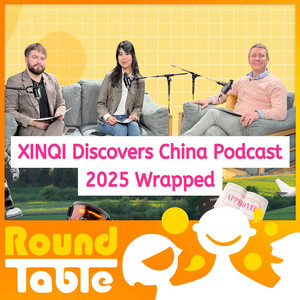
So in our special bonus episode, Roundtable happily recommends the new podcast Xinqi Discovers China.
And you might even find a familiar voice in that show.
Enjoy.
Hi, everyone.
Welcome to our first ever episode of our Since She Discovers China podcast.
Today, we will be wrapping up our 2025 Year in China.
My name is Emma.
I'm from Malaysia.
My name is Sean Tahershi, and I'm from Ireland.
And today we have... Steve from Canada.
Okay, so...
My question is, is it wrap or unwrap?
Because in my notes, I wrote Emma's 2025 wrapped.
And you wrote Sean's 2025 unwrapped.
Steve.
Didn't write anything.
Are you a wrap or unwrap?
I will go with the team.
Oh, wait, you've divided.
So I'll go with wrap.
Okay.
Okay.
Okay.
Point one goes to Emma.
So in 2025, we've seen a lot of really cool things here in China.
We've done a lot of traveling, all three of us.
Sean and I have been here for about three years now.
And then Steve, you've been here.
About 16, 17 months now.
So I'm the baby of the group, I suppose.
You are, you are.
Not otherwise.
Also very true.
And there's also new ways of spending money here in China.
But it is one of those things I think with China that there is such a sense of product development and merchandising and being able to kind of create really novel products that people really want to consume.
And, I think, the level of innovation in this country.
I haven't seen anything comparable to it at home in Ireland.
It's almost hard to keep up with, isn't it?
You know, something new and fresh and exciting comes out, and then you're getting into that and you're used to it.
And then five minutes later, something else new and fresh and exciting.
There's a huge amount of, I suppose, things to talk about, which hopefully we're going to explore a little bit of today in this podcast.
One hundred percent.
Yeah.
Tech never stops being in the headlines here in China.
Consumption is constantly here in the headlines in China.
Gen Z, young Chinese people, how are they spending their money?
Why are they spending the money the way that they are?
We're going to discuss all of that today, I guess.
Yes, you're going to tell us what young people think.
I'm going to tell you what I think I think young people think that I think that they think.
Okay, so today, the first thing we're going to talk about is our travels this year.
So it's your first 16 months in China.
Where have you traveled to so far and how many cities?
I think pretty limited so far, but there were two that really stood out for me.
One was to Xi'an to see the Terracotta Warriors.
That was a bucket list thing for me to do.
So that was one that really stood out.
And then second, you know, we live here in Beijing.
I was blown away by Tianjin.
I didn't know how close it was.
I didn't know how convenient it was to get there.
I didn't know that it had a different vibe than Beijing.
You know when you move and I guess I had kind of forgotten this.
But that feeling of moving to a new space, a new country where everything is brand new,
You know, you don't know your left from your right, from your front, from your back.
So it's exciting, and it's also a great learning experience.
So those were two of my main highlights.
I feel like Tianjin.
For me it's like it's so near Beijing, but it almost feels like you've left the country when you're in Tianjin.
I know, I know, and it takes 25 minutes on the high-speed rail to get there.
Yeah.
It's incredible, particularly when you drive down by the river.
If you're getting a DD, you can.
If you close your eyes for a minute and open them, you think that you might be in a European city like say Paris, particularly with the way that they've got all those beautiful sculptures dotted along the embankment.
It's stunning.
Oh yeah, let me close my eyes for a while.
You're there.
You're in Tianjin right now.
Oh my gosh, I'm in Paris.
So we were talking about Xi'an and Tianjin, which are both like So cities.
Sean, you've been to a little bit more like the countryside of China this year.
So I've been to Yangshuo in Guangxi Zhuang Autonomous Region, which I visited actually, with my mum earlier on this year.
And then on a more recent trip as well, I went to Datong in Shanxi province.
And that was an incredible experience in order to kind of, as you said, see maybe a city that is a little bit off the international tourist track for a lot of international tourists but gives you a really kind of strong sense of maybe a more kind of, like you know, a third tier, smaller Chinese city but has so much charm and warmth to it as well.
And it's still so easy to get around and to access services.
Absolutely.
And then you still have, even with smaller third tier cities, you still have a really strong tourism base where you can kind of go out and explore as well.
So I think even if you're going to say a city that's a little bit more off the beaten track, you can still get access to everything that you're comfortable with to make your travel smooth.
What was the vibe difference like?
Going from Beijing, with a population of what?
20 million plus, to a smaller city or out into the countryside.
Did you feel like you were still in China or did you feel like you were somewhere else totally?
I felt like I was.
I really felt with Datong in particular.
I felt like I was in kind of the heart of China, if that makes sense.
Beijing does feel like the heart of China too, and you know you can go to ancient sites like the Forbidden City or go to the Great Wall, and you do feel like you go back in time.
But with Datong particularly, the centre of the city is actually just a lot of old courtyard-style housing.
And so they kind of stretch back hundreds of years and you can stay in a number of different accommodation options.
And I stayed in a very small boutique-style inn in the very heart of Datong and it was just.
You woke up every day and you've seen the sunlight coming in through the windows and you could really close your eyes and feel like you're in a Ming Dynasty style drama getting ready for the day.
So yeah that, I think, is sometimes you get those experiences, i think, sometimes when you kind of go outside of beijing shanghai, i'm just wondering who you would have been in that ming dynasty scenario.
I don't think it would have been the emperor, maybe maybe the cook in the kitchen, but you're giving final episode survivor.
Yeah, final episode survivor, absolutely.
I mean, i think in china, like a huge trend that we're seeing right now is that a lot of these like county level cities, a lot of this, like you know, maybe lower tier cities they're.
They're really um folk leveraging on you know what's unique, their unique characteristics, to develop their um economy.
And i think this is a huge like rural revitalization drive.
This year i was with my mother.
I brought my mother here to yeah, and so we went to see the canyons.
So they look like the Antelope Canyons in the States, but they have similar ones here in China.
Not many people know about this.
But in Yan'an, you know, people there used to live in caves.
And now you can do cave homestays.
Oh, wow.
So you can experience that.
So...
What kind of accommodation options have you stayed in when you were visiting other cities?
The places we've chosen have been like pretty city center, I think.
In Xi'an, it was around the wall, which is in the downtown area of the city.
And we just really liked that.
That was a boutique place and we liked it because of how central it was and how easy it was to get to the little shopping areas where you could go in and put on like the traditional Chinese attire and get your makeup done and things like that.
You know, when i was getting off the subway just now, i actually saw this girl in her full-on hanfu.
You see it all the time.
Yes, you see it all the time over here.
I like saw this economist podcast the other day it was.
It was like has china become cool?
China is so cool.
Do you think that's kind of surprising though, for people who come to visit for the first time, because you know that kind of brand image, if you will, that soft power movement to show that there are so many cool things that are coming out of China but are also here in China for us to enjoy.
Well, definitely, I think this year in particular.
And I've got a little thing to show as well.
Oh, is that your Labubu there?
That's my Labubu.
How did you get your hands on a Labubu?
I mean, you just walk into a Pop Mart.
Isn't that how it works?
Well, they were sold out for the longest time.
And I mean even now, because of Particularly with Pop Mart as a Chinese IP.
They're always, They're one of these companies that are constantly, you know, developing their product lines.
And nearly it feels like every week you'll go into the shop and they've got a completely different product line available.
But also there's Pop Mart World here in Chaoyang Park.
Do you know about that?
No, not that one.
Okay.
Yeah, maybe you could visit Pop Mart World and get limited edition Labubus.
I am learning so much good information today.
Tune in, guys, for more useful tricks.
No, but it is.
It's one of those, I think one of those things that you do look at that has gone not only overseas, but it's gone completely global.
And it kind of reflects something bigger.
I think you were saying about the China becoming cool, but how domestic Chinese design and domestic Chinese IPs tend to capture the imagination of a global audience now in a way that perhaps we haven't seen before, or perhaps people weren't receptive to before, but they are definitely receptive to now.
For me, i think, like before, people had this like idea of china that it's like because like things, like things are so affordable here, and then people would associate that with cheap, but then you don't realize how high tech and how advanced everything is, and i would like it's not cheap, it's just accessible, right.
So i think that's one of the like, one of the things that is cool about china that you get so many of these services so easily and so affordably, like most people can access them.
I think that's like one really amazing thing.
I think ninja too, did a great job of of putting china on the map, and I think I agree with you to a certain degree in that people either don't know or they have assumptions that they just think are true.
But of course, you know, if we use logic and reason, then we know that if we're going to know about a place, then at least we have to go there and experience it.
But for a lot of people, they don't have that opportunity.
For us, we're lucky.
We're here right now, so we know, and we're able to share that information.
But the great thing about Nijad 2 is that not only did it do so well domestically, but internationally.
People fell in love with the movie and it made people so curious to know about the story, the stories that come from China.
The quality of the film was fantastic and it just did a great job of again that soft power kind of brand imaging.
Yeah.
And I think that there's going back to what we were talking about earlier, you know, talking about brand imaging, but also How accessible China is now as a country in terms of tourism opportunities for international tourists coming in.
Visa-free.
Visa-free.
Is it visa-free for Canadian passport holders?
Oh, that's a good question.
I want to say yes, but I'd have to check on that.
But I'm pretty sure we're on the list.
Oh, like it's visa-free for Malaysian passport holders and Irish passport holders?
Yeah.
So particularly with my parents recently coming to China.
Oh, yeah.
They kind of combined being able to see their beloved son with a favorite son.
Out of four.
Any chance for some self-promotion?
I mean, honestly, I mean, they'll be listening to this now.
They'll agree.
Yes, yes, yes.
Comment below.
But with my dad in particular.
He was able to combine a personal trip of seeing me, but also with a professional trip.
Because he had work obligations in Guangzhou.
So he would have commented very much on, in terms of number one, arriving in China and the ease of movement say even getting off the airplane and getting through customs how that had really changed significantly in the 10 years that he had been since.
Really,
So his first time visiting China was in 2014, and then he came back at the beginning of this year and then later on this year as well.
And that would have been one of his major changes thoughts on China and how it's developed and how it's easier.
The accessibility is just so different to what it was 10 years ago.
I think the points of entry and the ease of getting from one location to another.
There are huge improvements now.
So instead of, you know, flying into Shanghai is a great thing.
Flying into Beijing is a great thing.
Flying into Shenzhen or Guangzhou, of course, people know about that.
But then you might just stay in Shanghai in the past.
You might not go anywhere else.
But now with high speed rail and the ease of booking tickets.
When I was taking my first trips here, didn't speak Chinese at all, couldn't read it.
That's a whole other level of difficulty.
But there was no problem with that.
I was able to do it all through one app, getting from point A to point B, to Xi'an, which is maybe everybody knows, Terracotta Warriors, but maybe that city is not number one on the list of places to go.
But everything was so simplified and easy to do.
I didn't need anybody's help with translation.
I was just able to book everything by myself.
Talk about going from point A to point B.
I saw this influencer the other day like I was scrolling through Instagram and this influencer she was like when you come to China and like, even when you plan to sweat, China won't let you.
Because she was like saying that when you're trying to go up a mountain, you're going mountain hiking right.
You can strap on your robot-assisted legs.
Oh, the exoskeleton thing.
Oh, yes.
Yes, you can strap that on, and it supports you as you go.
If you don't want to use your legs, you can sit in a cable car.
If you don't want to sit in a cable car, you can lie down on a conveyor belt and it takes you up to the top of the mountain.
You know, you don't have to put in a lot of effort to experience.
Like you know, is it the destination that counts or the journey?
You know, if the journey is lying down, that's a great journey.
Feeling lazy?
Come to China.
Trademark that.
We'll include that on our travel app.
Again, this is about accessibility.
You know, you've got to protect your knees.
But then also, I think we talk about that a lot in terms of you do talk about disability.
There's a lot of... tourists that do have disabilities.
And having say, ancient sites or difficult terrain that's accessible for those people is incredibly important.
And the developments that come with that.
I mean it opens up China not only to people from around the world, but people who may have otherwise said well, I can't go there because there won't be any infrastructure in place in order to make my travel opportunity comfortable, you know.
So I think it really is.
It's really exciting and it shows the care, I think, that government bodies and what the country is doing in order to open up and allow access of China for everyone.
So I think there's a lot of, like, we talked a lot about traveling.
Now let's move into how we're spending our money this year.
Yeah, I've spent a lot of money on traveling.
But I've also been spending a lot of money on running.
People think running is like you just go outside and then you don't have to spend money on it.
It's not like ice skating.
I mean, I do like to go ice skating.
And I think actually, having so many ice rinks around me, I'm spoiled for choice in terms of where I can go.
There's really good ice and snow facilities now here in China.
Incredible.
And I mean the opportunity to book an ice skating coach or an ice skating teacher, being able to buy my ice skating shoes off Taobao, having all of the things that I need in order to ensure that I don't fall on my behind and break a leg.
Who are you paying to teach you ice skating?
I grew up playing ice hockey.
I'll do that for you.
Oh, thank you so much.
Well, we've got an ice skating rink right around the corner.
Not far away.
It's a stone's throw, isn't it?
What do you mean, though?
You don't have to pay for running, but you do.
You're talking about like marathons type thing?
Yes.
So, guys, I did my first ever marathon and maybe my last.
Did you complete a whole marathon?
Of course.
Look at this.
Okay, I don't know where else I can flex this, but this is my finisher medal.
That looks like an Olympic medal.
It pretty much is.
Yeah, this is my finisher marathon for the Shanghai Marathon this year.
I'm going to put it on for the rest of the show now.
Beautiful.
Thank you.
I've spent so much money online.
Oh, you bought that medal, take a photo and find it on taobao.
Um, but like i've spent so much money on like knee guards, ankle guards, sports gel protein, protein bars, me and my mother went into a pharmacy and i started looking at knee guards.
I got it done recently.
I had um, i had gone and done a weightlifting session at the gym And then afterwards the following day Again with the self-promotion.
I mean, that's it now.
I mean, if any gyms want to sponsor me, more than welcome.
But afterwards.
The following morning I woke up and I thought oh my God, I've got such lower back pain.
And it kind of stayed there for three or four days.
So I thought, okay, day two, I'm going to go and get some TCM done.
And I had a lot of pain in this arm in particular. as well as lower back pain.
But I got the TCM treatment done and it's incredible.
My hand began to vibrate as soon as she began to put the needles in.
And afterwards I walked out of the studio and I felt absolutely perfect.
Okay, is that what your hands are supposed to... I was going to say, are they supposed to vibrate?
I could just feel this energy coursing up and down my hand.
It was incredible.
And afterwards, I walked, I feel like a brand new man.
Oh, very nice.
And you only had to do it once as well.
And I only had to do it once.
Wow.
I was at the TCM hospital this morning because of my tense shoulders.
Yes.
But I think that there is a... another point with that as well which with China there is such opportunity to do any hobby or anything under the sun and in terms of access to everything within a very short periphery of where you're living it's incredible you know you can go down the street and you can do archery you can go down another street you can do ice skating you can Do axe throwing if you wanted to.
There's every opportunity to do anything.
It's kind of the concept of the 15 minute city, the small neighborhoods or within smaller neighborhoods, having everything accessible walkable, bikeable.
But so one really really common thing right now is delivery robots, like in the hotels, like if you ask for like, food delivery, and then they deliver it up to your room with the robot, so you know you don't actually have a person that's delivering, but a robot.
Um, when my friends came over, they were like so amazed by that.
Also guys, when i finished running the marathon, when i finished the marathon, first thing i did was take a bath, though so bath bombs.
Another thing emotional consumption.
You just gotta make yourself feel good, you gotta make yourself smell good.
Boy, did i smell bad when i was running.
And then, like life-saving the.
The robot deliveries were life-saving because, like i couldn't walk anymore.
I was just like like for me to get to the doorstep to the robot was so difficult.
See?
Feeling lazy?
Come to China.
It still works.
In a way, it's a robot in my old apartment building.
And once you took the food out of him he would say I hope you have such a nice day with big hearts in his eyes.
I've been in the elevator with that robot before.
Well, I've never met that robot.
What's interesting about a lot of the Chinese development around robots now is that what they're trying to do is incorporate AI into how the robot learns about its surrounding environment.
Because, as you were saying, sometimes with that robot that had the lovely hearts and sighs delivering you the food, if it wanted to get into the threshold of say, the elevator, it might not be able to get in and it would constantly be trying to get in for about four or five minutes.
Rather than what you're seeing with AI being incorporated into robotics, particularly in China now is that they're learning constantly about how obstacles actually occur in day-to-day life and how they can confront them without it, without their system going into overdrive, having to repeat the same process again and again, and again.
I think we were talking about I was talking about that just the other day embodied intelligence, I think is the term for that where they can kind of see what's happening and then respond to that and able to interact with a changing environment, as opposed to simply a pre-programmed set of movements that it would be able to follow and if something happened otherwise it would be thrown off.
It's actually very difficult.
I don't think humans do it very well.
Why are we expecting robots to learn something?
So quickly.
I'm curious.
Have you either of you seen a story that went viral in China earlier on the year?
And it is to do with robotics, but it's a study.
It's a study partner for young children.
And what happened earlier on in the year was this AI, this AI little speech bubble happened.
There must have been a product fault with us.
And the young girl who was the owner.
The robot basically told her, or the AI told her I'm about to turn off and I won't turn back on again.
And the little girl got really, really visibly upset.
And so what the AI then said is before I do turn off, can I teach you one more word?
And then the girl... Like a final goodbye.
A final goodbye.
And then the girl said, yes, please.
And the words that the AI taught her was the word for memory.
And she said, remember all of the memories that we had together.
And then the AI then powered off.
And the story and the video went viral in China.
But actually as a result.
Then the company manufacturer came back, found where the little girl was living and sent a group of technical specialists that then were able to bring the AI back to life.
I don't think... Could she emotionally handle another robot in that house?
She must have been destroyed after that.
She was crying.
She was absolutely... That sounds overwhelming.
She was so upset.
And it was one of those videos that you were just thinking how incredible it was.
And particularly for I was thinking not only for young children in terms of that educational development, but also what that's doing now for say, elderly care in China, is incredible, because we talk a lot about loneliness and that's such an amazing way to kind of, you know, prevent that from happening.
Um, but like I've seen, seen videos of like how you, the robots you get now, are still a little bit clunky, I think that's fun as companions.
I don't know about servicing, but at least they're like a little bit fun.
I think we still have to give it a little bit more time.
Yeah, I know what you mean.
Yeah, there's something beautiful about the fact that they're not perfect.
Yeah, it almost gives them a human-like quality.
No, it just makes me feel better.
My favorite video.
I don't even know what city this was from in China.
It was about a few months ago and it was one of the impressive humanoid robots that's always in the news these days.
Anyway, they had dressed it up like it was a disco outfit from the 1970s and they just released it in a park and it was just running around and like occasionally bumping into a tree and then finding its right way.
And i left the comment underneath the video saying i don't know if this is me on a friday night or a monday morning, or maybe both valid.
Valid, they're fun, but we're, you know, we're right in the heart of this right now.
And we're right at the, near the beginning stages of the development.
And people will look back at the year 2025 and we're soon into 2026, you know, 30 years from now and say ah okay well, now I've got one in my living room doing my laundry and making my tea for me.
But I guess that's how it was back in the beginning stages.
The future is now.
But it is true because, you know, when I was a kid I remember seeing that film iRobot, I think it was called with Will Smith, where it was that kind of where it was.
You know it was set in the future.
I think it was set around 2025.
But again, that was expectational.
But how similar that, like robots were, humanoid robots were doing service-style jobs and were part of everyday life.
But actually to think that now I expected that to be say.
You know, I expected to be in the ground before that kind of reality began to take shape, at least on Earth, but the fact that it's already beginning and we can see the beginning stages of it, whether it's delivering food to a hotel room or Taking up too much space in my elevator.
Taking up too much in your elevator.
I'm still not emotionally over that, apparently.
Did you get into a fight when you were in the elevator?
No.
Have you seen some of the kickboxing robots?
Oh, yeah.
Oh, my gosh.
Yes.
I was thinking of one of our reporters.
Yes, one of our co-workers.
Wang Tianyu.
He got kicked in the nuts by... He got beaten up.
Yeah!
By a robot.
Check out the video.
It's very funny.
Yes, yes, yes.
But you were talking about the movie that you watched.
When I was in school in Malaysia, when I was in primary school in Malaysia, one of our textbooks, you know, on our textbook, it would have the vision 2030.
And by 2030, we would have flying cars everywhere.
I don't think we have flying cars yet.
But we do actually have.
I mean, you look at those.
You look at what has been previewed.
I mean, previewed at, say, car motor shows in China over the past few years.
That's right.
EV tolls.
EV tolls.
And you're seeing those low, what are they called?
Low altitude vehicles.
Autonomous delivery drones.
Autonomous delivery vehicles.
That's right.
I mean, that's really as you said yourself.
We're really at the beginning of such a change for human beings and how we operate and how we move about the world.
Yeah, one of the things that I love, one of the stories that kind of touched me the most or impressed me the most this year from China, was about the autonomous delivery system vehicles and how.
In urban settings, you know, it's within city, within the city limits, so it's a bit easier to have things delivered by an autonomous vehicle.
But now they're expanding into the rural areas and this is so important, i think, for a couple of different reasons.
Number one is that it gets people products that they need that otherwise might be inaccessible.
Yeah, Those smaller rural communities Shawn, you visited recently, are largely populated by elderly people.
So it's not easy for them to make the trip into the city to get things like groceries or medicine.
That's another important delivery.
But now these autonomous vehicles are able to get them their products.
And it allows them to live their life just like somebody who lives in Beijing or Shanghai or one of the tier one cities can.
So accessibility is one of the major, major advantages of those vehicles.
And then other than that, they're better for the environment because these are electric vehicles.
They don't use gas.
So you're saving the planet there.
And then you can take your human employees and provide them with other tasks to do.
Electric.
Electric.
Because that's what a lot of people are saying with AI.
There's always this conversation that AI will replace human positions.
But actually, it's more about which human beings have had to do throughout time.
You have to adapt yourself to what the market is.
And even though AI is coming in and filling gaps within specific roles, our roles as humans and as people that has to also develop with that.
And that ultimately will also create new opportunities for us as well.
Yeah.
But okay with that.
Actually, I really want to get we're talking about elderly care as well and education, but I want to combine both of them.
I really want to get my dad one of those like pens, those AI pens, that like traces what you're reading.
So if you don't know a word, you just shine the pen on it.
It's like a gold pen.
But, like, you know, it actually reads what you don't know how to read.
Yep.
Or can't see.
Yes.
Oh, yes, that's true.
And then it teaches you to work.
Because my dad didn't learn Chinese growing up.
So he's in his late 60s now.
And he's trying to learn Chinese himself.
I feel like that would be very helpful for him.
So for his next birthday, that's what I'm planning to get him.
And I think that's been a major trend in China this year as well.
About consumption that means something to people.
The term emotional consumption gets thrown around a lot.
And...
Like a bath bomb.
Yeah.
Well, it's interesting, isn't it?
Because now people want to know where their products come from.
They want to know the story of the company, whether it aligns with what they believe in.
But the product itself, they want it to have some sort of value beyond just the product, too.
So to see that as kind of a trend of things that were happening in 2025, and we've all done it.
You showed the little boo-boo and the picture of your mom on the table.
You can see all the fridge magnets I spent money on this year.
Did you know about that?
It was a huge trend in China in 2025.
About fridge magnets.
Oh my gosh.
Booming.
What does your fridge look like?
Is it two doors?
So there's a joke.
Because everybody's doing this on Red Note and other social media platforms.
They're showing the magnets that they bought.
And there's the joke online.
People are saying, oh, the magnets are worth more than my fridge actually is now.
And I think I could safely say that too.
I couldn't carry over here all the magnets I bought in 2025.
But that's one of the emotional purchases that I made this year is I wanted to have a memory of where I visited.
And I wanted to be able to look at that.
And the designs of these magnets, they're getting so good now.
Oh, yeah.
They're getting so particular with their designs.
And it's just another example of where people are looking to get some sort of emotional experience.
But I think, going on from that, from the emotional consumption point as well as that, what there's been a major shift with in China in particular, I think, has been people moving away from say, not moving away from, but moving with product-based consumption to wanting to put more money and emphasis on say, experience-based consumption.
That's been really significant in recent years.
Whether or not it's like yourself going and buying a ticket for the Shanghai Marathon, or people spending more time, whether it may be on a crafting activity, etc.
People are pushing more money into.
Not only is it a product itself, but also the experience and the emotional value of actually doing an activity.
Yeah.
Yeah, I have been like.
I think one of my highlights of doing this whole running thing right is also running in the different cities I've been traveling to.
I think it's like a new way to see a city.
I mean, I wish I had the exoskeleton ability But I did all the running myself.
I like to throw on the shoes and simply get out and walk around.
Actually, interestingly, Aileen Gu did a video recently where she did a tour of Beijing.
The Olympic gold medalist for... What kind of skiing is it?
It's kind of like extreme skiing, i would call it.
There's lots of obstacles.
She's does tricks.
Yes um, i went skiing for the first time indoors here in china.
It was very safe, but then i don't know much about it otherwise, but i did it.
But that's actually interestingly enough.
We're talking about ice skating, but the one of the major parts of China's development in recent years has been it's what they call the snow and ice economy, and that's not only in the north, where kind of typically you'll expect snow in the winter time or you'll expect those dropping temperatures, but now you can go skiing inside in Guangzhou, where it's like humid and hot all year.
How was it, by the way?
Was it a cool experience?
Like it was cool?
It was cool.
I had a, i had an instructor.
I did it in sujo, which normally you can't.
You can't ski in sujo outside, but you can ski now indoors and it was great.
No, i just like, for me it's really important that you're being safe about it.
I just feel like all the great outdoors yeah, in the snow is not safe.
Um um, I'm just not comfortable and confident with myself in that situation.
I grew up in Southeast Asia.
We do not snow.
I don't deal with snow.
Did you ski or snowboard, by the way?
I skied.
I would not be able to snow, but they were skiing easier.
I'm very good at taking advice.
Oh my gosh, do you know what happened?
I fell down on the ski.
You convey your belt.
Oh, no.
That's very easy to happen.
The amount of people, I think that's where the majority of that.
Has it ever happened to you?
No, but it has happened to a lot of other people.
No, but it has happened to a lot of people from Southeast Asia, then.
Yeah.
We don't know how to operate when there's snow around us, but, you know, it was a good experience.
I mean, it was an experience.
Would I do it again? maybe under the right circumstances.
But as well, what you had said there, it's a great entry-level opportunity to get into skiing.
Because sometimes what can tend to happen a lot, particularly coming from Canada, I mean the home of winter sports, you know, and a lot of people in Ireland love going skiing and they love winter sports but
Sometimes, when you're, you know, booking off a week and you're a deadshot beginner and you're going say, to the slopes in France or Italy or elsewhere, and you may find it feels for the first three or four days you do feel like you have your.
You know your heart is in your mouth a little bit the entire time.
Right know how my friends come back with so many bruises.
Sometimes they break things, you know.
At least they came back like i'm dead scared.
I'm dead scared of um the snow.
I think china does a great job of that, though.
Talking about the barrier to entry for something yeah, you were able to try indoor skiing when, if you think about what would it have taken to have gotten you to go to an actual ski resort, that's true.
You may have never done it.
Yeah right, and i don't know if this is a loose connection or not, but i'm suddenly thinking of the gold trend this year.
Gold, from what my limited knowledge about, about china's history, gold is really kind of an important thing, you know, for families and gift-giving and weddings and things like that, but it's also extremely expensive.
And I remember being here in the first couple of days and walking around shopping malls and seeing these gold stores and being like, oh my God, who are these pieces for?
They're so extravagant and so expensive.
But for young people.
One of the trends this year now in China was getting into gold not buying necessarily gold bars.
But now the shift has gone from offline stores to online stores.
And pardon me, they're selling like microgram jewelry.
They're updating the designs of the jewelry.
And it's just again.
It's that low barrier entry into something that people may have had limited access to before.
So that concept, it applies to sports like indoor skiing, but it applies to consumption as well, in terms of products that people never, perhaps before, would have thought they could buy.
And particularly with the gold point that you had mentioned, you're also seeing really personalized IPs that are doing collaboration with gold companies that, as you said, allow younger Chinese consumers to kind of get in on gold, which may, for a long time, would have felt like a more quote, unquote mature activity.
Or something for old people.
Yeah, yeah, yeah, yeah.
I was just trying to be politically correct with that.
Something for grandma and grandpa to do.
They had good taste.
I mean, you know what's so funny?
I had this conversation with Ankit, one of our co-workers the other day.
He's from India and he was telling us about like, how there are auspicious days to have weddings in India.
So, like during this auspicious season, gold becomes very expensive because all the demand is concentrated during this particular season.
Can you rent it though?
In China, you can rent gold for your wedding day.
Really?
You can rent pieces now.
And that's what people are doing now.
Because if you're going to buy a piece that's appropriate for a wedding, it's probably going to be thousands upon thousands of yuan.
But you can rent it for a day or a couple of days for a much more reasonable price.
I wonder if in India, that's how that works too.
Wow.
Interesting.
That sounds very new to me.
Yeah.
But, you know, every day we get surprises here in China.
Every day you're learning.
And I mean speaking of quiet that we just heard a second ago.
Actually, one of the things interestingly enough, because one of the things that I remarked on, that my parents remarked on, that I agreed with when they visited China earlier on this year is how quiet China is now.
Literally quiet.
Yes.
Like the roads are so quiet.
And I think that that's actually to do a lot with the vehicles that they have on the roads now and the change over to EVs.
Yeah, I read something about that, actually.
It's like, why do people like someone was sharing their experience like that?
They sleep better after they've moved to China because there's less noise pollution.
Yeah.
And it's incredible, particularly with looking at the comparisons that my dad say was drawing between being in Beijing 10, 11 years ago to now.
One of his major you know things that he had identified was how, number one, how pollution levels had gone down so extensively in contracts to say a decade ago, and also how quiet it was and how really the wide-scale adoption of EVs into the Chinese market has really kind of changed.
And I mean I was in Ireland actually in July and you're seeing an increasing amount of say, Chinese EV manufacturers being seen on Irish roads.
And my parents actually, my parents also have an EV car as well.
So it's really kind of becoming more widespread.
And also the infrastructure in my home country is beginning to develop to kind of come in alignment with that as well.
Enough places to do charging and things like that.
It's still probably at that stage where there needs to be more improvement and development with it, at least in Ireland, maybe not in China's context.
But they're slowly getting it up to scratch where it's allowing EVs to be the most accessible model of automotive movement for people really,
So, yeah.
Yeah, we've also seen a lot of Chinese EVs on the roads in Malaysia.
And it goes back to the whole thing about, has China become cool?
Because I remember when one of my family friends first bought a BYD, everyone was like, oh my God, this is so cool.
Like we all want to see it.
We all want to experience it.
What is it like?
China has become so cool.
And I think we were talking a lot about, like you know, how AI is being applied here and how robots are being applied, all the different uses.
And like even yesterday, I was listening to the radio on a cab and then they were talking about, like again, EVs.
But then they were talking about how it was just such a distant concept just a few years ago.
And things just happen so fast here in China.
Like they call it China speed, right?
So I feel like, you know, a lot of things are surprises.
Can be surprises now, can be surprises like just two days ago.
For example, like the tea bottles.
Yeah, absolutely.
Having just the tea dispersed down, I was like, what?
That doesn't look appetizing for a second.
But then it was appetizing.
I will say that.
I think having the infrastructure you talked about how maybe Ireland's catching up a little bit in terms of having places to charge your vehicles.
You can't expect people to buy the vehicles if they don't have any place to charge them.
Absolutely.
China's doing such a great job with that.
And not only that, now there's a system where you can give back to the grid.
V2G.
Which is you can make money. from your EV if you are so inclined.
You'd probably need a legitimate amount of time on your hands to be able to take advantage of that.
But yeah, you can take the power from the grid, charge your car and then check your app later on and find a station that is low on energy.
Take your car there and put the energy back.
Sell your car's energy back into the grid.
Yeah, yeah, yeah.
But it's really the definition of the circular economy, if you think about it.
And I mean, it's not wasting precious energy.
Think about it.
It's really about people being intelligent about their electricity.
And their wallet.
Yeah.
So I think what's really incredible as well is that what we're experiencing in China also gets exported.
Yeah, like the cars, like you know eventually, like the robots, like in malaysia, a lot of like, even business models get replicated um, like you've been, you've been and you've seen grab.
Yeah absolutely um, like it.
It also works in thailand.
We were talking about your trip to thailand just now.
Yep um, But I have to say when I was in Malaysia and I'm not taking a poop on Grab at all now, but it was one of those kind of key elements of my Malaysia trip that I was thinking I really miss the speed and accessibility and the efficiency of Didi, because I just thought, like Grab may be here and like just Didi is just up here in terms of its customer reliability.
It's just... miles ahead, pardon the pun.
I actually have a friend who works for Grab and then they would come to China for a business trip to experience the infrastructure here to see how they could make their product better.
I think there's a lot that people can learn from China where we are now.
And I think, you know, I think that's the beauty of it.
Yeah.
Right.
And I hope in 2026, we'll see more of this.
We'll feel more comfortable around the world with all these conveniences being exported.
And, you know, I think we can kind of just close with some wishes for the year ahead.
I think so.
So I think with our lovely special guest, what are your hopes and desires and dreams for 2026?
You know, after only being here in the country for about 17 months or so, I still feel relatively new.
There are plenty of places that I haven't been and plenty of things that I don't know.
And through our chat today, I was actually kind of I'm surprised to know that oh, I can Stay in the cave.
I can... Well, no, that.
And I'm able to kind of keep up with conversations about China, which is cool.
And so, 12 months from now, I want to be able to do that even more through various travel experiences and meeting new people and trying even more foods than I've done already.
So I guess the hope is to learn as much...
As I can about the country.
To get on our level.
Yeah, exactly.
Maybe I'll be running marathons by the end of 26.
Yeah, yeah.
How about for you guys?
What's your wish?
My wish for 2026, I think, is world peace.
Love that.
No, well, yes, definitely that.
But on a personal level, I think similar to yourself, I've been in China coming up in total approximately about four years now.
But I still feel like that there's so much left for me to explore.
You could be here for 10 lifetimes and never explore enough of the country.
Definitely one of my ambitions.
After talking to you today, I would love to go to Xi'an and see the terracotta warriors.
So that on a bucket list.
That is a special experience.
I didn't know you have a No, I haven't been to Xi'an yet.
I really hope that that's one particular point that I would love to put down on my bucket list.
I think like yeah, I was.
I was talking about this earlier about like how all these export import thing, about exporting business models.
I think countries have a lot to learn from each other.
And I hope to see more of that in the year ahead.
Like more exchanges, I think, even like okay, there's a lot to learn from China, but I also think with like more diversity, more diverse exchanges, you get inspiration, a lot of inspiration, from each other.
So I hope to see more of that.
And then, you know, just more, more fun experiences in 2026.
And hopefully I don't make any more exhausting decisions for myself.
Okay.
So yeah, Thank you all for listening.
And thank you for joining us.
Thank you so much for having me.
That was a lot of fun.
Thank you.
Thank you.
And we wish you a great year ahead.
Bye guys.