It's the Book Club for Kids.
The Book Club for Kids.
It's the Book Club for Kids.
It's the Book Club for Kids podcast.
Hi, I'm Kitty Felde.
Today we take a trip to London and Paris, much of it by leaping from rooftop to rooftop.
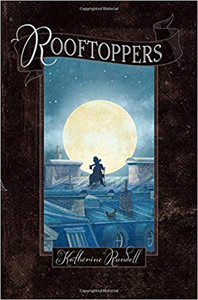
The book is called Rooftoppers by Catherine Rundell, who issues a warning.
Please, please don't do this at home, kids.
Our heroine Sophie is brought up with a very unusual set of parental rules.
And they eat off books in the dining room, and they can scribble on the walls and stuff.
She's a very, like, chill parent, almost too chill.
That's one of our readers from the British International School of Washington.
Music also plays a large part of the story.
It's like a rainstorm, she whispered to Charles.
That's the music a rainstorm would play.
Yes, said Charles.
And the man overheard and called over his playing.
Yes, exactly, Cherie.
That is it, exactly.
That's our celebrity reader, director and audiobook actress Stevie Zimmerman.
And this is The Book Club for Kids, the podcast where kids talk about books.
We'll tell you how you can be on the show a little later on, but first, let's meet our readers.
Hello, my name is Oliver.
Hi, I'm Olivia.
And I'm Helen.
And we're all 6th and 7th graders from the British International School of Washington.
So the book is Rooftoppers.
What's it about?
Well, it's about this young girl named Sophie.
She's about our age, like 12 13, and she might be taken away from her adoptive parent, and so she travels to France with him so they can find her mother and not have Sophie taken away.
What's Sophie like?
She is very adventurous and she is unlike other girls from at that time in England in the 19th century.
She was very rebellious and she was a very cool character.
She's quite ambitious in my opinion and she doesn't like to do what she's told.
She's very curious, like she can't just find something and ignore it.
Very determined.
Once she knows what she wants, she tries to get it.
Not in a bratty way, but she will go at long lengths to find out more and discover things.
Her adoptive father Charles, found her in a river and he just adopted her from there.
But it just got really difficult with just having one parent and also not having lots of amazing manners for a woman at that time.
Well, let's back up a little bit.
So how exactly did Sophie come to be adopted or picked up, shall we say?
Well, when she was a baby, she was on a ship, like a cruise ship, and it sunk.
And her mother.
Well, she presumes it's her mother, left her in a cello case and It just washed up onto the ocean.
And I'm pretty sure Charles Maxime, her adoptive father, was on the boat with her.
So that's why he felt like he wanted to adopt her.
Charles isn't exactly your run-of-the-mill adoptive father.
What's life like at Charles' house?
Well, they do a lot of things differently.
So instead of having the normal woman things like wearing a skirt and specific types of shirts, they wear men clothes and they eat off books in the dining room and they can scribble on the walls and stuff.
So he's a very, like, chill parent, almost too chill.
Well, I have to ask, I mean, did it make you nervous?
Did life for Sophie sound okay with you, or does there anything that even you guys felt was a little a bridge too far?
Shall we say the eating off books thing, because if she's in a situation where she there's a book and she has food and not a plate, she might eat off it and like, if that happens in a library or something, then no, she's gonna get kicked out of the library.
I thought it was quite fun.
In my opinion,
If I was Sophie, I'd probably quite enjoy it.
Not the whole eating off book things, because I think books are valuable and stuff, but I like the whole being able to be free and not have to wear a tight uniform and all sorts of things.
I kind of like the freedom, not just with the book stuff, sure.
My parents might get mad at me if I did that, and...
I probably wouldn't do it myself, but I feel like how later in the book, when she's a rooftop or, like the name suggests, when she's traveling around France on the rooftops, it just was very adventurous and very cool and engaging.
Let's hear a bit from the book where Sophie is trying to track down details about her missing mother.
Musical details.
Our celebrity reader is stage director and audiobook actress Stevie Zimmerman.
There was a cough.
The old owner had come round from behind the desk and was standing at his assistant's elbow.
He held a cello bow like a horse whip.
Try a little harder, please, Monsieur Lille.
Monsieur Lille flushed.
I meant she was peculiar in musical terms.
She played funeral marches in double time.
She played Fauré's Requiem without the necessary dignity.
She did, said Sophie.
She did.
The owner smiled.
I remember that.
That I do remember.
She said she knew nothing but the funeral marches from living near a church.
A church? asked Sophie.
Did she say which?
No, but she said people should be able to dance to music.
So she learned the church tunes and played them double time.
Sophie loved the sound of that.
It was something she would like to do herself.
And she was good, wasn't she?
I just know she was good.
Her fingers tingled.
Good has nothing to do with it.
It was indecent, said the assistant.
She made solemn music frivolous.
It wasn't comme il faut.
Could you demonstrate it for us, said Charles.
No, he said.
I could not.
The owner straightened his back.
It cracked like a revolver shot, and Sophie winced.
I could, he said.
Monsieur Lille looked staggered.
Monsieur, think of what your doctor said.
As a favour to the little girl.
He pulled a cello from its case.
Listen.
The music started slowly.
Sophie shivered.
She had never liked the Requiem.
The old man bit his tongue and quickened his pace.
The music sped up, to a march and then to a run, until it sounded rollicking and sad at once.
Sophie wanted to clap in time, but the rhythm was hard to capture.
It was music that kicked and spun.
It's like a rainstorm, she whispered to Charles.
That's the music a rainstorm would play.
Yes, said Charles, and the man overheard and called over his playing.
Yes, exactly, chérie, that is it, exactly.
Soon, far too soon for Sophie, the man put down his bow.
There, he said, something like that.
She was faster than me, I think.
But, the assistant said, She did not play as elegantly as Monsieur Estoui.
She rushed with her bow.
The young are foolish, and prize speed.
Charles raised an eyebrow.
Eyebrows can be powerful, and Monsieur Lille looked quelled.
I admit, said Monsieur Lille, that I have never heard anyone play as quickly as the girl.
Vivienne, said Sophie.
She said it in a whisper.
She was called Vivienne.
Vivienne.
"'Yes, Vivienne,' said Monsieur Estouil.
"'I remember clearly now, I think.
"'She was extraordinary.
"'Mon Dieu, the speed!
"'I would not have thought it possible.'
"'But it was not a proper way to play,' said the assistant.
"'I was not impressed.'
"'I was,' said Monsieur Estouil.
"'I was, and I am not easily impressed.'
Sophie left Charles to do the thanking and the farewells.
She couldn't speak.
She needed to keep the music in her head.
Sophie had a corner of her brain, it felt near the front and to the left, in which she kept music.
Now she stored this music away there.
So she goes to France in search of mom and encounters, as you say Oliver, this subculture of people who live on a roof.
I guess is the best way to describe that.
Talk a bit about that side of the book.
Well, they're mostly orphans and younger children who run away from orphanages and they hide from the police because at that time I'm not sure if this is real or not.
I looked it up to see if it was true, but I found nothing.
Apparently it was illegal to be homeless in France.
It got to a point where they'd run away and they didn't want to get caught.
They didn't want to get in jail.
So they just live on top of the rooftops in France.
Was that at all appealing to you?
I'm scared of heights, personally.
And the whole jumping across wide gaps in the sky, kind of.
It sounded very wild, but you have to be the right kind of person to live that life, in my opinion.
And you're not that kind of person?
Definitely not.
Oliver?
Maybe if I was a little bit more agile, I would like to do what they're doing, parkour or escaping.
I feel like the writing style was different.
I feel like it contributed to lots of good stuff, but also a few things that were a little bit confusing.
Like sometimes it just would either put lots of detail or not enough.
But I still thought it was a good book and adventurous when it needed to be, and when it didn't need to be, then it was fine.
Well, how would you describe this book to somebody else?
I would say it's a fascinating book.
I really like it because I like the way it's written a lot, because it's easy to get through and it's got a great plot.
I can't think of just one word adjectives except for like basic ones like fantastic or stuff.
But I think it's a really great book.
Well, would you say this book is like anything else you've read?
No, I thought it was quite a unique book because I've read some of her other books and they have the same kind of magical concept.
Yeah, I thought the plot was very unusual.
I can think of another book that's reminded me of Oliver.
Can you think of anything?
I don't think so, but I feel like it was very creatively.
Does it fit any genre that you can describe?
I mean, would you describe it as fantasy?
Would you describe it as realistic fiction?
Would you describe it as adventure?
Would you describe it as what?
Adventure and... I'm not sure, what else?
It's just like, it's different, but in a good way.
Well, it's sort of historical, because I quite like books like this, set in the past, and...
That's the only one I can think about for it, because it doesn't really fit in any genres, and I think that's what makes it so special and unique.
So I thought it was kind of fantasy because there's a kind of magical feel.
I know there's nothing like magic in there.
It just feels kind of magical with the whole France and rooftop and stuff like that.
All this walking around on the roof can make parental types a bit nervous.
Catherine Rundell, did you ever get any pushback on rooftoppers?
The thing that actually alarmed people was the worry that children would go climbing on rooftops.
And I should say now, please, please don't do this at home, kids.
I had one mother who said that her son got a hairline fracture in his arm and had to wear a cast because he read rooftoppers and went climbing on the roof of a shed.
But she was actually very proud of him because he was being adventurous and he was being daring.
And of course, it was very frustrating to have to end up in A&E.
But there was also, I think, She thought, that's a boy who wants to see the world from up high.
And so I think that when I get criticism, it's very much leveled at the suggestion that I might be encouraging kids to walk a tightrope between two of the highest buildings in Paris, which I would say again please don't do.
It only works in the world of fiction.
You're also a prolific playwright.
Is there a difference when you're writing novels for middle schoolers?
So writing for theatre and writing novels for children are in some ways very similar, in that you try to capture a character, something that's very ephemeral, and you try to pin it down for your audience.
You try to render it far more corporeal.
But of course, the main difference is that in theatre, people are literally corporeal.
People are literally bodily present.
I only do a quarter of the work when I write a play.
And all the rest of it is done by the director and the actors and the stage designers and the lighting and the music.
They help conjure the world.
With a book, the only thing that will conjure the world will be my writing and your imagination.
And your imagination will do a lot of the work, but I still need to make sure that I make the people seem real.
Whereas on the stage, they're real already.
So I found it fascinatingly different.
And in some ways, of course, there's also the fact that sometimes you write a line and you imagine it being said a very specific way, and the actor does it very differently.
And that can either be brilliant, because they do it so much better than you could imagine, or you want to stand up and shout no no, it's not supposed to be like that.
But I think that's just part of writing for the stage or for the screen.
I think you have to reckon once you've finished it, it's no longer yours.
What scene stuck with you the most?
Probably the end, like the fight scene, and also the even though this wasn't a big part when they were going to France how she had to be pretty secretive in the train station.
Well, this is no spoilers, but I love the end scene, because you didn't exactly get all the information, like it left on a semi-cliffhanger.
It didn't give too much detail and it gave enough for the reader to be satisfied and still have like imagine exactly what's happened next.
Like, everyone who reads it probably has a different imagination of what exactly happens next.
What makes a good ending for a book exactly?
I think a good ending is...
With the cliffhanger again, because then it makes you all intrigued and stuff which I kind of like in a book.
If there's not a sequel to the book.
Does that disappoint you?
Then that if there's a cliffhanger at the end.
No, I'm always sad if there's not a sequel of a book I like.
But then some books I think are better without sequels because the cliffhanger just gives it that edge that I kind of like.
Personally, if there's a cliffhanger, at least like a big one, I really feel like there should be a sequel.
What makes a good ending for you, Oliver?
Really depends on the kind of book.
Like if it's a book like Rooftoppers, maybe.
I think the ending was appropriate, but if it was like a book, like Wonder, I would definitely rather have just a stop instead of a cliffhanger.
Okay, so I'm going to be real provincial.
As an American, this book seemed very British to me in that it was quirky and, as you said, sort of a magical quality.
Not necessarily a book about magic, though.
That's actually something I wanted to talk about.
It was set in Britain, but I noticed some of the words.
It used words like trash. and pants instead of trousers and stuff like so.
Yes, because we wouldn't know what a lift was, or a bonnet or a boot or any of the other Britishisms that we only know from British dramas usually.
But you don't call boots, boots?
No.
You would call the back of your car a boot, your trunk of your car.
Oh, yes, boots.
What do you call, wellies, is that what you call boots?
Wellington boots.
Those are like when it's a wet day and there's all puddles and stuff, you wear Wellington boots.
More than a few times.
My parents have gotten very confused whenever I use a British term, because all my friends are British.
All right, hard question.
What is your very favorite book?
Well, I just read Mouse and it was probably one of my favorite books so far, especially because I'm Jewish, so it was a little bit tough for me to read it, but I found it very good.
Why?
Why?
The fact that they could illustrate the Holocaust, it wasn't too dark or depressing yet.
It still got to the point that the Holocaust was a horrible time.
Favorite book?
I pick a genre.
I like mysteries.
My favorite book is Mysteries.
I like all mystery books.
They're so fun.
And it's so fun to try to figure it out, but then it's never who you think it is.
I like Agatha Christie.
I read quite a few of her books.
They're really good.
I like those mysteries.
And for like newer ones, I like the ones by, his name's Stuart Gibbs, right?
Yeah, he has like the Fun Jungle series, which I think is really good.
And of course, Stuart Gibbs is one of our favorite people too.
Although we did a different series.
We did Spy School, the first in that series.
And we have that as a podcast and you can listen to it on our website.
We'll have a link to it at bookclubforkids.org.
So I have like a series and it's the Maze Runner series by James Dashner.
I really like it because, even though it's like it's kind of got a scary concept to it and stuff, but in the end everyone they're all just teenage boys and I like that concept of how weird and, you know, unusual they are.
So I really like the plot because it really makes you think.
So after just reading one chapter, I'll be sitting in my room like, what?
I've questioned life now.
Well, what about you, Catherine Rundell?
What is your favorite book?
Charmed Life by Diana Wynne-Jones, who is a brilliant British writer who isn't as famous as she deserves to be, although she is quite well known.
Charmed Life is about a wizard who goes to live in a castle and he has nine lives, and it's about how he accidentally loses those lives, and also about an evil wizard.
But the thing that makes it different from Harry Potter is it's so funny.
It's sarcastic and biting.
Diana Wynne-Jones was a woman who did not believe in talking down to children.
She was a woman who reckoned that children are fully as sharp, as smart as in need of big, wild stories as adults.
And for that, I will always love her.
Got a favourite book, Stevie Zimmerman?
It's a book I used to read with my children when they were little, which is quite a long time ago now, but they still love this book and I'm hoping one day, when they have children, we'll all read it together.
It's called Where the Wild Things Are, and it's a story about a little boy who's very naughty and is sent to bed without his supper, and he goes on a journey to a land where huge ogres and monsters live.
And of course, he's very scared, but he soon realizes that he can be the king of all of them.
And they dance and they have a party and they have a great time by the light of the moon.
A lot of the pages are just pictures.
And so my children and I would make up the words.
One of the pages is of all the ogres and the little boy dancing and the little boys wearing a crown and carrying a stick.
And my little boy, who was reading it with me, said Dem dance by the light of da moon and dem roar, dem terrible roars, and dem gnash dem terrible teeth.
I love that book.
It reminds me of some very, very happy times.
We'll have a list of everybody's favorite book at our website, bookclubforkids.org.
And if you have a favorite book, you can be on the Book Club for Kids podcast, too.
Just give us a call at 323-639-3560 and leave us a message telling us your first name, the city where you live, the name of your favorite book and why you love it.
That number again is 323-639-3560.
And if you live or go to school in Southern California, you can be on the Book Club for Kids too, and we will come out with a microphone to your school or library and talk to you about a particular book.
Just have your teacher, parent, or librarian send us an email to kitty at bookclubforkids.org.
Again, that's k-i-t-t-y at bookclubforkids.org.
Thanks this week to producer Ilse Setziel.
Jonathan Jensen composed our theme with additional music from Charles Nilman.
Emma Steinkalmer designed our logo.
Thanks to writer Catherine Rundell and our celebrity reader Stevie Zimmerman.
And thanks, too, to our readers this week, Oliver, Olivia, and Helen, and their librarian, Kristen Teeters, at the British International School of Washington.
We have a free newsletter for teachers, parents and librarians full of free tips about how to turn kids into lifelong readers.
You can sign up at our website, bookclubforkids.org.
And if you haven't yet sampled our new podcast, The Fina Mendoza Mysteries, do give it a listen now.
And let us know what you think.
There's a new detective in town.
My name is Pina Mendoza.
I moved to Washington, DC with my older sister, Gabby, because Papa works in the US Capitol.
He's a congressman.
Me?
I solve mysteries.
Subscribe now.
Vena Mendoza Mysteries Podcast on Apple Podcasts Spotify, Radio Public or wherever you listen to podcasts.
We'll be back again next week with a brand new bonus episode.
I'm Kitty Felde.
Thanks again for listening.