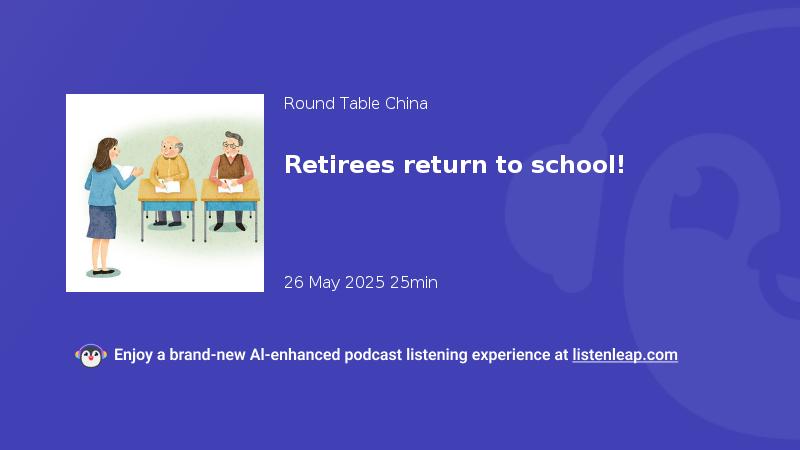
Discussion keeps the world turning.
This is Roundtable.
Guess who's back? Heading to school.
Retirees aged 55 and above, with time and curiosity on their side.
From China to the US, seniors are stepping back into the classroom.
But what are they really looking for in this second round of education?
And what does that say about how we're all reimagining the golden years?
Coming to you live from Beijing.
This is Round Table.
I'm Hea Young for today's program.
I'm joined by our very own Yu Shun in the studio.
Hi everyone. Hey, and look who's back and glowing.
Steve returns from vacation with stories to tell and a tan to prove it.
Excited to be back and excited for today's show.
Awesome. And I've seen some comments saying, we're Steve.
I'm here now, don't worry about it.
Wonderful to have you both in the studio and for this discussion.
First, on a nice show.
Gen Z don't look now, grandma's back in school and she might be better at Photoshop than you.
From spending big on college classes in the US to taking Tai Chi and photo editing lessons in a different type of elderly college in China, Seniors are redefining retirement and lifelong learning.
So what's behind this silver -haired student trend and what does it say about how people want to spend their retirement years today?
On some campuses in the U .S., the term college senior is taking on a whole new meaning.
So, Steve, tell us about these new options of university retirement community.
Yeah, this is kind of a hybrid model, isn't it?
and I think it's really cool, we'll get into the details, but I'll start with one specific example, there's an institution called Goucher College, and that's a private liberal arts institution, and it's just outside of Baltimore, which is a city in the state of Maryland in the United States, and what they did was they partnered together with Edenwald, Edenwald is a nearby senior living community, and together they piloted what they call a university retirement community, and the program invites residents aged 55 and older, so there is an age restriction there, to fully engage in campus life by auditing
courses. That means that they can attend university courses.
They don't take part like the students do in the sense that they're taking the tests and they're gaining credit for the classes, but they're available for them to go and see.
They can also use the campus facilities, they can attend events alongside the traditional undergraduates so they really do coexist all on the same campus there it's kind of a cool idea oh yeah they don't do get all of that exams as you said but they do share the classroom with you know all of the traditional students out there arranging in H from 18 onward and it is trying to the program is trying to foster a kind of cross -generational dialogue and collaboration, of course, and also participants receive official student card, it's called Goucher student ID, you know, which means it is granting
them library privileges, dining hall accesses, and entry to concerts and also attendance at athletic events, such as lacrosse games.
Yeah, which is a big deal, right, in in the United States, and in Canada too, students from the the school sports teams, basketball volleyball, football, whatever the sport happens to be.
Yeah, so the seniors here, they get the student card basically where it allows them to do all of those things.
In terms of the housing itself, the school leases three acres of land to Edenwald for senior housing and then in exchange for that, Gouger provides educational programming and then the access to the campus that Yuxin just mentioned.
So - Well, I was gonna get to that in a little while, but since you asked now yeah, it's it's not cheap It's expensive So the residents there will pay various prices depending on the size of the apartment that they have but it starts at $3 ,500 per month and it can go up to about $11 ,000 a month for premium units and again, that's with all the campus amenities included but still that's not cheap at all that like 3 ,500 us dollars that that's basically 25 ,000 yuan per month of your housing, right?
That immediately Prices out most Chinese people.
Well, I mean and that's the starting price right?
It can go up as high as $11 ,000 a month, but which is 79 ,000, it's extremely expensive.
So even for Americans this would be pretty expensive Oh 100 percent.
Yes Yeah, very, very much expensive.
I mean, I remember a friend of mine lived in Brooklyn in New York City, and the apartment, the one -bedroom, two -bedroom apartment, was $3 ,600 a month.
So it's basically like the equivalent of a Brooklyn apartment, what you're going to pay per month.
And that's retirement.
Wow. How popular is this university retirement community arrangement in the US?
Well, there was a report from Marketplace, that's a media outlet out of the United States, and they talked about this university retirement community.
They call them URCs.
And the fact that they've grown from just maybe having a handful in the 1980s to around 90 nationwide today, which isn't a mind blowing number, right, it's still under 100.
But if we compare it back to when it started in the 1980s, it is significant growth.
but they are expecting it as well to double over the next decade or so.
And in terms of the schools, they can range from small liberal arts colleges all the way up to famous schools.
Here's a couple of more examples.
It's called The Pines at Davidson College.
That's in North Carolina.
They welcome retirees into apartments and villas.
They, they have a campus that's about 150 acres And there they have lectures and art studios and fitness centers and social events with students and faculty and here's one more example for you.
Mirabella at University, Arizona State University, they have on -site senior housing alongside full access to campus libraries and dining and athletic events.
All the things that that we mentioned before.
What do you think is driving older Americans to go back to school and also they're paying a hefty price for it.
I was thinking for seniors at least they are having a chance to go back to university if they're like not considering about the cost, you know, access to campus life, mental stimulation and broader social networks with not people from the same age group, right?
Also from different age groups who are younger maybe and also from different walks of life and have like different kinds of dialogs.
It's another alternative.
It's outside of the stereotypical senior lifestyle that we think about when we think of the average retired person in the United States right so you know maybe wake up and play golf in the daytime you know meet your friends and go shot I mean these are the stereotypes these are stereotypes I love and some of them are very very true yeah but it provides an alternative right where you can continue to take a class if you if you feel like it you have like -minded individuals who are also living at the community as well, which is again, it's on a university campus.
There's the interaction with the younger people to taking classes, when you want to take them.
I think it's just a kind of a, for many people a more exciting opportunity.
This isn't the norm, I wanna point that out as well.
It's not like when you retire from your job in the United States, you immediately move on to university campus.
This is still quite niche.
but the fact that it exists is kind of testament to the fact that there is a demand for it.
Right and according to specialty investment banker Zegler baby boomers hold significant wealth and high educational attainment seeking intellectually stimulating socially rich retirement lifestyles roughly this figure kind of surprised me a little bit 39 % of adults of 55 and older have a but I don't understand how necessarily that is connected to them wanting to go to school again.
I don't know if it's wanting to go to school again.
What is it? Do they just want to be back in that ambience and that environment?
I'll give you an example of when my father retired, right.
So he was a high school vice principal for more than 30 years.
And he took an early retirement package.
They offered that in Nova Scotia because Nova Scotia has a lot had a lot at that time of teacher colleges So there were a lot of students coming out with degrees that needed teaching jobs So the government decided to offer an early retirement package to the teachers.
Anyway side story So dad when he retired, I mean, this is a man who never missed a day of work He loved his job so much. He was completely dedicated completely loyal and when he stopped working he kind of didn't really know what to do with himself for a period of time.
And we were at the beach house one day and I came out and dad is putting wheels on the bottom of a plant holder.
And I said, what are you doing?
And he said, I'm putting wheels on the bottom of the plants.
I said, why? He said, well, now I don't have to pick them up anymore.
I can just kind of kick them with my foot.
I said, oh goodness me, someone's retired and looking for something to do.
I think so my point here with that cute little story is that yeah if you want to draw a connection between people having university degrees and still wanting to have that atmosphere having the Opportunity or the option to attend a class.
I think that's very Attractive to them and it's not just the classes right?
It's the access to the library.
It's the athletic event it's all the things that the students get to do on campus too, but what I was thinking was it is quite you're not open to different age group of people to apply for colleges, right, no matter, like, there are limits, but for like 50 and above, you can still apply for a regular college degree or something like that.
Don't you? But in the US, it's so expensive.
And do you want to do that, take up so much debt, or do you wanna just throw that...
Well, we talked about this a couple of days ago, We're like 60 ,000 American dollars for one year education.
You still want that?
Yeah. I mean, when I was in my university days, we had older students in the class.
In Canada, many I think it's 65 and older.
Not every school, but I think many schools will allow people of that age group to attend classes for free.
And it's often subject to availability, right?
When I was taking my classes, maybe there were, I don't know, two or three or four students in there who were retired.
And it was just kind of a cool thing for them to do.
And we enjoyed having them in the class.
What I really like about these kinds of programs, not thinking about the cost and all that stuff for a second is that they force people to see each other as people not headlines because, well, in a society increasingly, it's atomized, and even in China, we don't live in three -generation households anymore.
And when we talk about older folks and a lot of the social issues with an aging society that brings, we don't necessarily see this living being in front of us.
We think of, oh, older folks that have nothing to do with me, and when in fact I think it's a really great way to, I don't know what this is called, embracing society or just to understand this country we live in in a better way if we get to work, live, or in this case go to classes and interact with folks of a different generation and really get to know them to a certain extent.
I agree and I think this is just my personal opinion.
I think we're going to be introduced to some new terms in the next few decades or perhaps see some terms disappear.
And what I mean is seniors, pensioners, the elderly with aging societies becoming more pop - not popular - more common around the world then I think that you're going to see these types of stereotypes start to slowly disappear as well.
And this, think programs like this at various universities can help with that.
And also one thing I see as, oh this is possibly a lifesaver or it could be seen as a lifesaver for a lot of these universities or smaller universities in America is that they're experiencing significant hardship in even keeping the lights on.
So having these older folks and apparently in the U .S., they're going through a similar process of fast aging society as baby boomers reach retirement age.
And therefore, these colleges are seeing, oh, our new customers are not 18 anymore.
or they're 80. So I don't necessarily think it's going to completely flip the switch for them for these colleges, because I don't think you can just rely on this bunch of older folks, that older demographic to pay to keep your university alive, but they do act as an extra revenue stream.
And on Friday, I believe with Josh, we talked about how extremely expensive university tuition has become in the UK and the US.
And with the younger generation over there, they were talking about is this even worth it anymore to take up that much student loan even before starting your first job.
So I think this is an interesting dynamic that's going on in the US.
So now let's turn back here to China.
We're seeing that in recent years, elderly universities or long -yen -da -shugh has been in the news quite a bit, but it's a different type of university.
It is not the regular university that undergraduates usually go to.
And could you sort of paint the picture for us here in China of how retirees or older folks are enjoying these elderly educational institutions or just go to class again.
Yes, and I think these are specially designed for these elderly or especially retirees and it is a kind of a public institution and they offer a wide range of curriculums designed to enrich senior's lives through maybe cultural, physical, technological, and practical skills training.
So that's why I was thinking of this kind of public institution when Steve was telling our example of your dad of maybe people when they're retiring they will think of something to do aside from just having a maybe luxurious and really free life.
and they would like to learn something that maybe they wanted when they were young or something like that.
These kinds of institutions are mostly aimed at providing these adults with opportunities to learn new things, though they aren't often about academic studies but more of electronic devices they may not know how to use, or just activities like dance or singing for fitness or enjoyment.
And this goal is to kind of enrich their lives and give them chances to connect and communicate with peers.
Are there a lot of senior students here in China?
Are there a lot of programs?
Are there a lot of institutions that are involved in this?
The market demand a kind of a fueled and explosive rise in this kind of an elderly universities.
An article from 36KR, which is a tech media outlet, reported on the April of 2023, saying that over 76 ,000 public and private elderly universities served more than 20 million senior learners.
Yet that addresses only about 8 % of China's Two hundred ninety million people aged sixty and above.
And this kind of capitalizing on this group, private brands require minimal qualifications, which is a standard business license leading to a franchise surge since twenty twenty four.
So many not only public institutions also some private brands are also creating or building up these elderly universities.
Oh, so private brands meaning like private educational institutions.
Yes. Like an academy type thing.
I don't think they're that formal.
I think they're using the idea of nursing homes, but they are for learning and for creating opportunities for elderly to learn things.
Well, there are the nursing home types, where, yes, you check into a nursing home usually well the price ranges there are the cheaper ones and the more expensive ones and then if you enroll into a nursing home then I think you kind of expect that there are gonna be these fun classes that are mainly for leisure and entertainment and you maybe learn a little bit of something along the way but also quite commonly seen is maybe in sort of like community colleges or maybe just a community learning center somewhere near your home And then you can pop in for a couple of classes maybe study photo editing
or using some of the digital devices or play Tai Chi, Guzheng, and all kinds of fun things.
And these are far more affordable although compared with the US but still I think it's pretty common for Chinese seniors to be very economical.
Or Maybe this is a stereotype, sorry grandma and grandpa.
To make them pay for stuff, you really need to make it worthwhile because they're very shrewd with their wallet.
So then, that's one of the key differences, I guess, between the two models, right?
By the sounds of things where in America, you have partnerships between the colleges and the senior housing providers that really integrates, fully integrates retirees into campus life.
but here in China it's a mix of public private with the government run centers mixed in and then you've got yeah these private franchises as you mentioned that are popping up to meet the demand for for these learning opportunities so I guess that's what we're not talking about exactly the same systems here are we?
They're very different I'd say.
Why do you think say, globally, people are kind of are they rethinking what retirement life looks like for them?
And how come education more or less seems to play a role here?
When my parents lived in in Florida, they lived in a community.
It wasn't a nursing home.
It wasn't. It wasn't even a retirement community per se.
But in the community.
So it was a gated community.
And then inside there they had the community swimming pool and there's a few different streets and homes and things like that.
And then they had, I guess you'd call it a community center, but that's almost a misnomer because it's small.
It was like a place that had a little bar in it, a little tiny restaurant, a cafe, a place to read some books and stuff like that.
But in there, once a week or twice a week, maybe more, a teacher would come in, And I remember my aunt took an iPad class at the time, and the teacher would come in and teach about, you know, different apps that you could download, and things like that, and then how to properly use an iPad.
And I guess that would fall into the educational category, right, when you're learning something new.
I guess what I'm trying to say is it doesn't have to be like advanced physics courses.
It can be, I suppose.
But education can mean a lot of different things to a lot of different people, and you can learn a lot of different things too.
And I think that people never really stop wanting to do that no matter how old they are.
And what I was thinking is that maybe education is not even the main point that a lot of people are seeking.
I would say it's more of an atmosphere or an environment that maybe they are looking for.
You know if This would truly be a great option even for me I was thinking if if cost wasn't a factor in this case, you know At least you know something that's something I would choose I would be you know, like having the chance to apply to a university and go back to School at almost any age without without the pressure without pressure, right?
Yes Yeah, you don't have the pressure of needing to get an A -plus on your whatever test Yeah, you're just purely enjoying your school life.
Yeah, and also university campuses tend to be quite nice.
Yes. Don't they. Often nicer perhaps even than the house that they used to live in.
So you know, it can be a really cool experience.
That said, you know, it comes with downsides to.
Is it the price? Well that's one of them, isn't it?
It's the monthly fees and I was reading that for some of these schools you need to pay a lot.
It's not just the monthly fee.
You have to pay almost like a membership fee, I guess.
Like to even get there in the first place.
I'll give you an example.
There's one place called The Pines and prices start with an entrance fee there of $55 ,000.
And that's before you pay your monthly charge of almost $3 ,300 a month for a studio apartment.
A two bedroom villa with a balcony.
So the upscale living spaces.
Your entrance fee for the Pines is $598 ,000.
Wow. Right? We're approaching a million dollars there.
And the cost per month is 7 ,830.
I'm not even converting them into yuan yet and it's very expensive already.
Yeah yeah it's pricing out almost everyone, isn't it?
Well it also shows having a comfortable retirement is out of the reach for many people.
Yeah I mean advocates of these types of programs and people who will defend those prices will tell you that they are somewhat similar to assisted living centers anyway, so the prices are comparable.
Well, retirement, with good health and a pension?
That indeed is the Golden Age—a rare chance to learn, travel, and thrive.
But this isn't the final chapter.
The hardest part of aging comes later, when health declines and dependency arises.
That's when gaps in elder care, housing, and health care become urgent.
And today's vibrant senior life, as we've been talking about, is worth celebrating.
But it's also a chance to rethink how we prepare for the full arc of aging.
The challenge is building systems that carry us through the stages of later life, and as a member of the fellow millennial generation.
And I've chatted with friends in America and the UK.
And my peers say, thinking about my golden years, I'm thinking about I might need to work till I drop.
And sorry to end this topic on a little bit of a bleak note but I think it is time for the whole world to rethink retirement.