This message comes from Greenlight.
Parents rank financial literacy as the number one most difficult life skill to teach. With Greenlight the debit card and money app for families, kids learn to earn, save and spend wisely.
Get started risk -free at greenlight .com slash NPR.
You're listening to Shortwave from NPR.
Hey Shortwavers, Regina Barber here.
So if I say unicorns, what comes to mind?
For me, I think about the way this legendary creature has been talked about for hundreds and hundreds of years.
It's linked to magic and fantasy.
And, of course, I also think of that key feature of unicorns.
You know what I'm talking about.
The famous unicorn horn.
You see, in medieval Europe, wealthy people could buy unicorn horns.
They looked like these long spiral horns that tapered to a point.
It almost seems like it was the strongest proof that unicorns really did exist." That's zoologist Greg O 'Cory Crow.
He's with Florida Atlantic University.
And he doesn't study unicorns.
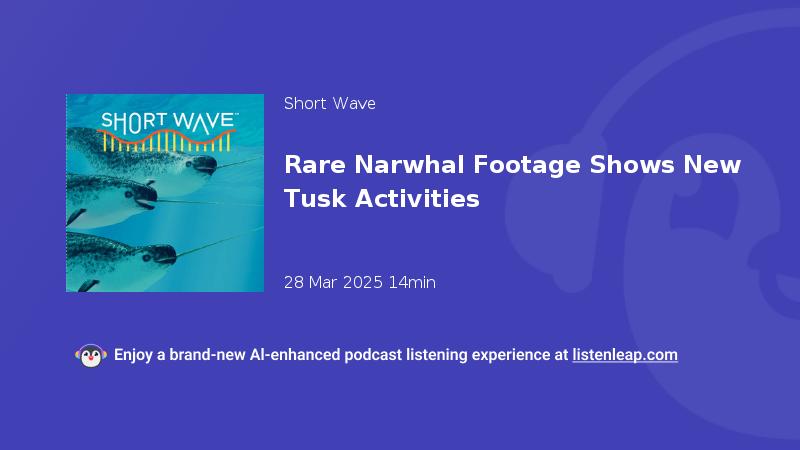
He studies narwhals — the arctic whale that has a long tusk jutting out of its head.
And it's sometimes called the unicorn of the sea.
Greg says way back when, seafarers brought narwhal tusks back to Europe and passed them off as unicorn horns.
And even though they're not really unicorn horns, they're kind of magical.
I've been involved in some satellite tagging of live narwhals obviously and it is quite an overwhelming experience to stand there in the water and help hold a live narwhal and sort of feel the tusk.
A tusk can be 10 feet long and he says it's beautiful.
It almost looks like it has been fashioned and carved.
It has a lovely spiral, scrolled pattern to it, so it's mesmerizing, really, in some ways.
So, he was actually talking about this with my colleague, science correspondent, Nel Greenphill Boys.
And Nel, I hear you're no stranger to narwhal tusks yourself, right?
Yeah, but you know I didn't see the narwhal tusks up close and personal like that on a narwhal.
The ones I saw were like in the corner of this small store in Greenland, up in an Inuit community where hunters sometimes kill narwhals for subsistence hunting.
and I remember seeing just like a table with this whole pile of narwhal tusks.
I mean, they were long, I was surprised at how long they were, they were like spears.
Did you actually get to see a live narwhal though?
Yeah, from a distance through binoculars.
I ate some too. So cool.
Honestly, there was narwhal meat drying on this rack on a beach and at the time, it seemed like the polite thing to do.
I mean, I would have. Okay so moving on to what narwhals eat and how this might relate to their tusks and why we wanted to talk to you today, we understand that there's some new drone footage of narwhals.
I am so excited. Okay, so today on the show, we're going to dive into what scientists recently saw when they spied on narwhals with overhead drones, and what it says about what this mysterious whale might do with its unusual and fantastical tusk.
You're listening to Shorwave, the science podcast from NPR.
This message comes from Schwab.
At Schwab, how you invest is your choice, not theirs.
That's why when it comes to managing your wealth, Schwab gives you more choices.
You can invest and trade on your own.
Plus, get advice and more comprehensive wealth solutions to help meet your unique needs.
With award -winning service, low costs, and transparent advice, you can manage your wealth your way at Schwab.
Visit Schwab .com to learn more.
This message is from NPR sponsor Total Wine & More.
This summer season, with so many bottles to choose from, it's easy to find your favorite and more.
Find what you love and love what you find – only at Total Wine & More.
Drink responsibly. Be 21.
This message comes from Charles Schwab.
When it comes to managing your wealth, Schwab gives you more choices – like full service wealth management and advice, when you need it.
You can also invest on your own and trade on thinkorswim.
Visit Schwab .com to learn more.
Okay, now let's just start with the basics when it comes to narwhals.
They're whales, right?
Right, they're whales, but not enormous ones.
I mean, think like 15 feet.
And their back is this kind of mottled gray.
And they live in the Arctic.
I learned that from the movie Elf.
Yes, it's a great movie.
So for much of the year during the Arctic winter, the narwhals are living in the dark, under sea ice way offshore.
And this is like thick pack ice.
so there's not much open water there where they can come up for air.
And they're just hard to study for that reason.
It's hard to watch them most of the time.
They're under the ice.
They dive down really deep.
How deep? Like a mile or more.
Wow, that's very far.
Yeah, so you can understand why scientists don't know much about their behavior.
And you know, they are so adapted to life in the Arctic, there's obviously concerns about how melting ice and warming temperatures could affect them.
Yeah, so what's the deal with the tusk?
Like my understanding is it's kind of like, like tooth coming out of their head.
Yes, I have seen it described as an inside -out tooth.
So it erupts out of the heads of males.
It's almost exclusively found in males, although a small percentage of females do have them like smaller tusks.
Anyway, so it's mostly the males and the males will sometimes stick their head out of the water and sort of cross tusks with another male.
Like they're fencing or like sword fighting?
It's more like just touching.
It seems like some kind of display behavior, scientists call it tusking.
Just like some male deer have antlers, Greg O 'Corey -Crow says the tusks on narwhal males are there to impress the ladies when all the whales are competing for mates.
So I think in many ways we've sort of converged on that as the primary use but it looks now like it has other uses.
The narwhal tusk may be more like a Swiss army knife.
Okay. So this is where we get into the drone footage.
Yeah, so, okay, he's part of this research team that sent small drones up in the air over narwhals that were hanging out in this Bay, like in the Canadian high Arctic.
And the drones would kind of hover there, you know high enough so that they didn't disturb the narwhals, but they can look down through the water, like, you know, down 15 feet or so.
And he says, you know, overall the narwhals were pretty chill.
This wasn't their main mating season or foraging season.
So they were kind of passing the time just hanging out together in groups.
Females were nursing calves.
Males were hanging out in these sort of bachelor herds.
He says it was really notable how little aggression there was.
They don't seem to be pushing and shoving each other with their tusks.
It's almost like, you know, don't touch the tusk.
But the drones did see that occasionally some of the narwhals were using their tusks to go after fish.
Ooh, so like, what do you mean going after?
Like, were they spearing them?
Not spearing them, but like in the videos, you'll see a fish swimming, and right behind it, you'll see the narwhal kind of tracking the fish with the point of the tusk, always staying close to it as the fish kind of changes directions.
And sometimes the narwhal would hit the fish, Like maybe hit it more than once, maybe flip it over.
In the video, you see this kind of silver flash of fish and then this splash.
The narwhals kind of messing with it.
They seem to be able to use their tusks to interrogate, manipulate incredible precision, small objects.
And so the dexterity and use of the tusks was really striking.
He says generally one or two other narwhals would be following along and looking on.
He said it was kind of like exploratory play.
And, as they were doing it, they were also socializing, so there seemed to be elements of social learning and possibly even social instruction, you know?
A larger animal helping a younger animal to explore its environment.
So are scientists saying this is like a part of how narwhals hunt?
Like using their tusks?
I mean, in the journal Frontiers in Marine Science, he and some colleagues say that narwhals could use their tusks to stun and even kill prey.
I was talking with another one of the researchers, Courtney Watt with Fisheries and Oceans Canada, and she's previously studied narwhal foraging using chemical tests to look at samples of tissue from narwhals, you know, so she could get clues about their diet.
And we found that there were differences, a little bit of differences between males and females, and so then that certainly piqued some curiosity as to what role the tusk might play in those differences that we've seen.
Now, she says these differences in diet were subtle.
I mean, obviously females managed to find food without a tusk.
Right, so it's not necessary for foraging.
Right. But she says, maybe as long as the males have a tusk, they've figured out how to use it.
I think it's sort of secondary use for their tusk that maybe some whales have learned and are utilizing to their advantage.
She pointed out there's some other video, critter cam video taken by cameras put on narwhals and it found that they roll their bodies when they get to the bottom of the water sort of prompting speculation that narwhals might use their tusk as like a shovel to shovel up stuff from the bottom.
There's also some other drone video that another group captured back in 2017 that shows narwhals near the surface also going after fish with their tusks.
So similar to this new footage.
Exactly. Yeah. And so that previous study prompted headlines like, video solves mystery of how narwhals use their tusks.
But I thought, like everyone had agreed that the main use of their tusks was to like amaze the females, like that was not a mystery, right?
Exactly. Exactly. And so while this drone footage is fascinating to watch, I mean, what to make of it.
It offers just these little glimpses into the world of narwhals when most of the time the narwhals and their behavior is just not observable.
I called up Kristin Leidre, she's a polar biologist with the University of Washington.
She was the researcher I went to Greenland with, she was trying to catch and tag narwhals at the time and I asked her what she made of this new drone footage.
I think these are short -term videos that show a few narwhals at the surface, you know, moving their heads around in the vicinity of a fish and whether it's play behavior or pursuit of that fish to consume it, nobody knows.
She says, the tusk is clearly a sexual trait that's designed to tell females what kind of mate a male narwhal will be.
The length of the tusk is closely correlated to the mass of the testes, which are internal.
So it's an honest mating signal.
And that's why narwhals have a tusk.
Wow. So the length of the tusk tells you how big those hidden male organs are.
That's right, yeah.
I mean, this is all documented in a research paper that looked at narwhals collected in subsistence hunting so they could actually look at the male organs and compare it to the length of the tusk.
And it's just more support for the idea that females see a bigger tusk as a sign that a male would be a more successful mate.
So, I don't know, insert your size matters jokes here, I guess.
I mean, Kristin Leidra says, ''We know why narwhals have tusks.
It's one of the few things about them that we do know, but their lives as a whole, like their whole social world, how they hunt beneath the ice, like all that's unknown.
Most of their life is spent underwater and actually very deep water in the darkness, they feed at great depths.
So there's so much we could learn if we could have images or video or something down there seeing their behavior and being able to record it.
But she says we have like almost no underwater images of these whales.
I mean it was hard enough for researchers to get fleeting looks at the whales using those aerial drones and yeah Even if it was possible to build some kind of underwater drone that could like follow after them the whales would probably flee Yeah, well based on these videos, maybe they would just poke it with their tusks or like play with it I don't know I don't think so they're skittish, but if Researchers build a robo narwhal and send it down there to learn their secrets I will definitely come back and tell you all about it for sure Nell, thank you so much for bringing us this reporting.
Thanks for having me on the show.
If you liked this episode, follow our podcast on whatever platform you're listening from.
Be it Spotify, Apple Podcast, or another app.
And if you have a science question you want to investigate, email us at shortwave at npr .org.
This episode was produced by Burley McCoy and edited by showrunner Rebecca Ramirez.
It was fact -checked by Tyler Jones.
Robert Rodriguez was the audio engineer.
Beth Donovan is our Senior Director and Colin Campbell is our Senior Vice President of Podcasting Strategy.
I'm Regina Barber. Thank you for listening to Short Wave from NPR.
tearful goodbyes and everything in between.
And with over a hundred years of experience, your Edward Jones Financial Advisor can help.
Edward Jones, member SIPC.
This message comes from Greenlight.
Adults with financial literacy skills have 82 % more wealth than those who don't.
From swimming lessons to piano classes, parents invest in so many things to enrich kids' lives.
But are you investing in their future financial success?
With Greenlight, you can teach your kids financial literacy skills like earning, saving, and investing, start prioritizing their financial education and future today with a risk -free trial at Greenlight .com slash NPR.
This message comes from Mint Mobile.
Mint Mobile took what's wrong with wireless and made it right.
They offer premium wireless plans for less, and all plans include high -speed data, unlimited talk and text, and nationwide coverage.
See for yourself at MintMobile .com slash switch.