This message comes from Progressive Insurance and the NameYourPrice tool.
It helps you find car insurance options in your budget.
Try it today at Progressive .com.
Progressive casualty insurance company and affiliates.
Price and coverage match limited by state law.
Not available in all states.
You're listening to LifeKit from NPR.
Hey, it's Maryelle.
Atlantic hurricane season started on June 1st, and it's hard to process for a lot of people whose communities and homes were wrecked by hurricanes last year in states like Florida, Georgia, North Carolina, and South Carolina.
A lot of people are still rebuilding.
That's the case for Jessica Mazaros.
She's a climate and environment reporter at WUSF, the NPR member station in Tampa.
will rapidly intensify as it quickly moves towards the Big Bend area where it's expected critical thing people can do to prevent mold buildup.
After any trends in storms recently in terms of like how frequently they come around or how quickly it's just FEMA offered to those impacted by storms like what is available to them.
Last year during Hurricane Milton she was working long hours getting people the information they needed ahead of the storm.
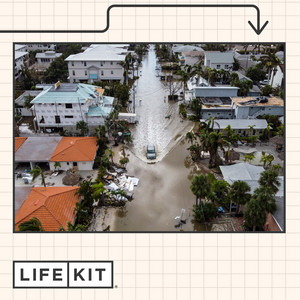
And my fiance and I are spending you know two nights in a row staying up 1 a .m. boarding up the house and then the the flood waters came in anyways from underneath the house.
So needless to say it was a really exhausting time.
They were actually some of the lucky ones in Tampa.
They had a few inches of rain water flood their one -story house but it wasn't salt water which can be much more corrosive.
Still rebuilding has been a lot of work and Jessica doesn't live right on the water or even in a flood zone.
On this episode of Life Kit, how to prepare are your home for hurricanes and flooding, two things that climate change is making more intense.
I talked with Jessica about what she's learned from her reporting and her personal experience, specifically how to know when your home is at risk of flooding, what to do with that information, how to keep your most treasured possessions safe during a storm, and how to rebuild in a way that makes your home less vulnerable.
This is part of NPR's Climate Solutions Week, a series where we examine how to be more resilient in a changing climate.
Support for NPR's Climate Solutions Week Rethinking Home comes from The Nature Conservancy.
People from all walks of life depend on nature for the food they eat, the water they drink, and the air they breathe for strengthening their communities, powering their livelihoods, and safeguarding their health.
Nature is common ground for everyone, and uniting to protect nature can help solve today's challenges and create a thriving tomorrow for future generations.
Discover why at nature .org slash npr.
This message comes from Capital One with the Venture X card. Earn unlimited double miles on everything you buy.
Plus, get premium benefits at a collection of hotels when booking through Capital One Travel.
What's in your wallet?
Terms apply. Details at CapitalOne .com.
This message comes from NPR sponsor, U .S. Bank.
With U .S. Bank Business Essentials, you get more than just a bank, you get a dedicated partner that provides you a powerful combo of checking and card payment processing with quick access to the money you've earned, proving that there is nothing as powerful as the power of us.
Visit USBank .com today to learn more.
Member FDIC. Copyright 2025 U .S. Bank.
This message comes from Schwab.
At Schwab, how you invest is your choice, not theirs.
That's why when it comes to managing your wealth, Schwab gives you more choices.
You can invest and trade on your own.
Thus, get advice and more comprehensive wealth solutions to help meet your unique needs.
With award -winning service, low costs, and transparent advice, you can manage your wealth your way at Schwab.
Visit schwab .com to learn more.
Jessica, what has rebuilding looked like for you and your fiance?
say. So we had to pull out the carpets, the vinyl wood floors.
We also had to take out some of the dry wall.
So that's what our walls are made of, typically, but basically it's like a sponge.
So whenever water hits it, it soaks up the water, it grows moldy really fast. So we replaced about three inches down with do rock, which is like a cement board instead of the dry wall in case it floods again, so mold won't grow on that.
So that's some of our prevention.
And then we had to pull out the wooden baseboards and right now we're replacing them with a PVC baseboard. And again, so if water comes it won't rot like it would the wood.
It's kind of a lot considering that you only had a few inches of rainwater.
Yeah, that gave me a lot of perspective.
I've been covering hurricanes since 2017.
I've lived in Florida my whole life.
So I've been going through hurricanes since Andrew in 1992.
But okay, I only had three inches and it was freshwater.
The people that I talk to with a foot, two feet, four feet of saltwater in their homes, I mean it's completely devastating and the home has to be almost completely rebuilt from the inside.
How has hurricane season changed over the years?
I speak to climatologists and hurricane experts here in Florida and we've had record warm waters recently and warming waters, especially in the gulf, are fueling these storms. not only making them stronger and more powerful, but it's making them wetter, more precipitation.
What I have experienced on the ground is especially more rain.
Are a lot more people seeing their houses flood during these storms?
So in 2021, NASA did release a study that showed people across the globe living in flood -prone areas has risen by 20 to 24 % since 2000.
that is 10 times greater than the number previous models had predicted.
It is directly linked to climate change driving this extreme rainfall, rising sea levels and more intense hurricanes.
And I am seeing it on the ground not only in my reporting but in my own experience as a homeowner.
You know I have spoken to residents who've lived in neighborhoods for three decades or even more and they never thought that they'd flood, but they experienced a flooding event last year.
How can you know if your home is at risk for flooding?
Well the first thing is you can always check FEMA's flood zones.
There are maps you know at floodsmart .gov again floodsmart .gov once you type in your zip code what happens is it'll tell you about the low or moderate or high flood risk, coastal flooding, the riverine flooding, and the hurricane flooding risk.
Okay, and what are some other ways you can get a sense of your risk?
Honestly, what I wish I would have done myself is, regardless of what it says online, to just ask around the neighbors.
Like, I have neighbors here who've lived, you know, next door for 30 years, and some people lived in the neighborhood since their grandma has owned a property in the same street for generations.
And so, I'm technically not in a flood zone, but my house physically is low lying on the block.
So the homes on my side of the street flooded, but the neighbors across from us didn't because they're higher.
So I think it just takes like, asking certain questions when you have an inspector come and look at your house or just kind of eyeing it and saying, okay, like, how does the lawn grade?
What does this road look like?
And asking people like what is the history here?
What do you know here?
And I think that's something that I wish I would have done.
Takeaway one to get a sense of your homes risk of flooding.
Go Go to FloodSmart .gov and put in your zip code.
If you're in a high risk area, and you have a government backed mortgage, you'll be required to purchase flood insurance.
And even if you're at moderate or low risk, your home could still flood.
In fact, more than 40 % of national flood insurance program claims are from outside the high risk areas.
So do some investigating.
Ask around your neighborhood.
Consult a home inspector and look into your home's history to get a sense of what this hurricane season might mean for you.
Also keep in mind that most homeowners insurance doesn't cover flood damage and that flooding can happen anywhere to anyone.
Not just from hurricanes but from things like broken water mains and issues at nearby construction sites.
If you're a homeowner and you can afford to modify your home to protect it against floods, what might you do?
For the people rebuilding after a flood event, if your material choices like instead of drywall using Durock instead of carpet or wood floors opt for the tile.
Some people are raising their electrical outlets so the floodwaters don't short -circuit the power lines and instead of installing the same wooden baseboards that will rot when wet use PVC baseboards.
But I think if you're just in general trying to protect your home from a storm you get like storm proof windows maybe you get roof clips put on, so that basically it clips the roof to the home itself, so it won't just fly away.
There's all kinds of things that you can do.
It does cost money.
One person that I spoke to, Steve Papola, so his family has been displaced since Helene.
It brought four feet of storm surge into his one -story house.
It's about an hour north of Tampa.
So just to give you a rough estimate of what rebuilding after four feet of storm surge looks like.
So Steve Pappolla thinks that it's about $145 ,000 all together for the flooring, the walls, the rebuilding of the kitchen, the electrical rewiring.
Thankfully for him it's all covered by flood insurance so he doesn't have to pay out of pocket for that.
He does have to pay out of pocket for being displaced.
He's still paying a mortgage while paying a rent somewhere else while he's waiting for the construction to be completed.
The water is not a game for the middle class or the lower middle class unless you're going to be able to ensure properly and make sure that you have the ability to mitigate whatever type of loss comes with the storms. Then again, the people are just leaving, too.
There's a lot of for sale signs going up in neighborhoods that flooded last year along the coast. And I went to at least three different counties for my reporting on this and every neighborhood that I went to, specifically to talk to somebody whose house flooded, there were for sale signs, one after the other, leading up to their home.
I mean, I guess it's like if you can afford it, then you leave but sometimes people can't.
Right, and some people are living in unhealthy conditions, you know, in a moldy home, and so there's some people who are just at health risk, actually, if they're not able to afford to move or to make any modifications.
Are there any resources available for folks in that situation?
FEMA would be, so as soon as a hurricane hits, they do make applications available for some money to help with modifications, to help you to stay in a hotel while you're displaced so you don't have to live under those conditions.
And then you can also check states might have some grants as well to help you out.
Takeaway two. If you can afford it and you own your home, make some modifications.
For instance, wood baseboards will rot when they're underwater.
But PVC baseboards won't.
Tile flooring is preferable to carpet, and consider using Durock, which is a cement board instead of drywall.
Also, move electrical outlets higher if you can.
What advice do you have for renters?
We've been talking a lot about homeowners, but if you're a renter and you live in an area that gets strong hurricanes and flooding, what can you do?
Definitely you have to get flood insurance.
Regular renter's insurance may not cover what You know, I know friends of mine, they rented on the ground floor an apartment near Fort Myers beach, and they lost pretty much everything.
There's stuff that can't even be replaced, you know, like childhood photos and things.
Are there any best practices for whether you're a homeowner or you're a renter and you have important documents, for instance, or childhood photos, things like that, something that you can store them in so they won't be destroyed?
Yeah, I know a lot of people that are putting stuff in plastic giant bins, maybe putting them in higher ground, if they have an opportunity to put it upstairs.
Or you you just you drive it somewhere else.
I mean, a lot of this is get to higher ground.
Well, hurricane season started on June 1.
How are folks in Florida feeling?
There is a lot of anxiety in Florida right now, especially along the Gulf Coast. just, you know, so many people still rebuilding after back to back flooding events.
There was hurricane Debbie in August, Helene in September, and then Milton in October.
So it was like three months of back to back storms that caused flooding in different areas in different ways.
As Steve Papola told me, his family is feeling the anxiety.
My wife is definitely getting anxiety every day that comes.
She watches the weather every of the week she's listening to the weatherman intently she has a lot of anxiety it's starting to build up again what do you tell to people who are feeling anxious like this in any sort of hurricane prone area i'm feeling super anxious and it's coming out sideways i think you know there's a lot of tension in my house because we still haven't even finished the rebuilding and so many people are in that position um to to not even feel like your home is safe yet and yet we're already entering another hurricane season.
It's an unnerving feeling.
And so what I would say is like, look down at your feet.
Look at where you are.
Like just because of whatever happened last year doesn't necessarily mean it's gonna happen this year.
But if it does, like, we're okay.
And so whatever things you can do that are actionable, like the things that we've talked about in terms of hurricane preparedness, and having your important papers in order somewhere safe, making sure that whatever you can afford to do to accommodate your home to flooding, if you know that it floods.
Evacuating if you can evacuate and just holding your loved ones tight.
That's all you can really do.
And just knowing that whatever you can control you're doing it, everything else, you kinda just have to wait and see, I guess.
It's a good life lesson in general.
Takeaway three, if you're a renter, know that standard renters insurance usually doesn't cover flood damage.
Look into flood insurance.
And regardless of whether you own your home or rent, you can pack away important documents and sentimental items in a waterproof container and either store it in a high place or take it to higher ground when you evacuate.
On that note, always follow the evacuation orders.
Jessica, thank you so much for this.
I hope that this hurricane season is calm.
Me too, I hope that the waters are calm and that we have a chance to breathe and to continue rebuilding in our area to make ourselves feel safe and secure at home because home should feel that way.
Okay, time for a recap.
Look at FloodSmart .gov to understand your risk level this hurricane season.
You can also ask neighbors and home inspectors and look at your home's history to see the bigger picture.
You might learn important information that you don't find online, and seriously consider buying flood insurance, because homeowners insurance generally doesn't cover flood damage.
Now if you're a homeowner and you can afford it, consider modifying your home's flooring walls and electrical outlets.
If you're a renter also seriously consider buying flood insurance on top of your renters insurance.
And in general, make sure you store important documents in a waterproof container and keep them in a high up location.
And always follow the evacuation orders.
This episode was part of NPR's Climate Solutions Week, which examines how climate change impacts where and how we build.
For more climate solutions, go to npr .org backslash Climate Change Week.
For more Life Kit, check out our other episodes.
We've got one on what to put in your go bag and another on what to do if your house floods.
You can find those at npr .org slash life kit.
And if you love life kit, and you want even more, subscribe to our newsletter at npr .org slash lifekit newsletter.
Also, we love hearing from you.
So if you have episode ideas or feedback you want to share, email us at life kit at NPR .org.
This episode of life kit was produced by Margaret Serino. It was edited by Sylvie Douglas and Megan Our visuals editor is Bec Harlan and our digital editor is Mallika Gharib.
Beth Donovan is our executive producer.
Our production team also includes Andy Tegel and Claire -Marie Schneider.
Engineering support comes from Simon Laslow Janson.
I'm Mariel Segarra.
Thanks for listening.
Sign up for your $1 per month trial at Shopify .com slash NPR.
This message comes from Thrive Market.
The food industry is a multi -billion dollar industry.
But not everything on the shelf is made with your health in mind.
At Thrive Market, they go beyond the standards, curating the highest quality products for you and your family while focusing on organic first and restricting more than 1 ,000 harmful ingredients.
All shipped to your door.
Shop at a grocery store that actually cares for your health at thrivemarket .com slash podcast for 30 % off your first order plus a $60 free gift. This message comes from NPR sponsor Viore featuring the performance jogger.
Visit Viore .com slash NPR for 20 % off your first purchase on any U .S. orders over $75 and free returns.
Exclusions apply. Visit the website for full terms and conditions.