This is the Global News Podcast from the BBC World Service.
I'm Celia Hatton, and in the early hours of Tuesday, December the 30th, these are our main stories.
After talks with Israel's leader, President Trump issues a warning to Hamas, telling the militant group it needs to disarm quickly or face serious consequences.
Russia accuses Ukraine of launching a drone attack on one of President Vladimir Putin's residences.
Also in this podcast... Me and my brother were both raised on my dad's stories when we were younger.
He always told us of his adventures when he was cycling across the world and how kind the world actually is and how amazing it is.
We hear from a cyclist who set out to repeat his father's epic bike journey from Britain to Australia.
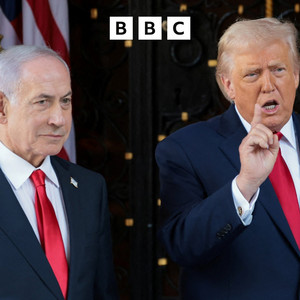
We begin this podcast in Florida in the United States, where a smiling Israeli Prime Minister has met Donald Trump at the US President's Mar-a-Lago residence.
Ahead of their talks.
The meeting had been billed as a chance for Mr Trump to press Benjamin Netanyahu to do more to move towards a lasting peace in Gaza.
A shaky ceasefire has been in place in the region for just over 80 days.
There have been indications the Trump administration has been frustrated by Israel's apparent reluctance to put an international governing body into place in Gaza.
But when meeting reporters after their talks, the president said that, unlike Hamas, Israel was complying with the Gaza ceasefire deal.
We talked about Hamas and we talked about disarmament.
And they're going to be given a very short period of time to disarm.
And we'll see how that works out.
Steve Witkoff and Jared Kushner will be in charge of that from our side.
But if they don't disarm as they agreed to do, they have to disarm within a fairly short period of time.
Mr Trump also said that the reconstruction of Gaza would begin very soon, without giving any timeline.
Our North America correspondent Sean Dilley has been following developments from Washington.
It was a very warm welcome for Benjamin Netanyahu at Mar-a-Lago, the president's Florida residence.
Donald Trump describing him as a wartime prime minister and even a hero.
And in return, Benjamin Netanyahu said that Israel had never had a closer friend in the White House.
In the afternoon, Benjamin Netanyahu said that Donald Trump was a man who bucked convention.
So Israel would too like to buck convention.
They awarded him the Israel Prize and he's the first non-Israeli to receive that for his support of Israel.
The two leaders discussed a variety of issues.
From Iran.
Donald Trump said if the country rebuilds its nuclear programme, that threat would be eradicated.
Donald Trump pledging that he would sort it so that the leaders of Syria and Israel get along.
But the hottest topic no doubt was that of Gaza, stuck in its first phase of a three-phase US-backed plan which involves 20 points.
If it achieves its aims by the end of 2027, the Palestinian Authority would take control of Gaza.
But the reason it stuck is that part of that plan is that Israel is supposed to remove its forces.
It says it won't do that until it sees the return of the remains of Rangivali from October the 7th in 2023.
And Hamas saying, well, they're not going to disarm until Israel removes its forces.
Donald Trump stepping in hoping to end that stalemate but telling Hamas that they will have a very short deadline to disarm.
And if they did not, he said they would be held to pay for them.
Well, that's the latest from the politicians who are determining Gaza's future.
But what's it like on the ground?
Civilians inside Gaza are facing a new threat.
Wintry storms have been battering the strip.
At least 17 people are reported to have been killed while sheltering in bomb-damaged buildings that have collapsed in high winds and heavy rain.
Rebecca Kesby spoke with Ghada Al-Khord, a local journalist based in Gaza City.
They are swimming in water.
As I'm sitting here, and in front of my eyes I see people who are living inside the tents and around them, the sewage, the infrastructure is completely destroyed.
People.
They are facing some problem in access to any kind of service, or electricity or water or oven gas.
It's now the 80th day since the phase one of the ceasefire.
What, if anything, has changed for ordinary people?
Actually, since the signature of the ceasefire, nothing has changed on the ground for the people.
It's not allowed for them to go back to their neighbourhoods behind the yellow line.
If they come close to this area, they can be shot or dead at any time.
But is the situation with food aid at least better than it was back in September?
It's bitter.
We can say slight improvement on the food situation.
But you have to pay too much money to buy this kind of food.
And people, they don't have cash.
They don't have access to banks.
I guess clothing, warm blankets, that sort of thing is an issue too.
Exactly.
Even these things, it's very hard to find it.
You have to buy it because of the looting.
And even the humanitarian aid organization.
They don't have like a systematic process for this distribution.
And we think if there is a good government that can come and control the situation for the Gazan, that can improve their life.
Since the October 7th, we witnessed lots of corruption and looting incidents in Gaza.
And you know there is no official government, so anyone can go and steal anything or loot anything from any Mediterranean truck and no one can control it.
This is like a catastrophic situation for the normal people, the civilians who are seeking for a fair distribution system here in Gaza.
We don't have any official government.
We don't have any officials who can control or rule Gaza.
So I think a technocrat government or a committee that can come and control the situation.
I think it's a bitter idea for the Palestinians.
Local journalist Gada Al-Kord in Gaza.
The latest on the Russia-Ukraine peace negotiations now.
After Donald Trump met the Ukrainian president, Volodymyr Zelensky, on Sunday, the mood was cautiously optimistic.
Mr. Zelensky said the U.S. had offered Ukraine security guarantees for 15 years.
And Mr. Trump said an agreement on this point was close to 95 percent done.
But on Monday, a new stumbling block emerged.
Russia accused Ukraine of launching a drone attack on one of President Vladimir Putin's residences, a claim which Kiev has denied.
It's accusing the Kremlin of trying to derail peace talks.
Steve Rosenberg, our Russia editor in Moscow, told us more.
The official line coming out of Moscow is this attack really happened.
That's what Vladimir Putin told Donald Trump on the phone earlier today.
That is what Russian television told its viewers.
This story playing very big in the main evening news bulletin here in Russia.
However, no images were shown on TV of any aftermath of the attack or any debris.
The Russians haven't presented any evidence so far to back up the claim.
And, of course, we heard that categorical denial from Kiev that this had happened.
I think there's one thing that we can say with certainty, and that is that Moscow is using this moment to try to get Ukraine into a lot of trouble with Donald Trump.
Portraying Ukraine as a terrorist state – that's the language the Kremlin is using –
And, I think, clearly trying to drive a wedge once and for all between Washington and Kiev.
Whether that's going to be successful, we'll have to wait and see.
Steve Rosenberg in Moscow.
Next year should see the start of a high-profile trial in Germany, which has big implications for its relations with Ukraine.
Prosecutors are expected to bring charges against a Ukrainian former military officer who's accused of blowing up the Nord Stream pipeline in 2022.
At the time, it was a major route for Russian gas to Germany.
But the prosecutor's pursuit of justice is controversial.
When a second suspect was detained in Poland on a German arrest warrant, the Polish judge refused to extradite him, arguing that Russia's war on Ukraine had made the pipeline a legitimate target.
Neither of the suspects nor any officials in Kiev have admitted to involvement in the deep-sea sabotage.
Our Eastern Europe correspondent Sarah Rainsford has been following the case throughout the year.
This autumn, TV crews crushed into a Warsaw courthouse to capture the moment when a Ukrainian man was led past in handcuffs for an extradition hearing.
I shouted a question, but he kept his head lowered and walked on in silence.
Vladimir Zhuravlov was accused of attacking the Nord Stream pipelines from Russia.
Before the invasion of Ukraine, Germany got almost half of all its gas through Nord Stream.
But in September 2022, it was blown up in Europe's biggest act of sabotage in decades.
For a while, Russia itself was the prime suspect.
Vladimir Putin had been threatening to cut off the energy flow to Europe, trying to force governments to stop supporting Kiev.
But the evidence soon began to point towards Ukraine.
Three years on, German prosecutors tracked Vladimir Zhuravlov to Warsaw and they issued an arrest warrant.
His wife, Yuliana, told me what happened next.
It was morning.
We all were at home.
Police came and it was six person, I think.
Started to talk with husband and they say that they need to take him.
It really was a shock.
The family had left Kyiv before Russia began its all-out invasion.
Vladimir began selling air conditioning units, but investigators believe he had another life.
They say, in September 2022.
He was part of a group of Ukrainians who used fake passports to hire a boat, sail out into the Baltic Sea and plant explosives on the pipeline far beneath the surface.
Ukraina.
That day in court in Warsaw, the Polish judge made a passionate speech about Russia's genocidal war, as he called it, and Ukrainians' right to defend themselves.
Even if Vladimir had blown up Nord Stream.
He said the pipeline was helping to fund Russia's war economy and so a legitimate target.
In a ruling that was very popular in Poland, he refused to extradite Vladimir, but the German prosecutors persisted and they had a second suspect.
This summer, Sergei Kuznetsov was arrested on holiday in Italy.
Fighting his extradition, his lawyer also argued that a Russian pipeline was a fair target.
Critically.
He pointed out that Sergei had been serving in the Ukrainian military at the time of the blast.
So how could he abandon the front line and mount a major attack abroad without his commanders, even his government, knowing about it?
I spoke to Sehi's Italian lawyer here in Rome.
Has he said whether he did this or didn't do it?
What I can tell you is that he told me.
I cannot tell you if I did it or if I did not because I'm a military officer.
But what I did, I did it under orders.
Those were his words?
Exactly.
The Ukrainian government knows exactly where he was in every day of September 2022.
If he's innocent, why don't they say?
If he did it, why don't they say?
That's his question.
Instead, the Italian judge did extradite Serhii and his own government stayed silent.
The most frank comment I got came from the Human Rights Ombudsman, Dmitry Lubinets.
He told me the Polish judge had had the right idea, considering the context of Russia's invasion.
But on record, no one will go further than that.
Because abandoning a soldier looks bad.
But riskier still is losing Germany as an ally when its support is critical for the entire Ukrainian military, for all its soldiers.
The controversial trial of Sergei Kuznetsov should begin in Germany next year.
What he chooses to reveal then will define how this drama unfolds.
Sarah Rainsford.
Still to come in this podcast, what's the fate of protected sharks in the Mediterranean?
A project monitoring fishing ports on the coast of North Africa suggests that at least 40 great white sharks from that sea have been caught and killed since January.
This is the Global News Podcast.
The Bangladeshi politician and former prime minister Khaleda Zia has died aged 80.
She was the leader of the Bangladesh Nationalist Party and she held the post of prime minister twice, starting in 1991 for five years and then again from 2001 for another five years.
The party said she died after a prolonged illness.
Jill McGivering looks back on her life.
Khalida Zia had a dramatic political life.
Her long, bitter feud with arch-rival Sheikh Hasina polarised Bangladeshi politics for decades and undermined any chance of much-needed consensus.
She said she was just a shy housewife when her husband Zia-ur-Rahman, a hero of the country's struggle for independence, became president in the 1970s.
When he was assassinated, she entered politics herself.
As the head of the Bangladesh Nationalist Party, she became a powerful figure in the fight against military rule and was jailed many times.
When elections were finally held in 1991, she became Prime Minister and served a second term in office the following decade.
But her lifelong inability to work with Sheikh Hasina, the other dominant figure in the country's political landscape, often caused deadlock, even violence.
The crisis in 2006 was a classic example.
In the run-up to national elections, Sheikh Hasina then, in opposition, called a series of strikes and protests because she felt the election rules favoured her opponent, Khalida Zia.
Khalida Zia responded by urging her supporters to use violence and fight back.
From now on, we will speak exactly the same language as they speak and reply in kind.
Don't threaten us with sticks and doors.
I'm instructing my workers and people of this country to respond with whatever they use.
The chaos escalated and a state of emergency was imposed.
Even as the rest of the world expressed concern.
Many Bangladeshis, exhausted by the antics of the two warring women, were relieved.
Khalida Zia was accused of corruption and sent to prison.
She was only allowed out on bail to contest the next set of elections when democracy was finally restored.
She lost them and staged an angry boycott of the new parliament.
Many will remember her as one of two women who held the country's politics hostage with decades of feuding.
The legacy of the Bangladeshi politician and former Prime Minister, Khaleda Zia, who's died at the age of 80.
Let's turn our focus to Venezuela.
Speaking to reporters in Florida several hours ago, President Trump said the US had carried out a strike on a target allegedly linked to Venezuelan drug smuggling.
There was a major explosion in the dock area where they load the boats up with drugs.
They load the boats up with drugs.
So we hit all the boats, and now we hit the area.
It's the implementation area.
That's where they implement.
And that is no longer around.
It's believed this may be the first US attack on Venezuelan soil since President Trump began his military buildup in the Caribbean Sea earlier this year.
US forces have so far struck at around 30 boats, killing more than 100 people in what Washington says is a crackdown on drug trafficking.
In the last few hours, the Pentagon said another boat had been hit.
I asked our Latin America correspondent, Will Grant, about the significance of a US strike on Venezuelan land.
All we have to go on is what President Trump has said to the press in two separate occasions, but there isn't a whole lot there.
He wouldn't take a question on whether or not this had been the US military action, if it had been CIA action or indeed where it actually took place.
OK.
So if we take Donald Trump's assertion at face value that this strike has taken place, how significant is it then that these strikes are now being carried out on Venezuelan land?
Well, those will be the very first questions we'd need to have answered.
If it is indeed an attack on Venezuelan territory, it clearly represents another significant development, another significant escalation in this ongoing conflict.
We don't yet know that.
We have to be aware of going too far.
There's been no response from the Venezuelan government confirming or denying anything either way so far.
But to your original question whether or not it would be a significant development, without doubt.
I mean so far we've seen attacks on supposed narco boats, speed boats or go-fast boats that run through the Caribbean carrying drugs.
We haven't seen the evidence that all of the boats that were hit were indeed carrying drugs.
So that has been the target primarily so far.
So the significance of the action, the military action, then moving to land would be an important and worrisome development.
Will any more information on why the U.S. is so focused on Venezuela at the moment?
We've heard quite a lot of reasons coming from the Trump administration, but is their reasoning any more clear?
Throughout it.
Really it's been the same broad reasoning that if we look at, for example, the last strike on an alleged narco boat, you know US.
Southern Command said that they were engaged in narco trafficking operations.
And, by extension, this is squeezing and pressuring the administration, the government of Nicolas Maduro in Caracas.
Now he is accused by Washington of essentially running a drug trafficking organization from the seat of power in Venezuela, something that he, his government, all his ministers completely deny.
But ultimately, you know, this is in part and I don't think there's any bones being made about this by the Trump administration, about the ultimate goal of removing Nicolas Maduro from power, of removing a man who claimed a victory in an election that was not seen as either free or fair by the international community.
So it has long been a goal, particularly of Marco Rubio, to see Nicolas Maduro removed from power.
Of course, Venezuela's vast oil wealth would be a huge boom for the United States if They had a much more, as it were friendly compliant even, government in Caracas.
Explicitly, it's not about taking the oil as far as the public explanation of it by Washington goes.
That is not the perception that the Venezuelan government have.
Will Grant.
Researchers monitoring shark populations in the Mediterranean Sea say some of the shark species are in danger of disappearing.
As evidenced, some of the most threatened sharks are still being caught and sold in North African fish markets.
Our science correspondent Victoria Gill has the details.
The great white shark is one of more than 20 shark species in the Mediterranean that's protected under international law, meaning it's illegal to fish for them or to sell them.
But a conservation research team led by scientists from the American University, Virginia Tech and the British conservation charity, Blue Marine, says that at least 40 great white sharks from the Mediterranean have been caught and killed since January.
That estimate comes from a project monitoring fishing ports on the coast of North Africa.
And the BBC has discovered and checked footage posted on social media this year of an adult great white being landed at a fishing port in Algeria and what appears to be a large short-finned mako shark another protected species, being prepared for sale at a market in Tunisia.
It's not clear whether the animals have been accidentally caught in fishing nets or if they were targeted, but the researchers say much more needs to be done to protect a rapidly dwindling shark population in the Mediterranean, one of the most heavily fished seas on the planet.
Our science correspondent Victoria Gill.
And last, lots of people follow in their parents' footsteps when choosing a career or even a hobby.
But how about this for an extreme example?
23-year-old Jamie Hargreaves from the English city of Derby has retraced his father's epic cycling trip from Derby in the UK to Derby Street in Sydney, Australia.
His dad, Phil, took the trip in 1984.
And with a few detours due to the modern political landscape, Jamie has just safely completed almost the exact same route.
Jamie spoke with Rebecca Kesby and explained why he did it.
Why did I do it?
Well, I mean, me and my brother were both raised on my dad's stories when we were younger.
And he always told us of his adventures when he was cycling across the world and how kind the world actually is and how amazing it is.
So I always wanted to have similar experiences.
I mean, the most obvious way to do that was also to cycle across the world.
I mean cycling.
When you're traveling on bike, it's a lot better than just sort of traveling as you would normally, because you get to fully immerse yourself everywhere that you are.
You had to make a couple of detours.
You couldn't go through Iran, which I think your dad did back in 84.
But then that took you through a very interesting route through Afghanistan and some of the other Central Asian republics as well.
Yeah, so we had to cut off from dad's path because obviously, as Brits, we're no longer allowed to go through Iran.
So I had to go up instead through Georgia and then detour.
The idea was originally to fly across from Georgia to Kazakhstan, but then I found out that we could actually go through Russia.
So we got the 10-day transit visa for Russia and we ended up cycling through Russia for 10 days, then entered Kazakhstan Uzbekistan, which are just incredible places.
So Jamie I mean a lot of people take a rather grim view of the world at the moment and think that you know there's a lot of pessimism about the way that things are, or you know the various wars and the state of the world as it is.
Did you learn anything on your trek?
That kind of gives us a more optimistic view of the nature of the world at the moment.
Yeah, so cycling across the world, obviously I got to meet all kinds of strangers, and 99 of the people you meet are incredibly friendly all over the world.
I thought maybe going across the world, I was going to be met with some hostility all over.
I thought I'd be sort of challenged a lot with that, but in actual fact I found that Everywhere you go there are incredibly hospitable people, very friendly people, very kind people.
And they'll stop by the side of the road and give you water, food.
The world is a much more friendly and kind place than we see it to be.
Because obviously everything that you hear on the media, on the news, you're kind of only really hearing the bad side.
But in actual fact, the world's a much kinder place than you deem it to be.
And just finally, before we let you go, what has your dad had to say about your travels?
He actually took a lot less time than I did, but that's for various different reasons because we had different journeys.
I had numerous different side quests which I went on.
In Pakistan.
I ended up going on motorbikes around the north for a month because it was going to be a lot easier than having to stop for all the escorts.
They give you military escorts in the lowlands near the mountains.
Yeah, I did numerous different sort of side quests, which took a lot of time in Nepal.
We ended up spending three months hiking the bikes up the mountains in the Himalayas.
We did Annapurna Circuit, Annapurna Base Camp and Everest Base Camp, all with the bikes.
Amazing.
And that was part of my dad's recreation, because my dad was the first person to take a bike up to Everest Base Camp.
So I had to one-up him.
So there's a bit of competition for you.
I had to one-up him.
That was the cyclist Jamie Hargreaves.
And check out the BBC website if you want to see photos from his epic trip and his dad's back in 1984.
Some incredible images there.
That's all from us for now.
This edition was mixed by Daniel Fox and the producers were Carla Conti and Stephen Jensen.
The editor is Karen Martin.
I'm Celia Hatton.
Until next time, goodbye.