You're listening to a special edition of the Global News Podcast from the BBC World Service.
Hello, I'm Oliver Conway.
We're recording this at 12.30 GMT on Saturday the 3rd of January.
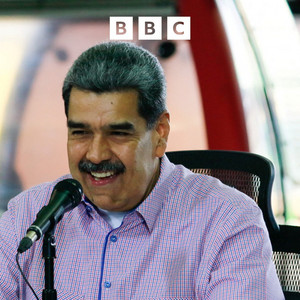
The US says it's captured the Venezuelan President, Nicolas Maduro, after launching airstrikes on Caracas and other cities.
Venezuela has declared a state of emergency and condemned the attack as a colonial war.
In the face of this brutal situation and in the face of this brutal attack.
We have no knowledge of the whereabouts of the president Nicolas Maduro.
We'll hear from Caracas and Washington and get reaction from our chief international correspondent, Lise Doucette.
He never has used the phrase regime change with Venezuela, casting it, as well as along with his top officials, as being a national security threat.
It is clear that this is regime change in all but name.
From the banana wars of the early 20th century to Cold War proxy battles, the US has a long history of military intervention in Latin America.
But not since the invasion of Panama nearly four decades ago has America unleashed the might of its armed forces in the region it considers its backyard.
That has all changed under President Trump, despite his vow not to get involved in foreign wars.
For months, he's been agitating for the overthrow of Venezuelan President Nicolas Maduro.
Since September, US forces have killed about 100 people on alleged drug boats in the region.
And at 2 o'clock this morning, local time, the American military launched a major attack on the Venezuelan capital, Caracas.
Footage posted on social media showed huge explosions across the city, while dozens of helicopters thought to be Chinooks and Apaches flew overhead.
Then, at around four in the morning in Florida, President Trump posted on Truth Social saying US forces had successfully carried out a large-scale strike on Venezuela and that the Venezuelan president, Nicolas Maduro, and his wife had been captured and flown out of the country.
Venezuela condemned the attack as a colonial war.
The defence minister said Venezuela's armed forces and people would fight to defend themselves.
The vice president, Delcy Rodríguez, had this message for the United States.
We demand our international rights be respected.
We condemn this brutal, savage aggression against our country that has taken the lives of military officials, who will now become martyrs of our country, and that have taken the lives of innocent civilian Venezuelans in all the different attack locations.
Ana Vanessa Herrero is a journalist in Caracas and she sent us this report.
I started hearing the planes around 2 am local time and I heard a huge sound, a loud bang that moved all the windows, not only in my place but around the area.
And immediately after I saw a huge cloud of smoke that almost blocked the entire view and a lot of detonations.
And immediately after, a lot of people started reporting from different parts of Caracas, of the capital of Caracas, the same things that I was witnessing there.
The same reports, the same explosions, the same sounds of planes and helicopters flying all over the city.
Now we do know that the government confirmed that this attack was not only in Caracas, but in Miranda and Aragua areas and also in La Guaira.
So Aragua and La Guaira are very important locations in Venezuela.
Military, they're very important for the military, of course.
But in La Guaira, it's where the port and the airport are.
And apparently...
There are reports of the port of Venezuela being absolutely destroyed.
There are several videos shared on social media that show a very popular street in La Guaira, in the port of Venezuela.
And you can see the devastation of the building of the port of La Guaira, absolutely destroyed, in the middle of the street.
I can confirm that that image corresponds to La Guaira, but I cannot confirm the extent of the devastation in the port of La Guaira.
Ana Vanessa Herrero in the Venezuelan capital, Caracas.
So what should we make of these extraordinary developments?
I asked our America's correspondent, Will Grant, who is currently in Washington.
It is really, genuinely nothing less than historic.
It is an extraordinary moment in US-Latin American relations, obviously in US-Venezuelan relations, but it has implications that go beyond the borders of Venezuela.
First and foremost and most immediately, the Colombian president has said that he is sending troops to the Colombian-Venezuelan border.
Let's not forget that there are left-wing armed groups, armed rebels, that still operate in Venezuelan soil and move back and forth through that porous border.
And he fears that they would become drawn into whichever conflict they further conflict that may take place in Venezuela.
There are also implications for Cuba, which is thoroughly dependent on Venezuelan crude oil, for its revolution to be continually propped up.
So it is a very, very unique situation in modern Latin America.
And, of course, we don't know where, quite simply, the rest of the conflict will go.
We know, of course, that Mr Maduro and his wife, that President Trump has said they are no longer on Venezuelan soil and that they are being brought to the United States, we believe, to face charges.
But we've only heard from the Venezuelan side noises of sort of digging in further, from the defense minister, from the vice president.
There's been a state of emergency, what they call a state of commotion has been declared.
And a message has gone out to all of the socialist allies within Venezuela, in militias and civil militias and grassroots organizations, as well as putting the military on a war footing.
So the picture for ordinary Venezuelans is deeply worrying.
How was this operation possible?
How were US troops able to fly in to Caracas, presumably, and capture the Venezuelan president?
Well, we can only speculate at this stage.
There is a press conference in Mar-a-Lago, President Trump's Florida residence, due in a few hours and hopefully we'll hear more information there.
But we speculate that there must have been, or we believe there may have been, some kind of inside information making its way directly to Washington insecure channels.
That may mean that somebody quite close in Mr Maduro's inner circle has turned on him.
That is the plausible explanation for how this could have unfolded quite so cleanly and quickly.
Marco Rubio apparently spoke to a senator in the United States and made those sorts of explanations.
It was Republican Senator, Mike Lee, who said that Marco Rubio, the Secretary of State, had told him that Nicolas Maduro has been arrested by US personnel to stand trial on criminal charges in the United States and that, as he put it, the kinetic action we saw tonight was was deployed to protect and defend those executing the arrest warrant.
And further down.
He added in a comment to that post on social media he anticipates no further action in Venezuela now that Maduro is in US custody.
Again, we are yet to get, as it were, more detail, the full story of these points being raised on social media by senators and by other members of the administration.
Scott, we do know the US has been massing military forces off Venezuela for months and threatening military action.
What more do we know about the sites that were targeted overnight?
Well, two of them are military installations inside Caracas.
The first is called La Carlota.
It's a military airstrip, very central, really, in Caracas.
You drive past it as you take one of the most important thoroughfares through the city, and it's just there.
The other is called Fuerte Tiuna.
That's the most important military base, one of the most important military bases in the country, certainly the most important in Caracas.
Very large, important military base.
We don't know what the damage, the full extent of the damage has been to those two sites.
We do know that power went out to both of them and to surrounding communities when those strikes took place.
You're in Washington.
What will Americans make of this after President Trump promised not to get involved in foreign wars?
Well, I think there'll be a mixed picture.
I mean, of course, the Venezuelan American, the Cuban American community, who are conservative.
The conservative part of those communities will be welcoming the idea of Nicolas Maduro being removed and his wife being brought to the United States to face charges.
However, if If the polling more broadly in the United States is anything to go by, only around 30 of voters seem to back the idea of US military action in Venezuela.
So President Trump has a lot of his constituency still to win over by the idea of this.
Now that polling was taken before there had been any military action and before it could be deemed, as it were, successful or painted as being successful by the Trump administration.
One will be interested to see exactly what the reaction is now that Nicolas Maduro has been removed.
And if the Trump administration can show that was done with no harm to civilian population or to US service personnel, then he will be able to more easily portray it as a victory.
Will Grants in Washington.
With the capture of Nicolas Maduro, attention will now turn to who will take over in Venezuela and what will be the role of opposition leader Maria Corina Machado, who has been living in hiding but who recently left Venezuela to receive her Nobel Peace Prize.
I spoke to our global affairs reporter Mimi Swaby.
The idea of one leader being removed and another stepping in is a deceptively simple question.
He has Mr Maduro, a very loyal circle around him, four key players, one of which is the vice president Del Ciro Rodriguez.
Another is the minister of internal affairs.
He's kind of the second in command here.
Now those individuals are already making public appearances, TV appearances, really galvanizing the idea that Venezuela will fight against any individual opposition coming in and taking power.
We understand that according to the Constitution, it will be the vice president who kind of fills that power vacuum.
However, we really are in uncharted waters and the opposition, who are heavily backed by the US, although they have said and made statements, no kind of comment about this operation.
They haven't been part of it.
They will be wanting to maximise and really take advantage of this situation, which is incredibly uncertain.
I think the idea that we'll know who will be the next leader of Venezuela is not going to be one which will be immediately answered.
This is probably... a question and an answer for days ahead.
Right now we're seeing police on the streets kind of cascading, anybody who's showing any idea of celebrations.
We know that there are armed militias, civilians who've been armed under the order of Nicolas Maduro, who are going to be looking for anybody celebrating and going against the state of commotion, meaning people have to stay indoors.
But the idea that the opposition are going to kind of swoop in and assume power of Venezuela is is one which is false.
This will be a long, long journey.
And that was our global affairs reporter Mimi Swaybe.
Colombia has expressed profound concern about the US raid and sent troops to the Colombia-Venezuela border, while Venezuela's allies, Russia and Cuba, have condemned the attack.
But Argentina's president welcomed the US intervention, posting on social media, liberty advances.
So how might others react?
Dr Christopher Sabatini is an expert on Latin America at the international think tank Chatham House.
It's going to be interesting.
So let's try to break this out a bit.
I think for European allies, many of whom had opposed Nicolás Maduro, had denounced the elections, this is still coming as somewhat of a surprise.
Some of it is a step too far.
I think many of them will welcome the fact that there could potentially be a democratic transition, will reemphasize the fact that Maduro was an illegitimate president in Venezuela.
But, of course, what comes next is really going to be the key because, as Everyone has been saying, including the Trump administration and this they get right this is a deeply criminal, corrupt regime.
So if there's going to be a regime change from within and some people are alleging right now that the vice president, Delcy Rodriguez, is somehow preparing to assume some sort of interim role that will not be palatable to many governments, even within the European Union.
So we'll have to see how this shakes out.
I think we'll see again denunciation of Nicolas Maduro, but some trepidation, concern even about US tactics to get there.
But in particular, what will happen in the next few days is going to determine how many governments will respond.
If it's, by some miracle, a successful operation that leads to a democratic transition and peace in Venezuela, then perhaps
The norm-violating actions of the Trump administration will be forgotten.
But if it suddenly turns south, I think we're going to see much more criticism.
For other governments within Latin America.
We are going to see from the left-leaning governments, such as in Mexico, Brazil and Colombia, severe denunciations of this intervention.
From the other governments that are closely aligned with the Donald Trump administration.
I think they'll remain quiet.
And the truth is is that Maduro remains a deeply unpopular figure across Latin America because of his transnational criminal ties and because of the massive wave of refugees that have left Venezuela more than eight million people and are placing severe difficulties on public not public safety, but public safety net programs, such as an education, health care and the like, among many of Venezuela's neighbors.
So they will welcome this change.
But the governments themselves, especially of the left, will feel a duty to denounce this as a violation of national sovereignty.
Christopher Sabatini of Chatham House.
When Donald Trump returned to the White House a year ago, he promised to be a president of peace, vowing not to start any new wars.
So what should we make of his attack on Venezuela, the biggest US intervention in Latin America for decades?
A question I put to our chief international correspondent, Lise Doucette.
It certainly does harken back to those decades which were described as gunboat diplomacy, where the US felt it had every right to meddle, often through the CIA, in toppling regimes, fomenting dissent.
And when President Trump entered the White House for a second term, as you've been mentioning, he was very clear that that era was over, that he would no longer, as he said in a major policy speech in Riyadh be intervening in countries where the United States had little understanding.
It would not be taking part in nation building.
He would be letting countries determine their own future.
A speech that received tremendous applause on his first foreign trip across the Gulf region.
Many capitals beyond also welcomed this new approach by President Trump, who had promised in his inauguration speech to be a unifier and a peacemaker.
Well, what has been happening this morning has certainly upended that and confirms what, as always with President Trump, you're never quite clear where he stands, because from one week to the next, and sometimes one day to the next, he seems to take wildly different approaches on key issues of our time.
And even though he never has used the phrase regime change, with Venezuela, casting it, as well as, along with his top officials, as being a national security threat, that President Maduro was an illegitimate president, it is clear that this is regime change in all but name.
Yeah now, according to comments attributed to the US Secretary of State, Marco Rubio, President Maduro will be put on trial on criminal charges.
I mean, that will be quite a sight.
All of the world's cameras will be on that if they are planning to make a show of this, to make an example of President Maduro on drug trafficking charges.
We heard from a U.S. senator.
He has confirmed that he is going to stand trial on criminal charges.
He said he received that information from the Secretary of State, Marco Rubio.
It is, of course, not the first time that the United States puts Latin American leaders accused of drug trafficking on trial.
And it's not escaped notice that a key Honduran official who had been in jail on drug trafficking job was recently pardoned by President Trump.
He wasn't a president, but he certainly was a key figure in the economy movement. of Honduras.
So contradictory moves by President Trump, who says it's all about fighting the scourge of drugs and narcotics which are entering the United States.
But I think this morning has really pulled back the curtain on this and that it is about something much deeper and indeed, in the eyes of many more dangerous.
Yeah, what next for Venezuela?
I mean, it's had years of authoritarian rulers, Nicolas Maduro and before him, Hugo Chavez.
We recently saw the Venezuelan opposition leader, Maria Corina Machado, winning the Nobel Peace Prize.
She had to flee Venezuela to get it.
We don't even know if she's gone back yet.
But where do you see things going from here? it's not simply removing one person.
President Trump has said that Nicolas Maduro and his wife are now on the way to the United States, as we've been reporting.
But he is part of a criminal network, which is well known right across the region and beyond.
What will they do?
How does the United States deal with them?
And will the United States deal with them?
We're again hearing from the U S Senator that he heard from Marco Rubio that there would be no more military action.
Uh, but it's the same as when you saw the toppling of Bashar al-Assad in Syria a year ago.
What about all the people around him?
Will they try to flee and where will they flee?
Will they also be put on trial in Venezuela or beyond?
This question, which seems deceptively simple, but we have seen time and again through history, is very, very complex.
Uh, and indeed fraught with peril is what next?
What about the day after?
And there are all too many memories, very bad memories, from what happened after the US-led intervention in Iraq, what happened in the US-led intervention in Afghanistan, that there was insufficient preparation for the day after.
And therefore, when you saw the Gaza war erupting in October, when President Joe Biden at the time flew to Tel Aviv, it was said at the time that already the US was saying to the Israelis learn from us, learn from our mistakes.
You have to start thinking about the day after.
We have seen that the United States has, month on month, intensified its military pressure on Venezuela.
But have they in secret been making plans?
We simply don't know.
But in the days to come, it will certainly become abundantly clear.
Our chief international correspondent, Lise Doucette.
And as we record this podcast, the US Attorney General, Pam Bondi, has said that the Venezuelan President, Nicolas Maduro, and his wife have been indicted in the Southern District of New York.
And that's all from this special podcast.
We'll have further updates in later editions of the Global News Podcast.
This edition was mixed by Gabriel O'Regan and produced by Daniel Mann, Ella Bicknell and Chas Geiger.
Our editor is Karen Martin.
I'm Oliver Conway.
Until next time, goodbye.