This BBC podcast is supported by ads outside the UK.
It's about what technology is actually doing to your work and your politics, your everyday life.
And all the bizarre ways people are using the internet.
Listen on BBC.com or wherever you get your podcasts.
This is the Global News Podcast from the BBC World Service.
I'm Pete Ross and it's 16 Hours GMT on Wednesday the 25th of February.
These are our main stories.
We'll take a closer look at Donald Trump's claim in his State of the Union address that America is in a golden age.
In Sudan.
Four leaders of the paramilitary Sudanese group, the Rapid Support Forces, have had sanctions imposed on them by the United Nations.
Police in Sri Lanka have arrested a former intelligence chief in connection with the deadly 2019 Easter Sunday bombings that killed nearly 280 people.
Also in this podcast, Japan says it will deploy missiles on a small but strategic island close to Taiwan, amid rising tensions with China.
And... If you're in a tall building looking out, it will help.
Or just somewhere over the sea.
All those things really help to find planets when they're low down in the sky.
A rare opportunity to see six planets lined up on Parade.
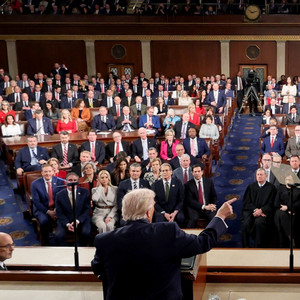
In our previous podcast, you heard about Donald Trump's historically long State of the Union speech, during which the US President told a sharply divided Congress that his administration had heralded, in his words, the Golden Age of America.
In nearly two hours of remarks, Mr Trump talked up his successes, railed against Democrats over the economy and immigration and warned Iran against developing its nuclear programme.
We'll have an assessment of the key points made by Mr Trump during his address in a moment.
But first, here's a reminder of the highlights of the speech from Helena Humphrey.
Mr Speaker, the President of the United States.
A primetime pitch to the nation from a president not known for his brevity.
True to form, Donald Trump delivered the longest State of the Union address in history.
As his approval ratings slide and concerns about affordability grow, the president insisted Americans have never had it so good.
Our nation is back, bigger, better, richer and stronger than ever before.
His greatest hits were on full display.
No tax on tips, doubling down on tariffs and and a promise to stay tough on immigration.
The only thing standing between Americans and a wide, open border right now is President Donald J Trump and our great Republican patriots in Congress.
Thank you.
The speech was often interrupted by cheers and chants of USA.
The Olympic gold medal winners in the U.S. men's hockey team received a standing ovation.
But at times, tensions spilled into the chamber.
You should be ashamed of yourself.
That is why I'm also asking you to end deadly sanctuary cities that protect the criminals.
Democratic Congresswoman Ilhan Omar shouted in protest during the president's remarks on immigration and the Somali community in her home city of Minneapolis.
Fellow Democratic lawmaker Al Green was escorted from the chamber.
He had waved a sign protesting a video the president had posted depicting the Obamas as apes.
Boy, oh boy.
We're lucky we have a country.
With people like this, Democrats are destroying our country.
And dozens of other Democrats had refused to show up in the first place.
We are in negotiations with them.
They want to make a deal, but we haven't.
But Donald Trump's speech was also aimed at an audience beyond the chamber.
With a military strike on the table.
The world watched closely for what the president had to say about Iran.
My preference is to solve this problem through diplomacy.
But one thing is certain I will never allow the world's number one sponsor of terror, which they are by far, to have a nuclear weapon.
Can't let that happen.
What was not said was notable too, including the Epstein files and growing calls for accountability here in Washington.
We did not hear the truth from our president.
Delivering the Democratic response.
Virginia's governor, Abigail Spanberger, accused the president of misleading Americans.
Is the president working to make life more affordable for you and your family?
We all know the answer is no.
The 250th anniversary of our glorious American independence.
In a speech marking nearly 250 years since America's founding, the president made his case that Republicans should shape its future.
As the country heads towards November's midterm elections, it's up to voters to decide.
We've seen nothing yet.
We're going to do better and better and better.
This is the golden age of America.
Helena Humphrey.
So what about some of the economic accomplishments asserted by President Trump?
I spoke to Ben Chu from BBC Verify.
He told us what stood out for him from the President's speech.
I think really the economy and the claims about the cost of living were the standout theme of this State of the Union, obviously with the midterms coming up and that being the top priority we know for American voters.
He really wanted to emphasise that a corner has been turned, that things are getting better and that people will be feeling it.
And can we have some specifics on the actual claims that he made?
Well, he made a claim that inflation in general is under control, but also actually the prices of things are coming down.
I think we're going to hear specific items which he singled out.
The price of eggs... is down 60 percent.
The cost of chicken butter fruit hotels automobiles, rent is lower today than when I took office by a lot.
And even beef, which was very high, is starting to come down significantly.
Let's hold on a little while.
We're getting it down.
So look, the price of eggs is a sort of iconic one, isn't it, in terms of the traditional shopping basket.
We think his number is a bit exaggerated there.
We're not quite sure over what period he's talking about.
They are down year on year eggs quite significantly.
That is true.
Beef is down very slightly month on month.
But the point is, these are specific things in the shopping basket.
If you look at the overall consumer price index, which is the main measure of inflation in the US, it's running at about 24.
So that's down from about 3% at the end of Joe Biden's term.
So it's true that the overall inflation rate has declined under him, but there's not been a radical shift.
Now, the economy was just one area that the president focused on last night.
Another area that he claimed success was immigration.
Can you tell us a bit more about that?
Yeah, he said that basically he had managed to cut off illegal immigration entirely.
I think we can hear exactly what he said.
After four years in which millions and millions of illegal aliens poured across our borders totally unvetted and unchecked, We now have the strongest and most secure border in American history by far.
In the past nine months, zero illegal aliens have been admitted to the United States.
So this claim needs a bit of context.
So he's talking about zero admitted, but that's not the same thing as zero illegal migrants crossing the border.
He's talking about them being enabled and permitted to stay while their claim is scrutinised by the courts.
Actually there have been about 6000 a month illegal migrants across that Mexican-US border crossing detected, rather than zero.
That's the appropriate figure to use.
But to be fair to the president and the White House, that is dramatically down on what it was under Joe Biden.
And sometimes under Joe Biden, it was more than 200,000 a month.
So it is radically down, not quite to zero.
Ben Chu.
On Iran, Donald Trump said that, while his preference would be to settle the issue through diplomacy, he won't allow Tehran to develop a nuclear weapon.
Our chief international correspondent, Lise de Sette, told us more.
It's a measure of President Trump's style of leadership.
Here it is, as we've been reporting, the longest ever State of the Union address, taking place at the very moment where there's the biggest US military buildup since the Iraq invasion of 2003.
And yet he leaves remarks on Iran to the very end and doesn't say that much.
And some of our viewers, our listeners, may remember that when George W Bush was preparing to go into Iraq, he traveled the country to make the case.
Okay, much of the case turned out to be incorrect, but he still felt the need to make the case to the people of America.
Two points on what he said.
He said, we haven't heard from them the words, we do not want nuclear weapons ever.
The foreign minister of Iran put up almost exactly those same words into a post he put on X as he was preparing to go to Geneva for another round of talks tomorrow.
The question is will Iran offer the kind of verification for that claim that they do not want ever to develop nuclear weapons?
And I understand from diplomats who are being briefed on these negotiations that they are within reach of a narrow nuclear deal.
Please dissent.
For more on this story, you can go on YouTube search for BBC News.
Click on the logo, then choose Podcasts and Global News Podcast.
There's a new story available every weekday.
The UN Security Council has imposed new sanctions on four leaders of Sudan's paramilitary rapid support forces over atrocities committed in al-Fasher in the western Darfur region.
Among them is the group's deputy commander, Abdulrahim Hamdan Dagalo.
The RSF's capture of the city from the army last October was one of the most brutal chapters in Sudan's nearly three-year civil war.
Last week, a UN fact-finding mission concluded that the violent takeover bore the hallmarks of genocide.
Our Africa correspondent, Barbara Plett-Usher, told me who'd been sanctioned and what they'd been accused of.
Well, all four of them have been accused of engaging in actions or policies that threaten the peace, security or stability of Darfur, including acts of violence and human rights abuses.
That's the UN language for why they are sanctioned.
The key figure is Abdurrahim Dagalo, who's the second in command of the RSF.
And they essentially say that he was in control of the operation, that there was video of him in the city the day that it fell on a day that there were many reported atrocities and that he was in charge of the operation.
Now, the fact that he was there obviously placed him in immediate proximity to those atrocities.
And so the conclusion was that he had operational authority.
Also, he's been in charge of other RSF operations.
Two other senior commanders who were present in Al-Fasher on the same day.
There was video of them there.
They were also sanctioned.
And then a commander known as Abu Luluh, who earned the nickname Butcher of al-Fasher because of the horrific videos that he posted, which showed him killing unarmed civilians, boasting about it, smiling as he did it.
That wasn't, of course, the only incidence of atrocities, but I think that the very graphic nature of those videos really highlighted to the international community what was going on in al-Fasher, and he has also been sanctioned.
And what are the practical consequences of these sanctions?
What happens next?
Well, there's travel bans and asset freezes.
That's the norm.
More generally, there's going to be increased scrutiny on financial transactions.
Long-term monitoring, access to services may be difficult internationally, and so on.
I think the reputational damage is another factor.
This is a very high-profile international stigma and especially, I think, for the RSF, which is trying to get legitimacy and recognition as a parallel government in Sudan, which set up last year as a national player with a legitimate seat at the table.
So this is not helping that project.
And bear in mind that this is the fourth time that Abdurrahim Dagalo has been sanctioned.
The leader of the RSF has been sanctioned, as has the head of the Sudanese army.
And these three commanders who were sanctioned have also been designated by the US and the UK.
So you're getting a kind of consistent pattern of targeting, you know, the same officials.
But whether or not that actually makes a difference.
I mean, as I said, this has happened before in terms of sanctions and it hasn't had an impact on the ground.
In Spain, dozens of documents relating to a failed coup d'etat that took place 45 years ago have been declassified.
In February 1981, about 200 officers in the Civil Guard stormed into Congress during a vote to swear in a new prime minister.
Then this happened.
Let's go!
Spain at that time was just a young democracy.
The military dictator Francisco Franco had died a few years earlier and the country was now a parliamentary democracy with King Juan Carlos as its constitutional figurehead.
But elements loyal to Franco weren't happy with the way the transition to democracy was going.
Many of the facts of this pivotal moment in Spanish history are known, but not all.
And earlier today the government released a bundle of classified documents relating to the failed coup.
Elma Saiz is a government spokesperson.
There are 153 documents that have remained classified for decades under Francoist regulations but can now be consulted by historians, researchers and the general public through official channels.
Under Franco's regime in our country, everything was secret by default and forever, unless otherwise stated.
We are thus putting an end to a situation that is atypical in modern democracies regarding the declassification of state information.
It's regarded as the defining moment in Spain's transition to democracy.
On 23 February 1981, a group of civil guards burst into Parliament and took MPs hostage at gunpoint for several hours, in an attempt to push the country back to authoritarianism.
The uprising was put down after the young King Juan Carlos addressed the nation, voicing his opposition to the rebels.
And the declassified documents include police and judicial reports and details of conversations between the king and officials.
The socialist-led administration says it's correcting an historical anomaly, it's not clear whether there will be any shocking revelations.
Perhaps the most interest will be focused on the former King Juan Carlos, who some observers believe did not play as heroic a role as the history books suggest.
Scientists say they fear thousands of emperor penguins may have died because the platforms of sea ice where they go to regrow their feathers are disappearing due to climate change.
Shrinking sea ice means they're re-entering the icy waters before their waterproof coats are ready.
Dr Peter Fretwell, from the British Antarctic Survey is the scientist behind the findings, know that over the last few years, the sea ice in antarctica has changed dramatically and in 2022 23, 24 we had record low sea ice years and in those years, in the areas that we've been looking at, which is about 30 to 40 percent of the emperor penguin population, the sea ice went out from underneath the malting emperor penguins, which possibly led to many of them going into water and many fatalities.
Our climate and science correspondent, Georgina Ranard, told us more.
In order to survive the cold, emperor penguins must remain on platforms of sea ice for long enough every year to replace weather-beaten feathers with new waterproof coats.
But global warming is rapidly changing Antarctica.
Satellite pictures show that, after summer sea ice shrank dramatically in 2022 and 23, there now appear to be far fewer penguins in West Antarctica.
Researchers at the British Antarctic Survey fear thousands of the birds may have died in the continent's icy waters, but there is some hope that a few groups manage to adapt and move to safer ice.
Still to come in this podcast.
We came round the corner and then we were confronted by a convoy of must have been ten vehicles loaded with cartel members, heavily armoured with automatics.
There were guns mounted on the roofs of the trucks and they blocked the road and they stopped us.
Cam is returning to the streets of Mexico after a wave of violence across the country sparked by the army's killing of the country's most wanted drug lord, known as El Mencho.
I've spent the last three decades trying to better understand money across the boardroom, the newsroom and the trading floor.
That's longer than most podcast hosts have been alive.
But even I've got questions.
Join me, Maren Subset-Webb, every week for my show Maren Talks Money from Bloomberg Podcasts, where I have in-depth conversations with fund managers, strategists and experts about how markets really work.
And join me for a separate episode where I answer listener questions on how to make those markets work for you.
Follow Merrin Talks Money on Apple Podcasts, Spotify, or wherever you listen.
Nearly seven years ago, terror attacks on churches and hotels in Sri Lanka saw nearly 280 people killed.
Now the police have arrested the former intelligence chief in connection with the deadly Easter Sunday bombings.
Retired Major General Suraj Saleh had previously been accused of involvement in coordinating the attacks, a charge he's denied.
Our correspondent in the region, Arunde Mukherjee, told me more.
Well, this was something that Sri Lanka was really jolted by.
The bombings shook the country.
It had not seen such levels of violence since the end of the bloody civil war in 2009, which is why it was extremely shocking where three very high-profile hotels, as well as other installations, were attacked and the blame had gone on Islamist groups.
And it was Easter Sunday, so it was a sensitive day as well, which is why it was a targeted attack is how a lot of people saw it.
So it was something that really really shook the country, which is why even now, so long after the attacks, people have been looking for justice.
And this arrest is the most high-profile arrest in the case since the new president, Anurag Kumar Desanayake, assumed office in 2024.
And Securing justice for the victims of those bombings was among his key pre-poll pledges, which is why this has been seen as a massive, major development.
A major development, but these bombings happened in 2019.
Can you tell us more about why this arrest has happened now?
This was something that had happened in 2019.
There was a lot of angst among the public and the families of the victims, who essentially claimed and made accusations that the government of the day was involved, which is why this became a political issue as well for the new government which took over in 2024, because there was political pressure to try and get to the bottom of what really happened, which is why this was an important pre-poll promise from Anurag Kumar Desanayake, who is the current president, that when he comes to power, he is going to get to the bottom of what really happened.
And this is being seen as a result of that investigation which, in a sense, has borne fruit under this new government.
This was something that the people at that time had blamed the establishment, which is why Major General Suresh Saleh's role becomes all the more significant, because the allegation was that he'd known about this attack that was going to take place and he allowed it to go ahead because the allegation was that he wanted it to influence the upcoming elections in favor of the candidate then Mr Gotube Rajapakse, and he actually went ahead and won the elections.
Now these are allegations that the general has denied completely, but it is an investigation that is currently undergoing and this is the first significant arrest.
Yonaguni is a small, remote Japanese island that's around 2,000 kilometres southwest of Tokyo.
But Japan's westernmost inhabited island is little more than 100 kilometres off the coast of Taiwan.
And now the Japanese government has for the first time given a timeline for the deployment of surface-to-air missiles.
There comes amid growing tension with China, which claims Taiwan as its own and has not ruled out the use of force to reunify it.
Our correspondent in Tokyo, Shauma Khalil, says the timing of this announcement was significant.
The plans themselves have been in place since 2022.
I think this is the first time that the government has announced a solid timeline for them, with the Defense Minister, Shinjiro Koizumi, saying that we're likely to see the deployment of these surface-to-air missiles soon, between April 2030 and March 2031.
Beijing will be watching this closely.
This is the latest development in a simmering regional tension between those two neighbors.
I think they'll be watching with alarm, with worry, but without much surprise.
Because remember that this comes under the heavy cloud of the sharp intentions between Tokyo and Beijing.
Because of the remarks by Prime Minister Sanai Takeuchi in November that Japan would become militarily involved if China were to attack Taiwan.
And in the same month, Shinjiro Koizumi visited Yonaguni, this beautiful, idyllic, sleepy island.
He visited there for the first time to announce that these plans were moving steadily forward.
And at the time, China slammed the proposal, saying it was extremely dangerous.
And within days of that, back in November, Japanese aircraft were scrambled near Yonaguni because of suspected Chinese drones.
You mentioned there, Shaima, that the Defence Minister had made a visit there recently.
But what about the role of the Prime Minister, Sane Takaichi?
She secured a landslide victory in parliamentary elections recently.
Has that had an impact on all of this, do you think?
I think what it does is it gives it a big push forward, because Sanae Takeuchi is a well-known China hawk.
She's very, very strong on defense.
And this landslide victory in parliament essentially gives her political space, gives her the impetus to double down on boosting Japan's defense capabilities.
And remember that in her announcement big policy announcement, a couple of weeks after this landslide victory where she won a big two-thirds majority one of the things that she discussed was to revise the pacifist constitution, essentially have a national discussion about the situation that Japan is in right now diplomatically, but also regionally.
Her and her party's stance is that Japan should be able to defend itself.
The Japanese army should be able to behave like a conventional army, which they don't at the moment.
So the planned deployment of medium-range surface-to-air missiles to Yonaguni feels like this opening chapter of a more assertive Tokyo led by Sanai Takayuchi.
What you're seeing really is...
Japan becoming more assertive on defense, come to fruition by bringing these plans forward, starting with Yonaguni, which is closest to Taiwan.
And that's what makes it so sensitive.
And that's why it's likely to anger China further.
Shaima Khalil in Tokyo.
Schoolchildren returned to classes in Mexico on Wednesday, following a wave of violence on Sunday that came in response to the army's killing of the country's most wanted drug lord, known as El Mencho.
Some of the worst violence took place in the popular tourist resort of Puerto Vallarta, from where Will Grant reports.
After moving to Puerto Vallarta from the UK nine years ago, Alan Percy and his family began adopting dogs.
Eventually they'd adopted so many, they opened a dog sanctuary called the Sula Society.
Today they care for 300 abandoned dogs in the largest animal refuge in Jalisco State.
It's all-consuming work.
But on Sunday, their task became even harder.
Alan was held up at gunpoint by masked cartel members, who pulled him from his vehicle and stole his truck.
Probably ten minutes into the journey, five minutes driving from my house, we came round the corner and then we were confronted by a convoy of must have been ten vehicles loaded with cartel members, heavily armoured with automatics.
There were guns mounted on the roofs of the trucks and they blocked the road and they stopped us.
I know enough Spanish that when they were saying solo coche, solo coche, that we were, they just wanted a car.
Alan must now rely on a loaned car to bring in food and supplies the rescued animals unwittingly affected by the violence which swept across Mexico following the death of the cartel boss El Menchón.
The cartel's show of force shook Puerto Vallarta, with videos of the violence still circulating on social media, including one in Puerto Vallarta where numerous cars in the parking lot of the Costco store were attacked.
I'm walking through the wreckage of a dozen cars around me which have been completely ruined, completely gutted.
It is an apocalyptic scene.
What was otherwise a quiet Sunday suddenly exploded into an extraordinary outpouring of cartel violence right before the eyes of the disbelieving residents and tourists.
But now the clean-up is well underway.
Puerto Vallarta's mayor, Luis Morgia, insists the town is getting back on its feet.
If we focus on tackling people's needs, strengthening institutions and showing our best face to the world, then we'll bring back trust to this town and be on the right path as a local government, he told me.
Are you worried that taking out El Mencho could then divide the cartel?
They start attacking each other and what happens here turns into a battle in the streets.
We have to make sure we don't make problems worse in a complex, intense moment, he said.
We must look out for our people, for the tourists who visit us.
That's what we need to do.
The fallout from El Mencho's death has knocked this tourist hotspot.
Now its leaders, residents and its visitors just hope the calm in this otherwise peaceful town isn't shattered again by armed men trying to sow fear.
Will Grant in Puerto Vallarta.
Now, depending on where you are, if you look up into the sky at night this week, you might be lucky enough to catch a glimpse of an unusual phenomenon.
Astronomers say that six of our solar system's planets will line up as if on parade later this week, although the first signs can be seen tonight.
Mercury Venus Neptune Saturn, Uranus and Jupiter will form a rare alignment and if the sky is clear, they can be watched early in the evening in the western sky.
While they're visible globally, the best views will be in the northern hemisphere.
Professor Robert Massey is Deputy Executive Director of the Royal Astronomical Society.
You're going to need to look for this almost immediately after sunset, but I should stress, not before sunset, because I don't want people damaging their eyes.
It's going to really help if you have a pair of binoculars as well.
Venus is very, very low down at that point, but also very bright.
So that might be a bit of a signpost.
Higher up from that is Mercury.
Quite a lot fainter, but you can pick it out that way.
Further up, Saturn.
Again, you know, tricky.
Probably be able to see it with your eye.
Near there is Neptune.
Definitely need a small telescope or binoculars for that.
And then, as you mentioned, higher up, Uranus.
Get an app of some kind to find it.
It'll be quite hard to find otherwise.
And then further around Jupiter, which is really standout and actually really great throughout the evening right now.
Also, the moon is near Jupiter too, so that's another thing to add to the spectacle.
To be honest with you, Venus is going to get a lot better over the next few months, or even the next few weeks.
Mercury is going to disappear.
It's going to be, think from memory, going in front of the sun right now.
Not exactly in front, but more or less in that direction.
Mars isn't around at all, but this is a nice chance just to see planets, and certainly venus very low down should be a standout thing, you know, if you sit there just at sunset and you've got.
I should also stress, you need obviously not just clear skies but a really really good horizon as well.
If due west over the sea would be my recommendation, i think get the best horizon you can.
Maybe if you're in a tall building looking out it will help, or or just somewhere over the sea.
All those things really help to find planets and when they're low down in the sky.
Professor Robert Massey of the Royal Astronomical Society.
And that's all from us for now.
If you want to get in touch, you can email us at globalpodcast at bbc.co.uk.
You can also find us on X at BBC World Service.
Use the hashtag Global News Pod.
And don't forget our sister podcast, The Global Story, which goes in-depth and beyond the headlines on one big story, available wherever you get your podcasts.
This edition of the Global News Podcast was mixed by Sarah Kimberly, and the producers were Ariane Kochi and Carla Conti.
The editor is Karen Martin.
I'm Pete Ross.
Until next time, goodbye.
I've spent the last three decades trying to better understand money across the boardroom, the newsroom and the trading floor.
That's longer than most podcast hosts have been alive.
But even I've got questions.
Join me, Maren Subset-Webb, every week for my show Maren Talks Money from Bloomberg Podcasts, where I have in-depth conversations with fund managers, strategists and experts about how markets really work.
And join me for a separate episode where I answer listener questions on how to make those markets work for you.
Follow Marin Talks Money on Apple Podcasts, Spotify, or wherever you listen.