The world is changing so quickly.
This is probably a little bit obvious, but you should just try things and, like every day, do something with AI.
Last summer, I took a weekend and used GPT-5 to help me build an iPhone app.
I hadn't done that in a decade.
So fast.
Yeah, it's so fast and so easy.
And that was an age ago.
That was like eight months ago.
Now it's even faster and easier.
Don't limit yourself.
Anything that you imagine, you should just try to use AI and see how far you can get with it.
And you'll be making the world better.
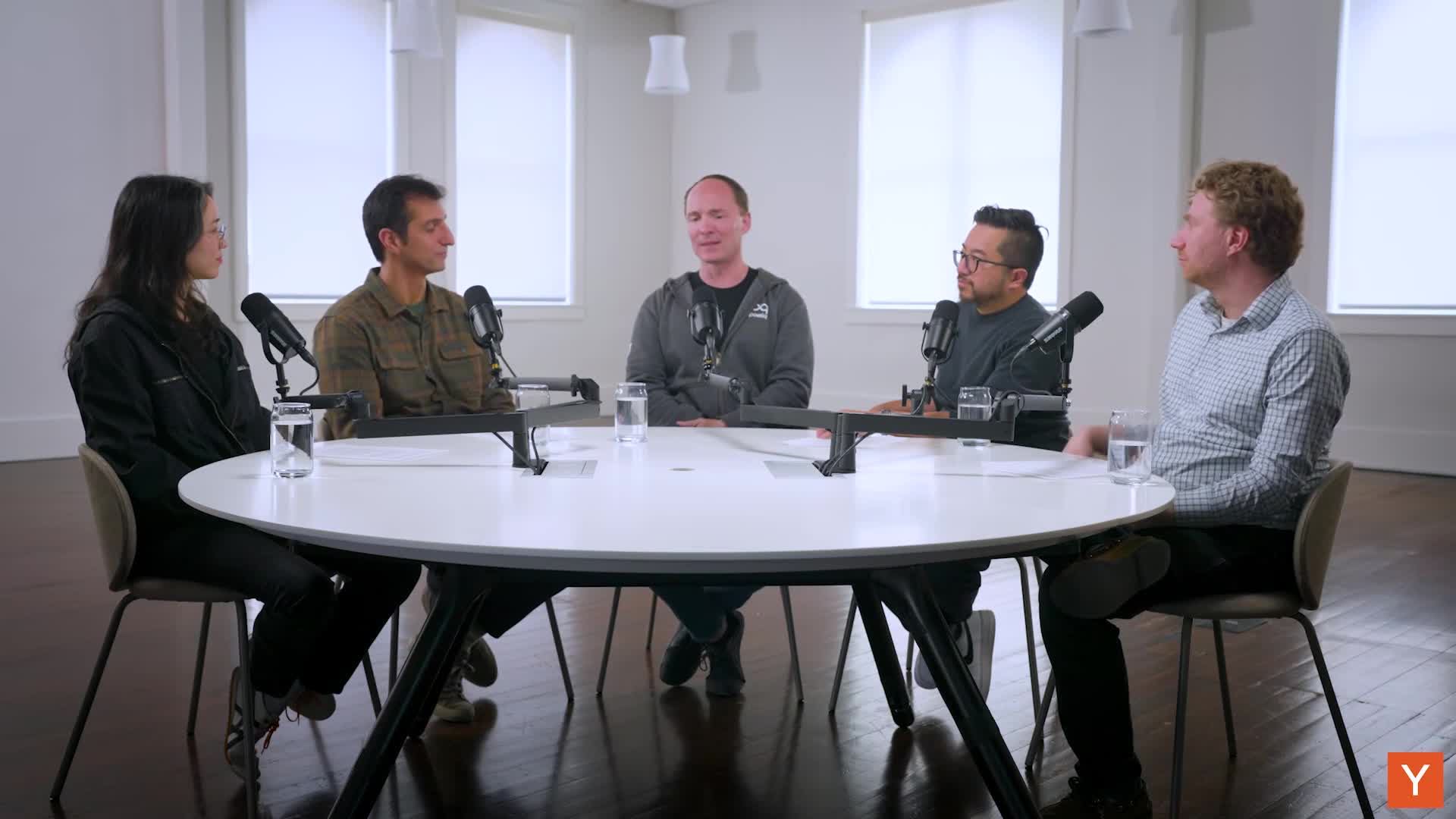
Welcome to another episode of The Light Cone.
Ian Fisher is the co-founder and co-CEO of Poetic, which is building recursively self-improving AI reasoning harnesses for LLMs.
Previously, he spent a decade as a researcher at Google DeepMind and founded a mobile dev tools company through YC years ago.
Welcome, Ian.
Thank you.
I'm so happy to be here.
What is Poetic?
How is it different than RL?
How is it different than context engineering?
At Poetic, what we're building is a recursively self-improving system.
And so recursive self-improvement.
Is this kind of the holy grail of AI, where the AI is making itself smarter?
The core insight that we had is that we could do recursive self-improvement far faster and cheaper than all of the other ways that people had been proposing to do this.
Obviously, I can't go into details about what that is, what our particular approach is.
Most of the approaches out there involve you know they require you to train a new LLM from scratch.
And training LLMs from scratch costs, you know, hundreds of millions of dollars and takes months of effort.
And then Anthropic or OpenAI will come along and just eat your lunch in the next model release.
Right, right.
And, of course, Anthropic and OpenAI and Google.
They're exploring recursive self-improvement, but typically at that level of having to train a new model for every step of self-improvement that they do.
I mean, that seems like actually the defining thing that a startup really, really wants.
I know that I want to take advantage of whatever the next model is, but the second.
You're in fine-tuning land.
I'm spending millions to hundreds of millions of dollars.
And then guess what?
I just lit it on fire because the next version of the frontier model comes out and I'll never catch up.
Whereas working with your systems means that I will always have the thing that is better than the thing that's out of box.
And that's sort of like the holy grail.
Yeah, we think that this is incredibly valuable to anybody who's building on top of large language models.
And we don't view the frontier models as competitors.
They're the ones that we're using the stilts, building stilts to stand on top of.
But if we didn't have that foundational layer, then Poetic couldn't exist.
Yeah.
I mean, being the smartest model, it's a game of inches actually.
And so those inches matter a lot.
Right, right.
How do we actually get started?
I mean you've built something that basically any startup could use.
That it's sort of like stilts really.
We have built a system that can automatically generate systems for your particular problem that will always outperform the underlying language models.
And without the massive expense.
As you're saying about the bitter lesson, what would you have done without Poetic?
You probably would have said OK, we're going to first collect a large data set like tens of thousands of examples for a particular problem that we're working on.
And we're going to fine tune the best model we can get our hands on.
Maybe that's one of the frontier models, or maybe it's an open weights model.
It doesn't particularly matter.
You're going to spend a lot of money on that fine tuning.
The compute is so expensive.
And then, at the end of it, you have something that works better than the thing that you fine tuned on top of.
But by then, a new model has come out, and it's better than the thing that you fine-tuned.
You fine-tuned three years ago on top of GPT-35 or whatever, and then GPT-4 comes out and it just blows you out of the water.
And so are you going to do that again, or are you going to go out of business?
And in some cases, the latter.
With Poetic.
What we end up giving you is a people are calling these things harnesses now, or an agentic system, or whatever you want to call it, that sits on top of one or more language models.
And it just performs better than them.
And when the new model comes out, that same harness is perfectly compatible with it.
And you don't need to change anything to get an even bigger performance bump.
Additionally, we can continue to optimize for this new model.
Whatever the new model is that you want to use, and make it even better.
But you don't lose out on hundreds of millions of dollars.
In fact, we do this so much more cheaply then fine-tuning would cost as well, and you've done this actually a bunch of times, right like I remember.
When you first came out with your paper in December of last year, you shot to the top of arc AGI v2, and then you've done this a bunch of times for other benchmarks to what you know.
What was that like?
RKGI v2 was us coming out of stealth, letting people know that we could tackle these really hard problems?
And, in particular, we wanted to show that our system could generate what we call our system, like the poetic meta system, can generate reasoning systems that are highly effective.
Gemini 3 DeepThink had just come out and they were really quite dramatically at the top of the leaderboard at 45.
And two days later we released our results where we were showing that we could get a lot higher than that.
So they come out with soda and then you come in right above them every single time.
Yeah, like wild to see.
Honestly, that's what it's like to have stilt.
You know, like whatever model comes out, you can be taller than that one with poetic, which is like that's so awesome Yeah.
So the interesting thing is that we were half the cost of Gemini 3 DeepThink because we were building on top of Gemini 3 Pro, which is a much cheaper model.
But we still got, in the end, a 9 percentage point improvement on the official verification.
So they were at 45% and like 70 something dollars and we were at 54% and $32 per problem.
So recently you guys just announced some incredible results for Humanity's last exam.
Can you tell us more about those?
Humanities last exam is a set of 2500 really, really hard questions written by experts in many different domains, or they're meant to be challenging even for PhDs in those fields.
AI hasn't passed it yet, but we got to 55, which is almost two percentage points higher than the previous state of the art which came out just last week from Anthropic with Cloud Opus 46.
They got 53.1% and we got 55% on it.
And one thing that a Humanity LS exam doesn't publish is the cost of getting those results.
In your case, this run was done with less than around six figure.
How much was it?
We didn't publish any cost for this, but I can say that the optimization costs us less than 100000.
Yeah,
Which is impressive, because each of these big foundation model train runs are in the hundreds of millions of dollars.
And you guys, as a company, you're only seven people?
That's right, yeah.
Seven research scientists and research engineers, yeah.
That's impressive.
And I think the thing that's very interesting about your approach is sort of taking a very scientific approach to the emergent behaviors that a lot of the best founders are doing with models.
I think a lot of founders that get very good results for agents.
They treat the underlying model as a common layer that you can switch in between and there's a certain task, for example for gpt 52.
Like very hard to verify bugs get sent to that versus architecture that gets sent to clot 46.
But you're kind of doing this automatically instead of having a human.
Conducting is very impressive.
I think there's something more special going on underneath.
Can you tell us a bit about how it works?
Yeah, it sounds magical.
So what can you tell us?
Right.
So you're getting at a really core thing.
These harnesses, they are code, prompts, data built on top of one or more language models.
This is something that, in principle, you can build by hand or with like Cloud Code or whatever.
But in practice It takes a lot of work to do these, to have all the insights to make these work well.
And so the core technology that we've developed at Poetic is recursive self-improvement.
So we have a recursively self-improving system, which we call the Poetic Metasystem.
The output of that system is systems that solve hard problems, where a hard problem is something that if you gave it to GPT-5-2, it would struggle to give you a reliable, robust result, just to use an example.
So this is a very big advantage for us.
We can generate these systems in a much more automated manner, which means that we can do it much more quickly and much more cheaply than if you hired a team yourself to try to make your own agent to solve your particular task.
But not only that, since this is really an automated optimization process.
If you already have done that work, you're a startup that's going after a particular vertical and you think you understand your problem pretty well.
You've put together your agent and maybe it's working pretty well.
But you know you can get something better or you really need something better.
Then you can bring that to us and we can optimize that entire agent or pieces of that agent.
We could optimize just the prompts, just the reasoning strategies.
There's a lot of different things that we can do depending on your particular needs.
It sounds like this is a complete different paradigm than RL, because we went through the S-curve of regular pre-training RL when OpenAI released 01 and now this feels like a new one.
It sounds special.
It rhymes a lot with RNNs, which is a whole different paradigm than RL, right?
It's going to depend on the particular task, the particular type of problem that we're going after, that we're trying to solve, and the underlying models that we're working with.
But effectively you could say, each model or each set of models that we're working with will have their own S-curve.
The poetic metasystem itself is also going to have its own S-curve.
And so as the poetic metasystem gets better and as the underlying models get better, you'll find that the S-curve that you're dealing with keeps shifting higher and higher until ultimately, either you saturate or like Reach AGI.
Yeah, reach AGI, reach super intelligences, yeah.
Given its stilts, you might like hit the ceiling first then.
That's the goal, right?
Yeah.
You want to hit the ceiling first with Poetic.
I think, a lot of startups that we work with and then in my spare time I do a bunch of context engineering.
And then the thing is we're sort of like tuning it tuning evals tuning, like we're context stuffing ourselves.
What does that even feel like to have a, you know, recursively self-improving version of like prompt engineering, context engineering?
We don't spend a lot of time looking at the particular data that we're working with.
Instead, we're letting the poetic metasystem look at that data.
And so the metasystem, if it thinks that it needs to put more things into context, do more context stuffing or whatever.
It'll do that.
If it needs to generate a bunch of examples to get better performance, it'll do that for you, right?
It was pretty interesting to look at the prompt outputs, in particular, I'd say, for Arc AGI, in that, you know, I think you can read those and say well, that's not what a human would have written pretty clearly.
And there's some unexpected stuff.
And it made some really simple examples.
And one of the examples is actually wrong.
But we didn't change it.
We were like, well, this is the thing that output will just leave it be.
We don't want to go in and monkey around with things.
And so historically, in machine learning, the rule was you have to know your data set really well.
But now we're kind of outsourcing that to the AI itself, where the AI is the AI's job to understand the data set and figure out where are the failure modes and where are the kind of robust reasoning strategies that the model that that the agent could use to get better performance.
The output is much better prompts, and then how much of it is like the harness itself context stuffing, or summarizing in the right way, or re-ranking in the right way so that, like You, have some number of like mega LLM calls.
And how do you get the most out of each of those calls?
Yeah.
And so that definitely varies per problem.
But what we've seen in fact, our last paper at DeepMind was not doing this recursive, self-improving stuff, but we were um, we were showing that you could build these harnesses manually to solve really hard problems and what we saw is there is that uh, you know, we manually optimized the prompts really hard for these very hard problems and that got us a little bit of the way.
Uh, in this particular case, you know, the hardest, the hardest task we were working on, we got like to 5 performance with Gemini 15 Flash.
This was a while ago.
And then when we added on the reasoning strategies, we went from 5% to 95%.
Oh my God.
And so this is typically what we see.
Everybody's out there kind of doing some amount.
I wouldn't say everybody, but many people are out there kind of doing some amount of automated, prompt optimization.
JEPA is this very popular paper.
Everybody's kind of re-implementing that.
That will get you some performance improvements.
But it's very far from everything that you can get if you actually think about these reasoning strategies that are really going to be written in code rather than in just better prompts.
So if startups want to use Poetic to put their agent on stilts, what should they do?
Yeah, so right now, we haven't released anything yet.
But if you go to poetic.ai, there is a button you can click to sign up for early access.
And if you're a startup or a company who has a really hard problem and you've tried everything that you can to make it reliable and robust and you just can't get all the way there, you need something more, then let us know.
We're looking for problems like that.
So just tell us what it is that you're working on and we'll reach out.
You'll be the first to know when we're ready to work with you.
I mean, if you're at the top of humanities last exam, then, I mean, that's pretty big.
So you're already all the way out there at soda.
And then I guess the stilts basically let any agentic company become soda.
That's the idea.
Yeah, yeah.
And we view the ArcAGI results and the humanities last exam results as showing kind of two different capabilities that we have.
We can really improve your reasoning and we can really improve deep knowledge extraction from these models.
And then you're just totally vaccinated against the bitter lesson.
Exactly.
Yc's next batch is now taking applications.
Got a startup in you?
Apply at ycombinatorcom.
Apply, it's never too early and filling out the app will level up your idea.
Okay, back to the video.
A slight change of topic.
But something I was curious about is you arrived at Google over a decade ago when they acquired your first YC startup Apportable.
Apportable was porting mobile apps cross-platform, Android or whatever.
It's quite different to recursive self-improving AGI.
How did you make that leap?
What happened once you got to Google?
What made you think that you maybe wanted to shift out and do something different?
And just would love to hear that story.
The acquisition was this amazing opportunity to reflect on what I really wanted to be doing next right.
Like Google was, you know, itself is a place where you can do so many different things.
So I spent some time thinking about where I wanted to go next in my journey.
I realized that the problems that I was most excited about were really actually AI and robotics.
And the best people in the world, many of them in those fields were at Google at the time.
And so I went and talked to them.
They let me come join a new AI robotics team in Google Research, which was this amazing opportunity for me, since that wasn't my background.
My background was like computer security and then this cross-platform mobile, you know systems building stuff.
I was able to join this team.
And I'll tell you the truth that I very quickly realized that hardware is hard.
And I didn't really want to be doing robotics.
It was more aspirational at that moment.
But I was really... passionate about machine learning.
So I just made a very hard switch into just doing machine learning research and did that for about a decade at Google, and then Google and then DeepMind.
What's maybe some advice that you have today for engineers who want to get into sort of more of the AI side probably the applied AI and build startups around AI.
Like how should they think about that?
The world is changing so quickly.
This is probably a little bit obvious, but you should just try things and every day do something with AI.
Always try to push yourself to find the boundaries of what they're capable of and build the things that you want to build.
Even for me, last summer, I took a weekend and used GPT-5 to help me build an iPhone app.
I hadn't done that in a decade.
It's amazing.
So fast.
Yeah, it's so fast and so easy.
An age ago, that was like eight months ago.
Now it's even faster and easier.
Don't limit yourself.
Anything that you imagine, you should just try to use AI and see how far you can get with it.
And you'll be making the world better.
That's all we have time for today.
But Ian, thank you so much for giving us all stilts.
We can't wait to use it at YC.
I can't wait to use it for Gary's list.
I mean, there's just so much to do.
Yeah, thank you for having me.
This was a lot of fun.