This is the Global News Podcast from the BBC World Service.
I'm Alex Ritson, and at 16 Hours GMT on Tuesday 16th December, these are our main stories.
It's emerged that the gunman who carried out the deadly Bondi beach attack in Australia spent most of last month in the Philippines.
Days after capturing the Congolese city of Uvira, M23 rebels say they will withdraw.
And the World Food Programme says 17 million people in Afghanistan are facing acute hunger.
Also in this podcast, Ukraine's President Zelensky speaks to the Dutch parliament as peace talks on the war with Russia take place in Berlin.
Russia behaves like a career criminal who's convinced he will never be caught.
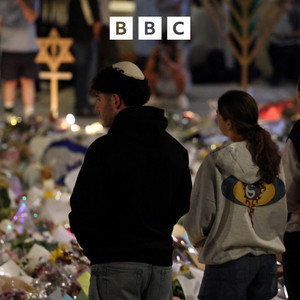
Tears, flowers and silent reflection on Bondi Beach and prayers.
Two days after the gun attack that killed 15 people at a Jewish Hanukkah party, more details have been emerging about the gunman.
Australian police are investigating a trip taken by Sajid Akram and his son Navid to the Philippines before Sunday's deadly shooting.
Authorities say homemade Islamic State Group flags and improvised explosive devices, or IEDs, have been found in a vehicle used by the pair.
Meanwhile in Sydney, mourners have been coming to a vigil near the site of the attack to lay flowers and remember the victims.
They include a 10-year-old girl and a Holocaust survivor.
These people explained why they were there.
We pray that those who are in power do the appropriate things to ensure that justice is sought and that everyone is free in Australia to practice their religion and go about their life in a free way.
There were significant people in our community who meant a lot and they were huge figures.
There's no one in the community who isn't still stunned, and I think the best thing that a lot of us have discussed today is that we are shocked, but not entirely surprised.
The BBC's Katie Silver gave us this update from Bondi Beach.
You might be able to hear behind me at the moment, there is a group that are still here.
They are engaged in singing.
Earlier, they were praying together.
It really is very powerful down here.
It was only a short time ago we saw a 90-minute service was held in commemoration of those that lost their lives.
We heard the people's names being said out loud, and when one of the names was said out Edith Burtman we heard a wailing through the crowd.
There's also a smoking ceremony, an indigenous smoking ceremony.
We also heard as well from an Anglican pastor who all signs and symbols of the solidarity between the various religions here down in Bondi to support the Jewish community that has been absolutely rocked through this.
Now, we also have just recently had an update as well.
We now understand there are 22 victims currently in hospital, nine in a critical condition.
Here.
As I say, it was only a couple of hours ago that we have seen the conclusion of the ceremony this evening and we are expecting people to continue to gather here.
One of the major issues that they're looking at at the moment is that of their trip to the Philippines.
The pair went the father and son duo, it's understood went to the Philippines in early November.
We have also reached out to authorities in the Philippines, who have confirmed that they flew there, the father on an Indian passport, the son on an Australian passport.
The question now is what did they engage in in the Philippines?
They were there the best part of three weeks, according to the Philippines authorities, flying out on 28 November.
So that is part of the inquiries now.
Many local media here alleging that they were there for military training.
Now to Berlin, where peace talks continue, all with the aim of ending the Russia-Ukraine war.
The US has offered Ukraine what it calls NATO-like security guarantees to safeguard an eventual ceasefire.
The Ukrainian president, Volodymyr Zelensky, spoke to the Dutch parliament in The Hague.
Every single detail matters.
Why?
Because not a single detail must become a reward for Russia's aggression.
If the aggressor receives a reward, he starts to believe that war pays off.
It is progress for Ukraine in that you have the senior US envoy, Steve Witkoff, now appearing happy to pose in photos of Volodymyr Zelensky.
You know, he is claimed to be handling these negotiations in an even-handed manner.
But the fact is he's visited Moscow six times.
And until now, Ukrainian delegations have had to travel to Ukraine.
Florida for discussions on the future of their own country.
So it is clear, and what reports are suggesting is that America is still trying to pressure Ukraine to give up territory.
And Zelensky is still saying he won't budge.
And then we're talking about security guarantees.
Ukraine is now saying explicitly, we'll give up our NATO ambitions.
And yet they talk about a NATO-like deterrent, some kind of military deterrent. presence.
It's very hard to see Russia going for that.
It said previously that it won't.
And so if you're not going to have US troops on Ukrainian soil, then you can imagine Zelensky will perhaps seek to get guarantees on the improvement, the continued improvement, of his own military to prevent Russia launching an invasion after the fighting pauses.
But, you know, for Kiev, It is keeping America engaged.
But as for progress, no matter how much positive spin or deadline Donald Trump imposes on things, we don't seem to be moving still.
Yeah, the wording's interesting, isn't it?
NATO-like security guarantees.
What does that mean?
In essence, it's the idea that Ukraine's allies, if Ukraine was attacked again, would come to its aid.
What Ukraine wants is our foreign boots on the ground.
They want a multinational force, which has been pledged by certainly European allies, but there has yet been any kind of strategic clarity as to what that means.
What he really wants is continued American involvement.
He wants America to share its intelligence.
It's a investigated long range missiles and to dangle the threat that it would directly intervene if Vladimir Putin replenished and had another go down the line.
But clearly, and has been the case throughout, the US has been very reluctant to do that.
James Waterhouse.
Meanwhile, the head of Ukraine's largest energy provider says his company is living in permanent crisis mode as Russia continues its attacks on the energy grid.
Most of the country regularly suffers lengthy power cuts as winter temperatures fall below zero.
Maxim Timchenko, the head of DTEK, which provides power for more than five million Ukrainians, told the BBC's defence correspondent, Jonathan Beale, the intensity of Russian attacks means it's proving very hard to recover.
Russians started so massive and intense attacks on every power station we operate.
Then we just don't have time to recover.
Waves of attacks by drones, cruise and ballistic missiles, all types of weapons, especially for the power station close to military front line.
More recently, has it become more intense?
Yeah, absolutely.
It become more intense.
You can imagine that at one of our power stations, five ballistic missiles landed.
So we have never experienced such an attack.
How often are they targeting your power plants?
Recently, for the last weeks, every third, fourth day.
And are you able to repair those facilities?
Of course we do our best, but we cannot repair it 100%.
It's just impossible.
What do you think the Russians' goal here is?
They want to break the spirit of the Ukrainian people, bring more suffering to our people, more fear to our people.
Can you carry on?
Do we have any choice?
So if you ask, either you want to lose your motherland or you want to stay and fight.
And of course, most of the people say, yes, we are staying and fighting.
Mother with kids going to bomb shelter every second night.
They're also fighting because they're staying in Ukraine and they're supporting their husbands on the front line.
And I understand that every night we have air raid and it's better to go to bomb shelter.
So it's the same for me and for all my colleagues at the company.
So we have full responsibility for this mother and millions of mothers, so that they have power and heat.
We need peace and security guarantees so that we can recover our country.
We can bring more companies, more investors.
We can rebuild energy sector.
We can rebuild Ukraine.
You grew up in Donetsk.
So are you prepared to, when Russia says it wants the whole of the Donbass region, what do you say?
What Russians brought to Donetsk, they brought destruction, pain.
In my opinion, there is no future for Donetsk under Russian occupation.
Maxim Timoshenko from Ukraine's DTEK power company.
President Trump has filed a multi-billion dollar lawsuit for defamation against the BBC.
It concerns a documentary that spliced together two separate parts of a speech he gave on the 6th of January 2021.
The edit gave the mistaken impression that it made a direct call for violent action before rioters attacked the US Capitol.
The BBC has already apologised to Mr Trump, but has rejected his demand for compensation, reiterating its intention to contest the claim.
Our British Affairs correspondent Rob Watson told us more.
It is a vast amount of money.
I mean, we're talking $5 billion as the claim, and the BBC's annual revenue is about $7.9 billion.
So it is absolutely astronomical.
What the BBC has said so far Alex, is that it will defend the suit.
Now What's not clear to me is whether that actually means that the BBC is saying see you in court, or whether that still includes the possibility of some kind of legal arrangement, some kind of deal between the Trump administration, or President Trump personally, and the BBC.
And Mr Trump has chosen to launch this in a Florida court.
And yet the BBC, of course, is based in the UK.
Yes, but you couldn't sue the BBC in the UK because it's more than a year since the programme went out and Britain's libel laws and indeed the libel laws, defamation laws in most of the US mean that you have to file within a year of a programme going out.
But in Florida, they allow it up to two years, so that's why Florida has been chosen.
What's the BBC's legal defence likely to be?
So we already know what the BBC's legal defence is, because they said it when President Trump first threatened the lawsuit.
And it is essentially four elements.
One is you're covered by freedom of speech.
Number two, that there was no malicious intent.
Number three, that there was no harm done to President Trump's reputation.
In other words, his central claim of damages for defamation just wouldn't hold up.
And then four, that the programme wasn't broadcast in the US.
It wasn't aired online.
And while Trump's lawyers have said that You could possibly have accessed the BBC programme if you had a VPN, one of those virtual private network things.
The BBC says, come on, if you look at it, not many people could have seen it.
And in any case, President Trump was elected.
Comes at about time for the BBC, though.
Not a great time.
I mean, the government has just published a paper looking at the future of the BBC, what its role should be, how it's funded.
And I think the good news for the BBC is that the government is immensely concerned, enthusiastic about the BBC and keen that it should be properly funded and continue to play a central role nationally and internationally.
But of course the idea that the BBC might have to hand over taxpayers money people who pay to watch the BBC here in the UK to a man who's immensely unpopular in the United States is a horrible, horrible thing for the BBC to have to contemplate.
And it's been widely suggested that this could have a pretty chilling effect on anyone else who wants to run articles about Donald Trump.
Yes, and that, of course, is why there are plenty of people, including sort of senior ex-BBC managers, saying you know the BBC should see you in court.
You know we don't think.
Yes, we made a mistake with the edit, but we don't think there was defamation.
So, yeah, see you in court.
Rob Watson.
And for more on this story.
You can go to YouTube, search for BBC News, click on the logo and then choose Podcasts and Global News Podcast.
There's a news story available in vision.
You can see us every weekday.
17 million people are facing acute hunger in Afghanistan this winter.
That's the dire warning from the UN's World Food Programme.
Childhood malnutrition is of particular concern.
Our global affairs reporter, Anbarasan Etirajan, told me more about the report.
The World Food Programme says this is the first time in decades they were not able to launch a significant winter response in Afghanistan.
Since 2021, the country is under Taliban rule, where the economy has weakened.
The job opportunities are few.
And in addition to that, the UN agency says that more than 25 million people Afghans were forced out of Iran and Pakistan.
So that basically increased the number by 3 million who are depending on this food aid by UN agencies.
And that is why it has issued a severe warning.
It's not only about the 17 million people, particularly children facing malnutrition.
And in winter, there are fewer job opportunities.
Your demand for basic amenities are more.
And what the UN agency says is that they are not getting enough funds to meet the target or meet the needs of the Afghan people.
Yeah, because organizations like the World Food Programme have been hit by huge budget cuts.
They are, like many other agencies, and in fact what people call as donor fatigue.
You have so many crises around the world, like in Gaza, the Rohingya crisis, and also in Ukraine.
So there is a demand for more international money and also big powers like the US, the UK and Germany.
They've also cut down substantially on development aid.
That is having a huge impact.
For example, the World Food Programme talks about requirement of 468 million, whereas for this year's budget they've got only 12 to 15.
So that means they are releasing some emergency funds.
So at the year end, they usually warn about the shortages, and that's why they need more money.
It is also appealing to the international community.
It is time to step up.
So that, in fact, out of 42 million people in Afghanistan, nearly 17 million people are facing acute hunger.
They have been depending on UN aid for food.
And that is why this warning has come and the request and appeal has also come.
Taliban, of course, are in charge of the country.
Are they planning to do anything?
Well, the Taliban they have been talking about.
You know, the Western countries have frozen funds from the previous government.
But in reality, how much they control the economy, how much in terms of providing aid to people.
They've already barred women and girls from most workplaces, educational institutions, and the economy has not grown really well.
They also have border disputes with Pakistan.
So the Taliban in reality?
How much they control in terms of economy and addressing the needs of the people is a big question.
Coming up in this podcast... I never saw this man before.
They forced me into their car and just took me away from the street.
We hear about the trade in kidnapping brides in Kazakhstan.
The US military says it's carried out more strikes on boats it has accused of trafficking drugs in the Pacific Ocean.
This time, three ships were hit, eight people are reported to have been killed.
Donald Trump has ordered attacks on more than 20 vessels at different locations connected to smuggling in recent months, killing dozens.
Our reporter Mimi Swaby told me more about the latest strike.
So according to the US military, they say their intelligence services had confirmed that these three boats in the eastern Pacific were carrying narcotics.
But just like all the previous strikes we've seen more than 20 now they didn't provide any evidence of this.
Only a video of the explosions posted online on X. And this is now the latest attack.
Since September, we've seen more than 90 people killed in strikes in both the Caribbean and also now the East Pacific.
Now the East Pacific is more of a common trade route for drugs traveling from South America to the US.
And we're seeing increasingly strikes happening there as well.
Why is Donald Trump seemingly scaling up these strikes in recent weeks?
So these attacks are part of what the Trump administration has described as an armed conflict against drug cartels.
It has designated as terrorist organizations and it's part of its combating drug trafficking in the region.
But it does come at a time we're seeing a very large military buildup in the South Caribbean Sea, with several vessels, including the world's largest warship, alongside thousands about 15000 soldiers, all kind of sitting just off the Venezuelan coast.
And this is heaping pressure on the government of Nicolas Maduro, who the Trump administration accused of heading Cartel de los Soles, which again, they say fuels violence drugs from Venezuela into the US.
It's also argued that Colombia has failed to crack down on drug trafficking.
Now, both countries, Venezuela and Colombia, have criticised these strikes immensely.
The UN has also called them extrajudicial killings.
And the Venezuelan government say that this is just a guise, this you isn't actually the aim of this huge operation, but the Trump administration is actually seeking regime change, as well as trying to access Venezuela's very large oil reserves.
Yeah, briefly, as you say, there are real concerns about the legality of these strikes.
Indeed, this campaign is increasingly controversial.
Both coastlines, fishing communities are terrified they'll be targeted while at work.
But in Washington Democrats and now some Republicans are arguing these strikes are illegal and are demanding evidence.
There's been even more scrutiny after reports emerged that a shipwreck dating back to early September, when these strikes first started, occurred.
There were survivors after the initial strike and a follow up strike was conducted, killing the survivors on board.
Now, many critics saying this basically constitutes a war crime.
So, yeah, there is a lot of criticism surrounding this campaign.
Mimi Swaby.
The M23 rebel group, which is fighting government forces in the Democratic Republic of Congo, says it's agreed to withdraw from the key city of Uvira in South Kivu province.
The M23 seized the city last week, just days after the Congolese and Rwandan governments signed a peace deal in Washington.
The newsroom's Richard Hamilton reports.
When the peace deal was signed on the 10th of December, President Trump hailed it as a great day for Africa, a great day for the world.
But those words seemed premature because fighting continued and just three days later the M23 said it had taken control of Uvira.
Now it seems that under pressure from the US, the group is backing down and will withdraw.
Uvira lies near the border with Burundi and is of strategic importance because of the presence of at least 10000 Burundian troops in South Kivu, who've been supporting the Congolese government.
Analysts say Uvira is therefore Burundi's gateway into eastern DR Congo to send troops and supplies.
It's also important from a humanitarian point of view, as hundreds of people had already sought refuge in Uvira, such as this woman, Bernadette Chalulo.
We fled our village because of the bombs, because there were more of them than bullets.
As we fled, we saw dead people, others who had lost their feet or hands.
Some had their legs cut off all along the road until we arrived here.
The United Nations Children's Agency UNICEF, says that since the beginning of this month, more than 500000 people have been displaced in South Kivu because of the intense fighting.
More than 100,000 of these are children.
It said it was gravely concerned for their safety, as serious violations had been reported, including killings of students and attacks on at least seven schools, with classrooms damaged or destroyed.
A law has come into force in Kazakhstan making it illegal to force women into marriage, including by kidnapping them.
Human rights activists say that thousands of women are coerced into marriage each year, some of them by total strangers, although exact figures are hard to judge.
Monica Whitlock has been to Kazakhstan to meet some of the women.
They stole me in my own village.
I was 19, almost 20.
And I was going to the shop, and after the shop I was going to my relative.
So I've noticed the car going around without plate, without any numbers, on the way to my relative, i realized that this car was following me.
It was the place where there were no houses and no one was around nobody.
So that was the place where they snatched me.
I never saw this man before they forced me into the car and just took me away from the street.
Dinara was a student visiting relatives in southern Kazakhstan when she was kidnapped in broad daylight in 2019.
She's in her mid-twenties now with two lively toddlers and a baby, all girls.
Her kidnapper and his friends drove her to his home, where his whole family was ready waiting.
First of all, they told me to change my clothes, all of it.
They gave me robes with leggings and the headscarf and underwear.
And for some time I was refusing to change my clothes.
But then at the end I did it.
I changed my clothes.
The headscarf was a symbol of possession by the man and his family.
It meant that Dinara was as good as married.
To leave, she says, would have brought shame on her and her family.
It must have been a just terrible shock.
I was crying.
I was in shock.
I was terrified.
I still have this trauma inside of me.
But at the end, I've decided to stay because of this shame.
Khalida Azhigulova is a lawyer in Kazakhstan.
She's been instrumental in pushing the new law through parliament.
So this is a very progressive law.
Human rights lawyers and human rights activists in Kazakhstan.
They have been advocating and fighting for criminalization of this violation of human rights for more than 20 years.
We're not just talking about the actions of a lone individual man, are we?
We're talking about a whole community of relationships.
Forced marriage.
It includes punishment for any person, including the parents and relatives of a girl or a woman, who force her to get married.
And also forced marriage includes the family of a kidnapper.
They are forcing her to agree to this kidnapping, to agree to her fate, to agree to marry her kidnapper.
And in my view, they're equally responsible.
They're equally liable, criminally liable.
And because they act not as a family but as a gang, as a criminal gang, and they all should be punished, in my view.
According to the Ministry of the Interior, seven cases are already underway in different parts of Kazakhstan and 15 people have been detained for investigation.
Under the new law, the minimum penalty for kidnap will be two years, with a maximum of 10.
I think we reached that boiling point, you know, when people started demanding that's enough, that's enough, we cannot tolerate it any longer.
Kalida Azigulova, ending that report by Monica Whitlock.
A French industrial tribunal has ordered the Parisian football club PSG to pay more than 70 million to its former star, Kylian Mbappe, who's now at Real Madrid.
The two angrily parted company in 2024 and were engaged in a bitter legal battle against each other.
Hugh Schofield reports from Paris.
The Labour Tribunal is more used to settling complaints for unfair dismissal from shop assistants and office staff, but this is an affair in which phantasmagorical sums of money have been at stake.
Kylian Mbappe, who left the club in such bitter circumstances in June 2024, wanted €260 million, 306 million from PSG.
PSG countersued for €440 million, $518 million.
In the end, the tribunal has found for Mbappe, but awarded him a smaller sum than what his lawyers were demanding.
Essentially, the 60 million euros or 71 million dollars amount to the salary and bonuses that he says PSG failed to pay him at the end of his time there, when the club was furious at his refusal to extend his contract.
And finally, today is the 250th anniversary of the birth of one of Britain's greatest novelists, Jane Austen, a moment of celebration that's been marked across the world.
We thought, what better way to honour the author than to hear some of her prose?
The actress Juliet Stevenson, the voice of many Austen audiobooks, sent us this reading from Pride and Prejudice, where Mrs Bennet learns that her daughter Elizabeth has just rejected a marriage proposal from the obsequious Mr Collins.
Mrs Bennet rang the bell and Miss Elizabeth was summoned to the library.
Come here, child, cried her father as she appeared.
I have sent for you on an affair of importance.
I understand that Mr Collins has made you an offer of marriage.
Is it true?
Elizabeth replied that it was.
Very well.
And this offer of marriage you have refused?
I have, sir.
Very well.
We now come to the point.
Your mother insists upon your accepting it.
Is it not so, Mrs. Bennet?
Yes.
Oh, I will never see her again.
An unhappy alternative is before you, Elizabeth.
From this day, you must be a stranger to one of your parents.
Your mother will never see you again if you do not marry Mr Collins, and I will never see you again if you do.
And that's all from us for now, but there'll be a new edition of the Global News Podcast later.
If you want to comment on this podcast or the topics covered in it, you can send us an email.
The address is globalpodcast at bbc.co.uk.
You can also find us on X at BBC World Service.
Use the hashtag Global News Pod.
This edition was mixed by Kai Perry.
And the producer was Richard Hamilton.
The editor is Karen Martin.
I'm Alex Ritson.
Until next time, goodbye.