Squiz Kids acknowledges the traditional owners of the lands on which we podcast the Turrbal and Gadigal people.
Squiz Kids!
It's your daily news fix.
Fun, free, fresh.
Welcome back to Planet Warriors, the podcast where we power up our brains and plug into the truth about energy and the amazing ways kids like you can help our planet thrive.
And along the way we get to meet the band of super-connected superheroes powering the path to a brighter future.
I'm Bryce Corbett, and today we're digging into an energy source that might sound a bit gross at first, but trust me, it's powerful stuff.
We're talking banana peels, cow poo, and even human waste.
Ew.
Yep, welcome to the world of bioenergy.
So grab your compost bin and your sense of adventure, and let's get started.
Now, you might toss a banana peel into the bin without a second thought.
But what if I told you that the same peel could end up powering your school, or that a cow's poo could help light up a whole town?
That, my friends, is the magic of bioenergy, where yesterday's waste becomes tomorrow's what's.
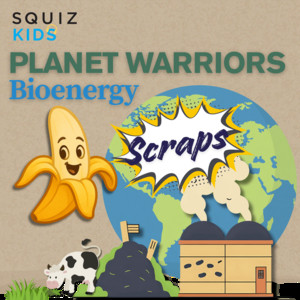
And here to talk dirty with us in the best possible way is our very own messy, mucky energy expert, scraps another member of the planet warriors super connected superhero crew hey hey hey scraps here i'm your leftover lasagna your moldy melon your chicken bone champion if it's slimy squishy or smells a bit off i'm into it why because that stuff is gold not the shiny kind the energy kind You'd be amazed what a banana peel can do when you give it the right treatment.
Bioenergy is all about turning trash into treasure.
Well, electricity, fuel and heat, really.
Scraps, that sounds like magic.
More like science, my friend.
Here's the scoop.
Bioenergy comes from biomass.
That's anything that's alive or was recently alive.
Plants, animal waste, even human sewage.
Ew.
Some of it gets burned like wood or sugar cane leftovers.
Some of it gets broken down in special tanks called anaerobic digesters.
That's when bacteria munch through muck without any oxygen and burp out the biogas.
Mostly methane.
Burp.
That gas can power homes, buildings and even trucks.
Biogas burps.
Got it.
But where does all of this stuff come from, Scraps?
All over.
In Queensland, we use sugarcane waste called bar gas. to power entire communities.
In Sydney.
Parts of the sewage system create gas to power treatment plants and farms across Australia are turning manure into electricity.
Even algae is being studied for biofuel.
It grows fast, doesn't need farmland and could one day fuel planes.
Wow.
Okay, scraps, that all sounds pretty awesome, but let's talk rumours.
I've heard people say some things about bioenergy that sound, well, a bit off.
Oh, I've heard them too.
People saying bioenergy causes food shortages, that it pollutes more than it helps, or that it's just not a big deal in the energy world.
That stuff gets my bin lid rattling.
Oh, I think it's time we brought in someone who actually knows their stuff.
Joining us now is Laureate Professor Bekdad Mochtaderi from the University of Newcastle.
He's been working on a super cool tech called Kimia that turns organic waste into chemicals and fuels.
And he's here to help us sort the fact from the fiction.
Now, some people might be surprised to hear that we can turn banana peels and cow poo into energy.
How does that actually work?
It's very simple.
You know everything around us, a lot of the things around us, including the examples that you mentioned.
They're essentially made out of carbon and hydrogen.
And that's why we call them organic matter.
Now there are various ways of converting that organic matter, or carbon and hydrogen, into other products.
It's very much like, let's say, you have a Lego piece.
You can pull it apart to smaller elements and put them back together in a different shape or form.
That's exactly what we can do with capo and banana skins.
How amazing.
Who would have thought?
Now, one of the things that people worry about is whether using crops for biofuel takes food away from people.
Is that true, or how do we make sure that bioenergy doesn't cause more harm than good?
Very good question.
There are two ways of addressing that.
Firstly, the focus at the moment is more on the food waste, conversion of food waste to other products.
So examples, as you said, agriculture, byproducts, that sort of thing, or forestry residues.
So whenever we have organic waste, we can use that as a feedstock for bioenergy.
Importantly, the additional thing that we do, we would use what is called second generation crops for bioenergy production.
And what it means is we're talking about crops that do not compete with food crops.
And it's specifically designed and essentially grown for energy applications.
For instance just to give you an example in Western Australia, oil mally, which is actually a plant, can be used to stop deserts growing into sort of green areas.
That is an example of energy crop, which is not competitive to food crops.
And that can be used for bioenergy.
Amazing.
Some folks also say though, that bioenergy is too small to really make a difference in the global energy mix.
But is it already starting to play a bigger role than people realize?
The simple answer is yes.
It's already started making an impact.
But to answer your first part of the question, I don't think in the renewable energy sector we're talking about a silver bullet.
There is not a single solution for everything.
So we have to have a portfolio of various technologies, various ways of producing green energy, green electricity.
Bioenergy is one of those options.
It's complementary to a range of other options.
And so we've talked a lot already in this podcast series about different renewable energies like solar and wind and tidal.
So what you're saying is that it will probably be a combination of all of these things that will help.
All of them, absolutely.
And you've got to understand also that solar and wind in particular, they're becoming cheaper and cheaper and well-known and more widespread, but still have that fundamental or core issue which is intermittency.
What it means is they fluctuate during the day.
Sometimes you can produce power with them.
Sometimes you don't.
If you have a rainy day or a day that there's no wind blowing, you know, you have those issues.
Whereas bioenergy or other renewables like geothermal energy for instance, they don't have that intermittency issue as such.
So that's why they all got to play hand in hand in order for us to have a green electricity available to everyone.
Now, what is the coolest or most unexpected thing that you've seen turned into bioenergy?
Well, believe it or not, we have converted biosolids into bioenergy.
And you may ask, what is biosolids?
Well, it's actually waste, solid waste from wastewater treatment plants.
We're talking about sewage.
Sewage, yeah.
He's talking about human poo, ladies and gentlemen.
But you can turn that into energy.
Energy.
Alternatively, if you're even smarter, you actually convert that to hydrogen, which is even more valuable.
Amazing.
Hydrogen is a feedstock.
You can run your car on it.
You can basically do other things in it.
So, yeah, it's all possible.
So each one of us is carrying around a little bit of potential energy and green energy without even knowing it.
Absolutely.
And finally, what would you say Professor, to a kid who wants to help our planet by using less fossil fuel energy?
How can they be a bioenergy warrior in their own home or their own school?
Well, I think the starting point would be to learn more about this.
So let's learn more about green energy, what it is and what we're trying to solve a better understanding of the problem and also potential solutions.
But then once you have that understanding, that sort of knowledge, then you've got to act on it.
It could be very, very small things.
Like you know, minimizing waste at your own home or if you're basically producing waste, inevitably make sure that you put them in the right bins.
You basically help the council to sort of make use of those and hopefully down the track.
If it is an area which is attractive for you, go and study at university in these areas and essentially become innovators and be the next generation who develop newer technology to make use of waste and organic matter and convert it to bioenergy.
Fantastic.
Professor Mohdaderi, thank you so much for joining us.
Thank you very much.
Appreciate it.
Thanks for having me.
Well, Scraps, it turns out there's more to banana peels than just slapstick comedy.
Absolutely.
With the right tech and a bit of brain power, we can turn the gunk in our bins into clean energy.
Less waste, less pollution, more power.
That's what I call a win-win-win.
And that's what Planet Warriors is all about.
Using science, smarts and a little bit of stink to help save the world.
We'll be back next time with an episode that might spark your curiosity.
We're talking energy storage and electrification.
Until then, my friends, stay curious, stay slimy and keep being planet warriors.