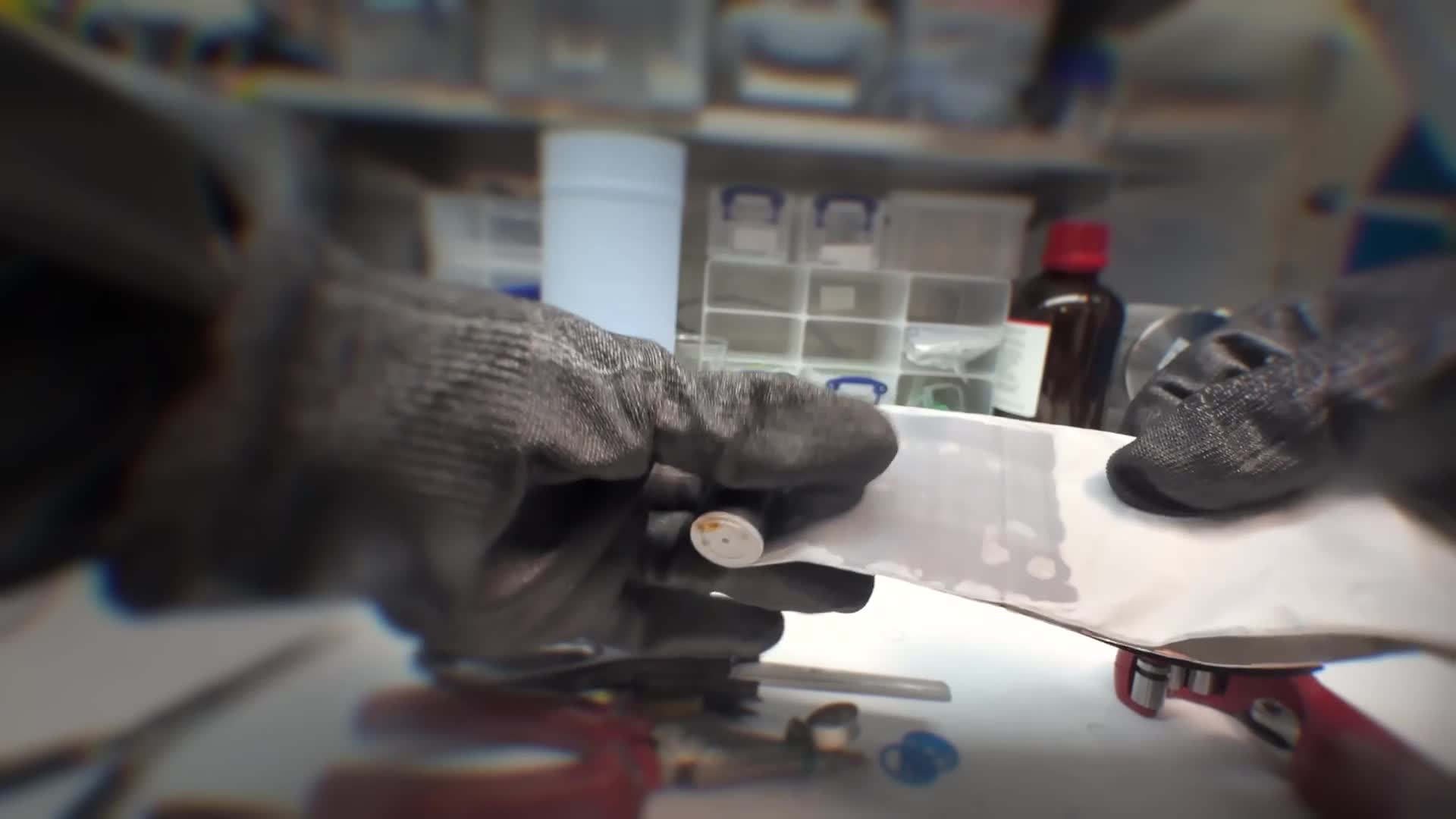
This is what the inside of a lithium ion battery looks like.
It's not exactly high tech just two meters of foil coated in black paste all packed into this tiny 45 gram cylinder.
But these are some of the best batteries we have.
They power everything from laptops and electric vehicles to orbiting satellites.
Yet when a battery fails, all that energy can get released in the wrong way.
Oh my God.
The latest incident involving lithium ion batteries.
So how did something so rudimentary looking end up in almost every electronic device on the planet?
And why don't we have anything better?
In the early 1980s, most rechargeable batteries were stuck at just 40 to 60 watt hours per kilogram, meaning you would need a kilogram of battery to power a 40 watt light bulb for just an hour.
As a result, when the first commercial mobile phone launched in 1983, It was pretty unimpressive.
It took 10 hours to charge for just 30 minutes of talk time.
Laptops, cameras, even medical devices all suffered from the same bulky batteries.
Everyone from electronics giants to oil companies were trying to make a better battery, because they knew that even just doubling the energy density could unlock a new era of portable electronics and power the digital revolution.
But what no one realized is that someone had already found the solution.
In 1972, a 32-year-old British chemist named Stanley Whittingham was studying how different materials store energy at Exxon's research lab in New Jersey.
Yes, that Exxon, the multinational oil giant, then the largest oil company in the world.
They were researching batteries.
The next year, war broke out between Egypt, Syria, and Israel.
When the US backed Israel, Arab oil producers cut off oil exports in retaliation.
And on December 22nd, the price of crude oil more than doubled from $5.12 a barrel to $11.65.
In response, President Nixon created policies to try to keep oil prices down.
But they backfired, and the shortage only got worse.
Americans were left queuing for hours at gas stations as the government introduced a rationing program.
It got so bad that they even dropped the national speed limit to 55 miles per hour just to cut consumption.
At Exxon, executives were worried that supplies would run out entirely, so they started looking seriously at alternatives like electricity.
This wasn't a new idea.
In fact, in 1900, when cars were first taking off, the top-selling car was electric, ahead of steam and gas-powered cars.
But the problem with these electric cars was their batteries.
They weighed 360 kilograms around 40 of the car's weight but they could only take you around 60 kilometers.
And the energy density wasn't just low, it also degraded over time.
Every time you recharged, it got worse.
After fewer than 500 charges, your range would have dropped to about 40 kilometers.
So by 1924, gas-powered cars outnumbered electric 10,000 to one.
But now that the oil supplies were running out, it seemed to Exxon that there was no other solution than to bring back the electric car.
And to do that, they needed a battery with a much higher energy density.
So suddenly, Whittingham's side project became a top priority.
Exxon poured in resources, giving him free rein to, in his words, do pretty much what I wanted, as long as it did not involve petroleum.
The very first battery dates back to a curious incident in the 1780s, when Italian scientist Luigi Galvani was dissecting a frog to study its anatomy.
He anchored one side of the frog on a brass hook and went to cut it open with a steel scalpel.
But when he touched the scalpel to the frog's leg he noticed it suddenly twitched, as if it had come back to life.
Galvani believed he discovered a sort of animal electricity, a living force produced by the tissue itself.
But Galvani's rival Alessandro Volta disagreed.
He thought it came from the metals themselves.
And you can see this with lots of different materials.
Veritasium producer Gregor set up a version of this experiment, minus the frog, to test it out.
I have zinc, magnesium, and iron here.
I can take any of these metals, stick them into one side of a lemon and stick some copper on the other side.
If I hook these up to a voltmeter, I should be getting a voltage.
And we got around 0.8 volts.
Now, the reason this happens is because some elements want to get rid of their electrons more than others.
So if you pair one that really doesn't want its electrons with one that really wants some, well then the electrons are going to be traveling across.
Let's look at the zinc.
What's happening here is that zinc is losing its electrons.
The zinc ions enter the juice and the electrons are forced to go through the circuit to get to the other side.
There.
Hydrogen ions in the lemon juice want those electrons, so they receive them and turn into hydrogen gas.
You've got one side that gives up electrons that's the anode and you've got one that receives them that's the cathode.
But why do you need the lemon at all?
If there's no flow of the positive ions through to the other side, the electrons stop moving almost immediately.
This happens because all of the electrons now get bunched up in the copper, making it extremely negatively charged, and that is just going to push away any more electrons from coming over to the other side.
That's because electrons can't travel through lemon juice.
Liquids like this don't have free electrons the way metals do, so electrons stay in the wire.
They'll only leave the circuit at the copper side if there's something in the juice like hydrogen ions ready to take them and if the reaction releases enough energy to make that transfer happen.
But positive ions in the juice can move.
They travel across to balance the charge, allowing the current to keep flowing.
A solution that carries charge this way by moving ions is called an electrolyte.
But we could also do this with the other metals to get a similar reaction.
And we can actually quantify how much each of these metals wants or doesn't want electrons.
With zinc, we already got around 0.9 volts.
But if you try it with iron, for example, you get something lower.
0.5 or 0.6 volts.
Now, magnesium is tricky and it would be a bit higher, but it oxidizes so quickly that even if I scrape some of the oxide from the surface, I'm still getting only around 07 volts.
The idea is that the larger the voltage on the voltmeter, the more energy each electron has to give as it passes through the circuit.
But there's also a limit to this.
See, this beaker is full of lemon juice from the lemons we used earlier and they're hooked up using spoons and these wires to a variable power source.
Now look what happens when I up the voltage.
You'll actually start to see bubbles forming on both spoons and that's water in the lemon juice actually being broken down into oxygen and hydrogen gas.
This already starts happening at 1.23 volts.
And that sets a limit on how much voltage you can push through this electrolyte.
Up until the early 1970s, just about every commercial battery used a water-based electrolyte.
And as a result, none of these battery cells could push much beyond the 1.23 volt limit.
Now, the total energy a battery can store depends on how much energy each charge has to give times.
How much charge can move.
That is the battery's voltage times its capacity.
So if you can't increase the voltage, your only option is to make more battery, more cells or bigger cells.
But that won't increase the energy density.
And this is exactly the problem Whittingham was trying to solve.
He was searching for materials that could store large amounts of energy in a compact space with light weight.
That led him to a class of compounds called transition metal dicalcogenides.
He zeroed in on one in particular, titanium disulfide.
Titanium in this compound has effectively lost four electrons, two to each sulfur atom, meaning it sits at a plus four oxidation state.
That leaves it very electron hungry, exactly what you want in a battery cathode.
But titanium disulfide has a second key advantage.
This material is made of stacked layers held together by weak van der Waals forces.
This creates natural gaps between sheets of titanium and sulfur atoms just wide enough to let certain ions slip between the layers, a process known as intercalation.
Better still, the structure can expand and contract repeatedly without breaking down.
Now Whittingham just had to decide which ions to use.
He initially looked at potassium, but it was just too reactive and far too dangerous to work with.
Oh yeah!
He turned to this, a soft silvery metal called lithium.
What makes lithium unique is not the fact that it has one electron in its outer shell that it wants to get rid of.
No, that it shares with the other elements in its group.
What sets it apart is how much energy you can get out of lithium when it reacts in a battery.
See, when it loses that outer electron, it forms a tiny, incredibly stable positive ion.
And so that reaction, paired with the right cathode, releases more energy per electron than any other metal.
That's why it produces the highest voltage of any metal used in batteries.
And because it's so small, with just three protons, lithium is also the least dense metal, at just 053 grams per cubic centimeter.
This combination of low density and the tendency to give away its electron made lithium perfect for Whittingham's vision of this high energy density battery.
But while lithium was easier to work with than potassium, easier still didn't mean easy.
I mean, they only let me hold it in this glove box.
And matter of fact, here's what happens to lithium if you put it in a glass of water.
It's safe to say you don't want this happening inside your battery.
So Whittingham had to switch out the water-based electrolyte for something else.
And that change unlocked the possibility of higher voltages.
He turned to a solution of lithium salt in an organic solvent, and it worked.
But it came with serious risks.
The solvent was volatile.
The lithium salt was chemically unstable.
Together, they formed a mixture that could explode or release toxic fumes if mishandled.
Everything had to be done with extreme caution.
A stray spark or a trace of moisture could destroy the experiment or start a fire.
But if you could get around the danger, this new electrolyte was a huge perk.
It let lithium ions shuttle between electrodes without breaking down the solvent or the cell, at least not until much higher voltages.
Whittingham had unlocked lithium's potential and in the process he'd broken through the 123 volt ceiling.
His new chemistry delivered nearly double, a huge 2.4 volts per cell.
He now had a working prototype a metallic lithium anode on one side, a titanium disulfide cathode on the other, his new liquid electrolyte.
In between.
There was also a thin, porous separator that kept the electrodes apart, so they couldn't touch, and short circuit.
Here's how it works.
When you close the circuit, lithium atoms at the anode give up their electrons.
Those electrons travel through the external circuit toward the cathode, generating a current that powers whatever's connected.
At the same time, the lithium ions are released into the electrolyte, and then they pass through the porous separator and migrate toward the cathode.
The electrons arriving through the circuit are taken up by the titanium atoms and the titanium disulfide.
The positive lithium ions slide between the layers to balance out the negative charge of the electrons and they become locked in place.
And this process is reversible.
When you apply a voltage to recharge, the extra electrons are stripped from the titanium and pulled back to the anode.
The lithium ions are forced out of the titanium disulfide layers into the electrolyte, and they too migrate to the anode, where metallic lithium reforms.
What Whittingham had created here was a rechargeable battery, one that worked reliably, cycle after cycle, with incredible consistency.
I don't normally think about batteries this way, but what they really are is tiny little contained chemical reactions.
And in a chemical reaction if you could get a 60 yield, that would be considered good.
But in a battery, especially one that you want to recharge a thousand times, you need that reaction to be say, 999 efficient, because if it's not, the capacity of that battery rapidly deteriorates.
If you have say a 95% yield, then you'd lose a significant fraction of lithium ions every cycle.
After just 50 cycles, you'd only have 8% of your original capacity left.
So it's pretty incredible that every single lithium ion has to leave one electrode, pass through the electrolyte and slot neatly into the layered crystal structure of titanium disulfide.
And then when you recharge it, they have to leave again cleanly, without incident, without getting stuck, make their way all the way back to the anode.
Amazingly, despite just being an early prototype, Whittingham's battery came close to that 99%.
In the winter of 1973, Exxon's managers summoned Whittingham to the company's New York office.
Whittingham later said, I went in there and explained it.
Five minutes, 10 minutes at the most.
And within a week, they said yes, they wanted to invest in this.
They got to work at the Exxon laboratory, but it wasn't all smooth sailing.
Firefighters had to be called out repeatedly.
They were called so often.
They threatened to start charging the lab for the special chemicals needed to extinguish the burning lithium.
The problem was the anode.
Whittingham's design used pure lithium, which worked brilliantly until it didn't.
We've made a special cell.
We made a transparent battery.
That's so cool.
But they're very, very small, so we have a microscope lens just to allow us to see it.
What you're seeing here is a piece of copper which we're gradually plating with lithium.
So this is analogous to the first generation lithium metal batteries, which use lithium metal as the anode.
On this side, we have a piece of lithium.
As we charge the battery, we're stripping the lithium from that electrode and we're plating it.
And actually what's happening right now is the ideal reaction.
Where it's very slow, we're getting a dense plate.
The challenge then becomes if we go too fast.
Oh, that is huge.
Everything's fine until all of a sudden it's not fine.
So we want the lithium to play evenly across everywhere, but instead it forms in that one location, and that is what is a lithium dendrite.
That lithium dendrite can grow the length scales of this is on the order of um, you know millimeters, so that would have easily short-circuited the battery And that dendrite can just keep growing and eventually it's going to poke through the separator and reach to the other side.
Now the electrons are going to have a shortcut.
So, instead of going through the circuit, they race straight from the anode to the cathode using the dendrite.
And that sudden surge of electrons cause intense heating and that can trigger a chain reaction inside the battery, leading to a fire or even an explosion.
For all its promise, Whittingham's battery was just too dangerous.
And then the oil crisis ended.
Prices dropped, and Exxon's urgency evaporated.
The company shut down its lithium battery program.
Whittingham published his design in 1976, and Exxon licensed the patent to a few manufacturers.
But with no funding and no momentum, the first lithium battery revolution died before it had a chance to take off.
Fortunately, a copy of Whittingham's paper made it across the Atlantic to Oxford University in England, where it caught the attention of John B Goodenough, an American physicist leading a solid-state chemistry group.
As he read the paper, one thing stood out.
The cell voltage was being held back.
The material Whittingham chose for the cathode, titanium disulfide, capped the cell at just 24 volts.
But Goodenough believed that with a better cathode material, he could do better.
He had previously worked with compounds called transition metal oxides.
They were more stable than sulfides and some he knew were extremely hungry for electrons perfect for a cathode.
He tried one of these compounds in his battery and the voltage immediately spiked from 24 volts to 4 volts.
This jump was incredible.
But what was even more surprising was the fact that this compound already had lithium in it.
The material was lithium cobalt oxide.
Lithium cobalt oxide is arranged so that the cobalt and oxygen atoms form tightly bonded layers with lithium ions nestled in between.
This means that your supply of lithium ions doesn't just have to come from the dangerous lithium metal on the anode side.
It's already there pre-built into the cathode.
So theoretically, you don't even need lithium metal at all.
You could assemble the cell in a discharge state with all your lithium ions in the cathode.
Then, when you connect it to a charger, these ions will get expelled from the cathode, crystal lattice and into the electrolyte.
At the same time, nearby cobalt atoms will give up an electron to balance out the charge, and those electrons then go through the wire to the anode to meet with the ions.
If Goodenough could find an anode that would replace lithium metal, the battery would become safe enough to leave the lab and actually power real-world devices.
Goodenough was so excited about the potential of his design that he reached out to battery companies across the US, the UK and Europe.
But incredibly, no one was interested.
So he asked Oxford to file a patent, but they refused.
So he took it to a government lab near Oxford, the Atomic Energy Research Establishment.
And finally they agreed to fund the patent, but only if Goodenough signed away his financial rights.
Seeing no other option, he agreed, and the lab patented the invention in 1981.
Now this should have been a gold mine, but the lab didn't realize what they had.
And so for the second time, the lithium battery revolution was boxed up and shelved.
This should have been a turning point for battery science, but bureaucracy and inertia stalled progress.
Every field has its bottlenecks.
For batteries, it was slow moving institutions.
For developers today, it's slow moving code reviews.
And I can relate.
When we make these videos, especially the ones with simulations or complex animations, it's rarely the ideas that slow us down.
It is the reviews.
Developers face the same thing.
They're writing code faster than ever thanks to tools like Copilot and Cursor.
But code reviews?
Well, they're still manual and still slow.
That's where this video's sponsor CodeRabbit comes in.
CodeRabbit automates code reviews with generative AI.
Unlike basic tools, it understands your code base, your architecture standards, even naming conventions.
It pulls contacts from over 40 sources to give feedback that feels precise and human and tailored to your team right in the Git workflow.
That's why it catches what other tools miss.
Logic errors, bad conditions, math mistakes, even security vulnerabilities like SQL injections.
The result?
Well, your senior engineers spend less time buried in reviews and more time solving the problems that only humans can solve.
Try it out at coderabbit.link slash veritasium to cut code review time and bugs in half.
And if you're working on open source projects, it's completely free.
That's coderabbit.link slash veritasium.
I would like to thank CodeRabbit for sponsoring this part of the video.
And now back to Goodenough's design, a breakthrough with nowhere to go yet.
While Goodenough's battery design was gathering dust, 10000 kilometers away in Japan, a 34-year-old chemist named Akira Yoshino was trying to find a safer battery anode, one that didn't require lithium metal.
Yoshino was actually looking at plastic.
Now, normally plastic is an insulator, but the kind Yoshino was looking at is different.
It's called polyacetylene, and its carbon atoms are arranged in a repeating chain of single and double bonds, a structure that gives it unusual electronic properties.
If you tweak polyacetylene by adding or removing electrons, electrons can actually move along this carbon chain, so the plastic conducts electricity like a metal.
And that got Yoshino thinking, what if polyacetylene could work as a battery anode?
During charging it could absorb lithium ions and electrons and then during discharge it would give up those electrons to the circuit, just like lithium metal does.
If it worked, it could eliminate the most dangerous part of the battery, the metallic lithium.
But for months, Yoshino struggled.
Obviously, since he removed lithium metal from the anode, he had to get lithium ions from somewhere else.
And he couldn't figure it out.
And then, just as he was losing hope, on the last workday of 1982, while cleaning out his office, he stumbled upon a 1980 paper by John B Goodenough.
It described a cathode made of lithium cobalt oxide, a cathode that already contained lithium.
This was the missing piece.
He sketched out the reaction between lithium cobalt oxide and his lithium-free anode, and then built a test cell using the two materials.
It worked, safely and reliably.
But Yoshino wasn't satisfied.
The material he used for the anode, the polyacetylene, had an extremely low density.
I mean, it couldn't pack in enough lithium.
So the energy density of the battery was terrible.
Yoshino needed something more lightweight compact, conductive and crucially, something that could reversibly accept and release lithium ions within its structure without breaking down.
He tested material after material, and every single one failed, until a breakthrough came from within his own company.
Another team had developed a new form of carbon with a unique crystalline structure.
They called it vapor-grown carbon fiber.
He got his hands on a sample, tried it in the lab, and it worked.
To prove it, he placed a test cell containing metallic lithium into a safety rig, one that's designed to test explosives.
Then he dropped a heavy iron rod onto it.
It exploded violently.
Then he ran the same test again, but this time with his new design, using carbon as the anode.
He charged the cell, placed it in the rig, and dropped the rod.
But nothing happened.
The contrast was undeniable.
Later Yoshino would say, that was the moment when the lithium-ion battery was born.
But his employer Asahi Chemical.
Well, they weren't a battery company and they didn't know how to make batteries.
So in 1986, Asahi executive Ezeo Kurabayashi flew to Boston on a top secret mission carrying three jars containing cathode, anode and electrolyte materials.
He handed them to a tiny firm called Battery Engineering, working out of a converted truck garage, and he asked them to turn the materials into cylindrical cells like the kind you might buy for a flashlight.
The team did just that, completely unaware of what they were handling.
It wasn't until 2020 that employees learned the truth that they had helped assemble the world's first pre-production lithium-ion batteries.
Two weeks later, Kurabayashi returned to Japan with 200 finished, perfectly functioning cells.
Even then, Asahi's leadership hesitated.
Kurabayashi refused to give up.
On the 21st of January 1987 he visited Sony and he took one of the prototype cells and rolled it across the conference table to the Sony execs.
And at last, they saw its potential.
They reworked the design, swapping out Yoshino's carbon material for graphite that could better intercalate lithium ions between its layers.
And in 1991, Sony launched the first commercial lithium-ion battery inside this, the Sony Handycam.
Their battery was compact, rechargeable, powerful, and crucially, free of unstable lithium metal.
It was Sony who first coined the name lithium-ion.
And it stuck.
But this wasn't just about one camcorder.
Competing companies like Panasonic and Sanyo raced to catch up.
Lithium-ion batteries started appearing in phones, CD players, laptops.
Manufacturers actually began to advertise the use of lithium-ion batteries as a key selling point to their products.
I'm showing my age here.
I joined the industry when lithium-ion cells were first introduced and there was a Sony camcorder that was introduced, and then there was Dell Computer, and I still remember the ads when Dell Computer introduced their lithium-ion battery.
They had eight hours of runtime so they had an advertisement in a magazine and it was eight pages long.
Each one was an hour longer, so it was a big deal.
But what's crazy is that even after all this, these batteries should never have worked.
See, when you charge the battery for the first time, lithium ions move from the cathode to the graphite anode.
And here they react with the electrolyte to form this weird complex patchwork of compounds that build up on the anode surface.
These parasitic side reactions should keep going on indefinitely, using up all the lithium and destroying the cell.
But they don't.
Instead, they form a thin protective layer known as the solid electrolyte interface, or SEI.
It's a kind of chemical shield protecting both the graphite anode and the electrolyte from further reactions.
But crucially, lithium ions can still slip through it.
When the SEI originally forms during the first charging cycle, around 5 of the lithium in the cell actually gets stuck in this layer, decreasing the battery's capacity.
But this little trade-off is what makes the battery stable enough to be used for years or even decades, which is why today, lithium ion batteries are virtually everywhere.
From 1991 to 2023, the price per kilowatt hour dropped by 99%, from nearly $9,000 to just $100.
At the same time, energy density and cycle life how many times a battery can be charged and discharged before it wears out improved.
Dramatically crossing a critical threshold.
Lithium-ion batteries had become powerful enough and finally cheap enough for something bigger the return of the electric car.
Today, lithium-ion powers a $100 billion industry.
In 2019 Whittingham, Goodenough and Yoshino finally received the Nobel Prize in Chemistry for an invention that, in the committee's words, revolutionized our way of life.
This made Goodenough the oldest Nobel laureate in history, receiving the award at the age of 97.
But lithium ion isn't perfect.
Scary moments aboard a jet blue plane a fire erupting after a passenger's backpack suddenly exploded.
Every week inside an airplane, there is at least one event of a battery of a phone, of an iPad or a toy or something that has caught into fire.
What?
Every week?
Yeah, every week.
It's just the latest incident aboard a plane involving lithium ion batteries.
So far this year, 60 onboard battery incidents through early october.
Every flight in the us has a bag, a specialized bag, which very thick, non-flammable materials, where you put the phone inside and you close it and you still have a hazard and you have to deal with these gases.
But now you, you have put the fire ignition away from anything else and if it burst into fireworks then at least it's in a container and then you tell the captain we need to land immediately.
So what is actually happening when a battery fails like that?
This is a classic lithium-ion battery and today we're going to do something I always wanted to do.
We're going to tear one down.
I guess, safe to say, don't do this at home.
But what would happen if you were to do this outside of the glove box?
If you charged up the cell and then you tried to tear it up, then you could accidentally short it and then it could burn and it could even explode or fire.
If you discharged it and you opened it up, you'd release all the different gases and really toxic chemicals.
And if you inhale those, then you'd probably end up in hospital.
So at this point, we have what we call the jelly roll.
So it's a roll of the cathode, separates the anodes, stuck together with a bit of tape.
So Liren's just going to scalpel off the tape, and then we should be able to unroll it into a nice sheet.
So these little patches are the electrolyte?
Yeah.
So as time goes by, it will start evaporating out.
That is so cool.
It's so obvious when you see it, but I don't think anyone intuitively thinks that it's a rolled up sheet of anode and cathode inside.
But these layers inside the battery, they're not going to stay perfect forever.
Here's an electrode from a new cell compared to one from an old one.
You can see that the lithium is building up in all the wrong places.
And if this sort of degradation gets out of hand well, we're about to push a cell past its breaking point.
How do we blow up a battery?
So today we've got a prismatic battery.
It's a small battery from sort of a power tool or a phone or something similar.
We're going to wrap it in some Nikron wire.
So we pass current through this wire, something like 200 watts we pass through this wire.
That's a lot.
Yeah, it's a significant battery.
We want it to go and we want it to go pretty spectacularly.
Good luck, Harry.
What we're simulating here is a catastrophic battery failure, the kind that could happen if a cell is damaged or overheated or even just badly manufactured.
It starts around 80 degrees Celsius when the protective SEI layer on the anode starts to break down.
It's gonna try to reform, but these reactions are gonna release more heat and if that heat can't escape, the temperature is gonna keep rising.
How close is it to exploding now, what do you think?
It should burst very soon.
At roughly 130 degrees Celsius, the polymer separator is gonna melt.
And now the anode and cathode can come into direct contact, and a massive internal short follows.
The cathode itself starts to decompose.
And because transition metal oxides release oxygen from their crystal structure, they're gonna fuel the combustion.
And now the fire is just feeding itself.
Oh.
Yes!
Oh my god!
That's really violent.
This is insane from one small battery like that.
And it's only 50% of charge.
What we call ignition happens inside the battery, not outside the battery.
And it requires a fuel or a substance that will undergo a reaction.
It requires an oxidizer, or the equivalent of an oxidizer, and it requires heat.
The battery contains these three inside.
So it has its own equivalent to an oxidizer, its own equivalent to a fuel and its own source of heat.
All of it in one device.
So it's not actually lithium that burns.
A modern lithium ion battery, like this one here, contains very little lithium, ironically.
It's actually everything else inside here that's dangerous.
It must be really hard putting out a battery fire if it really has everything it needs.
Yeah, exactly.
So you can still put the blanket and stop the oxygen from arriving, but the fire will not go to zero.
It will be smaller, but it will still be there.
And then with water, yeah, water has the ability to take heat away.
So it is possible to take the heat away from the battery with water.
The best thing is to put an immersive battery into a bath of water.
It's brutal.
You can do it with one battery, with 10 batteries, with 15 batteries, but when you have very large packs of batteries with thousands of batteries, you cannot physically put that under water.
Yeah, one thing that is popping up recently as a threat to cities is electric car fires.
Well, we know a lot of water works.
Yeah.
Well, if there's a water source nearby, I guess.
Yeah.
Yeah.
I mean, this is what they do in some countries around the world.
They have a truck, a specialist truck, full of water, and you just take the car that has been involved in electric fire and they dump it into it.
No way.
Yeah, they do.
But and actually it works.
So how dangerous is it really?
It's very rare.
Every million batteries, there is a fire.
So that's very safe.
That in the standards of engineering that's like oh, you have a good system, one out of a million, that's fine.
But batteries are everywhere.
We don't even think about it.
So within our lifetimes, we are going to reach a point where we would have been exposed to more than a million batteries.
So we would be, all of us, experiencing a fire of a battery.
With billions of batteries in circulation, even rare failures become inevitable.
Meanwhile, demand is skyrocketing.
By 2030, we're projected to need over 17 million tons of battery-grade materials.
And making lithium ion batteries comes at a cost.
Lithium only makes up around 20 parts per million of Earth's crust.
It's expensive and water-intensive to extract.
And 70 of cobalt, another key ingredient in many lithium ion designs, comes from the Democratic Republic of Congo, much of it mined under hazardous, often exploitative, conditions.
We need more batteries and we need them fast.
We can't just rely on lithium alone.
So it's not like lithium is as good as we're going to get.
Then we're going to get much better batteries in the future.
If our priorities are about saving the planet from runaway climate change, we need to have massive scale energy storage system and electrify almost everything else that we do.
The hunt is still on for safer batteries, for cheaper ones, ones that last longer, charge faster and ones that store far more energy.
The lithium ion battery changed the world, but the future of energy storage won't be about just conquering one element.
It'll be about mastering many.