I'm not entirely surprised.
At heart, of course, is the lose -lose reality of tariffs.
This kind of tariff regime that Trump is trying to impose is not going to make America great again.
It's going to make America gravel again.
Maybe temporarily, the United States will not suffer a lot, but it's just temporarily.
By the end of his term, he may regret the liberation date this evening.
The Chat Lounge. Chat Lounge.
Chat Lounge. The Chat Lounge unpacks views and opinions on hot issues in a more casual way.
Welcome to the Chat Lounge.
I'm Tiyun. Joining me to discuss the latest round of China -U .S. trade talks, Harvey Zeldin, Senior Fellow, Center for China and Globalization, Dr. Zhou Mi, Deputy Director, Institute of American and Oceania Study, Chinese Academy of International Trade and Economic Cooperation, Professor Qu Bo, Director of the Institute of International Relations, China Foreign Affairs University, and Warwick Powell, Adjunct Professor, Queensland University of Technology, Australia.
Welcome to the chat, gentlemen.
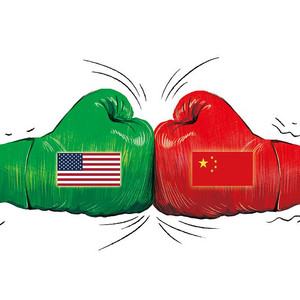
So China and the U .S. have concluded their third round of tariff talks in Stockholm, calling the discussions constructive.
But they stopped short of reaching a much -anticipated deal to extend the 90 -day tariff truce.
So were you surprised at the outcome and what might have been the decisive factors behind the lack of agreement?
We'd like everyone's input, but let's keep it short and sharp.
Shall we start with a third -party perspective?
Professor Paolo, would you like to start the chat?
Look, I think it's probably worth just setting a bit of context.
This issue has, of course, been unfolding now on and off since the 2nd of April.
Broadly speaking, the United States, through the agency of the office of the White House, the presidency has been hot and cold.
It has been up and down and it has been in effect, perhaps unintentionally and perhaps perhaps intentionally creating discord and instability in the global trading environment with a view, I think, trying to divide and conquer.
And in doing so, the White House has sought to line up, firstly, some of what they would perceive to be the weaker trading countries in the world, certainly in geopolitical terms, over which the United States believes it has substantial leverage.
And of course, it has also targeted erstwhile security partners and allies for special treatment.
We've now reached a point at the end or the very beginning of August, where we now have tariffs unilaterally imposed by the United States of anywhere between 15 and 40 to 50 % on over 30 countries.
This is, of course, well short of the presidential targets set in the early days, which was the 70, 80 countries that were lining up to pucker up to the president and he's behind.
But nonetheless, the United States has now announced a slew of unilateral tariffs on a bunch of countries wrapped up in the language of some grand deals.
These grand deals are largely imaginary in nature.
They involve commitments of investments and purchasing American LNG and military equipment and Boeing aircraft, most of which can't be delivered because the real world simply doesn't have the capacity to meet these obligations.
So I think that that's where we're at.
The China situation has been progressing ever since the detente was achieved in the middle of May through three meetings now.
Insofar as there have been meetings, they have been conducted in what I can see to be a professional and relatively calm manner.
But it would seem that there is still quite a substantial gap between the expectations and needs of the parties involved.
And the last thing I will say is that in the last few days, President Trump has been threatening Russia with so -called secondary tariffs, which in effect target Russia's major trading partners, China, India, and to some extent Brazil of 100 % tariffs.
And at the moment, the drop dead date on that is the 12th of August. So that's where we're at.
Thanks for the background intro, but you're not surprised at all that there is no agreement on another extension?
Well, in many ways, I think everyone is still expecting there to be an extension, but that has been clouded now by the Russia question, which in effect cuts right across any extension period, because if there was an extension and then in 12 days time, the 100 % tariffs were imposed on Russia, which ultimately would impact China, because that's what it's about.
It's actually not targeting Russia per se, it's seeking to punish other countries, so to speak, for trading with Russia, then there would be absolutely no point whatsoever in extending the discussions for 90 days.
Now, let's bear in mind, of course, that so far in this this particular presidency, the president has announced on various occasions all sorts of deadlines and timelines, many of which have never been upheld.
The president has made a habit of capriciously changing the timeframes involved and arbitrarily changing his mind.
So in many regards, there is no dependable basis upon which these engagements can take place in any regard. And that means that if you are in the business of engaging with the United States at the moment, you need to be prepared for all eventualities, engage in good faith, but nonetheless work on the basis that there is every possibility that the terms of engagement will be changed at the drop of a hat.
So I'm not entirely surprised because the President has demonstrated an erraticness towards his engagement with global counterparts.
I anticipate that the China side will be well prepared for all eventualities, certainly won't have put all of their negotiating negotiating or strategic eggs in the same basket and are ready for what may come.
All right. Then to our Chinese guests here, Professor Chee, what about you?
Yeah. First of all, I think why like of agreement.
So the first reason is due to the tariff per se.
So if we look at now the current tariff level, U .S. imposed on China already about 50%.
When Donald Trump came into power eight years ago, and that imposed the first round of tariff war between China and the United States.
And the United States has gradually imposed tariff on China, already reached like 20 percent.
And so Donald Trump, the second term, and this time he raised another extra tariff on China goods.
So I think this is a pretty high tariff.
So for both sides, that is a great stake in reducing the tariff.
So this is the first reason.
And the second reason, pretty simple.
I think from China's side, we do not have much more confidence in in Donald Trump and his style of leadership is very, it's unpredictable and even when there's one reason some consensus he may be changed according to his choice.
So for China I think it's very cautious about making commitment.
So you're not surprised at all?
Yeah, no. Okay. What about Dr. Zhou?
Well, I think that, you know, they have some prediction the additional tariff of the so -called reciprocal tariff, I think that he is trying to get some of the response by the different countries.
So there may be a differential ratio rates about different countries on the tariffs, but I do believe that he's trying to gain more by having the tariffs, by additional revenues to the government.
So I would say that maybe the rates are not so high as we observed in April.
But it's still so different.
So the widely spread tariffs are really making us more confused.
I mean, especially for the enterprises themselves.
So I don't know how long they get used to these new levels of tariffs.
But I believe that is really a tough thing.
Because it's not only about the tariff.
Like you can go to this store or next store.
in the neighbors. This means that you have to find some relations based on the trust. How can you try to do that without enough investigations or history of transactions?
I don't think these are really easy things for the people to adapt to the new scenarios.
So this plan seems still a little bit more naughty, I would say, compared with April.
the plans, they just put the import and export together to get the tariffs.
After so many months, there are still a lot of unseen reasons for why the United States is putting those tariffs on those different governments, the import from those countries.
I don't think that we have a reasonable reason to try to understand the logic behind these tariffs.
So that is confusing me.
All right. We will explore further on what's been the major obstacles later on.
But to our American guest here, Harvey, though you're now living in Europe, what about you?
Well, as an American, I talk about what Trump is doing and have to admit I'm a Democrat, but I'm not surprised.
I look back to the period before President Trump's first term, and we had what was a rules -based international order that was established at the end of World War II.
It included the World Trade Organization and many other multilateral organizations.
But when Trump came in, he's shredded all this.
It's in part because Trump sees government as just another TV show, and he's always trying to get attention.
That's what he craves.
Unfortunately, tariffs were under 3 % before Trump started this mess, and we're talking of tariffs now of triple digits.
And so I believe that a lot of this is just to appeal to Trump's base to, as he says, try to make America great again.
And I don't think any country that negotiates with the US now can be sure that any agreement is an agreement because President Trump changes his mind faster than a Sichuan mask changer changes masks.
So we never know what he's going to do.
So I'm not surprised that we're at a point where we haven't gotten any agreement and we still don't know.
We expected an agreement already to be announced.
But as Scott said, it's all up to President Trump.
I think we have to keep our fingers crossed and prepare for the worst, but hope for the best. Yes, we are.
I think the whole world is waiting for his decisions.
But for now, something certain that we can talk about.
Let's take a look at some of the context.
Harvey, how would you interpret the choice of timing and location?
Stockholm, right? For this round of talks, you're living quite close to that city.
That's true. You know, August 12th deadline and actually August 1st staring us in the face already because we're already at one of those points.
And I think it was to put maximum pressure on China as well as other countries to reach a deal, to give them very little time, very little maneuvering room and so on.
But I want to talk about the choice of locations.
This is very interesting.
For me personally, living in Vienna, I would have thought that Vienna would have been a better choice historically and politically, and maybe then followed by Geneva.
They're both UN cities.
They're in neutral countries.
But certainly like them, Stockholm and Sweden are trusted.
But I have to say they're infrequent neutral hosts.
And so I suspect that by choosing the Scandinavian capital where Nobel Prizes originated, Trump may have had the coveted Nobel Peace Prize, or I have to say, delusionally, the economics prize on his mind, because both are decided in Scandinavia.
And the Nobel Prize is a trophy.
Trump has made no secret at all of coveting and in fact saying it's something he richly deserves.
Heaven help us if he gets either of the prizes.
That's quite a novel interpretation of the choice of location.
The Chat Lounge. The Chat Lounge unpacks views and opinions on hot issues in a more casual way.
Well, let's go to the details.
Actually, there are few details about the two -day meeting.
And what could be the key sticking points likely raised by both sides and from each of you?
Professor Powell? Look, the Americans clearly have got issues with the rare earth metals, rare earth elements, I mean.
That's clearly been a big challenge for them, despite all of President Trump's huffing and puffing and Scott Besant's bloviating in the early days about America holding all of the cards, they realised that the cards themselves were made in China, and the temporary cessation of the rare earth element exports and the introduction of export administrative controls, I think, clearly demonstrated to the Americans that not addressing the rare earth elements question was going to be of considerable strategic problems for them, and not only because of some of the electronic sectors would be affected,
but ultimately many of these rare earth elements are essential ingredients for America's own military industrial complex, including the F -35 fighter jet.
So I think that that's the first issue that the United States would have put on the table.
We also know that they've introduced extraneous issues along the way, including the fentanyl questions, which, of course, sparked one of the early rounds of the tariffs that were imposed because America has failed singularly for four decades in relation to its opioid problems and has persisted in failing wars on drugs that haven't worked.
But of course, it insists on blaming other countries for its own social fragmentation and problems. And it continues to do that.
It's also raised the issue of China's trading relationships with Russia, which is a relatively new issue insofar as these tariff talks are concerned and in effect challenged China's own sovereign capability to make decisions as to whom it will trade with and whom it will not trade with.
Needless to say China pushed back on that and so I think that they are three big ticket items. The rest of it is relatively small beer in the schema of things.
The United States is of course seeking to increase its sales of agricultural products once again.
The United States agricultural sector is going to experience its third consecutive year of trade deficits, which is the first time in 70 years that this has happened.
And there are some clear problems across the Midwest and other parts of the American agricultural sector that are eroding at the support that President Trump garnered from these parts of Middle America.
From the Chinese side, the issues I don't think have ever really changed.
At heart, of course, is the lose -lose reality of tariffs.
And that makes no sense at all for anybody to operate trading relationships on the basis of tariffs.
Secondly, I think China has been raising consistently, not only in these talks, but ongoing its objections to the American weaponization of technology exports, particularly in relation to semiconductors.
So they are some of the big ticket items that I think will have been central to these discussions.
And of course, these issues are strategic in nature and will not be readily resolved without some very deep and serious willingness to consider basically strategic and structural questions.
If they're strategic, that means those issues are quite important to both countries.
So it's understandable that it will be a bit hard for both countries to give in in any aspect.
So, Professor Qi, what's your take here?
How do you think Russia weighs in the bilateral talks between the U .S. and China?
Yeah, I think this time really talking a lot of things.
And according to the U .S. side, they're talking about their concern about China import energy, especially the oil and gas from Russia.
Russia. But for me, I think this is now the key issue.
This is maybe the negotiating leverage.
And for the United States, I still think that the tariff, especially for Donald Trump, the tariff still is the key issue.
Depends on how he will announce to the Americans and to the world he win again, right?
What tariff level he will impose to China.
And in order to achieve that, that now the United States bring more issues into the negotiation.
So this time we look at the Russian issue, we look at state owned enterprises issue and over capacity production issue.
So a lot of issue came in.
So I think I still think the key issue is still the tariff issue.
And by the way, if the United States really concerned about Russia issue and that is why Donald Trump will not When he came into power, he will now – for European countries, they felt betrayed by Donald Trump, by the United States, right?
He tried to bring Russia and Ukraine together to reach a deal.
And I think for many European countries, they felt betrayed by the United States.
So I think the key issue is still the tariff issue, and Russia is now the major issue between the trade deal.
All right. And Dr. Zhou, do you have any inside information from your peers at the Commerce Ministry?
No, I don't think that I have this kind of information coming from them.
But I believe that there are a lot of discussions about the tariffs, about the practices of China's imposing some restrictions on the railways or other issues.
But there seems no one just to remind themselves about the reason why we're seeing the so -called reciprocal tariff.
I think that is our unilateral, totally unilateral practices.
So like many other countries or regions have reached some agreements, I don't think that China will just follow the style that we made some commitments to open our market and trying to buy more things from the United States.
Maybe it would be some of the results.
doubt but I'm not quite sure about whether we can do that together by all these countries to just follow the suits and accept all these new things of the unilateralism.
We still believe in the multilateral system.
Maybe it's not perfect but if we want to do more for the sustainable development and have a better trade in the future I think that we are facing so many uncertainties.
So the multilateral system is providing us with better certainty and also the rules -based system.
I think that the speaking points are widely covered in different areas.
There are so many new restrictions, even after we have the talk in Geneva and London.
The United States has posed more restrictions on some of the issues.
And also, they are trying to to do more to restrict the trade, including China, but not only limited to China.
So if we are going to roll back this kind of practices, I think that is something we want to do.
I mean, it's not only about tariff.
Maybe the tariff is more about drawing.
But I believe that we have so many concerns.
The concerns are coming from the common rules or some of the attitudes towards such a rules -based system or not.
… Which one would you say maybe the key item that China is asking for but Washington maybe won't budge during the talks?
I think that many of these new restrictions are some new things, like when we're talking about the H20 chips, which can be sold to China, there are even new concerns about the security security of those chips.
So many new issues.
I'm not quite sure which would be put in the priority, but to my understanding I would say that the impacts of those practices will be the most considered because China has a lot of enterprises who are doing business with our U .S. counterparties.
So the tariffs must be the most widely impacted to China's consumers and exporters.
All right. And then, Harvey, your take here, please.
Well, I think it's pretty much been covered, but I have to say the original purpose of tariffs, whether you agree with them or not, is to protect domestic industries, as Trump says to make, in his case, America great again.
yen. But tariffs have been used as a political weapon, a broad range political weapon.
And that really is where the problem is.
So you don't like the president of Brazil because he treats your buddy Bolsonaro poorly, then you slap a big tariff on them and this kind of thing.
I don't agree with the purpose of tariffs, but I think an argument could be made for them.
And I certainly don't agree with the fact that tariffs are being used as weapons in a wide range of areas.
And I have to say that this situation about tariffs has been a creation of the United States because we had a working World Trade Organization with a working appellate body until President Trump and Biden neutered them.
And also about rare earths, which we've talked about.
Well, this is another self -inflicted wound on the U .S. The U .S. in the 1990s was the leader of rare earths, but they didn't follow that leadership.
And so I think the U .S. only has itself to blame.
It's trying to get out of a hole.
And I must say that I think a lot of this is about revenue raising.
thing. The U .S. wants to maximize revenue based on these punitive tariffs in order to fund this so -called Big Beautiful Bill, which is a huge wealth transfer from middle and lower income people to the richest Americans.
And they're running a huge deficit by doing that.
So this is a very complicated picture.
It's not straight line.
And I think the devil's in the details.
And already. I don't think we can go back to that good old time.
But as we speak, we haven't got any final say from President Trump.
Professor Powell, how likely do you think two sides won't have another extension before the August 12th deadline?
Well, it's a matter for President Trump in the sense that he's the one who insists on putting these sorts of deadlines in place, right?
The The key point here to bear in mind is that anybody dealing with the United States as a counterparty needs to be prepared for the reality that whatever it is that President Trump says one day will be changed the next.
It wouldn't surprise me if in preparing for these discussions that the Chinese side will have long ago prepared for scenarios in which extensions weren't granted and we will move straight into a situation in which the tariffs will kick back in at the higher levels.
But let's again consider what's going on here.
We've got a United States administration that is willfully breaking World Trade Organization laws.
What that says to the rest of the world is that the United States is now the rogue nation par excellence, and the rest of the world needs to remember that.
The rest of the world continues to trade with each other under the rules of the World Trade organization, and a raft of multilateral and bilateral agreements that have been established that are consistent with the provisions of the WTO.
So in that regard, the rest of the world is able to just get on with things.
The United States represents 14 % of global imports and declining.
Its position as the center of the global economy, as it was 30 odd years ago, is no longer the case.
And therefore, if it wants to isolate itself from the rest of the world, Despite best efforts of countries like China to impress upon the United States that a zero -sum mentality in terms of trade is a lose -lose proposition, you can't commit time and effort forever to stopping the Americans from this path.
The Americans are insisting on imposing a consumption tax on their own buyers.
That will be contractionary by nature.
Higher prices will reduce demand in the first instance.
And as people pay those tariffs in part or in whole, liquidity in the American economic system will reduce, which by definition is contractionary.
So these particular moves are going to lead to a contraction in the North American economy.
Be that as it may, President Trump is highly unlikely to modify his views on tariffs given the amount of political capital he has invested in this one instrument as the centerpiece of his return to America's golden age.
And the only way in which one could even contemplate any movement in the tariff views of the presidency is if he can somehow package something up as a big win to offset any reductions of note in the tariffs that are currently on the table.
and to be frank I don't believe that there are any such big wins on the table.
There is no reason why any country let alone China needs to give President Trump any such wins because he is single -handedly seeking to wreck the global economy without care or favor insofar as America's historic role as a putative global leader and responsible actor and if the presidency in this current phase of the united states wants to go down that path then there is actually not much the rest of the world can do about it other than prepare to adapt and move on with a post america multi -polar world i think you know most countries or most of government leaders they understand this, but like
you said, there's little that those countries can do right now, because President Trump believes, I guess, very, I don't know if I can use stubbornly in what he believes, but that's what we have to deal with, right?
You've been listening to The Chat Bounge.
Coming up next, who's going to suffer more if the truce expires?
The best military commander is not he who fights a hundred battles and wins every one of them The best military strategy does not lead to the desiccation of the enemy's capital city Decoding the art of war will help you understand why there's no art in war And how Shunzi stayed undefeatable using the science of war With fun stories and insightful breakdown of famous battles Find Decoding the Art of War wherever you listen.
Welcome back to the chat lounge.
We continue our chat on the latest round of Sino -US tariff talks.
So to Harvey, when do you expect President Trump will make up his mind?
For now, what's most urgent or imminent one is the Sino -US tariff deals.
I think he's trying to exercise a maximum pressure.
So it should have been decided a few days ago.
So it hasn't been. I think ultimately that Trump may acquiesce on an extension.
But as Professor Powell said, China and I think other countries are prepared for any eventuality.
Again, I want to go back to the original purpose of tariffs.
I think that there was some logic for them, obviously, but I agree with what's been said that this kind of tariff regime that Trump is trying to impose is not going to make America great again.
It's going to make America gravel again, like it was in the 18th century, in the first part of the 19th century.
And so America is on a downward trajectory because of Donald Trump.
And Donald Trump will do anything to appeal to his base.
But now the picture is much more complicated for him because he has to deal with declining polls.
He has to deal with a major scandal that he's facing in the Jeffrey Epstein matter.
And so he's going to flail out.
And I worry that his decision making will become even less rational than it has been in the past. But I'm still hopeful that Trump will grant the several month extension and maybe some of these issues can be resolved or can be finessed and kicked down the road.
Do you think President Trump will wait until the last minute to reveal his decision because it allows for gathering more information, potentially leading to a more informed choice, right?
I don't think it's about informed choice at all.
I think he's just making China and some other countries sweat.
He enjoys and takes pleasure in doing that.
I hope that he makes the right decision for the moment, but I'm not sure that he's going to.
But I think he has to decide one way or another, because otherwise, there is this provision for these punitive tariffs to go into effect very, very soon.
And so I don't know why he hasn't made the decision yet.
I think it's to maximize pressure on China and other countries.
Then what happens next if an extension isn't reached?
Professor Chi, you can go first word on this question.
So first of all, I think that there will be a high probability The United States will announce the extension before August that well, but if not to reach a deal and I think definitely the first is about the tariff and the United States will raise the tariff added added another 34 % tariff on Chinese schools.
And China will definitely impose retaliation.
So the first thing definitely that will hurt both countries' economy.
And second, that will hurt the world economy.
And especially that will hurt the international trade system centered around the WTO.
And there will be no meetings before two leaders by the end of this year.
To Professor Powell, we can have some, you know, detailed numbers here.
A study by Yale's Budget Lab estimates the Trump administration's new tariffs, including those on EU imports, could raise prices by 1 .8 percent, nearly double the U .S. inflation target.
And it translates into a 2400 U .S. dollars hit for the average American household.
household. So from an economist's point of view, if the US and China disagree on a tariff freeze, how severe could the fallout be for consumers in both countries?
Well, it'll ultimately feed into the American system in a few different ways.
One is some shortages of certain categories of products, which will contribute to price rises.
The second one will be some reduction in options and choices.
So from the point of view of consumer choice and variety will see adverse effects.
And of course, ultimately, it will lead to an increased cost base of the American economy as a whole.
Don't forget, we're talking not just about the impact on end consumer goods, we're also talking about the impact on factor inputs into production processes, which the United States needs for a whole lot of its own domestic production.
So I think it is fair to say that over the course of time, tariffs will contribute to an increase in the cost structure of America.
So that's broadly speaking.
Just as importantly and arguably from a political point of view is the fact that the impact of inflation will actually be quite different depending on product category and therefore on the demographic groups affected.
We know from many studies that inflation disproportionately adversely affects lower income groups because a larger proportion of their income is committed to regular household consumption expenditure, and as prices rise for ordinary, regular things, a larger part of their household budget is affected.
American households are in no position to absorb additional price increases.
They will simply be in a position that will reduce their quality of life and their standard of living.
Many American households are heavily indebted privately, whether it's through credit cards by now pay later schemes student loans car loans let alone mortgages and we know from many studies in the united states that a large proportion of american households over 60 percent in fact are living paycheck to paycheck that over 20 percent are skipping meals so that they can pay mortgages and rent and 14 almost of households in america according to the united United States Agricultural Department is experiencing food insecurity.
In other words, they simply don't have enough food.
So American households are in no position to absorb the rising prices without there being an impact on their quality of life.
That is likely to feed through into political discontent.
And as this unfolds over the course of the latter half of of 2025 and into 2026, it is possible that these political effects will rumble through all the way to the midterm elections, where President Trump's party's hold on the Congress and the Senate will be under severe challenge.
So inflation will ultimately affect the United States.
It will make the United States simply a more expensive place.
It will reduce the standard of living in overall terms, but most significantly, it will disproportionately adversely affect the lower income groups, many of whom took on board at face value President Trump's promises during the election campaign to bring inflation under control and to improve their living standards.
And unfortunately, those hopes look like they might well be dashed.
Then, very simply, which country do you think would turn out to be a bigger sufferer?
Well, I believe the United States world, in large part because it is going to become a more expensive place with lower standards of living.
It will adjust. Big systems always do.
It's not a small economy.
And it will take years to adjust to a new situation where it has cut itself off from many crucial global supply chains.
These are the choices that get made politically, which ultimately have long -term path dependency dependency implications for the United States economy.
Of course, countries that exported to the United States will also be impacted in the short term where exporters will need to find alternative markets, whether they be domestic or whether they be in other overseas environments.
Now, we have already seen over the course of the last six months in the case of China that its exporters have more or less successfully navigated volatility in the American market and have grown their market opportunities not only internationally but importantly through fiscal and related measures domestically.
Over the course of the next 12 months to two years China's own fiscal stimulus contributions will I think further increase the role of the domestic circulation system as part of this ongoing evolution of China's own economic structure.
And in fact, today, domestic economic factors are the principal underpinning driving force of China's economy.
So China will be affected, but its adaption time period will be much shorter than the United States, and it won't land at a higher cost environment, whereas the United States world.
Lastly, and this is a very important point, the United States will be landing at a higher cost structure with fewer material resources available to it in a state that is suitable for a mature modern economy.
China has global dominance in every product category.
Let me just say that again.
Every product category, hundreds and hundreds of product categories, China has a capacity to manufacture itself it dominates the entire supply chains so that it mitigates risks should there be external risks and is therefore able to drive economic development because it has the raw materials to do so the chat lounge the chat lounge unpacks views and opinions on hot issues in a more casual way to uh dr joe professor powell just said uh america may suffer more if if there is no extension or if this escalates, and especially those low -income households.
So what's the calculation on the Chinese side?
Yeah, I would say that, you know, like we always say that when there is a trade war, there's no winners.
I mean, there may be a lot of readjustment about the global supply chains.
And I can find that according to the agreements signed by the United States and other countries or agreed by these sides, they are talking about to purchase more things from the United States, maybe they can create some demand often for producers of the United States, but I don't think that will be enough to support its sustainable development, because if you're looking at the trade relations between China and the United States in the past decade, China's imports from the United States are based on our consumption, our ability for sustainable development.
It's based on the market.
It's not just one shot of the purchase, so it's reliant on the complementary relations between these two countries so if you are not able to do that if you ask say that they can like to have the eu to buy the things from them or other countries buy the things from them maybe they can just realize their promises in one shot and can that be continued or they will have to stop this commitment because their domestic industries countries are suffering too much. Well, it is very possible that China will also suffer from higher tariffs and also more limited imports from the United States.
But I think that China's market is very huge and we are so resilient.
If you're looking at the first half of year's data about economic performance, I mean, consumption, import and export, and also investments are performed very well.
So we don't want if we want to say that we want to stop the trade with U .S. but if we have to do that, I think that we have many reasons to trying to give our new trend of development and according to HSTRE, according to ETHERENCEN, the Chinese enterprises are more active and more resilient in the shock like the financial crisis, like many other impacts I think that Chinese companies are really very competitive in many areas and in many supply chains, and it is also true that we have more room to cope with our trading patterns.
We keep on opening our market and that is helping them to do business with us.
So compared with two conditions I will say that maybe temporarily, the United States will not suffer a lot, but it's just that temporary.
If you're looking at the longer term, in China definitely will have a stronger and more reasons I think American economists or economic advisors of President Trump, they're well aware of what is going to happen after that.
And we've seen over the past few days the U .S. successively announcing tariffs for other economies.
For Washington, obviously China is the toughest nut to crack.
So, Professor Qu, do you think the U .S. is also calculating whether the benefits it gets from other countries can offset the losses it will suffer from continuing the tariff war with China?
So I think yes. So first of all, I think now Trump has his own mindsets, the roadmap.
So if we look at the United States already announced agreements reached like with the EU, Japan, and South Korea.
So the first thing is about the tariff.
And there are several categories like 10%, 15%, 20%, or 25%.
And the second part, and actually it's about the investment.
investment, you have to invest in the United States.
And the third component that is about the purchase U .S. goods, especially how to purchase U .S. energy and gas, the energy goods.
So I think this is a pattern.
And this is definitely what Donald Trump treated as the top policy priority.
already and I think he tried to make to reach the so -called to reach the deal before August the first day now according to the US announcement so by now the US already reached like dozens of countries already reach a deal but this deal is still not now the need for their negotiation but anyway they just try to announce in the first step so this is the first one and secondly in terms of your question and definitely according to trump's uh more kindly is the logic the top policy priority is that the treaty balance of the current kind of balance so that is why he imposed tariff on almost on every
country about 10 percent and the other country you can now impose tariffs on u .s schools so this is his logic this is his coercive treaty policies on other countries For example, in terms of several issue areas, for example, like the rare earth metal, the United States definitely try to diversify the suppliers.
So I think according to his own logic, he is not thinking about the consequence of a high tariff, what happened well on the United States.
He just thinks about, according to his own logic, he just thinks about what the tariff can really make money for the U .S. government and for his administration.
So I think the tariff just can solve the long -term problem.
So let's see, maybe by the end of his term, he may regret the Liberation Day decision.
season. All right. And you already talked about whether there will be a meeting between the two heads of state.
And what would be your suggestion or advice for President Trump if he wants to set up a meeting, you know, with President Xi Jinping, maybe later this year, probably during the APEC summit in South Korea?
So my recommendation, I think this time the U .S. representatives also stay through these three rounds of negotiation, and the United States, both sides realize to deal with each other should be based on a mutual respect and understanding.
And I think the first thing, the mutual respect is pretty important.
And the second, that will be if you make the commitment and you have to increase the credibility of your commitment, you cannot change it so quickly.
I think you have to make a stable expectation of each other.
You cannot change so quickly.
All right. The same question to our other guests here.
What would be your suggestions for negotiators on both sides if they want a meeting or summit happening later this year?
Professor Powell? Look, it seems that President Trump is the one who wants a meeting.
If he wants a meeting, then perhaps he needs to instruct his team to focus on getting some tangible results.
If I was to advise the Chinese side, which of course I'm not in a position to, I would say focus on the issues of substance, time is on your side.
It's important to get results that are in the country's national interest and at the the same time deliver a clear message globally that China remains a stable and foundational contributor to a rules -based trading system based around the World Trade Organization and its mechanisms. That would be the focus.
The issue is more than a bilateral question.
This is a question of what kind of world do we want?
And the issue here is actually being watched by people around the world.
As for the United States, well, again, you know, as I said, it's President Trump's team that seems obsessed by the idea of these face to face leaders meetings, as if somehow, you know, they're there to groom an individual's vanity.
But they've got to move on from cliches.
They've got to focus on proving that the commitments that they make are real, capricious and arbitrary changing of timing and introducing extraneous issues in an arbitrary way simply don't help advance the discussions in ways that perhaps the United States wants the United States also needs to demonstrate a lot more coolness in addressing the issues these are are genuine and substantial issues and emotional kind of commentary, belligerent, finger pointing and waving in ways that actually demonstrate American hypocrisy don't help in creating a genuine environment in which dialogue based on mutual
trust and respect can take place.
They're the things that it's going to need to do.
So a fundamental change change in style.
Unlikely. Concentration on the issues of substance.
Well, let's see if America's capable of doing that in a way that understands that it takes two to tango.
A quick one. You do see another 90 -day extension coming up.
Me? Yeah. Well, it may or may not.
I don't know. And so, you know, my general view, as I said, is I don't know because President Trump has a track record of making things up as he goes.
But the key issue here is to be prepared for all eventualities.
And no doubt the negotiators on the Chinese side have been preparing for these discussions.
And part of that preparation will be to acknowledge that extensions won't be granted.
All right. Dr. Zhou, your take here?
I mean, for the negotiator?
Yes. If I have the opportunity to talk with negotiators of the U .S. side, I would say that you should not try to copy what you have done to other trading partners, to China.
I think that China is not the same as many other countries.
We have our principles, and the hatred has proved that we will stick to the principles, no matter how pressures we got from some other countries.
I think that is the key message I want to see.
And the second message I want to deliver is that we should not just be looking back, we should be looking forward to see the future.
Actually, there will be so many errors that cannot be just solved by just one country, even for the United States.
So we have so many opportunities to create a bigger cake.
That is the thing that we can do more by the coordination and also the practices based on the roles.
And third one, I think that is the messages I want to say.
We are not focusing on the bilateral levels, so we are trying to have the support the globalisation.
Maybe the globalisation are facing our many challenges but we believe that it's still there.
So we are trying to give the better support for that.
If the US companies want to do businesses in China, I think there's no doubt we want to do that.
And it is also true that we want to do the same with our U .S. counterparts, so we can provide them with better opportunities.
Fair enough. And last but not least, Harvey, please.
Well, we're making the assumption that especially the American side is acting rationally.
And I think with President Trump, that's a stretched assumption.
But let's make it. So as to the question about what to do to ensure a bilateral summit, I think it's very important to try to establish some kind of mechanism where both sides can easily talk to each other on a continuing basis.
We used to have the strategic and then the strategic and economic dialogues for most of this century until Trump killed them in his first term.
We need to get back to this open form of communication where we can share problems and possible solutions on an ongoing basis.
Those were shown to be very helpful in problem solving.
I don't know if we can get back to them.
So I think, though, the best we can hope for is that we open up the communication so there's no surprises.
Both sides can have an ongoing dialogue of great substance and try to address these issues.
I think that would be maybe all we could hope for in the foreseeable future, and that if there is a meeting between the two heads of state, that something like that can be discussed.
and implement it and we go from there.
All right. On that note, we wrap up our chat for this session.
Many thanks to Harvey Zod and Senior Fellow Center for China and Globalization, Dr. Joe Meade, Deputy Director of the Institute of American and Oceania Study, Chinese Academy of International Trade and Economic Cooperation, Willik Powell, Adjunct Professor at Queensland University of Technology, and Professor Chi -Bua, Director of the Institute of International Relations, China Foreign Affairs University for Time and Insight.
You can find us on all major podcast platforms. Please email us your comments at radio at cgtn .com.
And tune in, thank you for listening.
Join us for more chat at the chat lounge next week.
I cannot marry you while your mother requires me.
Stepping to the world of timeless elegance with Mrs. Spring Fragrance.
A captivating audiobook by Edith Eaton, read by Manling.
Experience the lively yet complex lives in Chinese American communities at the turn of the 20th century as Edith Eaton's delicate prose weaves together themes of tradition, change, love and identity.
Forget all that belongs to the joy of life Follow the journey of Mrs. Spring Fragrance And witness the struggles and fights Of those living on a rapidly changing exotic land While holding on to their cultural traditions Or more importantly to their identities You could hardly believe that his daughter Was seriously opposed to becoming the wife Of such a good looking prosperous young merchant As Wa Ling Join Books and Beyond for Mrs. Spring Fragrance.
Let the stories come to life in your imagination.
Subscribe to Books and Beyond for free on your favorite podcast platforms or log on to radio .cgtn .com for more.