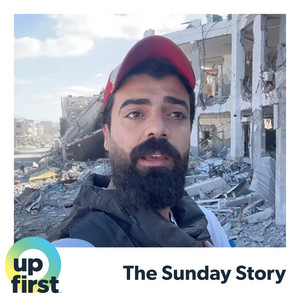
I'm Ayesha Roscoe and you're listening to the Sunday Story From Up First, where we go beyond the news to bring you one big story.
If you've been listening to NPR's reporting on Gaza over the past year and a half, there's a name you've likely heard.
NPR's producer in Gaza, Anis Baba.
With Anis Baba in Khan Yunus, Gaza.
That was NPR producer Anis Baba.
Anis Baba. Anis is one of the only Palestinian journalist in Gaza working full -time for an American news organization.
He's from Gaza City, and he's been NPR's eyes and ears on the ground.
He sends dispatches from hospitals, displacement camps, and bomb sites.
Dust everywhere. The balda of the guns and explosions all over the air.
Wherever you put your eye to the horizon, it's the same.
Destruction everywhere.
Anas does all of this with little more than a cell phone.
He works closely with a team of NPR journalists who've been covering this war from outside of Gaza.
Israel has banned international journalists from independent access to Gaza since Hamas' deadly attack on October 7th, 2023.
On January 19th of this year, a ceasefire deal between Israel and Hamas went into effect.
The ceasefire permitted Palestinians to return to the north of Gaza.
And today, we are returning.
Hundreds of thousands of people.
Literally hundreds of thousands of people.
Honest Babbo was one of them.
Nothing is still the same.
Got to keep reporting here.
Justine Yan is a producer for the Sunday Story.
She's been keeping in touch with Honest since he returned to Gaza City in late January to try and understand what it's like to be a reporter covering the war, while also living through it.
Justine takes up the story after the break.
Stay with us. for guests without interrupting your day.
Visit ADT .com. When every second counts, count on ADT.
Requires ADT Complete Pro Monitoring Plan and compatible devices.
Copyright 2025. ADT, LLC, all rights reserved.
This message comes from NPR sponsor Odoo Business Management Software.
Some say Odoo was like fertilizer because it promotes growth.
Others say it's a magic beanstalk, scaling with efficiency.
Odu exactly what a business needs.
Sign up today at ODOO .com.
Support for NPR and the following message comes from Boland Branch.
Change your sleep with the softness of Boland Branch's 100 % organic cotton sheets.
Feel the difference with 15 % off your first set of sheets at Boland Branch .com with code NPR.
Exclusions apply. See site for details.
I started calling Anas Baba after the ceasefire went into effect and he was home in Gaza City.
The only place he could find with a good internet connection was a cemetery next to a hospital that had generators.
So that's where he'd sit to talk with me about what he'd been through during this war and how home had been an idea that sustained him for 15 months.
I was always fantasizing how because I thought this road's going to be the first moment that I'm going to see my old neighborhood.
He said he wasn't sure what he'd find.
But as he walked down the street, reality sunk in.
The mosque of my neighborhood, it was totally flat into the ground.
He walked past a community kitchen.
And it was flat into the ground.
And another building that had housed 20 families.
It was flat into the ground.
and trying to tell myself that my house is OK, I do believe that my house is going to be OK." And in a way, it was.
Unlike so many other houses, his was still standing.
Anis' house is at the end of a small street.
It's four stories high with concrete verandas on the top three floors.
He said his father designed it to look like an Italian villa.
Anas lived here with his mother and father, his sister, and two of his younger brothers.
They all evacuated Gaza early in the war, and he hasn't seen them in almost a year.
So when he walked up to the front door of his house, he was alone.
He reached for the keys in his pocket.
But there was nothing left to unlock.
The doors were exploded.
I found shutters of the locust itself.
So the dream of unlocking my door was taken, so I just kept the keys inside my pocket and I entered the house.
Once I entered, I started to feel the beating of my heart going crazy.
All of the windows had been shattered by bombs.
There were gaping holes in the walls.
And on the third floor, he found an unexploded artillery shell.
Ana surveyed the damage, the broken glass and piles of rubble.
The kitchen was totally empty.
No cooking gas, no blades, no mugs, no spoons, nothing.
My house was super sad.
There was no people here in order to spread life.
I tried my best to stay strong but having that rush of emotions was good for me.
It really was good for me because I thought that I lost that sensation.
Onas is used to being in reporter mode.
On the on, on, on, on, on, go, go, go, go, go mood.
Yes, I can not even stop for a second.
And if I stop that means that I'm gonna fight that ghost inside of me.
Now the bombs have stopped, I think now is a good time to ask him to sit and think about what it's been like.
This is Aya Batrawi, NPR's correspondent in Dubai.
She's been working closely with Anas since the start of the war.
I still think he's in a little bit of a fight -or -flight mode, like, he hasn't really settled in yet.
Eija has covered the Middle East for more than 15 years.
After Hamas' attack on October 7th, her editors in Washington called her and asked her to fly to Israel to join the NPR team there.
Eija got on a plane to Tel Aviv the next morning, and she got her assignment.
From day one, I was told, call Gaza.
From then on, Eija was on the phone with Anas almost every day.
Trying to figure out how we tell the story together and what the story should be.
It was a very intense, very intense time.
In the chaos of that first week, Anas and Eja collaborated on several stories.
Anas would upload recordings and videos he'd gathered on the ground, and Eja would write the stories for the radio, including this one.
This is the sound of Gaza's biggest hospital al -Shifat.
All of its beds are full, like all of Gaza's hospitals, clinics, and medical centers, serving its population of 2 million.
Every functioning hospital is at full capacity, the stream of wounded and dead.
So he was there interviewing staff, documenting some of the cases coming in, just getting us information of what it was like on the ground.
And this was some of the last reporting Aya got from Onas in Gaza City, before he had to evacuate.
I remember having this call with him and he was like, okay, this is the situation they're telling us to evacuate to the south, all of Gaza City, it was kind of like panic mode.
Israel rained on paper leaflets across parts of Gaza's north telling residents to leave their homes.
Aya went on the radio again and again, trying to describe what was happening.
And there's Aya Betrawis, and Jerusalem, Aya, thanks for being with us.
Hi. Thanks, Scott. What do you hear from people inside of Gaza?
I've been talking to them all week.
It's been sheer terror and trauma.
They tell me the sounds of the bombs this time are different.
And even Israel has said that this war is different and that the response will be harder and harsher than Hamas has ever seen.
I can hear my voice quivering and going away because it had been such an intense week, already been like seven days of nonstop reporting, and calls and yeah like I can hear in my voice already like a sense of exhaustion.
I spoke with our producer in Gaza, Anas Babbah who also had to leave with his family.
He told me scenes of mothers carrying their babies and walking by foot for miles, fathers walking with kids on their back, young children having to walk for miles and miles.
and all of them trying to head south.
Anas documented every step of that journey.
I'm standing at the moment inside of Nassar Medical Complex in Han -Yunish -tay.
Sending dispatches to his colleagues in Israel.
I'm now standing in the middle of the rubble of what was, before, a peaceful neighborhood in Rofah -tay.
But sometimes, Eya didn't hear from Anas for days.
Was the phone line down?
Because they run out of fuel to keep their telecoms operating.
Or something was struck.
He had to use an eSIM, or was there like 3G or 4G available?
There were multiple communications blackouts during the war.
There is nothing like being disconnected.
It's a feeling that you don't know anything.
You are now able to understand what happens around you.
Just as Aya depended on Anis' reporting, Anas depended on Eja to help him see the bigger picture.
So that meant, sometimes, Anas took big risks, like moving closer to the Israeli border to connect to their cell towers.
I just put myself in danger in order just to get some internet near to the borders.
I can't stay there much more.
Eja and the rest of the team worried about Anas's safety.
When there were bombings in an area Anas was thought to be in, someone would reach out just to ask, Are you okay, is it near you?" And Anas would respond as soon as he could.
He was alive. And he had recordings for them.
Most mornings, Anas told me, he woke up at 4 a .m.
and began scrolling through updates.
What had happened while he was asleep.
The problem? It was at least 90 airstrikes every day.
So what am I gonna cover?
Am I gonna cover the airstrike on the school or the airstrike on the mosque or the airstrike that's on the hospital?
Or the airstrike that killed 100 person or is gonna be the children that were amputated?
One thing he always did was try to name the victims.
An Israeli airstrike targeted a house of Rafah.
The house that belongs to Shaheen's family, which is a airstrike, targeted a civilian house of R This is the sound of a mother that's more his 10 years old child.
She really lost a daughter before and now she lost another son.
It's too matcha. I wish that I do have a hundred clone of me that can be everywhere, to just document every single thing.
But it was impossible.
It all felt impossible for Aya Batrawi to.
After a few weeks in Israel, she went home to Dubai.
From there, she continued to work with Anas to tell stories from Gaza.
And that was a different sort of challenge.
I can't remember exactly when I came across it on Instagram, but this is like a collage by this group called Gaza poets.
And it sort of spoke to me so much because it's how I felt.
It's just says, in big black letters in the middle, Gaza is being bombed.
And all these tiny little words around it saying things like, I eat breakfast, won't Gaza is being bombed?
I read a book, won't Gaza is being bombed?
I laugh at a joke while Ghaz is being bombed.
I go to the gym while Ghaz is being bombed, I fall asleep while Ghaz is being bombed.
Reporting was actually like a really important way to release some of that pressure that was building up.
After the break, how Aya covered the war from afar.
While Anas only got closer and closer.
after. – This message comes from Comedy Central's The Daily Show.
John Stewart and the Daily Show News team are kicking off 2025 with brand new episodes, covering a brand new administration and a not quite brand new president.
While it may feel like history is repeating itself, it's never been covered like this.
With John Stewart behind the desk, kicking off every week, Comedy Central's The Daily show, new weeknights at 11 on Comedy Central, and streaming next day on Paramount+.
This message comes from NPR sponsor Dana Farber Cancer Institute.
Breast cancer cells multiply faster because of CDK46 proteins.
But what if blocking those proteins and stopping runaway cell division was possible?
Dana Farber scientists laid the foundation for CDK46 inhibitors, new drugs that are increasing the survival rate for many advanced breast cancers.
Dana Farber's Momentum of Discovery keeps finding new ways to outmaneuver cancer.
More at danafarber .org slash everywhere.
This message comes from HubSpot, where you can create content fast, get better leads, and crush reporting.
All in one place. Visit hubspot .com slash marketers to see how companies like yours are generating 110 % more leads in just 12 months.
We're back with a Sunday story.
I'm Justine Yan. For Dubai -based correspondent Aya Batrawi, as the war dragged on, it got harder to make sense of what was happening.
It's war. It's war, but it's also a war that was happening so quick and so fast, and one that had the full backing of the United States.
And also, there are certain numbers that certainly have defied the history books, like Oxfam reports that more women and children were killed in one year of war in Gaza than in any other war in decades.
The Committee to Protect Journalists says more journalists were killed in Gaza than any war on record.
Same with healthcare workers, civil defense rescue workers, like the list goes on and on.
I really had to think, how do you tell the story of Gaza?
Everywhere she looked, there were images of atrocities.
Men, women, children, injured and killed.
It was live -streamed every day on like every platform.
TikTok, Instagram, Facebook, Instagram, WhatsApp.
People saw and had access to see everything.
Everywhere she went, everything she did, she thought of Gaza.
Her own life outside the frame of the war felt unfair.
Like why are my kids able to just bike?
Stub their toe, cry for an hour and get ice cream?
And like all these other kids are like dying, these very slow painful deaths under the rubble.
There's such a disconnect that for me was a moment where I felt like, I don't know if I can keep doing this.
I don't have the luxury to tap out.
Like you have to keep going.
You have to keep reporting.
This is what you do.
You have to keep documenting.
It became our only way to cope with a feeling of helplessness.
It's because every single aspect of this conflict has been under dispute or questioned.
Starting with death tolls, the number of dead, who died, how they died, why they died, even just the number of aid trucks going in, you'd think that's a pretty straightforward thing to count, it's not.
AYA made phone call after phone call to doctors, rescue crews, and aid workers on the ground, trying to verify the basic facts.
And while doing that, she'd also call on us.
And a lot of times it would just be venting frustrations, just being there for each other as colleagues.
Reassuring each other that what they did mattered.
And then there's also just the element of like, how are you?
How are you? You know?
What did you eat for breakfast?
Did you get food today?
Um, did you sleep well?
Once I return from any documenting an airstrike, I feel that I'm still doing nothing.
The burn of blood and flesh after an airstrike.
I do wish that no one truly knew and can can smell it in his life.
In the south, Anas was displaced again and again.
He lived in his car.
That's where he slept at night.
I do suffer from insomnia.
I'm not gonna lie about that, I cannot sleep that much.
He was always hungry.
Annas has lost almost 70 pounds since the start of the war and there were days he couldn't eat because of what he saw.
The repetition of bombing evacuation and bombing again.
It's the cycle and the loop never ends.
That just keeps going and going and going.
but that takes you more and more and more and more to the same spot always none always anxious always on your toes.
Anas has often been among the first to arrive at the scene of a bombing.
Several times he's tried to save someone's life.
After one airstrike in Alberage central Gaza Anas found a group of people trying to rescue women and children trapped in a building that had just been bombed.
It was a human chain.
So he joined it. Someone passed him a young woman.
She was semi -conscious and couldn't breathe.
He carried her out of the building.
And I started to take out most of the sands and even small diaprise of sand and cement out of her own throat.
Once I just make sure that it's opened, I started to give her a CPR and she took the first exhale and inhale and opened her eyes." There's no footage of this moment, because Anas had put down his phone.
He wasn't reporting anymore.
It took more than 15 months for the bombs to stop.
The day the ceasefire went into effect January 19, 2025.
It was also Anna's birthday.
He turned 31. About a week later, Anna set out on the coastal road towards Gaza City.
It was a seven mile walk north.
He was surrounded by thousands of other Palestinians also heading home.
Aya Brahtawi called him a Carl Popping How do you feel I feel like I'm flying to me It was a march and a celebration.
People were waving Palestinian flags, singing, chanting, playing drums.
Reunions were happening all along the road.
People who had stayed in the north during the war were meeting people who had been displaced to the south.
Anna spoke to a woman who hadn't seen her son in 16 months.
He left as a boy, she said, and now I meet him as a man.
I'm feeling that there is like shiver all over my body, electricity that's just like gives me more energy to keep going, to keep working.
I'm grateful. I'm feeling that with every step that but I'm just like putting here, it's me back.
As he and the crowds got closer to Gaza city, Aye reminded him to take in the moment.
Wait, I want you to just...
Like you said the sea is on your left the Mediterranean, the coast.
Uh -huh. Can you just like take a big breath of like the fresh sea air for me?
I read this book… saying, Hallelujah!
As Allah chose Allah, who acted not alone, Who acted not alone.
When Annabaras finally returned to his house, it was not as he remembered it.
He found the shattered lock, the empty kitchen, the unexploded artillery shell.
But there are some signs of his former life, like his garden.
I do have lemon tree, I do have a palm tree, I do have an olive tree.
And they got bigger, to be honest.
It all gave Anas an almost irrational hope.
I started to shout, is anybody here?
Is there anyone inside the house?
To be honest, I wanted my mother or my sister or maybe my brothers to answer me and to say, yeah, we are here.
We're waiting for you.
Well, no one answered me.
And when I entered my own parent room, But I felt a little bit brokenhearted that I didn't find my father and my mother just to scream on me, to, go out!
You need to knock first.
Did you really think that they would be there?
Just thinking after 16 months of war, we didn't have anything in our lives that we can control to accept of our dreams and our fantasies.
And so Anas went from room to room, letting the house welcome him home.
I laid on every single person of my family bed for around one minute.
Even though it was dusty and super dusty, but it was just like I'm embracing them.
Anas's family is now in Europe, seeking asylum, home, but so far they haven't received it.
They're not classified as refugees.
So they're in limbo, waiting.
I only call them once a month for ten minutes.
You only call them once a month?
Yes, because I don't want them to be attached to me, because maybe in one day at any moment I'm going to be killed.
Because I told them since the start of this war that I want to here and I want to keep doing what am I doing.
In the first days of being home, Anas started settling back in.
He wanted to fix his house.
There was a lot to do.
That leak on the roof, those windows without glass, damage to the walls.
He went to the market and bought some materials.
I started to buy some plastic wraps and even I was planning to have some bricks in order to build again the the most damaged areas of my house Anas and his neighbors even made plans for rebuilding the neighborhood.
We can live with the dust.
We can live with the dep comprise We learned by the hard way That's always be fast.
We don't have that much time in our lives Then, just a week after Palestinians were allowed to return to Gaza city, President Trump gave a press conference with Israeli Prime Minister Benjamin Netanyahu.
I also strongly believe that the Gaza Strip, which has been a symbol of death and destruction for so many decades and so bad for the people anywhere near it.
And especially those who live there.
And frankly, who's been really very unlucky.
It's been very unlucky.
It's been an unlucky place for a long time.
Being in its presence just has not been good and it should not go through a process of rebuilding and occupation by the same people that have really stood there and fought for it and lived there and died there and lived a miserable existence there.
There was no reason, Trump said, for Palestinians to stay in Gaza.
It's right now a demolition site, this is just a demolition site.
And he put forward a plan.
The US will take over the Gaza strip and we will do a job with it too, we'll own it.
Anas put his own plan to rebuild his house on pause.
I started to feel that Mr. President Donald Trump is just giving me and the other people of Gaza the chance to say goodbye for one last time for our houses before he takes it from us, and just like the farewell.
It's been cold in Gaza City.
Anna sees people, often children, searching the rubble for firewood.
I reached to a point four days ago that I burned one of my house doors.
Yes, I took it off.
So yesterday, I took some of the root, I started the fire, and I started to think what am I going to eat today.
Thank God I grabbed some tomatoes with me, five eggs, a chili pepper, and some olive oil, and I made a shakshuka.
Yes, it's an Arabian Palestinian dish that we truly love.
So, I made a shakshuka, which was the first time, to be honest, in 15 months to eat it, and I was super, super, super happy with that, with the result.
Then, he heard a knock on the door.
It was his neighbor.
And he told me that I smelled that you made a fire.
The neighbor asked if Annas could spare any wood.
I told him, yes, I do have it.
So do you wanna - and he told me, yes I wanna give it to him.
And he told me that he wants for his own daughter that she got birth two weeks ago and he needs to keep the room as warm as possible.
I told him, yes, for sure.
And if you need any woods, I'm gonna go, like I can't take off another door for you.
And so instead of rebuilding, for now, Onas will keep taking the doors down from his house, for himself and for his neighbors.
We truly can live without anything.
But you cannot take the dignity which is called Al -Karami.
So the last thing that anyone can take from you is your dignity.
Our land is of our dignity.
The ceasefire remains fragile.
The first phase of the deal between Israel and Hamas ended on March 1st, with no agreements as to what comes next.
On March 2nd, Israel blocked all goods and humanitarian aid from entering Gaza to pressure Hamas into a different deal, one that frees more hostages but does not end the war.
Anas Baba continues to report for NPR from Gaza City.
— This episode was reported and produced by Justine Yann, additional production by Adelina Lancionis, editing by Jenny Schmidt, fact checking by Will Chase, and audio engineering by Jimmi Keel.
Thanks to Aya Batraui, D .D.
Schenke, Daniel Estrin, and Mary Glen Denning.
The Sunday Story team includes Andrew Mambo, Kim Naderfang, Peterson and our senior supervising producer, Liana Semstrom.
Irene Noguchi is our executive producer.
I'm Aisha Roscoe, up first is back tomorrow with all the news you need to start your week.
Until then, have a great rest of your weekend.
This message comes from Rinse.
These days, you can do a lot from your phone.
Book a vacation, buy and trade stocks, but you can also make your dirty laundry disappear.
And then reappear, washed and folded with rinse.
Schedule a pickup with the Rinse app, and before you know it, your clothes are back folded and ready to wear.
They even do dry cleaning.
Sign up now and get $20 off your first order at rinse .com.
That's r -i -n -s -e dot com.
Support for NPR and the following message come from Rosetta Stone, the perfect app to achieve your language learning goals no matter how busy your schedule gets.
It's designed to maximize study time with immersive 10 -minute lessons and audio practice for your commute.
Plus, tailor your learning plan for specific objectives, like travel.
Get Rosetta Stone's Lifetime Membership for 50 % off, and unlimited access to 25 language courses.
Learn more at rosettaestone .com slash NPR.
This message comes from your part -time controller.
They're experts in nonprofit accounting and their services are customizable to your nonprofit's specific needs.
Learn more at yptc .com.