This BBC podcast is supported by ads outside the UK.
Then, it evolves with you at each step.
Make security and conformity a force.
With Shopify, get all the good tools to sell.
Design tools to develop your brand.
Marketing tools to arouse the interest of more customers.
And sales tools to expand your field of action.
Online, on social media, in person, and even more.
From small companies to multinationals, Shopify tools support your growth.
You can thus focus on what you do best.
This is the Global News Podcast from the BBC World Service.
I'm Keith Adams, and at 5 Hours GMT on Friday 27th February, these are our main stories.
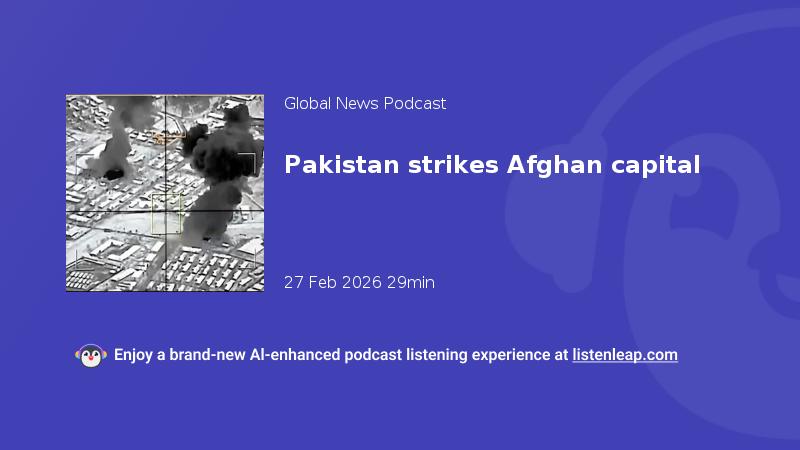
Pakistan has bombed the Afghan cities of Kabul and Kandahar in response to cross-border attacks by the Taliban.
Netflix has backed out of its bid to buy Warner Brothers Discovery, potentially clearing the way for its rival, Paramount Skydance.
And the governing Labour Party in Britain has suffered a historic by-election defeat at the hands of the Green Party.
Also in this podcast, the plaintiff in a landmark trial in California on whether social media platforms are addictive for children has been testifying about her use of Instagram and YouTube harmed her mental health.
And...
They're so cute.
I feel like the Pokemon characters are just really adorable.
You get attached to them and I think that's how people overseas started getting interested too.
30 years of Pokemon.
We start in Pakistan, where the Defence Ministry says it has declared open war on the Taliban in Afghanistan, with military jets bombing parts of Kabul, the capital, as well as the city of Kandahar.
The strikes follow escalating fighting over the two countries' shared border, with the Taliban attacking multiple Pakistani positions.
Earlier, the Afghan Taliban said their forces had attacked Pakistani border posts, killing at least 10 soldiers, while a spokesman for the Pakistan Prime Minister said more than 70 Taliban combatants had been killed.
Cathy Gannan is a former AP news director for Pakistan and Afghanistan.
She told my colleague Steve Lai more about this unfolding story.
I mean, it's a serious escalation.
So I think that's one thing that's very important, but it's not new.
And Pakistan did hit the Afghan capital in a series of attacks several months ago as well.
And then after several attacks in Pakistan carried out by the Pakistani Taliban, who Afghanistan says is finding safe refuge in Afghanistan, in which the UN does say no.
There are probably about 10,000 Pakistani Taliban in Afghanistan.
So in response to those initial attacks, Pakistan hit Afghanistan and really hit it hard.
And there were a lot of reports of civilian casualties.
The Taliban responded.
And now this is a response to the Taliban's response.
So it's really a continual tit for tat.
It's just the escalation that is really difficult.
And it's really problematic for the entire region.
There's also shifting alliances in the region between Afghanistan is closer to India, which is a longtime enemy of Pakistan.
It is a nuclear-armed region.
The escalation in tension now between Afghanistan and Pakistan is really beginning to peak, and it's hard to understand why.
Where does it go from here?
What's the next step?
How much can you do?
The okay?
Pakistan hits Afghanistan, Afghanistan hits Pakistan, and always along the border region, except for these forays deeper into Afghanistan by Pakistan hitting Kabul.
And again, it isn't the first time, but it is a dangerous escalation.
And just help us understand the context then when it comes to the Taliban.
I mean, they have a presence.
There is a Pakistan Taliban as well.
Is Pakistan going after them?
How does it all fit?
Because, you know, the Taliban weren't ruling Afghanistan going back years.
It's only a fairly recent thing.
Sure, absolutely.
There are Pakistani Taliban in Afghanistan along the tribal areas.
There's also other militant groups here in Pakistan.
There's the Baloch Liberation Army.
It's certainly the presence of the Islamic State.
There's the Islamic State in Khorasan province.
And then there's also a new, not a breakaway, but a subsidiary of the Islamic State in Khorasan province that has emerged in Balochistan in Pakistan, and that's the Islamic State Pakistan province.
And then you also have the militants in Afghanistan.
And one thing to understand in this region is every country in this region uses militants as proxies.
Pakistan uses them against India, India against Pakistan and Afghanistan against Pakistan and within their own warring groups.
So it's a really difficult situation.
And as it escalates, it's really difficult to No, where does it go from here?
Who else gets involved?
What does that involvement look like?
And add to this Stephen, I'll just mention, is the isolation of the mostly Western world of the Taliban.
You're not on the ground in Afghanistan.
So understanding the complexities is very difficult from a distance.
And unfortunately that is where we are in most Western countries, looking at it from a distance, despite occasional visits by the intelligence agencies which we all know.
So it really is a worrying situation and it's not really clear where it goes from here, you know, and how much more you can have this back and forth that it doesn't escalate beyond that.
Cathy Gannon speaking to Steve Lye.
The BBC has uncovered video footage and numerous eyewitness accounts of the killing of a 14-year-old Palestinian boy by Israeli soldiers in the occupied West Bank last November.
Jad Jadallah was shot at close range but tried to run away before collapsing.
Most shockingly, the footage appears to show that the child was left with no attempt to administer first aid at any point.
Our correspondent in Jerusalem, Joel Gunter, has been talking to Jad's family and looking at the video footage.
You may find some of what you hear in this report distressing.
Jad was born and raised in Al-Farah refugee camp in the occupied West Bank.
His father, Jihad, took us to the place where he was shot.
Hold on.
Hold on.
He's showing us the bullet holes where Jad was shot, and CCTV video shows Jad and his friends in this spot, when Israeli soldiers appear just a few metres away.
First, you see Jad's friend run up the alley.
Then you see a soldier, who appears to raise his rifle and shoot from close range.
Jad appears to be hit before running a few metres and collapsing.
The Israeli military has accused Jad of throwing a rock which can, under their rules of engagement, permit them to respond with lethal force.
But this sequence shows an Israeli soldier dropping something next to Jad after he was shot.
The object seems to be heavy.
The soldier steps back before stepping forward again and appearing to take a picture.
Jad's mother, Safa, says this footage shows the soldier planting a rock to frame her son.
They dropped a stone by his hand so they could frame him and make it look like he was throwing stones at them.
Anyone who watches the video will see it.
The Israeli military told the BBC they gave Jad initial medical treatment, but they refused to give any more detail.
In the video, the soldiers appear to ignore repeated attempts by Jad to get their attention.
Local paramedics arrived on the scene within minutes, but were blocked at gunpoint by Israeli soldiers.
One of them told us they could have saved Jad's life.
We tried to tell them to move forward.
We tried to advance several times, tried signalling them to let us reach the child, but we were completely blocked.
According to the UN, Israeli forces have killed 227 Palestinian children in the West Bank since the October 7th attacks.
In some cases, including Jad's, they have refused to return the body.
The families say it is deliberate cruelty.
I want to die.
I want to be buried.
I want my son.
I want to bury him.
They have the right to bury their children.
I want the right to bury my son.
They already killed him, but they won't give him back to us, and we don't know why.
We asked the Israeli military why they haven't returned Jad's body, but they declined to answer.
The bidding war for the Hollywood studio and media company Warner Brothers Discovery appears to be all but over.
Paramount Skydance has been in a battle with Netflix to buy the business since December, but in the last few hours the streaming platform has, in effect, pulled out of the race, saying it would not raise its current takeover offer.
Our business reporter, Nick Marsh, is following developments from Singapore and told me more about what Netflix was prepared to fork out in comparison to Paramount.
So slightly different offers.
Netflix was offering roughly 83 billion for Warner Brothers Film Studio and for its streaming services, so things like HBO Max.
Paramount said, well, look, we want everything.
We're going to offer $110 billion.
So that means films TV HBO Max, but also the traditional networks, so things like the Discovery Channel and also CNN, very interestingly.
Yeah.
For a long time, the Warners board said, we like the Netflix offer.
It's cleaner.
It's an all cash offer.
It doesn't require debt financing.
And plus, it's not for the whole business.
So maybe there'll be a little less regulatory scrutiny.
You know, you've taken over so many different media assets.
Shareholders, though and we see this a lot in business they want different things sometimes to the board.
Quite simply, Paramount was offering more dollars per share as part of its offer.
So we thought well look, we're in for a months-long saga where everyone's trying to up their bids, a bidding war.
But now Netflix has just said, nope, we're out, that's enough.
And it looks like it's all Paramount's, basically.
Right, so money talks in this deal.
It's a bigger deal if Paramount win.
Why did Netflix pull out, though?
I mean, it seems like they still were in with a shot, no?
Yes, so money talks, but that's not the whole picture with this, because there's also politics at stake.
So on the face of it, Netflix has said, we just don't want to up our offer.
We just don't want to carry on.
It's just not worth our while.
Netflix, though, realistically could have upped its offer.
You know, it could have afforded to match Paramount, really, and to exceed Paramount.
What's interesting is that Ted Sarandos, so he's the co-chief executive of Netflix.
He was at the White House yesterday.
He was meeting with Susie Wiles, Donald Trump's chief of staff.
We don't know what was said in that meeting, but clearly this decision has come straight off the back of that meeting.
And the fact of the matter is that Paramount Skydance is backed by Larry Ellison and David Ellison.
They are big Trump supporters, big donators to his political campaigns.
And there has always been this swirling inference that they were the preferred bidders because, quite simply, they are Trump allies.
This is going to draw a lot of scrutiny in the sense that if Paramount Skydance does go ahead and acquire Warner Brothers, what's going to happen to networks such as CNN?
What's going to happen to just the general media landscape?
Because we're talking about a behemoth here.
We're talking about all of Warner Brothers, plus all of Paramount Skydance's assets, all coming under one umbrella.
Nick Marsh.
Next.
Do you recognise names such as Snorlax, Bulbasaur or Pikachu?
30 years ago today, a game called Pocket Monsters was released on Game Boy in Japan, later known as Pokemon.
When it burst onto the global scene,
Audiences were introduced to a universe of magical colourful creatures with special powers, ranging from flying, spitting fire or sparking electricity.
It's become one of the world's highest grossing media franchises, with an anime series films, video games, Pokemon Go and playing cards.
So why is it so popular?
It's because it's cute.
They're so cute.
I feel like the Pokemon characters, their voices and everything are just really adorable.
You get attached to them, and I think that's how people overseas, people outside of Japan, started getting interested too, and how more fans came on board.
You have a story.
It's such a good conversational point and like communication starting with loads of friend groups.
I really like how cute they are.
Yeah, my favourite Pokemon are all the cute ones.
Well, our correspondent Shaima Khalil is in Pokemon's birthplace, Tokyo.
I asked her, what's the secret behind the franchise's success?
I think there are two things.
One is, if you're talking in today's theme, it became viral before viral existed, right?
It was everywhere.
And I remember kids in the playground showing off their cards, opening up these packs.
And if one of the kids got the rare card, they were kings or queens for the day.
They had folders and folders of them.
But also there was the anime.
There was the Game Boy.
God, I'm aging myself.
And, of course, there were the characters you know Pikachu, or Pikachu depending on where you were, and Snorlax, my favorite.
There were so many.
And I think it's the fact that you trained them, you caught them and it felt like an accomplishment.
And like one of the fans said, it was a conversation starter.
And they were everywhere.
They were on Nintendo.
They were physically, you know, you could physically change those cards and trade in them.
And they were fun and games for some, but then through the years they became really serious business where rare cards right now can fetch you tens and if not hundreds of thousands of dollars.
And of course, there are the cartoon characters and the merch.
There's just merch madness everywhere, including, of course, the all-important soft toys.
So I think it's the fact that the characters... were very, very likable.
And they kind of crossed generations from physical cards to actually through the years catching Pokemons.
Shima, you're much too enthusiastic about this story, I think.
Just briefly, how's it been celebrated?
Well, in true Japan fashion, there is a theme park, of course, an all Pokemon theme park that opened this month, just in time.
And of course, there are rare collectibles like coins and cards, if you can get your hands on them.
Shaima Khalil in Tokyo there.
Still to come in this podcast.
The thing about many of the words that we struggle with is they've come through so many different languages and sort of morphed along the way.
So spelling is one of the trickiest educational journeys I think any of us will ever make.
Can you spell the words many British schoolchildren struggle with?
Pour une entreprise, la sécurité et la conformité mal faites, c'est un vrai casse-tête.
Mais bien penser et exécuter, c'est simple, c'est Venta.
Venta aide votre entreprise à gagner la confiance de vos clients et à aller plus vite, sans tableur et sans stress.
De la start-up au grand groupe, Venta automatise la conformité et la gestion des risques grâce à l'IA.
Puis, elle évolue avec vous, à chaque étape.
Avec Shopify, obtenez tous les bons outils pour vendre.
Des outils de design pour développer votre marque, des outils de marketing pour susciter l'intérêt de plus de clients et des outils de vente pour élargir votre champ d'action.
En ligne, sur médias sociaux, en personne et bien plus encore.
De la petite entreprise à la multinationale, les outils de Shopify supportent votre croissance.
Vous pouvez ainsi vous concentrer sur ce que vous faites le mieux.
Sign up for a trial period of 1 euro per month on shopify.fr slash audio.
Go to shopify.fr slash audio to pass your mark to the higher level of today.
At La Massif, the word of our businessmen will always be our best advertising.
Jason Auguste, businessman at La Massif.
Virtualism is a spirit of sharing, it's something that has value.
Because when we are united, we are stronger.
This is the Global News Podcast.
Bill Clinton's relationship with the late sex offender Jeffrey Epstein will come into focus later today.
The former US president has never been accused of any wrongdoing, but features in the notorious Epstein files and admits he flew on the billionaire's plane several times.
He'll be questioned by the House of Representatives Oversight Committee, the same panel that his wife, the former Secretary of State Hillary Clinton, appeared before on Thursday.
The chronology of the connection that he had with Epstein ended several years before anything about Epstein's criminal activities came to light.
But I think it is fair to say that the vast majority of people who had contact with him before his criminal pleas were like most people.
They did not know what he was doing.
And I think that that is exactly what my husband will testify to.
While Bill Clinton has denied wrongdoing and expressed regret for his association with the late paedophile, our North America correspondent, Simi Jola Osho, told me more about what we can expect from Mr Clinton's testimony in front of the committee.
As you've touched on there Keith, there's more about former President Bill Clinton in the Epstein case files than anything on his wife, Hillary Clinton, including his name appearing in multiple flight manifests for Epstein's private jet in the early 2000s, photos of him with Jeffrey Epstein and with Ghislaine Maxwell like the one of him taking a night swim alongside Ms.
Maxwell.
What did he or his security ever see or hear when he was on Epstein's plane?
After her deposition, Hillary Clinton was asked whether she was confident about Bill Clinton being questioned.
And she said she is.
She said that Jeffrey Epstein's predatory behavior could have been stopped if he didn't get what she called a sweetheart deal in 2008.
And that she believes her husband would testify that he didn't know of Epstein's crimes.
What about the hope that they had the Clintons, that they would kind of set a standard, that high level names would come before the committee, in particular Donald Trump?
Could that happen?
Well, the Clintons' testimonies could help establish a sort of political precedent or expectation that other prominent figures should also cooperate and testify about their knowledge properly of Jeffrey Epstein.
Lawmakers could say Democrats have testified, now Republicans should too.
But after Hillary Clinton's deposition today, House Oversight Committee members were asked whether President Donald Trump would be called to testify, seeing as he's also mentioned in the, And the Republican committee chair, James Comer, said that President Trump has already answered questions from the press regarding his relationship with Jeffrey Epstein and that President Trump has already been transparent by releasing some of the Epstein case documents.
Committee member Republican Representative Anna Paulina Luna also claimed that the committee had spoken to survivors of Epstein's abuse and she claimed that they exonerated the president.
Donald Trump himself has denied any wrongdoing in relation to Epstein and believes that too much attention is being paid to the Epstein files.
The governing Labour Party in Britain has suffered a historic defeat in a by-election at the hands of the Green Party.
It's the first time the Greens have won such an election and it will pile more pressure on the unpopular Prime Minister, Keir Starmer.
Just before we recorded this podcast, I spoke to our UK political correspondent, Rob Watson, who's in the north-western English constituency of Denton and Gorton, where the by-election took place.
Rob, this is a spectacular defeat for Keir Starmer and his Labour Party, isn't it?
It is a seismic defeat, because this is traditionally one of Labour's absolute rock-solid, safest seats, made up as it is of a large Muslim community, which normally votes Labour, and a large white working class voters.
But they have deserted Labour.
And I think it just shows you how much anger and volatility there is out there in British politics.
But it's not just about Labour, because it's worth remembering that the previously governing Conservative Party they also did spectacularly badly.
So this is a plague on the mainstream parties in British politics.
And the Green Party, tell us about them.
Why are they significant and how have they managed this feat?
So, like other green parties in Europe, they have become more than just eco-warriors, if one could put it that way.
They're now firmly on the left in terms of economics.
They're very much in favour of taxation on the rich, of nationalising large parts of the economy and make the case that essentially working people work hard, as they put it, to line the pockets of billionaires.
I mean.
What's also been very controversial about their victory here though, is that the Greens are very pro-Gaza, very anti-Israel, and they have been accused of blatant sectarianism by constantly raising the Gaza issue, particularly in the parts of the constituency here with very large Muslim populations.
You talk about this being a blow to the two-party tradition in British politics.
Is this a blip or are we going to see a return of those two parties?
What do you think?
Well, I think the by-election result tends to confirm what we've been seeing over the last few months and indeed couple of years, and that is a fragmentation in British politics.
British politics becoming more like European countries, where the sort of two main parties have broadly centred and left since the Second World War, suddenly find themselves in deep, deep trouble and profoundly unpopular now.
Whether this continues, whether it's a blip, it is hard to say.
But I think all the evidence tend to suggest that what's driving this volatility, that is, concerns about stagnating living standards, a sort of sense that nothing in British works, a concern for some about immigration, that those factors that are driving this volatility driving voters towards populists of the left like Green, populists of the right, like the anti-immigration reform that unless those issues are somehow solved, one feels this volatility will continue with all sorts of consequences.
Rob Watson, next to California, where the plaintiff in a landmark trial on whether social media platforms are addictive for children has been testifying about how her use of Instagram and YouTube harmed her mental health.
Lawyers for the plaintiff, known as Kaylee GM, in court claimed that Meta, the owner of Instagram, and Google, which owns YouTube, aim to profit from children becoming hooked on their services, despite knowing it could harm their mental health.
Both companies deny the allegations.
Our correspondent, Peter Bowes, has been in court in Los Angeles and told me more about what the plaintiff had to say.
Well Keith, she went into a lot of detail about her social media use from the age of six when she said she started to watch YouTube.
By the time she was eight, she had set up her own YouTube channel.
And she said at that time she didn't really encounter any difficulties because of her young age.
She said if there'd been any small print about age restrictions, she hadn't noticed.
Reddit, so implying that it was actually quite easy to get onto the platform.
By the time she was 10, she posted more than 200 videos and she in fact had multiple YouTube accounts and Instagram accounts, and she said the reason for that was that she wanted to use these other accounts to like what she had herself posted on her other accounts.
And she wanted likes.
And she said when she didn't get them or when she lost subscribers, she was very upset.
She said, and sad.
She said, it would make me feel like I was not worthy.
She also told the jury about cutting herself.
She said it.
It wasn't an attempt to take her own life, but it was a coping mechanism to deal with depression.
She had said she'd been bullied and made to feel fat or ugly in social media.
So have the tech firms had a chance to defend their platforms at this trial?
They have certainly had an opportunity in the last couple of hours to cross-examine Kayleigh.
And we've already heard from certainly Instagram's lawyers suggesting that it's her upbringing and her relationships with her family and her parents in particular. that are to blame for her mental health problems.
They say it's nothing to do with an addiction to their platforms.
And in fact she did talk about the relationship especially that she had with her mother, which she said at times was difficult, although earlier in the day that she said she had a very good relationship with her mother then and now.
But that is certainly the defence that...
Whatever problems she has suffered during her life were nothing to do.
They claim to an addiction and nothing to do with a deliberate attempt by the social media companies to make people like Kayleigh addicted to the platform.
Peter Bowes in LA.
One thing every child has to learn is how to write in their own language, but they don't always get it right.
A new survey of school pupils here in the UK has revealed the most commonly misspelt words.
The list includes the words February, licence and definitely.
Teachers say that what they call spelling uncertainty can undermine writing confidence.
So should we worry about those words, we just keep getting wrong.
Adrian Childs asked the lexicographer Susie Dent for her analysis.
The word physique, that's a really tough one for anyone to learn.
I looked it up and lo and behold, in its earliest days, we actually spelt it with an F.
So we had kind of made it easier, although it came from Greek.
The thing about many of the words that we struggle with is they've come through so many different languages and sort of morphed along the way.
So spelling is one of the trickiest educational journeys I think any of us will ever make.
Until the days of printing, which obviously standardized spelling because information could be disseminated much more widely.
It was glorious in a way.
It was full of words from local dialects.
Shakespeare famously, his name was spelled in so many different ways in his lifetime.
He himself spelled it differently on his will.
I think not twice, but three times.
So it was very chaotic.
And I think because people weren't traveling particularly widely, it didn't matter quite as much as it does today.
So many of these have lovely etymologies, which in turn can help you learn the spelling.
This is school pupil, so this might be different for adults.
But the most misspelt words, according to this survey, the top one is sketch.
Is it the T being missed out?
Possibly the T, for sure.
Yes, that's a good example.
I think the second one was mischievous, which I'm pretty sure is now being spelt mischievous because that's how it's being spelt. because people are moving it towards devious, a word that they're familiar with.
And I think in the study actually several experts were quoted and said this isn't just sort of sloppiness.
It is a recognition of how A English is evolving, but also how people are getting rid of unfamiliar sounds and moving towards ones they are familiar with.
And English has always done that.
Not to say at all that spelling isn't important.
It is.
But For me, the joy of it is to kind of link to our history.
Little, tiny footprints of one person who may have changed the spelling of a word, put an H in ghost when there wasn't one, because it seemed right to them.
And so learning spelling through etymology, I think, can be a joy.
Susie Dent on the joys of spelling correctly and incorrectly.
I'm Keith Adams.
Until next time.