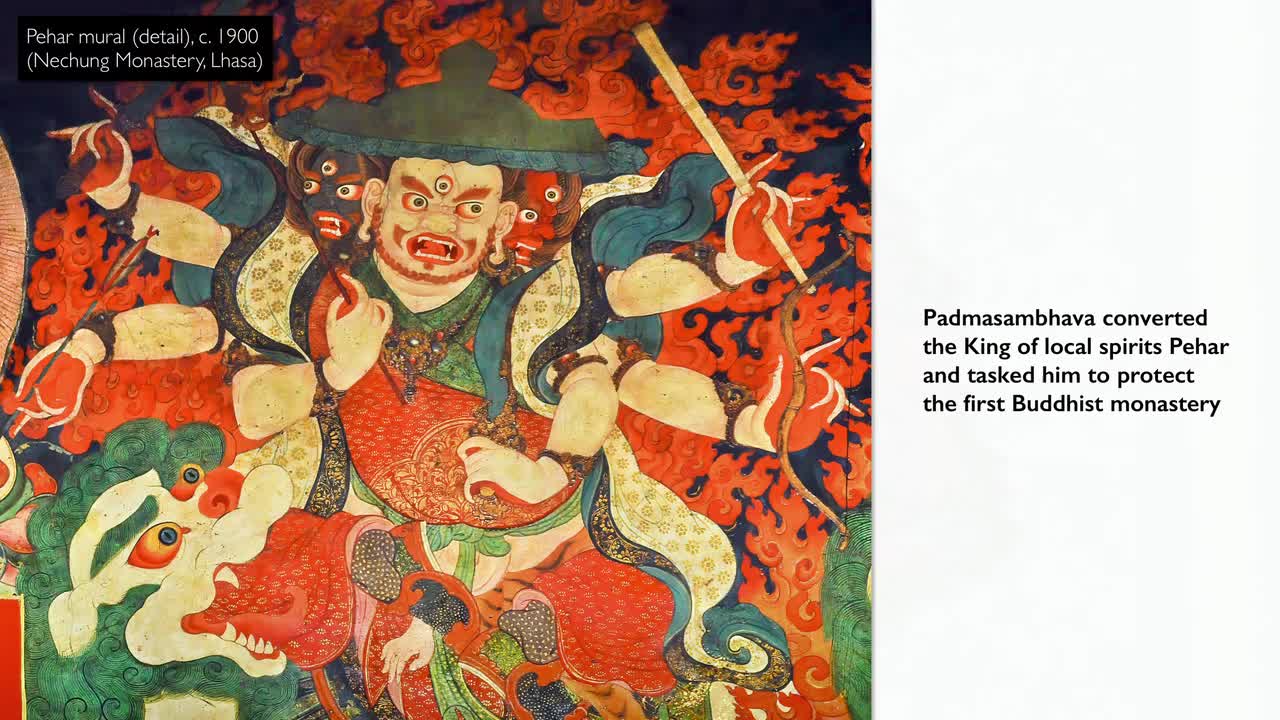
We're looking at an absolutely gorgeous painting from Bhutan that depicts the eight manifestations of Padmasambhava.
According to multiple biographies, Padmasambhava was an Indian Buddhist master and tantric practitioner who was invited by Tibetan king to help him convert Tibetan land and Tibetan people to Buddhist tradition.
Part of what he was able to do was to quell the quarrelsome gods of Tibet of the land itself, because they were not happy with the introduction of this foreign religion.
As described in the biographies,
And according to tradition, he arrived in Tibet in the 8th century.
So Padmasambhava is the central figure you see in the painting.
But a little detail shows a procession with a parasol and this probably depicts his arrival to Tibet.
Let's spend just a moment explaining what eight manifestations mean in the context of this painting.
All of these figures around the central, starting from the top figures and then the figure in monk's robes holding a bowl, and then flanking figures on the right and left and two fierce figures in the lower corners all of these figures, in fact, are aspects, if you will, of the same central figure.
Let's start looking closely in the upper left corner.
There's this wonderful scene where we see this very small figure who seems to be floating on a lotus blossom.
Padmasambhava translated from Sanskrit means the lotus born.
And here we have Padmasambhava being born from the lotus.
And it's a little vignette that tells the story of how he was discovered by a king on the lake and then brought back to the kingdom and installed as a prince.
Let's move to the largest central image.
We see this figure who sits cross-legged on a lotus, surrounded by a wreath of lotus blossoms.
There's this rainbow halo, and beyond that he's framed by this magnificent foliage.
Padmasambhava wears a lotus hat topped with a vajra.
He holds a vajra in his hand and also holds a skull cup.
There is a staff resting on his shoulder, which has three different heads, if you will.
A fresh skull, a decomposed head, and then a freshly severed head.
And on top is a flaming sword, which usually represents blazing wisdom.
The staff's tip is also a trident.
Altogether, this is a staff of a Siddha, someone who mastered tantric practices and gone beyond the conventional understanding of reality.
The clothes that the central figure wears are magnificent.
Look at the way that they flow and you get such a clear sense of the way in which one garment drapes over another.
The outer red shawl is actually the same garment that monks would wear.
But then his other garment, which is richly brocaded and has a sash and long flowing sleeves, is the garment of a king.
The image on the lower right is just amazing.
We're looking into a cave and there we see what seems to be a teacher and a disciple, but in back of them is this mandala and five figures that arch above it.
I think this references a moment of tantric initiation or empowerment in which the mandala is visualized and the five deities above are the five directional Buddhas.
For Tibetans in general, because they came to encounter and practice Buddhism slightly later than all of the countries that surrounded Tibetan kingdom at the time.
Teachers or people who were the source of Buddhist teachings and knowledge were considered equal to the Buddha himself, because only through those teachers they could get the access to the tradition, and Padmasambhava being one such, and maybe one of the most legendary and famous ones, he is often referred to as the second Buddha.
For that reason, The skull cup that he holds and these three heads on his staff refer to this idea of impermanence and freedom from attachment, whether to physical phenomena such as our own bodies or anything that is considered to be real.
And then two figures on the left and right of Padmasambhava, also depicted on lotuses, are his two consorts.
Of the things that i'm really struck by is the attention to architectural detail, usually in narrative paintings.
Architecture or elements of landscape often serve as the framing element for the narrative vignettes, but at the same time they can serve the purpose of referencing various sites.
If we look at the lower center, we see this golden stupas with a red door that invites people to come in.
And scholars think that this is a reference to the Buddhist site of Bodh Gaya, the site of the Buddha's enlightenment.
Because in Padmasambhava's biography, he is said to have studied with learned scholars and practitioners in Bodh Gaya.
Let's spend just one moment looking at the extraordinary, wrathful figure in the lower right.
The form we see here is called Doja Droller and, according to the legendary biographies of Padmasambhava, refers to the event when his consort Mandarava, transformed into a tigress.
On the back of this tigress, Padmasambhava then travelled to this area, which now is the country of Bhutan, but at the time was just an area in southern Tibet.
And it directly relates to the story of the country of Bhutan.
Which is where this particular painting was made.