In a divided America, a new trend is emerging among those on the political left.
After seeing J6, I started getting interested in getting some firearms training.
On the Sunday Story.
Meet the liberals, the people of color and LGBTQ folks who are arming themselves because they fear more civil unrest.
Listen now to the Sunday Story on the Up First podcast from NPR.
You're listening to Shortwave.
From NPR.
Hey, short wavers.
Emily Kwong, here with a love letter to the layer of the Earth's atmosphere that acts like a sunscreen.
I'm talking, of course, about ozone.
Without ozone, that would be impossible to live on Earth.
This is atmospheric scientist Irina Petropadlovskikh.
The ozone is a layer of the stratosphere with a high concentration of ozone molecules, each one made out of three oxygen atoms.
And it's very good for us.
It protects us from the harmful UV radiation.
And that's why we want more of this, not less of that.
To form, ozone needs sunlight, which bursts oxygen apart.
You know, the O2 version we breathe.
And then each single atom of oxygen can then connect with another O2 to form our girl O3, aka ozone.
But sunlight can also destroy ozone, and the balance generally depends on the season.
But starting in the 1970s, something weird happened.
Scientists noticed that ozone is changing slowly but surely, but they didn't know how much it's changing until maybe the beginning of the 80s, when the scientists actually measured significant change.
That was happening in the springtime in Antarctica.
And so they noticed that there was less ozone.
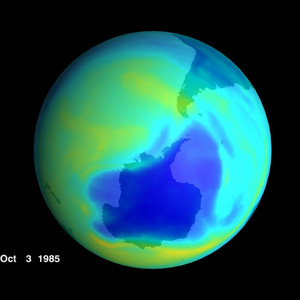
A giant hole is forming in the Earth's protective ozone layer.
Scientists discovered a hole.
Remarkable loss of ozone that occurs over the Antarctic in October.
A lot of people call it the ozone hole, but it was really more of a thinning.
Scientists launched weather balloons to study its size, and they found something shocking.
High levels of two chemicals, chlorine and bromine, were breaking down ozone faster than it was being made, letting in the kind of radiation that causes cancer.
Crop failure.
And it was happening because of ozone-depleting substances made by us on Earth.
So the race was on to save the world.
Today on the show, how researchers mobilized on a global scale to close the ozone hole.
Plus why the ozone layer is still recovering and what climate scientists can learn from this success.
You're listening to Shortwave, the science podcast from NPR.
There is a lot of fear these days that AI could be a bubble.
So, Nick, is it?
I don't know.
Right.
It is hard to tell.
But there are some clues that economists say might kind of sort of help us predict bubbles.
On the Planet Money podcast, the dark art of bubble detection.
Listen on the NPR app or wherever you get your podcasts.
Netflix's Stranger Things has reached its end and we're unpacking the biggest moments in the final season.
We'll talk about what we thought of the finale, what happened to our heroes when they set out to battle the forces of evil one last time and, of course, the terrible wigs.
Listen to Pop Culture Happy Hour in the NPR app or wherever you get your podcasts.
Have you ever thought about leaving the U.S., starting over somewhere new?
Well, I have.
And according to one poll, 40 of young women said they'd move to another country permanently if they had the chance.
But why?
Where to start?
Listen to the It's Been a Minute podcast on the NPR app or wherever you get your podcasts.
So Irina, I want to focus on how the ozone is operating over Antarctica, because that's where the hole is.
And I know that the ozone layer over Antarctica naturally thins, because things are a little different there, right?
Yeah.
In Antarctica, the maximum of the ozone is happening during months of December, January.
And it's happening naturally.
You know, there is a increase in ozone throughout the year, and then, when the polar night comes in, there is no sun, and so there is not much of the ozone production happening during the wintertime.
And that's because sunlight triggers ozone formation, but also sunlight destroys ozone.
So the amount of ozone is always kind of fluctuating when the sun is present.
And during the Antarctic polar night in June, July and August, when there's no sun, the the ozone amounts are basically steady.
They don't really fluctuate.
And then in the spring, the sunlight comes back and these chemical reactions start happening again.
But isn't the Earth's atmosphere always moving and mixing?
So wouldn't the air from other parts of the world that have access to sunlight mix with Antarctica's air?
Antarctica has a very specific process Because it's a continent.
The atmosphere can create these strong winds that circulate around Antarctica.
And so they separate the air that's over Antarctica from the rest of the other latitudes outside of Antarctic vortex.
So there is no really way to mix it with other airflow.
Oh, okay.
So the atmosphere of Antarctica is isolated because of this polar vortex, which results in this seasonal cycle that has its rhythms.
Now let's go back in time, when scientists really started noticing the ozone layer was changing over Antarctica beyond what was typical for the seasonal rhythm.
And these researchers went on an expedition to Antarctica to figure out why.
What did they do?
So scientists flew into Antarctica on the aircraft and they also set up the camp on Antarctica continent.
But what the most interesting observation they made is that when they're flying inside of Antarctica, They continuously measured both ozone and chlorines, the chemicals that they thought that might be destroying ozone.
And they noticed that flying into Antarctica, the ozone started to go down and chlorine started to go up.
And so that made very good sense to them so that those chemicals are destroying ozone.
It's like their Achilles heel.
I read that one chlorine atom can destroy over 100,000 ozone molecules.
Yeah, definitely.
What the heck were we doing in the 50s and 60s that created this abundance of chemicals in the atmosphere, chemicals that we can use in refrigeration?
Those chemicals were put in the firefighting equipment, for example.
They were very effective at that.
They were put in the aerosols sprays, and so they've been used for fumigation of the vegetables and the fruits.
So they were working really well.
But what I think people did not realize right away is that those chemicals actually are capable of escaping into the stratosphere.
But I'm curious, how did stuff made on Earth produce molecules that got all the way up there?
Because the stratosphere is miles above our heads.
It's like where planes fly.
How could chemicals travel upwards that high?
Well, the atmosphere has these mixing properties.
You know, there are a lot of exchange between the troposphere and stratosphere in the tropics.
And they can travel also with this flow of the air from the tropics into the middle latitudes in the polar region.
There is the so-called Brewer-Dobson circulation in the atmosphere.
And they get distributed everywhere.
So they hang out a long time.
And then they can hang out for a long time, yes.
Oh, there's another thing that we need to remember.
There is also the specific clouds that are formed in Antarctica, and they're called the polar stratospheric clouds.
Polar stratospheric clouds.
So they're also quite essential for this depletion to occur.
And the reason for that is that they actually set up this activation of the chlorines that are typically not very active.
So they set them up such that there will be only chlorines and bromines released once the sun comes back.
And so then those chemicals are released, and then they will start to destroy ozone very, very rapidly.
But there are also other chemicals that get frozen into the polar stratospheric clouds that typically neutralize these reactions.
And so there is nothing to stop those chemicals to destroy ozone for some period of time, until the polycystic clouds disappear.
What an accumulation of forces that led to this problem.
Okay, so what did scientists do in response?
Because obviously today the ozone is okay.
So what happened? ultimately, to save the world.
Right, exactly.
So they started to present their findings to the public, to the governments.
And so eventually they got enough people to listen to their worries that the Vienna Convention happened, where the representatives from many, many countries got together and they discussed these issues.
Wow.
And then the Montreal Protocol in 1987, actually signed by every country.
I mean, this is really amazing.
Agreed to stop production and use of those ozone depleting substances.
Right.
And that is how we get to the point now where the ozone layer is doing well.
I read it's the fifth smallest since the crisis.
Why hasn't the ozone fully thickened over Antarctica?
Is it because people are still using chemicals even though they're banned?
Some chemicals actually can leave, once they get into stratosphere, they can live up to 100 years.
So once they're released let's say they've been released in the 50s and even before that they have quite a long way to go before they get completely removed from the stratosphere.
So the ozone hole is recovering, but very slowly because we still have a lot of these chemicals in the atmosphere.
Still
And to this day, people are still monitoring the ozone layer, right?
Like, we didn't fix the problem and just abandon Antarctica, right?
No, we are very lucky.
We still have a lot of observations.
So, yes, I mean, we still need to monitor it.
And the reason for that is that there are some other chemicals that have been released in the atmosphere.
They're not really destroying ozone.
They are a replacement for those CFCs.
We need to know how they're impacting the atmosphere.
And some of them are so-called greenhouse gases.
So they're heating the atmosphere.
And with that, there is also some impact on the way how the ozone is recovering.
Yeah.
Greenhouse gas emissions.
We talk about that a lot on ShoreWave.
And it's a useful comparison, because that existential issue is also human-caused and could be human-solved, so to speak.
So, in comparison to climate change that we're all struggling with now, why do you think the ozone issue was dealt with so swiftly?
I think because that was a problem affecting everybody.
It wasn't something that would require people to stop using, for example, that people were advised not to use the aerosols, for example, by scientists.
But it wasn't a very big impact on everybody's life.
Giving up CFCs was a lot easier than giving up oil and gas.
Yes, yes.
I think that was one condition.
And then, of course, the industry also agreed to change and move away from the CFCs and start producing other chemicals that are not destroying ozone.
And not just that, that the developed countries also said that they will set aside the funding for supporting and helping the developing countries to change their technology.
And so that still continues.
How does that make you feel, as a researcher, that humanity scientists, working with policymakers, working with many stakeholders were able to do this?
How do you feel about that?
I'm really excited about that.
And we were very young when we started to hear about ozone, you know, in my generation.
And it was a very acute problem.
And it's just really good to see that ozone is on the way to recovery.
It's in the 2050s, 60s, you know, when people expect the full recovery of the ozone.
But, you know, who knows?
Maybe I will live long enough to see that.
I hope you do.
I hope I do.
Irina, thank you so much for coming on Shortwave.
Oh, thank you so much for taking time.
If you liked this episode, follow us on the NPR app or wherever else you listen to podcasts.
And check out our episode about how tourists are solving a plankton puzzle in Antarctica.
And Shortwave's Nature Quest series.
That's where we delve into an environmental mystery driven by your questions.
I'm Emily Kwong.
Thanks for listening and tune in tomorrow for more.
This is Tanya Mosley, co-host of Fresh Air.
You'll see your favorite actors, directors, and comedians on late-night TV shows or YouTube.
But what you get with Fresh Air is a deep dive.
Spend some quality time with people like Billie Eilish Questlove, Ariana Grande, Stephen Colbert and so many more.
We ask questions you won't hear asked anywhere else.
Listen to the Fresh Air podcast from NPR and WHYY.
On NPR's Wildcard podcast, heavyweight host Jonathan Goldstein talks about his early years as a writer.
I was writing and no one was buying what I was selling.
I just couldn't get anywhere.
And I just kept doing it because I felt compelled to do it like a spider spinning a web.
Listen to that Wildcard conversation on the NPR app or wherever you get your podcasts.