By the time I was in my early 20s, it had gotten to a point where I could not get out of bed.
I could not do anything.
So I went from cooking a bazillion hours a day to not even being able to get out of bed.
And it was really awful because I loved cooking so much.
It's like my happy place.
It's very soothing.
So, yeah, I just it was awful.
Jules Sherrod suffers from a progressive autoimmune disorder, and then, on top of that, an untreatable spinal cord tumor is slowly leaving him paralyzed, and this all has severely restricted his abilities.
His mobility and his dexterity are limited, and he experiences a lot of pain and fatigue.
And for a while, all of that ruined his relationship with a room that, like he says, had previously been his happy place the kitchen.
Oh, I hated it.
The kitchen is a torture chamber.
Today, Jules not only is happily back in the kitchen, but he's the author of a cookbook called Crip Up the Kitchen.
So what changed?
What adaptations and tools did Jules need to make the kitchen work for him again?
For that matter, what does it take for a blind cook to win MasterChef and run a James Beard-nominated restaurant?
This episode, Betty Crocker, Julia Child and the Butter Chicken Lady all help tell the story of how the kitchen became a more welcoming and accessible place for everyone, and how the tools and techniques developed along the way have become key parts of all of our cooking lives today, even though most of us don't realize it.
This episode was supported in part by the Alfred P Sloan Foundation for the Public Understanding of Science, Technology and Economics.
Gastropod is part of the Vox Media Podcast Network in partnership with Eater.
This is a Monday.com ad.
The same Monday.com designed for every team.
The same Monday.com with built-in AI, scaling your work from day one.
The same Monday.com with an easy and intuitive setup.
Go to Monday.com and try it for free.
We're leaving today and entering a world of Mickey Mouse waving, princess meeting and greeting, lightsaber clashing, the Twilight Zone, Tower of Terror dropping Banshee flying.
Space Mountain launching!
Galaxy rewinding!
Galaxy rewinding!
Fireworks igniting!
World of Other Worlds.
For whatever you love.
Infinite worlds await at the most magical place on Earth.
Walt Disney World Resort.
Um, welcome.
Thank you.
Um, first name is?
My name is Christine.
Christine, in the history of MasterChef, we've never had a blind contestant.
You know, you're going to be judged like everybody else in this competition.
Yes, chef.
That was Gordon Ramsay, the shouty British chef on season three of the reality cooking competition show MasterChef.
And the person he's talking to is our guest Christine Ha, who first taught herself to cook in college, really just to save money and eat a little better.
Her first big triumph back then was Vietnamese ginger braised chicken, which she served to a bunch of friends.
The chicken turned out pretty tasty and that's when I realized.
You know, I looked around the table.
I had vision in college.
I looked around the table and saw... my friends with satiated faces and smiles on their faces.
And then I realized this is something I liked to do was to be able to make something and have other people enjoy something I cooked or created.
But around the same time, she started to lose her vision.
So it was in college in actually my third year of college that I noticed one of the my eyes started going blurry and I thought it was my contact lens.
But it wasn't.
Christine has a rare immune system disorder that attacks her nervous system and after a few years her optic nerves had atrophied and she was blind.
Christine was worried about losing her independence, but she was also worried about losing something that at that point she just loved to do feed people.
You know, one year I could cook a full Thanksgiving meal and then...
A few months later it was really hard for me to just make a sandwich that was not even a cooked sandwich, like a cold cut sandwich.
So I wasn't sure if I'd be able to cook again.
And that was very discouraging at that time.
Christine had been studying business, but this whole experience made her want to do something different with her life.
She switched gears and went back to school for creative writing.
But at the same time, she had to learn how to do almost everything over.
She didn't want to move back in with her family.
So she reached out to an organization that helps with life skills for adults who are losing their vision.
They lined up a lot of instructors to teach me Braille to come to my house and show me different ways that I can adapt my house or adapt my kitchen to being able to prepare simple meals.
So one day it would be trying to cut an orange with less vision.
And that was scary because you know I knew how to use a knife before, but I had never tried using one with my eyes closed or without any vision, or how to turn on the stove again and deal with frying an egg or putting something in a toaster oven and trying to figure out the settings on that.
Christine kept practicing and practicing until she could cook again, maybe even better than she did before.
And then honestly more, in the hopes of getting some material to write about, she applied for MasterChef.
So I really went for the creative material and just to experience it, not expecting to get as far as I did.
I was just hoping to live it and then just kind of come back with some great stories.
As it turns out, though, she's a pretty competitive person.
Congratulations.
Congratulations.
Christine!
I just can't believe it.
I'm the master chef.
She then went on to open two acclaimed restaurants in Houston, Blind Goat and Stuffed Belly.
Christine had helpers to guide her as she relearned cooking as a blind person.
For Jules, the help he needed to get back in the kitchen came from the internet.
Specifically, the butter chicken lady.
Hi, I'm Urvashi.
My blog is TwoSleeverscom, and today I'm going to show you how to make an Instant Pot Butter Chicken.
If you've ever heard of the Two Sleevers recipe, or if you've ever heard of the Butter Chicken Lady, that would be me.
A friend had told Jules that he had to try this recipe out.
He was intrigued, but a little nervous about Instant Pots.
He had fears that the pressure cooker could explode.
But he watched Urvashi's videos about her chicken recipe.
And she started talking about how the Instapot had helped her with her rheumatoid arthritis.
And she talked about how her autoimmune disorder had also affected her in similar ways as my autoimmune disorder.
And suddenly a light bulb went off in my head.
I'm like, oh, this is why I need an Instapot.
And then I got angry that no one had ever mentioned, aside from Yves Vachy, the benefits to cooking in an Instapot for those with disabilities.
And I decided that I was going to start making or adapting recipes that I had missed cooking for the Instant Pot.
Jules started getting comfortable with the Instant Pot by making Indian food.
Once he felt like he'd figured out some of the tweaks he needed to make the Indian recipes he knew from before work in it, He decided to tackle a favorite dish from his childhood, a unique version of the beet soup borscht, known as dukabor borscht.
It took me months and months and months to be able to finally crack that nut.
And the day that I cracked that nut I cried because it had been, I want to say, 30 years since I had dukabor borscht.
Both Jules and Christine not only cook for pleasure today, they're culinary professionals.
But go back about a century or so, and that would have seemed absolutely impossible.
For most of history, in most places, the perception of people who had a disability was that they were not going to be able to achieve the sorts of things that quote-unquote normal people could.
For women, that meant the assumption was that they were not going to be able to fulfill their prescribed roles as housewives and mothers.
So sort of general attitudes surrounding sort of disabled women, both sort of including deaf and blind ones, but also ones with a variety of physical disabilities.
Their options were pretty limited.
They were often seen as not marriageable, sort of not able to be mothers or at least not be fit mothers or good mothers.
This is Laura Puaka.
She's a professor of history at Christopher Newport University.
Disability was seen almost as a moral fault and something they shouldn't be allowed to pass down to a new generation.
As part of that, people who are disabled, they weren't seen as having value to society.
And so there weren't many programs to help them, to give them tools to navigate a world that was challenging for them.
After the First World War, there were a lot of men who came home from the trenches missing limbs.
So there was a boom in designing prosthetics of various sorts.
The prevailing idea was to fix the missing parts on the person to help them navigate the built environment, rather than redesign the environment around them to make it more accessible.
The concept of rehabilitation and adaptation changed after the Second World War.
There was another sort of expansion of that vocational rehabilitation system itself, both with regard to veterans, but also a significant expansion of the civilian component of it at the same time.
Meanwhile, the U.S. was experiencing a huge polio outbreak.
There were hundreds of thousands of victims in the peak years between 1937 and 1955, when the lifesaving vaccine was introduced.
Polio left people paralyzed to various degrees if they even survived it.
These weren't people who were born with something disabling.
Many of them were white middle class kids and young adults, and their fate wasn't seen as a moral failing.
It was seen as deeply unfair.
All of this changed attitudes about disability and in turn about the importance of rehabilitations.
And that sort of collided with the post-World War II sort of heightened emphasis on domesticity.
This focus on domesticity and on making domestic life work for people of all abilities.
It was strengthened by the need to kind of tempt women back into the kitchen.
During World War II especially, many women had left the home to take up jobs to help with the war effort.
So in the post-war period, there was this interest in re-domesticating women.
And part of that was to make kitchens seem more appealing as workplaces.
This is Barbara Penner.
She's a professor at the Bartlett School of Architecture at UCL.
Kitchens had gone through a bit of a transformation over the decades before this time.
In history, unless you were rich, kitchens weren't necessarily their own room.
They were just part of the home.
But then in the late 1800s, early 1900s, kitchens became specialized rooms and they started to become standardized.
And so all mass-produced kitchens will have counter heights at 36 inches.
And the reason for standardization is to allow mass production.
Mass production makes things cheaper, which is great, but It's obvious that the moment you start standardizing, you're privileging production over the bodies of users.
To arrive at the standards for kitchen design, you needed a standard body to calculate the average height and reach for your surfaces and cabinets.
This data, which went into the process of standardizing users, that was drawn mostly from US military studies.
And that meant that the standard user was implicitly a fit, usually white, male figure.
And, if it's not perfectly obvious, this was not even the standard body, if there is such a thing.
That was in the kitchen at the time.
While this standardization was going on in the early 1900s, and following the same kind of logic as mass production, but with different goals, a group of home economists had been trying to optimize the kitchen for maximum efficiency.
We have made a whole episode about this surprisingly radical movement, but basically it was a handful of women who were trying to take this new science of making factories more efficient and apply it to kitchens.
Partly as a way to make people take the work that went on in kitchens more seriously.
But the woman who really ended up being at the forefront of efficient and then eventually accessible kitchens wasn't trained as a home economist.
In fact, Lillian Muller Gilbreth barely cooked at all.
You literally could not make up a character like her.
Today, we know her best as the wife of Frank B Gilbreth, who was one of the founding fathers of scientific management.
They had 12 children, and two of those kids wrote the book Cheaper by the Dozen, which you might also know in its movie form.
And I think, because Cheaper by the Dozen is this slightly madcap gentle family comedy we've forgotten what a really consequential figure Lillian Kilprith was.
Lillian started out working with Frank on time and motion studies in factories and workshops.
They worked to identify what they called thurbligs, which is a near anagram of the word of their last name, Gilbreth.
And they use this term to sort of signal discrete movements.
And so they would actually like watch how workers carried out their work.
And they would count the number of thurbligs which referred to sort of these individual, discrete tasks.
And they would total them up and figure out how can we eliminate some of them.
And she really believed that through work simplification principles, people would be freed to pursue self-cultivation, what she called happiness minutes, without any irony.
Frank died suddenly when he was in his 50s and Lillian was in her 40s.
She wanted to keep working.
She had to keep working.
She had 11 surviving children to support.
But nobody in industry would hire her.
So she did what many women would do.
And she turned to the domestic realm.
So she ended up designing department store layouts.
And she worked on things having to do with feminine hygiene and she eventually made her way into home economics as well.
Her first big foray into the kitchen was called the Kitchen Practical.
It was displayed at the 1929 Women's Arts and Industries Exposition in New York City.
It is essentially what was called a functionalist kitchen, which had dedicated work centers for different tasks and paid a lot of attention to workflow issues to help save labor and energy for the housewife.
Lillian evaluated existing kitchens and felt like they weren't organized the way women would actually use them.
So she created a tight triangle of refrigerator, sink, and stove to be more efficient.
There was a rolling cart to provide an expanded work surface that could also be moved around.
Barbara says that making a meatloaf went from taking 57 steps to just 39 in the kitchen.
Practical way better.
Seems like there would have been a lot more happiness minutes.
Lillian's contributions to designing kitchens that worked for people with disabilities came about sort of sideways, thanks to heart disease and war.
So during World War II, because she was considered an efficiency expert, she ended up on this sort of manpower quote, unquote manpower.
Committee of the New York Heart Association.
Cardiovascular patients were medically required to take it easy.
But to win the war, everyone needed to do their bit.
And Lillian, because she was a woman and she had worked in the domestic sphere.
She wanted to expand that mission to the home too.
And so out of that subcommittee of the New, She ended up helping to design a kitchen that became known as the Heart Kitchen.
That was designed specifically for women with cardiovascular disease.
At this point, cardiovascular disease was getting attention.
It had gone from a relatively rare problem in the early 1900s to being the leading cause of death in the US by the mid-century.
The Heart Kitchen was designed to help.
A lot of its design innovations were borrowed from Lillian's original kitchen.
Practical, with the idea of minimizing movement.
But there was also a lot of focus on putting things within easy reach.
So the dishwasher was elevated on a platform and there were fold-down, height-adjustable work surfaces and space under the sink for a chair, so you could sit and work rather than having to stand.
The goal for this project was to help women with cardiac issues conserve their energy.
It really wasn't geared to solve problems for women with other accessibility issues, but it was launched and displayed at the American Museum of Natural History as part of their National Employ, the Handicapped Week in 1948.
It was very popular.
The New York Times covered it and people, just you know, swarmed the museum and there is a lot of foot traffic.
After that, the Heart Kitchen ended up at a new civilian focused rehabilitation center at NYU.
And it inspired similar projects all around the country in Chicago LA Baltimore Milwaukee, you name it.
And there emerges really interesting program that was initially for cardiac homemakers at Wayne State.
But other homemakers quickly got wind of it and requested that some programming be made to accommodate them as well.
In response, the folks in charge of the project at Michigan's Wayne State broadened their programming beyond just cardiac issues.
So the Heart Kitchen research and design expanded not only geographically, but it expanded in terms of who the researchers were serving as well.
And also in terms of who was teaching whom.
One of the most ambitious efforts took place at the University of Connecticut.
It was called the Handicapped Homemakers Project.
There were workshops and demonstrations, but the project leaders also did a bunch of field work to learn from the real experts.
They went into the homes of over a hundred severely disabled women and studied how they had already adapted their homes.
And this was really radical, a time when institutionalization was the norm.
And disabled women actually participated in leading the research itself too.
One of them was named Neva Wagner.
She was a polio survivor who had lost the use of her left arm, and she taught home economics at UConn.
She started off consulting and ended up being a project coordinator.
I think she's really important because she really was able to say quite explicitly to sort of the non-disabled home economists in the room that it's really, really important that you take disabled women's experiences seriously and that you all don't make these decisions for yourselves, but that you consult us and listen to us and rely on our expertise.
There were a whole series of ingenious adaptations that the team documented.
Women had wrapped rubber bands around the knobs on their kitchen cabinets to make them grippier, and they'd built ratchets to turn faucets by hammering nails into a wooden spoon.
Out of the workshops that they held, the UConn team developed flat-bottomed mixing bowls, reach extenders and the use of pegboards to hang utensils and pots and everything that someone might need at the appropriate height.
And they also used a lot of Lillian Gilbreth's ideas about workstations and workflows and optimizing layout for minimal effort and steps.
So at this point in the 40s and 50s, some universities had gotten interested in making kitchens and cooking more accessible, and the women themselves who were interested in kitchen accessibility were getting involved in the work as well.
The next to join the party?
Big business in the form of Betty Crocker.
That's coming up after the break.
When it comes to the new Melania movie, here are some important numbers to remember.
40 million.
That's how much Amazon paid Melania Trump's production studio for the rights to the film.
It's the highest price ever paid for a documentary.
35 million.
That's about how much Amazon spent marketing the film.
$28 million.
How much went to the First Lady?
And $7 million.
That's how much the Melania movie made on opening weekend, which is honestly pretty good and certainly more than many box office insiders projected.
So, how did this movie get made?
Who's it for?
And if this is finally Melania Trump's side of the story, what does she have to say?
That's coming up on Today Explained from Vox.
Listen weekday afternoons, wherever you get your podcasts.
This week on Net Worth and Chill, I'm talking about what happens after you've mastered the basics.
How to build wealth that actually lasts for generations.
With the top 1 holding nearly a third of the nation's wealth, and 98 of them being men.
Breaking into generational wealth isn't just about getting rich.
It's about changing who gets to stay rich.
Plus, I'm explaining the great wealth transfer 124 trillion about to change hands over the next 25 years and what it means for you.
I'm answering your questions about calculating your net worth, whether you should rent or buy to build wealth, and how to pass your retirement accounts to your kids without losing them to probate court.
Whether you're just getting started or already maxing out your 401k, this episode will show you how to think bigger than just making money.
Today,
Listen wherever you get your podcasts or watch on youtube.com slash you're rich BFF.
The Betty Crocker Service Program, a regular feature of General Mills.
Friends, the leader of this band of gallant home front women is Betty Crocker.
Hello, everybody.
Of course, when you think of preparing a meal that will go to a man's heart, you think of steak.
For all men seem to love steak.
Betty Crocker sounds like a real person, but she's not a real person.
She's an actress playing a brand that was created in 1921 by the company that became General Mills.
And she came about in connection with this contest that the company had sponsored.
It was a jigsaw puzzle contest where Saturday evening post readers assembled these pieces and returned them to the company and they were promised some sort of prize.
But what happened was that when readers did this, they sent in all these letters asking for cooking advice, for baking advice,
Laura says that the company started to respond to all those letter writers, but then they had an idea.
Instead of having a real person, a male executive at the company, instead of having him be the official signature on the letters, they came up with a made-up spokeswoman named Betty Crocker.
Betty didn't just write back to the readers with baking advice.
She also launched her own radio show.
I mean, this was before podcasts.
We played a little snippet just now.
It was a mix of stories, advice and recipes.
This radio show was a huge deal.
It ran on networks around the country for nearly three decades.
Millions of people listened to it.
Betty Crocker received about four to five thousand letters a day in the 1940s.
In 1945, Fortune magazine called her the second most well-known American woman.
Second only to Eleanor Roosevelt.
Of course, she was a brand, not a woman, but whatever.
Among her many fans were blind women who wrote in to say how much they appreciated having audio versions of recipes.
Part of the reason they were such Betty fans is, at the time, if you were a blind person wanting to consult a cookbook, your options were extremely limited.
There had previously been some Braille cookbooks already on the market, but most of them were very unsatisfactory.
And most of them were actually like literal transcriptions of books for sighted users.
And so it would not be uncommon to contain instructions like cook till golden brown or cook until meat is no longer red.
And it was just sort of difficult to use a Braille cookbook when you're trying to cook and have to wash your hands all the time so that you could read the instructions.
And in any case, about 80% of blind adults at the time didn't know Braille.
There were a few audiobooks available, but none of them were cookbooks.
General Mills was vaguely aware of this issue.
They had received letters from blind homemakers, and some of their staff had connections to the blind community in Minneapolis, where they were based.
But it took one blind woman in particular to really get them to do something.
Her name was Margaret Mumford Neal.
And she was local to Minneapolis.
She became blind later in life.
It was the result of like a botched glaucoma operation.
And she came home from the hospital ill.
And, you know, her kitchen was fully stocked, but she couldn't read the ingredients.
She couldn't read Braille.
And so she contacted General Mills to see if they could do anything.
General Mills had a sense of corporate responsibility.
This apparently was a trend in large companies at the time.
And so they were interested in this opportunity as a way to help people and be a good citizen.
But then of course, General Mills was also eager to expand its business and recognize blind homemakers as consumers, which was important both from General Mills' perspective but also ends up being really important in terms of these blind homemakers' perspective as well, because they often sort of felt left out of consumer culture.
So what General Mills did is make a 10-inch record set called Directions for Using Betty Crocker Mixes.
There were three records, each labeled in Braille and large type.
One was for Betty's Bisquick mixes, one for her cakes and frostings and one for miscellaneous Betty goodness.
Betty Crocker's Good and Easy Cookbook.
Banana cream, pineapple cream and coconut cream.
Puddings may be made from the vanilla mix by adding sliced bananas, drained crushed pineapple or shredded coconut.
All of these records were the result of collaborations with local organizations.
Blind cooks participated and offered advice.
They tested the recipes and they said what else needed to be added to make them useful for blind cooks.
A lot of the recipes ended up instructing users to rely on other senses besides sight in order to test doneness or to just test that the consistency was correct.
And so the date bar recipe, users were advised to make sure it felt crumbly with their fingers.
The biscuits and brownies were supposed to feel crusty when they were done and blind cooks were encouraged to listen for when a cake stopped whispering to know that it was ready to take out of the oven.
These records were free, basically.
You just had to pay 10 cents for the shipping.
And the blind community of Betty Crocker fans were super excited, and they let General Mills know.
Oh, it was overwhelming.
Just all sorts of users wrote in very, very enthusiastically.
And so...
You know, a lot of it was just a lot of sort of appreciation and excitement and demand for more.
So General Mills got to work and put out a new three-disc set called Tips and Talking Recipes.
Betty was still the narrator, but these recipes went beyond her mixes.
In the second round of records, General Mills included recipes for like, scallop potatoes and you know sort of a really wide variety of foods.
Ham and lima.
One package frozen baby lima beans.
One center cut sliced ham.
One cup grated American cheese.
Cook lima beans until tender.
Meanwhile, place ham in shallow pan.
Sprinkle with cheese.
Arrange lima beans over ham and broil until cheese melts and bubbles.
Serve immediately.
Make four to six servings.
Not necessarily appetizing to modern ears, but hey.
Despite what sounds pretty gross to us today, that record set was so successful that they kept going.
The next set of records were back to focusing on newer Betty Crocker products, but they included useful sensory cooking tips they hadn't included before, like testing a cake by putting your finger in the crack at the top and it's done if it feels dry and no batter sticks to your fingers.
And then finally, there was a six-disc set in 1962.
Betty Crocker, what a legend.
But she wasn't the only celebrity who was busy making kitchens more accessible.
Welcome to the French Chef.
I'm Julia Child.
Just as Betty Crocker wrapped up her involvement with kitchen accessibility, Julia Child was there to pick it up.
Her show launched in 1963 and she became an icon of the accessibility movement, because kitchens weren't made for people as tall as she was.
And also, she really wanted her space to be efficient.
She used some of the same techniques that Gilbreth would have used.
So for instance, her counter heights were raised to 39 inches to accommodate her height.
And she had this very famous pegboard wall where she arranged her battery to cuisine.
And all of her pots and pans had a designated place that was silhouetted in marker.
So as Julia said, they always get home again.
Continuing the accessibility theme, PBS even first trialed closed captioning on Julia's show.
But her involvement went beyond her own kitchen and the TV show.
Julia's whole project was to make cooking inclusive.
She wanted all Americans to cook.
And know how to cook and take pleasure from it.
But you couldn't have inclusive cooking unless you had inclusive kitchens.
If you can't access a kitchen, you can't cook.
So Julia ended up joining something called the Universal Kitchen Project in the 1990s.
It was based at the Rhode Island School of Design, or RISD, and their goal was to rethink the kitchen to make it accessible for people of all ages and abilities.
Julia actually volunteered as a research subject for the project.
One of the best moments I had in doing this research was going to Brisdy to the archive and watching the video of her lab test.
And it's just hilarious.
She came with three television crews And you almost can't see her because of the scrum of television cameras around her.
But that's what she brought was this incredible star power.
The project was led by a designer called Mark Harrison, and it was really pretty radical for the time.
RISD put out an oral history interview with Mark reflecting on it.
I remember a department head from another school saying how come you're worrying about designing for cripples?
And so this was very telling.
At the end of the project, they came up with two designs Min, which was designed for small spaces like hotel rooms or studio apartments, and Max, a larger kitchen for families to work in together.
Rizdi made a video about the designs.
The centrally located oven is located within the comfort zones.
Its position avoids heavy lifting in or out of the oven.
At this point, a lot of the adaptations built into these kitchens are going to sound familiar.
Adjustable height surfaces, movable elements, organization, minimizing the number of steps.
There were some innovations, like a nifty pasta pot that could be drained from the bottom, so you didn't have to lift a heavy pot over the sink.
RISD claimed that a spaghetti dinner that took 400 steps to make in a regular kitchen only took 100 in their universal kitchen.
The countertops have a no-spill edge, which functions as a grab rail.
And the contrasting materials make borders visually clear.
The kitchens were unveiled both at the Cooper Hewitt Design Museum in New York and on Oprah's TV show in 1998.
But at the end of the day, the designs weren't produced by any manufacturers.
The barber says they still had a big impact.
It indicated this new level of acceptance and interest in universal design.
Because previously, of course, designing for the elderly or the disabled, that was seen as quite niche and potentially stigmatizing.
Companies did incorporate a lot of Lillian's ideas about workflow and the triangle of sink fridge, stove.
Like an IKEA fitted kitchen will often reflect that design philosophy.
But height-adjustable countertops and other more individual adaptations?
Those were considered to be too expensive.
Basically, it was still cheaper to make a standard kitchen with everything at a fixed height, so that's what manufacturers did.
But where this idea of universal design did get some traction is in the world of kitchen gadgets.
Those were cheaper and easier to design and sell, rather than doing the hard work of adapting the built environment.
It turns out that many of the tools in our kitchens today were inspired by designing for accessibility.
We've got that story after the break.
This is the story of the one.
As the purchasing manager at a manufacturing plant, she knows the only thing more important than having the right safety gear is having it there when you need it.
That's why she partners with Grainger for auto reordering, so her team members can count on her to have cut-resistant gloves on hand and each shift can run safely and efficiently.
Call 1-800-GRAINGER, click Grainger.com, or just stop by.
Grainger, for the ones who get it done.
Ready to relax in your dream bath retreat without the stress of figuring out every detail yourself?
At The Home Depot, your bath upgrade is covered.
Shop fully designed rooms and curated bath collections to go from inspiration to transformation fast.
Savings of up to 40 will make it easier on your budget and find everything you need, from tubs to toilets and all the tile in between, to bring your vision to life.
The Home Depot.
Dream baths built here.
Universal design was this design ethos really that aimed to make product design usable for everyone.
Mark Harrison, the guy who had been in charge of the Universal Kitchen at RISD.
He'd already incorporated these ideas into his redesign of the Cuisinart in the late 1970s.
He had suffered a brain injury when he was 11, and his motor skills were damaged.
The Cuisinart he designed had, and still has, a rubber base and a large handle on the mixing bowl and very large paddle switches with raised lettering.
But probably the best-known icon of universal design in the kitchen is the OXO Good Grips range.
OXO was born because of a guy named Sam Farber.
He was a designer.
He ran a company called Copco that made tea kettles and other types of home goods.
He was super successful, and then he retired.
And he went on a long vacation to the south of France with his wife Betsy.
So far, so delightful.
I got a call from him one night.
It was probably about 6 p.m. at night, maybe 7.
So it was after midnight in France.
That's Davin Stoll.
He's the founder of a company called Smart Design.
And before this phone call in the late 1980s, Davin and Sam had worked together for a few years on designs for Copco. and he was incredibly excited.
He had this idea of a product they wanted to make.
He and Betsy had been cooking a few nights before, and Betsy was complaining about the peeler.
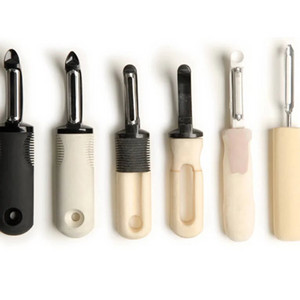
She was peeling an apple for their favorite dessert, an apple tart, and the metal peeler she was holding and y'all Probably remember those metal peelers.
It was just a bent piece of metal with a blade stuck on the end that hurt her hands and she was having trouble peeling.
Betsy had arthritis, and she was also a designer.
She had trained as an architect.
So she started squeezing clay around the metal peeler, making a handle that felt more comfortable.
And she was convinced, too, that this could be better.
So anyway, Sam called me up, and he just couldn't sleep.
And he wanted us to start on this immediately.
David thought this was a great idea.
We immediately contacted the American Arthritis Foundation just to see if we could connect with some people that could help us test products, could tell us a little bit more about it?
First thing they tackled was the handle.
And one of the things we found out quite quickly there was an optimum size.
You know, as we tested with a number of people,
If it was too big, you couldn't get a very good grip on it.
And if it was too thin, you couldn't get a very good grip.
And we realized that making it oval actually gave you a lot more control over it, because it tends not to rotate.
And it also gives you an orientation in your hand.
It's often right for the task.
They also wanted a handle with a little give and they wanted to give people some guidance about where to squish it.
We just happened to have a sample of a bicycle handle nearby when we were meeting with Sam.
The whole handle was covered with very thin fins that squished when you squeezed them between your thumb and forefinger.
And we just looked at it and said, well, maybe we can make that area out with fins in it.
Then they had to find exactly the right kind of durable, food-safe, but soft and grippy rubber.
They ended up using a new rubbery material that was otherwise used for gaskets and dishwasher seals.
And then to make the blades, they ended up partnering with a manufacturing company in Japan that historically had made samurai swords.
We thought that, well, this is perfect.
If they can make a samurai sword, they can certainly make a very sharp peeler blade.
A super sharp blade was also really important.
That makes it way easier to peel.
So after all this time and money and prototype testing and development, Davin and Sam had a peeler.
And they did tests with folks from the Arthritis Foundation and even people with severe arthritis found it super usable.
Time to launch it.
They planned that launch for the 1990 Gourmet Products Show but they didn't plan on launching it as a specialty tool for people with arthritis.
The one thing that Sam was really insistent on is he said, this has to be for everybody.
And by everybody I mean everybody that doesn't need something special because it's an economic reality of when you're producing a product.
If you're only making it for a niche group, it's economically not feasible because the market's not big enough.
And he said, well, this should be something that's in everybody's kitchen drawers.
The initial response was intrigued but cautious.
People thought it looked a little weird with this chunky black rubber handle.
One home goods chain decided to stock the peeler, but it wasn't exactly flying off the shelves.
Then Sam had the idea to display a bowl of carrots and have the peeler there chained to the table so you couldn't walk off with it.
But this would let people actually see what it felt like and how it worked.
And this time sales totally took off.
We would get letters from people that said you know, I bought this peeler and for the first time in years, I'm actually enjoying cooking in the kitchen.
This is so much easier to use than anything I've ever had before.
In fact, I bought them for all my friends to use too.
Before long, there was an OXO Good Grips version of everything.
One of the earliest products that we extended the range with was actually a mixing bowl.
The mixing bowl which Davin designed with his grandmother in mind.
It's lightweight and it has rubber all up the sides to keep it from slipping.
And it has an easy to grip rim.
I have this set of mixing bowls and I do not have arthritis, but I love that they don't slide around on the worktop when I'm whisking stuff.
That's what we're always trying to do is integrate the solution in a way that it doesn't look like it's, you know, an accommodation.
It looks it's just better for everybody.
Jules Sherrod does have motor skill issues, and OXO Good Grips products were really useful for him when he started getting back into cooking, and they still are today.
Because the grip on them is thicker.
It has a thicker handle.
It's easier to use when you have issues with your hands, either with grasping or pain.
A lot of both Jules' and Christine's kitchen adaptations, the tools and design choices that let them get back into cooking again.
They're the exact same things that Lillian and others pioneered decades ago.
For both of them, how the kitchen and its contents are laid out is key.
The place for everything and everything in its place, just like Julia Child.
Organization, of course, is the biggest thing.
So I've always been organized all of my life and that really helped me transition, funnily enough, into the world and life of vision loss.
So all of my spices, for example, are alphabetized in a drawer and then I'll know, in alphabetical order, what I have in my spice cabinet.
So I'll count down like OK, let's say cinnamon is the fourth spice, then I'll count.
You know, in my drawer
OK, the fourth spice bottle.
I know that cinnamon.
And of course, I verify it by smelling it.
Jules is short and he can't stand up for long to do food prep.
So he finds he needs a lower countertop.
He doesn't have one of those adjustable countertops that Lillian Gilbreth first recommended.
So instead, he likes to work at a dining room table.
He also suggests a coffee table if that's the best height for you.
So wherever you can sit down comfortably to do your food prep, that is where you should do it.
Like Lillian, Jules is all about minimizing the effort he needs to make in the kitchen.
And, like Lillian and her third legs, he even has a measurement system for how much energy each of his recipes is going to take.
He measures it in spoons.
Spoon theory is that we only have so much spoons of energy to use.
And those of us who have issues with fatigue.
It's a lot easier for us to not only deplete our spoons, but it also takes us way more time to refill those spoons.
And so my cookbook is organized in order of like the lowest amount of spoons all the way up to it's going to take all your spoons.
You're only going to want to cook this for a very, very special occasion.
Christine has raised bumps on her appliances, like on the oven and the toaster, to tell her what setting they're on.
And when it comes to the food itself, she relies on senses like touch and also smell and sound.
I'll sometimes go up to the stove and put my ear up close to the pot and you can hear like the little bubbles and then you know okay, it's simmering.
Or if you hear loud bubbling and longer bubbling, then you know it's like a rolling boil, for example.
A lot of Christine's sensory cues would be familiar to listeners of Betty Crocker's records.
So you can easily, by experience.
If you close your eyes, you'll know when garlic is smelling good and golden and you'll know when it's starting to smell burnt.
Same goes with meat.
Same goes with things with sugar in it.
And then by feel too, it's like you can tell the proteins will start seizing up in a piece of meat as it's cooking.
If it's still super tender, then it's maybe still raw.
If it's still sticking to the pan, it's still raw.
So it's just feeling around with the utensils and on the piece of meat or whatever that you're cooking in the pan as well.
Of course, there have been new developments since the 50s and 60s that make kitchens even more accessible to well, to everyone.
Jules, as we said, became a huge Instant Pot fan when he first got back into the kitchen.
OK, so the first one I bought was the Instant Pot Six Quart Duo Plus.
And now I have a whole fleet.
Howdy, I have one, two, three.
Three six-quart Instapots, an eight-quart Instapot, a four-quart Instapot, and a ninja foodie.
So I now have six electronic pressure cookers.
Is that correct?
Yeah, six.
His beloved Instant Pot lets Jules just set it and forget it.
And it means he doesn't have to wrangle pots and pans on a stovetop.
Because using a stove is not safe for me.
Especially on days that I have to use, I have a mobility chair.
And the days that I have to have it in the kitchen.
You cannot open an oven when you're in a wheelchair.
A lot of people have issues with other types of mobility issues that make cooking in an oven unsafe.
This is why he's also completely in love with his air fryer.
The downside to an air fryer is that you cannot cook as much in it.
That's why I have cookers. two oven-type air fryers because you need that extra space.
Christine told us that she also relies on all sorts of tech talking scales and talking thermometers.
These days we have the smartphones and smart tablets that we can use screen readers to read back to us what we write in there, and using smart home appliances to set timers and do.
It could seem that basically, the kitchen is now totally accessible for everyone.
But Christine says that not all of her solutions work for all cooking scenarios.
She still relies on occasional assistance from her husband when she's home and from her colleagues at the restaurant.
The biggest challenge, and it still is to this day, is actually having to bake something.
Even with Betty's tricks, it's still hard to know for sure how a cake or bread is doing in the oven.
And so oftentimes baking proved to be a challenge, because I wouldn't know if something is rising correctly in the oven, or if it's browning correctly in the oven or how it's looking.
The other big challenge is measuring hot liquids.
Christine's husband has put raised bumps in her measuring cups so she can feel with her fingertips how much liquid there is.
But if it's something hot, for example, if I have to measure boiling liquid, of course I can't touch it without hurting myself.
So that's where it gets tricky.
Just like in baking.
She has some solutions that get her partway there, but it's better if she has some help.
Barbara says that's the way people are thinking about disability these days.
The model for talking about disability has changed quite a bit.
And one criticism.
First of all, there's a move away from insisting on independence in designed environments.
Part of this criticism is that insisting that everyone is productive and independent and self-sufficient is actually just normalizing a very particular american capitalist viewpoint, and maybe our kitchens don't need to enforce that, barbara says.
Instead, there's more focus on the value of interdependence and care And also people with a variety of different needs criticize the very idea of like a universal design.
Because they feel that their very real differences and needs get erased in this kind of neutral discourse that seems almost uncomfortable with disability as a reality and as a sort of lived experience.
Like the way Jules and Christine have different needs and have made different adaptations to meet those needs.
These adaptations can be shared, they're useful to many, but they're not one size fits all.
The other thing that these projects have been criticized for historically is reinforcing gender roles, that women's value was in the kitchen and that kitchens that were more accessible to all women trapped them in those traditional roles.
I'm a little more forgiving, I think, of the home economists and what they were trying to do.
I still think that what the home economists were offering was a way of making female domestic labor visible and really trying, through their kitchen studies, to dignify that work.
And then more generally, especially if you think about, you know, homemaker rehabilitation.
It very much hinged on this recognition of women's work inside of the home as economically important or economically significant.
And I think that was quite revolutionary as well.
In fact, some of the folks involved with the kitchen accessibility projects we've talked about went on to inspire the Wages for Housework movement.
That's a story we've saved for our special supporters newsletter, which you can get by supporting the show.
Even with their flaws and limitations, these movements made our kitchens more accessible for all of us and gave us better tools and created spaces that were more welcoming to people with a variety of needs.
These tools have benefited all of us.
The Cuisinart, the OxoLine, the more efficient kitchens, they help everyone.
And honestly, even those of us who don't have accessibility issues now.
Christine says it doesn't mean we won't in the future.
For me, I tend to harp a lot on the fact that disability is a topic that we all need to think about because, As a society or as a population, we're all aging.
And even if we don't become disabled, we surely will know someone who will, whether it's our grandparents parents, sometimes friends, children.
And at the end of the day, kitchens that feel more comfortable for more people are better kitchens.
All of our sort of built environments, I believe, would be substantially improved just by doing and following the process that someone like Gilbreth did, which is actually placing a user at the center of your design.
Thanks this episode to Jules Sherrod, Christine Ha, Laura Puaca, Barbara Penner, and Davin Stoll.
We have links to their books, restaurants, companies, and research on our website gastropod.com.
Thanks also to archivist Ethan Persoff for sharing his Betty Crocker records with us.
And of course, to our producer, Claudia Geib.
We'll be back in a couple of weeks with a brand new episode.
Till then.