Ted Audio Collective.
You're listening to Ted Talks Daily, where we bring you new ideas to spark your curiosity every day.
I'm your host, Elise Hugh.
Singapore is one of my favorite cities in the world.
And while it is super modern with skyscrapers climbing high into the clouds, it's also home to wild parakeets, pangolins, and all sorts of lizards and snakes.
In his 2023 talk, animal behavior expert Philip Johns zeroes in on one prominent creature that is everywhere in Singapore.
It's otters, and what otters have to teach us about interacting with the natural world.
That's coming up after the break.
And now our Ted Talk of the Day.
Hi, I'm Philip, and I want to talk about what we can learn from urban wildlife.
When I first moved to Singapore, I thought it was magical.
Here's this clean, bright, pretty, well -run city with twisted, tall skyscrapers made of steel and glass that's rising out of what's left of a tropical rainforest.
And it wasn't just tropical rainforests, it was animals.
Walk around and you see sunbirds flitting amongst the flowers.
You see hornbills hopping from branch to branch on campus.
You see Kalugos and Sumatran flying dragons and paradise tree snakes gliding from tree to tree.
All of this was just so amazing to me.
The first week I came to Singapore, there was a fight during the day out in the open between a King Hobra and a reticulated python on the campus of NTU.
That same first week, there was video of a pangolin walking down the stairway between Yale and US and RC4.
I started to look for a place to live, and I went to a flat that I wanted to rent, and I walked out on the balcony, and a wild parakeet flew and landed on my shoulder.
And the property manager asked me, are you going to take the flat?
I said, of course I am, a little bird told me to.
This was just amazing to me.
Everything about Singapore was just incredible to me when I first moved here.
I kept wondering to myself, what is this place with these tall, twisted skyscrapers?
And at the same time, we have brightly colored birds flying, hornbills that are eyeing people on campus, gliding lizards and Kalugos and snakes.
It was just amazing to me.
To me, it was utterly fantastical, and everything everywhere was otters.
The otters started to blow up on social media just before I came to Singapore in 2015.
And one family in particular started to get a lot of attention, the Bishan family, because it lived downtown near all the famous landmarks of Singapore.
And so they were getting a lot of attention, and this was really exciting to me.
And part of the reason it was incredible to everybody is that the otters were returning after a long absence.
So we know that there were otters in Singapore sometime before the mid -20th century, and we know partly because of individual accounts, but partly because of things like this.
This is Hawpaw Villa, and these are statues of otters in Hawpaw Villa, but this installation was moved in 1937.
So before 1937, we know that otters weren't just present in Singapore, but they were prominent in Singapore and prominent enough that their statues were put with Chinese legends.
But then Singapore started to change.
It modernized, it started to industrialize, and all of a sudden the waterways got filthy.
What happened was they started to fill with sludge, industrial pollution, and dead animals to the point where they stank.
And otters live in water.
They eat fish in water, and they couldn't eat and live in waterways that were that dirty.
So they left. But things changed again.
Singapore enacted policies to clean up their waterways, and they were really, really successful.
So all of a sudden, instead of having waterways that were filled with filth, we had waterways that were filled with fish.
And from the otter's points of view, they were feeding troughs, so they came back.
And now we have lots of otters all over Singapore.
We have about 12 families.
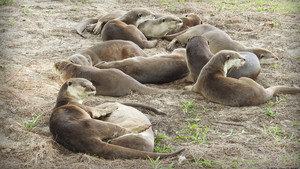
These are smooth -coated otters.
They're a pretty large otter.
The adults get up to about 10 kg, which is larger than the European common otter.
They're a little bit unusual as mammals go because the adult offspring stay with the family as helpers.
So a family group might have two dominant breeding individuals and one or two sets of adult offspring that are staying as helpers, and then a brood of pups, which is pretty typical.
The family sizes are quite large in Singapore.
We have families that are over 20 individuals, and we have more than a dozen families in Singapore.
And those families are watched by otter watchers, some of whom go out and watch the otters every day.
My students worked closely with some of the otter watchers, and we got to find out all sorts of interesting things.
Otters have a really tough life.
They wake up in the morning.
They fish. They roll around in the grass.
They play. They go to sleep.
And then a few hours later, they do it again.
And now back to the episode.
So my students wanted to know whether adults and pups played differently.
And what they did to look at this is found literally dozens of interactions like this and looked at the frequencies of role switching among the individuals who were playing.
If you watch them long enough, they do something where one pup will chase the other and then it'll switch roles, so the second pup chases the first.
It's very much like tag your it.
It turns out that pups do this a lot, and adults don't do this much at all.
If an adult is in a dominant position, it stays in a dominant position.
But this tells us something.
It tells us something about how play has different functions for pups versus adults.
For pups, play is a way that they're figuring things out and they're learning, but for adults, they're jockeying for a position in a social group, and that's why they don't give up their position of dominance.
Monitor lizards and otters live in the same environments.
They both eat fish, and they bump into each other all the time.
And otters sometimes attack the monitor lizards, and sometimes they kill the monitor lizards, but not all the time.
So my students wanted to know when the otters attack, what conditions lead to the otters attacking sometimes but not other times.
This is a pair of otters that are approaching a monitor lizard.
And if you notice, the monitor lizard's throat frill is open.
It's in an aggressive posture right here.
And in fact, just seconds after this picture was taken, the monitor lizard whipped its tail at the otters.
So monitored lizards can also be aggressive, but most of the time, they're reacting to the otters.
What my students found after looking at dozens of these kinds of interactions was that otters were more likely to be aggressive if there were pups around, and they were most likely to be aggressive if there were more pups in a group than there were adults.
So the otters are only aggressive to defend the pups.
The otters are big, and they're fast, and they're smart, and they don't really have to worry about the monitored lizards very much, but the pups do because they're small and they're kind of dumb.
It turns out that pups drive a lot of the things that otters do.
What they're doing here is catching fish, but what's interesting is they're catching really small fish.
This is called herding or corralling, depending on the medium in which they're doing it, and it turns out that otters do this only when they have pups, and when they do it, they typically catch very small fish.
So this isn't a way for them to catch more fish, and it isn't a way for them to catch larger fish.
What it is is a way for them to teach their pups how to hunt, and it's not just that the pups are learning how to hunt by being with the adults.
It's that the adults are actively changing their behavior so that they can teach the pups what to do.
So all of these discoveries, and there are a few more of them, we couldn't have done without the otter watchers, and the otter watchers are incredibly dedicated to watching otters.
We really owe them a lot, and I really want to kind of voice that gratitude towards them.
And a lot of things motivate otter watchers.
So otter watchers might be curious about the otters, they might like the otters, but a lot of the otter watchers are photographers, and that's their primary hobby.
And for them, this is a chance to get really excellent photographs.
The same thing in Singapore is true with birders.
If you've ever gone birding in Singapore, it's a little bit surreal, because rather than go out and look for people with big binoculars, you look for people with big cameras.
But otter watching and bird watching are gateways.
They're gateways for people to interact with nature.
And so people who might start otter watching, because they want to get photographs of cute pups, might continue to do other things because they've formed a connection with nature.
And we see this all the time, that people care about nature when they form some connection to nature.
Whether that connection is to otters, or to a pair of hornbills on campus, or to a bird that visits them on their balcony.
We need these personal connections, and we see them all over the place.
So that's one thing to emphasize, but I'm not the only one who's thinking about this.
Singapore has enacted a lot of policies that make these kinds of connections a lot easier.
So we talked about Singapore cleaning up its waterways in the 70s and 80s.
They've done a lot of other things, too, including plant over a million trees.
There are over 300 parks and nature reserves.
Singapore has a plan that no one should be more than 10 minutes away from some kind of park.
Now, there are a lot of reasons to do this, and some of these are public health reasons, but one of the effects of this is that people will have more chances to interact with nature, and they'll have more chances to care.
So I'm really excited about these possibilities, especially in Singapore, especially because Singapore is one of the most densely populated countries in the world.
Recently, Enparks changed its motto.
Enparks had the motto that Singapore is a city and a garden, and they changed it to Singapore is a city and nature.
And I think this is a real effort on Singapore's part to shift how they view their relationship to nature.
I think we're trying to get away from something where nature is over there on the other side of a fence or a wall or something like that.
Nature is something that's around us and above us and beside us, and Singapore is acknowledging that, and that's true in lots of places, including in cities.
So I think this also raises other questions, such as can cities be wildlife refuges?
Is the biodiversity we see in Singapore, is this the last hot ember of the biodiversity that was here before?
Or is this something that we can protect and maybe foster and grow?
Lots of cities have wildlife.
It's not just Singapore.
Most North American cities have wildlife like raccoons and coyotes, and some have bears and bobcats, but sometimes they're even more impressive things.
For example, Los Angeles has mountain lions and Mumbai has leopards, and there's still one jaguar kicking around Tucson.
So there's still these big cats, not just predators, but big cats that are in other cities.
And Singapore, unlike some of those cities, is just incredibly, incredibly dense in terms of human population, and yet we're ripe with wildlife.
So I think it's a real question.
Can we make cities that are wildlife refuges?
Can we make cities that foster some kind of productive relationship between wildlife and humans?
Can we make cities where we exist in close proximity, side by side?
I think we can. The founder of Singapore, famously, or at least as legend has it, saw a large creature moving along, and he thought it was a lion and so he named Singapore after it.
Singapore, lion city.
And much later, Singapore adopted its mascot of a merlion, which is supposed to celebrate Singapore's history as a sea city and this legacy of it being a lion city.
Obviously, there are no lions in Singapore outside of the zoo, and there never were.
But we do have a ferocious mammalian predator that hunts in groups, that fights giant lizards, that protects and teaches its offspring, and that's frequent in the waterways around Singapore.
Isn't that predator sort of half fish and half lion?
Singapore is magic.
That was Philip Johns speaking at TEDx Yale and US College in 2023.
If you're curious about TED's curation, find out more at TED .com slash curation guidelines.
And that's it for today.
TED Talks Daily is part of the TED Audio Collective.
This episode was produced and edited by our team.
Martha Estefanos, Oliver Friedman, Brian Greene, Autumn Thompson, and Alejandra Salazar.
It was mixed by Christopher Faizi -Bogan.
Additional support from Emma Toppner and Daniella Balarrizo.
I'm Elise Hugh. I'll be back tomorrow with a fresh idea for your feed.
Thanks for listening.
Thanks for watching.