From The New York Times, I'm Rachel Abrams, and this is The Daily.
Ice out now!
Ice out now!
Ice out now!
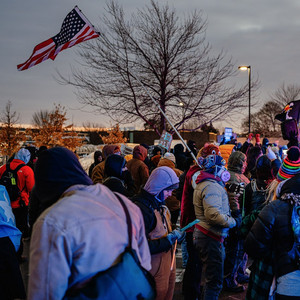
For weeks, protests around Minneapolis have caught nationwide attention as the city shows open defiance to a federal immigration crackdown.
When our immigrant neighbors are under attack, what do we do?
Get out of here!
But behind the scenes, a quieter, organized resistance has taken shape.
Today, our producers Anna Foley and Michael Simon Johnson go on the ground in Minneapolis to capture that effort.
And our colleague Charles Homans explains why the city has become ground zero in the fight over the government's deportation strategy.
It's Wednesday, January 21st.
This is Michael Simon-Johnson.
I'm here with New York Times reporter Charlie Homans.
And we are, what neighborhood are we in, actually?
So this is the Lynn Lake area of Minneapolis.
We're in South Minneapolis, and it's named after this intersection that we're standing at actually, which is Lyndale Avenue and Lake Street.
It's kind of the place where sort of the recent waves of immigrants and settled refugees and the Minneapolis of the kind of white, liberal urban culture intersect.
And those groups have been brought together in an interesting way by this ice crack down in the city.
I mean, the thing that's different about Minneapolis compared to Chicago or Los Angeles or other cities that have been targets of this crackdown so far is that it's a very small city.
It doesn't have that many people in it.
And the number of federal agents that have been sent here is really quite huge.
And what I've been hearing, just talking to people here, is that in the last few weeks, people who are potential targets of these raids have really felt like they can't leave their homes at all.
And so that has kind of become a focus of the organizing of a lot of these local organizations and businesses which are kind of gathering donations.
So we're about to go to one of these places.
Tell me about what this place is and then what its role is in this kind of network that you're talking about.
Sure.
So we're going to go to Smitten Kitten, which is a sex shop on Lindale here.
And it's been playing a very interesting role, kind of what's been happening here lately.
Okay.
Well, let's go inside.
So I'm Anne.
I work here at the Smitten Kitten for the past two years.
During the regular day, we are an adult store.
We really focus on trying to give people accurate information about sex education.
We also have stuff for like every gender ever.
Well, it is very striking that this is like a sex shop a really nice one beautiful, we laid out, but also at the front there's this uh, mutual aid, mutual aid.
Yeah, we're always doing mutual aid, but we just expanded it and like imploded ourselves with mutual aid, basically.
Well um, let's go downstairs.
Yeah, I'm now walking past the sci-fi fantasy dildo section.
This is a lot.
Lots of boxes of diapers, lots of boxes of formula, wipes.
That is huge.
Just so I have a sense.
How many people have come by today, for example, to like pick up some.
Hundreds of people.
Hundreds?
Because I was getting anxiety.
Probably a thousand people over the past couple of days.
But the goods are moving.
Like you're not like.
We're not sitting on it.
It's got to go.
Yeah.
It is insane the volume and the urgency that we have been meeting people with.
They will be bringing their papers into the store.
They are afraid.
They are leaving their house to come here to get resources, even though they are at risk for being picked up by ICE.
And they're all wanting to prove to me the validity of that.
And I'm like, I really don't care.
Like you, don't have to tell me because I know that the next person behind you has the exact same story.
It's like there's no time to notice that there's a dildo on the wall because like, your family is being torn apart.
That's what's in the store.
I'm curious like what you think it says about sort of Minneapolis right now that a shop like this is kind of on the front lines of the community.
Response to the situation.
Yeah.
Sex workers and marginalized groups of people like that will radicalize you.
I really learned in the strip club that everyone agrees with the revolution.
We just don't all have the same language to talk about it.
And I feel like we inspired a bunch of other businesses to begin taking in donations and distributing them to their neighbors.
And I've been telling people all day long the more spots that we can pop up with resources, the harder time that ICE is going to have keeping track of where everyone is at.
Because we've also had ICE agents follow people from our spot.
Wow, so they know.
Yeah.
What you're describing is a, at least citywide, I don't know exactly what the right word is.
I don't know if it's like a movement.
I don't know if it's a network.
I don't know if it's like a change in, It's like a bunch of people realizing like oh, they're really not coming.
Something that happened in 2020 was the first time I realized, like My neighbor's house is on fire and the fire department is not coming, so you better find a garden hose.
Like, why am I, Ann Lehman at the Smitten Kitten, doing more than Jacob Frye?
You feel like you're doing something that is far more actionable is having like immediate direct.
Yes.
I think that's why our shit blew up because they're like, oh, look at these people at the sex shop.
Why are they like, I can't believe I'm just some kid.
I love Elvira.
Like I just watch horror movies at home and listen to Beyonce.
So that same day I went to the site where, just a week earlier, an ICE officer had shot and killed a Minneapolis resident, Renee Good, in the city's south side.
I'm on the corner of Portland and 35th on one end of the block, and there is a sign on this tree that someone posted.
It says, visitor guide.
The block you are entering has become a space of mourning.
Remember, you are a guest in this neighborhood.
Take a deep breath.
Drive slow.
Approach the space with reverence.
Notify neighborhood leaders of suspicious activity.
There's a lot of flowers, a lot of flags, a lot of teddy bears.
There's a bunch of people that have made a fire.
A car just pulled up, like driving down the block stopped, asked if these people need more firewood for this fire and dropped it off.
There were about a dozen people there.
Some people were staying for just a few minutes.
Others were lingering.
Why did you choose to come here today?
To bear witness to what's happened.
This is a city where people, there's a very strong sense of community.
There's a lot of political involvement.
People look after their neighbors and things like that.
It's not a faceless city.
Right.
I asked the woman who'd brought flowers what she was feeling.
You have mixed emotions, because you have just this heartbroken feeling for the family because this did not have to happen.
But then you have this hypervigilance and you're watching every vehicle that has tinted windows and seeing
You know it's like trying to pay your respects but also trying to watch out, like is somebody going to come up here and break us up.
Like today, our building, we have a cleaning lady and I gave her a ride home today because I was like, do not stand at the bus, stop today.
It's not safe anymore, so...
That's so sad.
It's one of those things that it's if you want to help out in any way or if you need help, you know, all you have to do is ask.
But that's I mean, that's what the Twin Cities is like.
As I was talking to people there, I got the sense that residents were actively looking for ways to show up for each other.
I saw strangers bringing each other coffee, giving each other nods, exchanging information.
There was one guy there named Nero who seemed like he was sort of the unofficial shepherd of the group.
He was tending to the fire and he was curating the space, is what he said.
I've been hearing different anecdotes of people.
I mean, I know, you know people have the whistles, but also people dropping off mutual aid related packages at like, local stores or specific places.
People, you know, it seems like people are protecting.
Yeah.
Yeah.
Like kind of stepping up in a way.
It almost made me want to cry.
I feel proud and happy to talk about how people are pitching in.
And I'm sad and hurt because of why we have to.
We shouldn't have to.
You know?
We shouldn't have to do this.
And it's...
I don't know what it's going to take, man, but I'm here.
I'm in it.
I'm here.
And I'm going to be here.
Anna Foley here.
I'm a producer on The Daily who also spent the weekend in Minneapolis.
Along with the networks of activists, mutual aid and neighbors taking care of neighbors, there are people avoiding ICE because they're afraid of getting detained or deported.
Immigrants afraid of being targeted.
I talked to one of them.
We're calling her M.
Can you tell me about the moment that you found out the ice was coming to the Twin Cities, to Minneapolis?
Yeah, so it wasn't something that, like, changed from like one day to another.
I think it was like a slow trickle of, hey, ice was spotted over in Richfield.
Everybody be careful.
And then it was slowly and slowly more agents are spotted here and someone was taken.
Avoid Lake Street.
And then it snowballed.
And then you're really noticing everybody's like, there's ice agents here.
In December, when ICE really ramped up enforcement, Em realized she needed to make some changes and take precautions.
I start to strategize like different routes to get to university, different routes to get to work.
And I ended up not going to the grocery anymore at all.
It's been a long time since I've been at the grocery and I love a grocery.
Em actually can't be sure she's a target.
Her parents brought her to the U.S. when she was two.
She's a DACA recipient.
But that feels very tenuous to her right now.
Given how intense everything has been, she worries.
It was kind of looking at what is the busiest cross-sections.
Like, am I going to be going by a high school or am I going to be going by, like, a church?
I tend to avoid that area because you never know.
Are they going to set up by a daycare?
We have to consider that.
For a while, the plan was avoid risk, lay low.
But over time, that changed.
She was watching the raids, the arrests, and then Renee Good was killed.
It kind of set something on fire for me.
The fear became, like, resentment and became anger.
I was at school and, you know, I was talking to my colleagues.
I was talking to, you know, fellow students.
And I realized that, like...
These people have families, they're teachers, they're taking risks.
People are putting their lives on the line.
Who have children?
You know who are.
You know loved ones.
You know wives, you know husbands.
And as soon as they realize that, like everybody's taking a risk, you might as well also take a risk for your community.
Taking a risk meant that, instead of going out of her way, trying to avoid run-ins with ICE, she took routes where she knew she might see them.
So she could alert activists on a signal chat.
I would see suspicious vehicles and I'd be like hey, there's a weird vehicle at the gas station at this cross section.
Just letting you guys know.
And, you know, sometimes people ask of you if you can, like, circle back.
And I was not able to.
I was very explicit.
I was like I could not turn around, but here's the information and that felt okay.
I'm like, here you go, hope for the best, hope this helps.
The network m is alerting on signal when she sees ice.
I got in touch with some of the people who are on the other end, these civilian patrols that have proliferated in cities like minneapolis, people showing up where ice is.
I asked them if I could ride along to get a sense of what they're doing and what that's like right now.
I met up with two of these activists, Patty and Mitch, on Friday afternoon.
I came to their house on a block with lots of cute bungalows.
They met me at the front door.
But they stopped me before I came inside.
In an abundance of caution, would you mind verbally telling me that you're not with ISCBP or any government agency and then show me your press credential?
Yeah, I'm not with ISCBP.
Here's my press credential.
Come on in.
Do you want to take a look?
Yeah, I appreciate it.
Yeah, of course.
My name's Anna.
It's nice to meet you.
Anna, great to meet you.
I'm Mitch.
I'm Patty.
Nice to meet you.
After a few minutes, we hopped into Mitch and Patty's car.
Mitch drove, Patty was in the front, me in back.
Patty had brought along a small notebook.
And before we left, they stopped to make sure they both had everything, especially their whistles.
I have an extra whistle.
Oh my gosh, thank you.
How often do you guys use your whistles?
Um, every time we see ice, so that's been probably almost every time that we've been out patrolling.
And you just, once you see it, that's when you start bawling?
Yeah, pretty much.
Kind of been a somewhat informal but accepted like do a little peep peep peep if like, ice is around.
And then if they're actually in the process of taking someone, if they're in the process of a raid or something, blowing the whistles a little bit harder to really get people's attention.
You're blowing hard on that whistle, yeah.
Do you feel like, even when you're not patrolling, do you hear whistles kind of piping through the city?
Yes, especially in the last week and a half.
I mean you'll just be yeah, just in your house or running errands, or you'll hear whistles here and there.
You'll hear cars honking and that's how you know ice is out and about.
Mm-hmm.
They told me their goal today and really any patrol they go on is to document where ICE is, what they're doing, who they're taking, all as an act of resistance.
To show ICE, they want them out, and they're watching.
I am connecting with our group chat to get a sense of if there is any particular part of South Minneapolis where we should be looking around for ICE.
And actually, Mitch, if you could.
Take a left here and go down to Lake Street.
Yep.
Patty told me people patrolling like this coordinate through group signal chats.
Usually they'll hop on a group call and share information about where ICE has been spotted, where they think people should focus.
Hundreds of people can join these calls, and they don't necessarily know who else is there.
On this day, Patty made it really clear to everyone that I was in the car with them, though I couldn't hear.
Everyone is very nervous about who might get into these signal chats and be monitoring.
There's a bit of a paranoia and a hypervigilance that everybody in the city has.
I'm just looking at basically any vehicle with suspicion.
It's put us all on edge, and so it's not just driving around.
It didn't take long for them to spot a car that, to their eyes, seemed suspicious.
We just pulled onto a side street.
You just slowed down the car and you were looking.
Can you tell me what you're looking for?
There's a black truck that had their lights on.
They've got a grill guard.
We definitely have seen ICE agents in a lot of, like, bigger vehicles.
And Patty, what are you doing?
I am writing down the license plate of this car and I am going to ask for a plate check on it.
So you're asking for a plate check.
Somebody who's in front of their computer is going to run the plates.
And what are they looking for?
We're not exactly sure.
What we know is that we can send the license plate in the group chat and then someone will check to see if it has been like a license plate that is confirmed to have been ICE.
And it's deeply decentralized.
We have no idea who is running these plate checks.
After sending the plate number to the group and signal, Patty and Mitch hear back very quickly.
I just got confirmed ice for that vehicle.
All right, so we should loop back around and what should we do?
Should I park on the other side of the road from him so that he doesn't feel that we're obstructing?
Mitch and Patty drove around the block while wondering what to do next.
In the time that took, people had actually already started to gather in the spot where they'd identified the suspected ICE car.
Look, there's already a bunch of people here.
There were more than a dozen people a neighbor peeking out to see what was happening and a gathering group of activists, some in cars, some on foot, some filming.
Mitch rolled down his window.
You saw him go in the house?
Got you, got you, got you.
Word was, the agent had gone into this one house, but people weren't sure.
So now everyone was just waiting to see.
Was ICE in there?
What were they doing?
Do you want us to go check the alleyway?
Mitch and Patty pulled up near the alley to watch the back of the house.
And just to say, this kind of waiting can apparently take a very long time.
I talked to one woman who told me she'd staked out an apartment building in this way for about four hours.
Mitch and Patty told me this waiting can make them feel very anxious.
Today, Patty said she was particularly on edge.
This was her first time out doing this after getting detained about a week earlier.
So last Sunday I was with my friend Brandon and we were responding to an ICE sighting in my neighborhood.
We followed them for about 40 seconds and then they stopped their car, got out of the car and came and surrounded us, screaming at us to stop following them.
Patty says one of the agents set off pepper spray so that it would get pulled into her car's ventilation system.
She tried to shut off her heat quickly, but some got in.
Her eyes and throat started burning.
Then, according to Patty, the agents then surrounded her.
And then proceeded to tell us that we were under arrest.
Mm-hmm took these instruments out of their vests and smashed in my front two windows and dragged us out of the car, put us in handcuffs and put us each in separate vehicles.
What was going through your head when that was all happening?
How are we getting arrested right now?
We didn't do anything wrong.
We weren't committing any traffic violations.
So it was like, how can this be happening right now?
How am I in handcuffs?
How am I in the back of this unmarked car?
Something that stood out from this story and other things this past weekend is just how unclear it is to the activists what could get them in trouble, detained or arrested.
People seemed like they were trying to figure out the rules in real time.
Is it blocking traffic?
What's a safe distance to follow a car if you think it might be ICE?
As for Patty, whatever she'd done to get detained, she didn't get charged with anything.
She was released later that evening, and she still doesn't know why they took her in.
Now, a few days later, here she was, back out patrolling.
About 20 minutes after we started staking out this one truck, the suspected ICE agent emerged.
This is him.
He got in his car and started driving.
Do you want to start following him?
Yeah.
Just at a pretty safe distance.
How are you guys feeling right now?
Um, I am feeling a little nervous, but also um, also feeling like it's important that we stay out here, right?
I think part of it is just knowing that the point of the arrests and the detentions is to instill fear and is to deter people from doing this important work.
From ICE's perspective, you're saying their point is to instill fear?
I think so.
I think that ICE's point in making these arrests and detaining people who are then oftentimes let out without charges, like I was, is to, you know, intimidate people and deter them from doing this work.
And to me, if they are willing to go through the whole process of trying to intimidate people like that and use their resources that way, then I think that that means that it's having some sort of impact.
So I want to keep showing up and doing everything that I possibly can.
To, you know, gum up the works and For Patty and Mitch and the other activists I talked to, two things are true in Minnesota right now.
The last couple weeks have been scary as things have escalated.
And, at the same time, the intensity of the response from ICE.
It feels like a confirmation that they are making it harder for ICE to do their job.
Otherwise, ICE wouldn't care so much.
So their plan is to keep at it.
I think we should go up and check that car, but... They're turning around.
Do you want to get their plate as well?
Yeah.
Or you can read it to me and I'll read it down.
Yeah, I'll read it off to you.
After the break we talked to Charles Holmans about the situation on the ground in Minneapolis and how Minneapolis became ground zero for pushback against ICE.
We'll be right back.
Charlie, you are currently in Minneapolis.
That's also your hometown, we should note.
And you have spent a lot of time recently with our producer Michael, who we just heard from, when you were both covering the protests over the weekend.
And we just heard voices from residents, some of whom you spoke with, who are responding in real time, sometimes in very personal and precarious ways, to federal officers.
So I want to start by asking, why has this federal force descended on the Twin Cities specifically?
Well, the official Trump administration explanation is this fraud scandal that's been sort of building for a while.
That does implicate a number of members of the Somali community of Minneapolis.
And it's been a little hard to keep track of why they're here, because they've thrown out a number of other reasons since then, having to do with the immigration crackdowns in general that we've been seeing, which have spanned Los Angeles Chicago, New Orleans, other cities.
But if you're the Trump administration and you're looking to just arrest a lot of undocumented immigrants.
Minneapolis is an odd choice because it's still a largely white city that doesn't have the sort of numbers that you would have in California or Texas or many other states, which has made it pretty clear that a lot of the context of the decision here likely has to do with other factors.
Minnesota is the state of Tim Walz, the vice presidential candidate in 2024, who Trump does seem to truly hate, and vice versa.
It's also a very liberal city in a state that Trump has not ever won.
He's claimed that the election here has been stolen from him several times without any evidence.
And it is just sort of a state that embodies in many ways ideas and people that he has really staked his second presidency against.
Minneapolis, of course, is also, we should note, the site of George Floyd's murder and the eruption of protests that obviously convulsed the country back in 2020.
That's right.
Minneapolis was very deeply affected by what happened here in 2020.
Minneapolis is a very liberal city and a lot of people here were extremely outraged over the murder of George Floyd and broadly sympathetic to the protests.
But they were also very directly affected by the rioting that followed some of these demonstrations and often lived in neighborhoods where they saw people showing up in masks to burn a police station and things like that.
So it's left all of these kind of divisions within what is really like broadly a white liberal city.
When I've come back here in years since then, you really see the long shadow of 2020 in Minneapolis.
But what's been very interesting being here over the past week is that you also see a lot of the legacy of that in these kind of community structures and just kind of an ethos that is being applied to the current crisis in Minneapolis.
A lot of the same relationships and organizing ideas that people used to respond to what was happening after George Floyd, Whether it was coordinating protests or doing these sort of neighborhood watches to keep what people considered sort of bad elements from causing trouble on their block.
A lot of that stuff is being used now in sort of updated and evolved ways in the response to the federal deployment here.
It is really interesting to think about how what happened after George Floyd changed the city in a way that is affecting the response currently.
But I want to also acknowledge that, while we are talking about broad opposition to what the federal government is doing, there are also people who support what ICE is doing.
Of course,
I wonder how many of those supporters you've actually encountered on the ground.
In Minneapolis, very few.
There are many people here who view the fraud scandal as genuinely appalling.
And there are certainly people who are broadly supportive of removing undocumented immigrants with criminal records from the streets, here as elsewhere.
You don't hear those people talking vocally in Minneapolis right now.
I think because the crackdown itself has so visibly been sweeping up a pretty wide range of people beyond the stated targets of it, that has contributed to a sense of real embattlement in Minneapolis itself.
Right.
There have been all these videos and images, some very graphic and violent, of federal agents detaining people, grabbing people out of cars.
We know, in at least some instances, folks that have been detained by federal agents ended up being US citizens.
Video, of course, that has gotten the most attention in recent days is the footage of Renee Good being fatally shot by an ICE officer a couple weeks ago.
That certainly infuriated people all over the country and mobilized people on the ground in Minneapolis.
Can you talk a little bit about how that shooting changed things on the ground in the Twin Cities?
I think that it made this much more direct and personal for a lot of the people who are involved in the response, many of whom are white liberals from these sort of South Minneapolis neighborhoods that have been most galvanized by what's happened.
And it's a city that has a long history of somewhat impersonal liberal activism on things like civil rights by kind of white liberals who don't necessarily have a ton of skin in the game themselves, or particularly direct relationships or even interactions with people of color here.
And I do think that the shooting of Renee Goode changed that in a way.
And I've heard this from both people who are involved in the activism here and also some of the people who are immigrants, who are targets of these raids.
They recognize that something really shifted with the shooting.
I wonder what you make of what we've seen in Minneapolis the last couple weeks just in total.
The stakes obviously feel very high.
We've all seen these incredibly violent images.
But the weekend did not escalate, I think, the way that a lot of people had been worried about, or may at least have anticipated,
The federal government has also been trumpeting its success in Minneapolis.
And there's this open question about whether the president will invoke the Insurrection Act.
And basically, there's no sign that the feds are planning a widespread pullback anytime soon.
So I just wonder if you have any sense from your reporting what to expect in the coming days.
That I think is really the big unanswered question.
And you hear it from people a lot.
Like there's a sense that something really profoundly different is happening here, that we're sort of off the map of prior experience.
When I was in LA in June, when this was happening there, there was certainly a sense that oh, you know, these agents are actually kind of making a lot of just very opportunistic arrests.
They're not necessarily targeting people they know have criminal records.
They are looking for a landscaping truck and then just grabbing everybody in the landscaping truck and seeing who they have.
And so there was a very palpable sense there that anybody could be a target, who was an immigrant, or even ethnically Latino or otherwise, not white.
I think that what is different in Minneapolis is that there is a more pervasive sense that not just could anybody in those categories be a target, but that there's a good chance that those people will be a target.
Because it's a small city.
Non-white people here tend to be very visible because it is a heavily white city.
And there are just so many federal agents here.
And so there's a sense of real vulnerability that feels different from other places where these federal raids have happened.
But I think the extent of what's happened so far and the uncertainty about what could happen from here has led a lot of people to ask themselves these real questions about how far they're willing to go in the response efforts here.
I've talked to people who have said am I going to need to start hiding people in a spare room in my house?
Those are questions that people are seriously asking themselves and each other right now.
And there is a real sense that this is an important moment in history that's unfolding, and how people respond to it does have the ability to kind of direct.
You know which direction history goes from here.
Charlie, thank you so much.
Thanks for having me.
We'll be right back.
Here's what else you need to know today.
In a nearly two-hour speech to mark the first anniversary of his second term in office, President Trump listed a litany of grievances and accomplishments that wavered from his prowess as a Little League player to complaints about European allies.
He also said he'd learned that Rene Good's father had been a Trump supporter and said that he hoped that he still was.
The administration has accused Good of being a domestic terrorist.
The SP 500 dropped more than 2 for the first time since October as investors reacted to President Trump's increasing threat of higher tariffs on European allies unless they supported his plans for America to take control of Greenland.
Tuesday's trading was the first chance US markets had to react to the threats that Trump made over the weekend, when he also declined to rule out the use of military force to take over the country.
And was engineered by Alyssa Moxley.
Special thanks to Vivian Yee.
That's it for The Daily.
I'm Rachel Abrams.
See you tomorrow.