Let's cut to the chase.
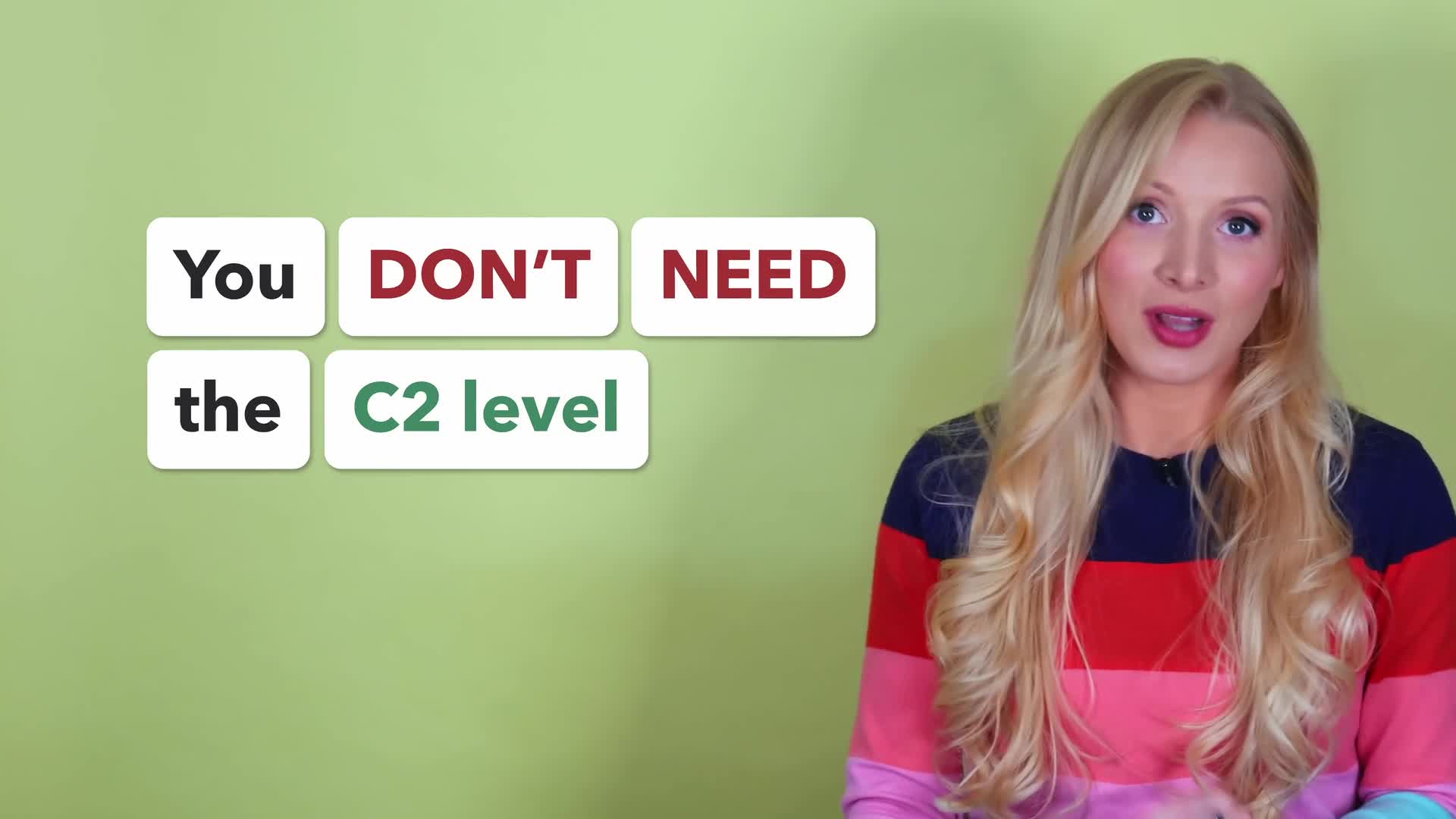
You don't need the C2 level of English.
For most people it is 100.
True that they don't need to reach the highest level of English, but that's just it.
Most people who reach C2 don't need it.
They just want it.
And now here's where a lot of teachers and students might disagree with me.
You've probably heard the claims it's impossible to reach the C2 level in English, or no one even uses C2 level language in real life.
Now, this might start a war in the comments, but I'm gonna say it anyway.
I think that some people don't have a fully accurate picture of what C2 is.
In this video we're going to explore the level together so you can decide for yourself if you want to reach C2, because virtually no one needs it.
And honestly, there are so many things in life that are a want to have over a need to have, and those want to haves tend to be gorgeous, just like C2.
When I was a young, fresh teacher, I listened to a lot of my colleagues who were very anti-C2 level.
But what I learned over time is that there is a specific group of students who just want more.
They want to achieve, they want to reach the top.
So now I've formed my own C2 opinion.
I will not push it as something that everyone needs, but I have to acknowledge that it's something that a lot of people want.
I have created a PDF of everything we cover in today's lesson.
It's essentially your cheat sheet to C2.
So you can start building your C2 proficiency today.
I've included something that nobody has seen yet the full curriculum for my brand new beautiful British English C2 program.
You'll see exactly how you can approach C2 level general English with me.
In just three months you can be so much closer to C2 than you ever thought possible.
Download your cheat sheet and see my full C2 program curriculum, maybe just out of morbid curiosity, out of fascination, just to see what the highest level English course could possibly consist of.
Just click the link in the description or scan the QR code here.
I'll send it straight to your inbox.
I'll also add you to my C2 waiting list, which opens on Monday the 19th of January.
Okay, let's start with an example of what people think C2 is.
The subterranean rail conveyance was an exercise in corporeal compression and look Technically, this is C2.
At C2, you need to be able to understand pretty much everything you hear and read.
But while that vocabulary has its place in academic writing, very few people talk like that.
It's very formal.
So here's the same sentence in less formal but still C2 level language.
Tube was rammed.
That simple.
It's that simple.
Tube is rammed.
As in, the London Underground was very crowded.
Now, technically it should be the tube, but native speakers sometimes drop articles, particularly at the beginning of a sentence.
Rammed means full or very crowded.
I use this word all the time.
This place is rammed, let's get out of here.
It's very common in British English.
Also, don't stress, I've put definitions of those words and the elaborate language in the PDF.
Let's do one more stuffy C2 versus real life C2.
What am I talking about here?
My reliance on this venerable bean-derived infusion has reached a level where abstention engenders physiological disarray and existential malaise.
What a sentence!
Basically, that's my coffee addiction.
Again, some of those words would be right at home in an academic journal.
And we will absolutely look at that sort of language in my C2 program, but we'll also look at real life C2 language like this
If I miss my morning coffee, my soul literally clocks off and I'm pretty much comatose by 9 a.m.
So that's definitely something I'd say, unfortunately.
To clock off means to stop work and comatose means extremely tired or literally in a coma.
Well, in which of these places will you not find C2 level language?
Let's make this a quiz.
At the pub, in a newspaper article, in the queue at Tesco, on a podcast or in a novel.
I'll give you a few seconds.
I'm so sorry, that was a trick question.
You will find it in all those places and many, many more.
It's everywhere.
C2 level language isn't rare.
It's not about using the longest words or creating the longest, most complex sentences.
And it's not explicitly old-fashioned, archaic, or elite.
Features of C2 are used every single day by proficient English speakers.
And in my C2 program we cover it all, from the academic to the colloquial, so that you feel completely at home in English.
Let me describe C2 in one sentence.
At C2, English feels effortless.
That means you can understand basically everything you hear or read, whether it's a podcast, a lecture, a news article or a fast conversation at the pub.
You can talk about almost any topic spontaneously and fluently, without searching for words and without second guessing yourself.
At C2.
You have a massive range of vocabulary and structures at your disposal, including idioms and colloquial expressions, and you know exactly when and how to use them.
Your pronunciation sounds natural.
Your grammar is spot on.
You can talk to anyone anywhere, anytime.
In short, you've mastered the language, but that is still quite abstract.
So let's see what C2 might really look like in some of the scenarios I mentioned earlier.
We will start at the pub, listen and see if you understand what's happened.
Where's John?
That sneaky boy.
It's locked off again right when it's his round.
Well, John's disappeared just as it was his turn to buy drinks for everyone.
As for C2 level vocabulary, we had sneaky, meaning behaving in a secretive or dishonest way.
And then there was a word elided, and it would be up to you to fill in the gap, probably with an insult or a swear word.
Knowing how and when to elide for dramatic effect and being able to fill gaps like this is a high-level skill.
We also had to slope off, meaning to leave somewhere quietly, often to avoid something.
And round, which is a set of drinks bought for a group.
Everyone takes turns.
Okay, next up, newspapers.
Here is a short extract from a music roundup in the Guardian newspaper.
I will link to the article in the PDF and in the description below.
This part is about Chapel Roan.
Listen and read.
What does the writer think of her?
The writer simply loves her.
Now that might be closer to what you think of when you hear c2, but it's not from an article about nuclear physics, it's a music review in a very popular newspaper.
Let's go through the vocabulary we have.
Electrifying meaning, very exciting.
To subvert is to challenge expectations or established norms.
A pastiche is a piece of art, music or writing that imitates the style of someone or something else.
And if you're able to turn your hand to something, you can start something new and do it really well.
Okay, we'll pop into Tesco now.
We're in the queue.
And Tesco is one of our most, I think it's probably the most common supermarket in the UK.
We're in the queue.
What is happening in this exchange?
Don't worry, we've got all day.
Oh, I know, I'm ravenous.
I might have to break into the Bickies before I even get to the till.
So the queue is moving very slowly and someone is so hungry they might have to open their biscuits before they've paid for them.
The exchange started with some sarcasm.
No one has all day to stand in a queue at Tesco.
For our C2 level vocabulary we have ravenous, great word meaning extremely hungry and bicky, which is British slang for biscuit.
Now you don't need to know all British slang or all American slang at C2, but it's likely you'll understand quite a bit through immersion in the culture.
Next, let's listen to a bit of a podcast.
This is a clip from Science Versus.
I'll link to the episode, which is called The Funniest Joke in the World.
Listen and try to complete these gaps in the transcript.
There is a gaggle or giggle of research out there that shows why laughing matters.
So what's curious is that we, as humans, we're not the only animals to laugh.
You should have had giggle and humans.
Did you get those?
So the speaker really played with the sound and meaning there.
Gaggle means a noisy group of people, but in the passage, it referred to a lot of research.
Then the speaker added giggle, meaning a silly laugh.
A gaggle or giggle of research, which links us back to the topic of laughter.
After that, we have some interesting grammar. a cleft structure used for emphasis.
What's curious is that, instead of it's curious that.
You may have noticed that I haven't mentioned grammar much yet.
And at C2, you should already be familiar with most structures.
But we do cover grammar, including some really high level parts. in the C2 program.
I've put a short passage from a novel in the lesson PDF, and it also includes some high-level grammar as well as gorgeous descriptive vocabulary.
Okay, so that was just a tiny snapshot of C2, but hopefully you've got the idea.
I stand by my point that C2 is a want, not a need for the vast majority of students.
But if you want it, you are capable of achieving it.
Students like you are the reason I have created my beautiful British English C2 program.
It is not for everyone, but if you think it's for you, we launch on the 19th of January.
If you haven't downloaded your cheat sheet yet, it's got everything we've covered today, plus the full curriculum from my brand new C2 program.
I'll also add you onto the waiting list, so you'll be the first to know about the huge launch discount I'm offering.
Just click the link in the description or scan the QR code there.
And that's it.
That's C2.
It's not impossible.
It's not just for academics.
It's right there waiting for you if you want it.
Thank you so much for watching this video.
I hope you enjoyed it.
I hope you learned something and I hope you have a stronger opinion about how you feel about C2.
I'll see you in the next one.