NPR.
This is The Indicator from Planet Money.
I'm Darian Woods.
And today, Dustin Dwyer is joining us from Member Station Michigan Public.
Hey, Dustin.
Hey, Darian.
So, look, I wanted to tell you about this meeting I went to not that long ago.
It was a planning commission meeting for a little place called Pavilion Township, Michigan.
Okay, haven't heard of that town before.
Yeah, you know, I hadn't actually either, even though I live like about an hour away.
Yeah, there's a lot of data center talk at the moment.
Yeah, because there's such a huge factor in the economy right now.
These are the massive buildings filled with the computers to power all these new AI models.
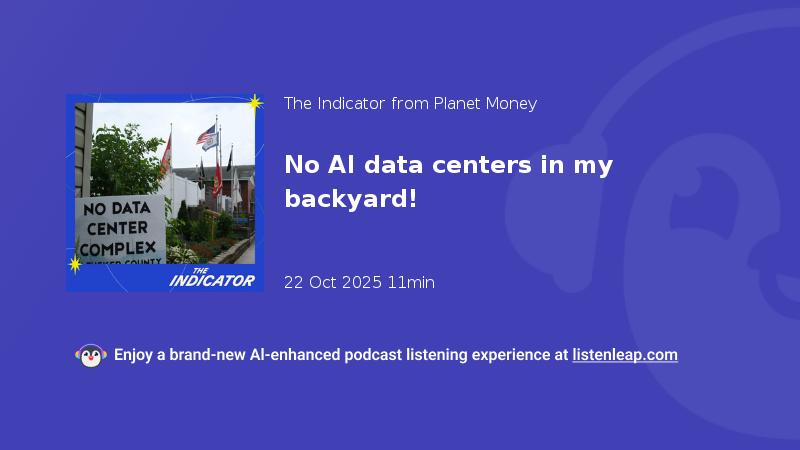
And it turns out data centers are a new hot button issue in local government.
So I went to this meeting expecting just like a boring little discussion about this zoning amendment, but it was not.
The place was packed.
All right, we call the meeting to order.
So these people, they're all against the data center?
Yeah, all of them.
All right.
Well today on the show, the local pushback to the data centers and how it might actually force tech companies to adapt.
This message comes from NPR sponsor Capella University.
Sometimes it takes a different approach to pursue your goals.
Capella is an online university accredited by the Higher Learning Commission.
That means you can earn your degree from wherever you are and be confident your education is relevant, recognized and respected.
A different future is closer than you think with Capella University.
Learn more about earning a relevant degree at capella.edu.
This message comes from Fisher Investments.
Senior Vice President Michael Hosmar reflects on one of their core values.
We want to empower our clients with knowledge.
In fact, Fisher is built on that idea.
It comes straight from our founder, Ken Fisher, who believes the more our clients understand about the plan we've built for them, the more comfortable they will be with their personal financial situation.
Learn more at FisherInvestments.com.
Investing in securities involves the risk of loss.
So Dustin, we're at this meeting in Pavilion Township, Michigan, and it's full.
Yeah, it's a very small building, small room.
And the head of the planning commission was starting to get worried.
So if any more people show up for this, we're gonna have to adjourn and then re-notice it for a bigger space, because we're at limit now for capacity.
And so is somebody leading the opposition here?
No, there wasn't like a group that organized this response.
This was just people from the community.
And it's a small community.
Only a little over 6,000 people live here.
But when it comes to data centers, they are united.
It's great to see community coming together.
This is Elizabeth Clark, and when she gets up to talk, she asks people to raise their hands if they live within 10 miles of here.
And most people do.
And Clark says, for her, this is actually about water.
Right, because data centers can use a lot of water, like hundreds of thousands to millions of gallons a day as much as a city.
Yeah, it depends on the design of the data center, but the water is mostly used for cooling the computers.
Michigan has a lot of water.
We're surrounded by the Great Lakes.
But folks here are concerned that the proposal does not forbid using the community's drinking water.
We are not all on the same side of a lot of issues.
We're all here on the same side of this one, because we all know that we can't live for seven days without drinkable water.
And so Michigan isn't like a hotspot for data centers.
A lot of the action we've seen in Northern Virginia, also Texas, Arizona, and Nebraska.
Yeah, there are definitely clusters, places that have cheaper power, lots of land or just lots of data centers already nearby.
But there are people who've been trying to push more data centers in Michigan, including our governor, because of the investment, the tax revenues that can flood in from a massive data center.
And the demand for the AI data centers is just so big right now that the proposals are showing up everywhere, including more proposals in places that weren't at the center before places like Michigan.
But the people here are not sure it's worth it.
And at the meeting, this one guy, David Soten, raised another community concern.
He said, it's all risk, no benefits.
So for the people in this room, the community that lives here, there is no reward for this.
It doesn't bring jobs.
It only brings issues.
It won't bring tourism.
It won't bring jobs.
It brings nothing.
Sounds like he's exaggerating a little bit.
You know, tax revenue can bring in a lot of money.
I've seen some places using that to pay for local services.
And it's not true there are no jobs.
There are jobs, at least initially during the construction of the data center.
Right.
Initially, although it is worth mentioning there's some research out there that these benefits don't always outweigh the downsides.
And either way, the potential benefits are what's pushing data centers forward in a lot of communities.
But what it seems like now in places like Pavilion Township and many other places is the size and scale and resource requirements are just really sinking in for nearby residents.
It's kind of, it's an AI gold rush right now.
After this meeting, I met up with John Paver, who'd been very vocal.
He actually lives in the next township over.
And he's not against AI.
He uses it.
And I'm not saying just for like chat GPT to write an email.
He told me he used a program called Cursor AI to code a video game for him.
So this guy is in deep.
Yeah.
So he pointed out that one of the state's big utility companies, CMS Energy, has recently announced plans to provide power to a data center that will use one gigawatt of electricity, which is a lot.
This facility will use as much energy as 750,000 homes.
There's no city in Michigan that is that large.
And I will say it's not confirmed yet where this one gigawatt data center is going to be located.
It's not necessarily Pavilion Township.
And when I asked the utility CMS Energy, Consumers Energy about it, they said they wouldn't disclose the location of the site or who they're even building it for.
But for Paver, he's not saying, no, absolutely not, no data centers.
He just wants to see more from the developers.
Really all gotta come up with better proposals that benefit the community and not yourselves directly, because right now it seems it is far too one-sided and you're not going to convince anybody to give these companies tax breaks and tax incentives for them to come in and just use up the natural resources.
You know, that doesn't even pass the common sense test.
And so this is becoming a more popular take all around the country, and not just your neck of the woods.
According to the group Data Center Watch, more than 64 billion in data center investment over the past year was blocked or delayed nationwide because of local opposition.
Yeah, and here in Michigan just in the past couple of months, at least three local communities have had significant pushback against data centers coming in.
And it's not just that, because also utility regulators are starting to impose these new rate structures on data centers.
Because there's this concern that the utilities will build out infrastructure to feed power to the data center and the data center could just go belly up in a couple of years.
And that would leave regular rate payers, just their local residents, to pay for all of those utility upgrades.
That happened.
And so they're imposing these new structures so that local residents won't get stuck with these costs.
And that is a realistic concern because there's just so many data centers being built.
And as we discussed last week, there could be some inflated demand here, aka a potential bubble.
So This makes me wonder how much this pushback is going to affect new projects across the board.
Right, because until now, it's all just been about speed.
You get the data center up and running as fast as possible, put the servers in, and go.
So the local opposition could stop individual projects.
It could slow down the overall build-out.
But could it really kill this AI data center boom nationwide?
Well...
Maybe not.
But it could change the approach companies might take to data centers, according to Vijay Gattapati, who's at MIT's Lincoln Laboratory and he runs a couple of startups.
I don't think development will grind to a halt.
There's too many economic reasons for it, at least in the near term, for it to grind to a halt.
The consulting firm McKinsey & Company has estimated that companies will spend $7 trillion globally over the next five years building out data centers.
Yeah, and Vijay says the way data centers have been going up, there hasn't been a lot of reason for companies to really be efficient with the way they're using all those computers inside the data center.
Now that there is some pushback on construction and either it's becoming more difficult to get new builds or it's becoming more expensive, I think that math is starting to shift again, where people are like okay well, let's just look at the existing asset and can we get more out of it?
Okay, so one result of all this pushback, he thinks, is that the people running the data centers that already exist will start running them more efficiently.
Yeah, that's his take.
He sees a lot of opportunity to squeeze out a lot more computational power out of the data centers that already exist.
The alternative is more of what we've seen so far.
A lot of these hyperscale data centers have started bringing in their own temporary power, like natural gas generators and fuel cells.
And that probably would not go over well in places like Pavilion Township either.
No, it definitely, definitely would not.
This episode was produced by Julia Ritchie with engineering by Ko Takasugi Chernefin.
It was fact-checked by Sierra Juarez.
Kate Kincannon edits the show and The Indicator is a production of NPR.
This message comes from BetterHelp.
To mark World Mental Health Day, BetterHelp is thanking the therapists who change people's lives all around the world by providing accessible mental health.
With over 12 years of experience matching clients with therapists and one of the world's largest online therapist networks, better help can help you find the right therapist.
Visit betterhelpcom.
Slash npr for 10 off your first month.
This message comes from Capital One with the Venture X card.
Earn unlimited double miles, a $300 annual Capital One travel credit and access to airport lounges.
Capital One.
What's in your wallet?
Terms apply.
Details at CapitalOne.com.
This message comes from Capital One.
The Capital One VentureX Business Card earns unlimited double miles on every purchase.
Capital One.
What's in your wallet?
Terms and conditions apply.
Find out more at CapitalOne.com VentureX Business