Discussion keeps the world turning.
This is Roundtable.
Move over, Jedi. China's moviegoers have spoken.
Neja, the sequel, has dethroned Star Wars The Force Awakens as the highest -grossing film in a single market.
But beyond the numbers, there's another surprise.
This record -smashing hit was crafted entirely in the Chinese city of Chengdu, what's driving the city's rise as a new force in animation and beyond.
And Motivational Monday is here to turn meh into magic.
Tune in for stories and songs that will light a fire under your week.
Coming to you live from Beijing, this is Roundtable.
I'm He Young. For today's program, I'm joined by Steve Hatherly and Yuxian in the studio.
First on today's show.
Since its release on January the 29th, Neja, the sequel, Devil Boy of the Sea, has been smashing records almost daily.
As of February 24th, the global box office for this Chinese animated blockbuster has soared past 13 .7 billion yuan, or about 1 .9 billion U .S.
dollars, making it one of the top eight highest -grossing films of all time worldwide and the highest -grossing animated film ever.
But beyond the dazzling box office numbers, there's an unexpected star behind the Neja movie.
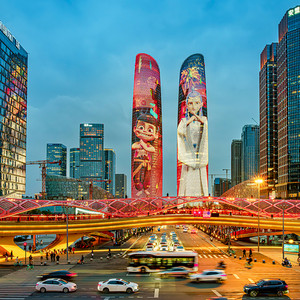
This cinematic phenomenon was entirely made in the city of Chengdu in southwestern China's Sichuan province.
This powerhouse isn't just about pandas and hot pot, it's proving to be a rising force in animation.
So guys, let's give Chengdu its big stream, big screen moment.
Tell us about the city behind Nezha.
Yeah, like you said, Heyang, Chengdu is the capital of Sichuan province in southwest China.
And yeah, it's not just very well known for its rich history and culture and also modern development because apparently Chengdu now blends traditional Chinese elements with rapid urban growth, making it a hub for both tourism and business.
And I think this is also why we're mentioning the city of Chengdu when we're talking about the movie Nejia 2 once again, because there's this strong connection as shown in the movie.
And some of you might could be able to recall that in the movie, the teacher of Nejia, the Tai Yijenren, I'm not really sure how to translate his name directly into English, but he is visibly, you can tell he is speaking this Chengdu accent or Sichuan accent.
That sounds very amusing to a lot of the audience.
And also there's, among all the cast, there are two boundary beasts or ziyajiehshou.
Some call it boundary guardian beasts because in the movie sequel, they appear to be the boundary guard who can cast power and protect Nejia and their home in a sense.
So yeah, all of these design of these little characters, they have their origin back in the real -life relics from Sanxingdui in Sichuan province as well.
So all of these elements, they originated from Sichuan province where Chengdu is located.
Very cool. Question about the accent.
Is that a Sichuan accent or is that a Chengdu accent that is unique unto its own city?
I think it's more of a Chengdu accent.
because that's an impossible question to answer i think we need to get somebody who's from sutron to talk about that because in china it's just considering how vast and diverse we are sometimes um in between a mountain oh actually okay let's say with the division of one mountain two villages on two
sides they speak completely different dialects so yeah it's actually quite difficult to answer that question understood yeah for now i guess i'll just say it's a chungdu accent Ni Da Wa Sa.
Everything has to end with a sa.
Okay, that was my second question.
Is it immediately recognizable to people outside of that region?
Yes, it's quite unique on its own taste as well.
And also, I think besides the direct elements and connections to the movie, the city itself is intrinsically a cultural hub in Southwest China as well.
And it has incubated such a matured creative industry with over 1 ,000 cultural creative enterprises in the city and an annual industry output exceeding 39 billion US dollars, which equals 280 billion yuan.
So that's a pretty much matured and sophisticated creative industry that's also there, located in Chengdu.
I remember when I was living in Korea, and everybody knows about Chengdu, by the way, but you know the reason why everybody outside of China knows about the city is because the pandas.
Yeah, and my friend, when I was living in Korea, he said, one weekend, he said, I'm finally going.
And I said, going where?
He said, I've been wanting to see the pandas my whole life, so I'm finally going to Chengdu.
And when he came back, I asked him how it was.
And he wouldn't stop talking about how great the food was, how spicy the food was, how cool it was to have that experience with the panda bears, so sweet, so lovely.
And he just raved about the city, raved about the experience.
Oh, nice. And yeah, for pandas, there's also this Chengdu Research Base of giant panda breeding.
I'm not sure if that's where your friend went to.
It's more commonly known as the panda base.
So this is a quite big of an area covering three square kilometers.
And it's a big place that not only pay attention to giant panda conservation, but but also for red pandas and all the biodiversities that's residing in that area.
It's quite a large and mountainous place, I would say.
And also, I was there about a decade ago, and there was a time every day when they have this open window, like a demonstration time for newborn, tiny little panda babies to be just shown in that little glass box to keep it warm and for it to just climb around and for people to just see it outside of the box
and just say hi before it can open its eyes.
Oh, my goodness. So cute.
Don't let me go on with 50 panda questions because I absolutely will.
Let's keep talking about film because Nujat 2 is far from the only success story in the regions.
There are other popular animated works such as 100 ,000 Bad Jokes.
That's a great title.
Rakshasa. I think I've told 100 ,000 bad jokes in my life.
Rakshasa Street and Year Hair Affair, H -A -R -E, rabbit.
They've also had deep ties to Chengdu as well.
And even the globally popular mobile game IP Honor of Kings is another product of the city too.
Yeah, it's really interesting that not that many people perhaps outside of China know that Chengdu has become a new powerhouse for animation.
And animation is also so closely tied to gaming.
It's perhaps an industry inside joke that, you know, for a lot of folks or people who train and get degrees in animation, it could be difficult to find a job, a lucrative job.
And therefore people would actually go to video gaming instead.
But also just with the success of Nezha, the sequel, you can see that so many of those who work in the video gaming industry have actually come over to help out with the Nezha production as well.
And all in all, just to say that it's important to discuss that Chengdu has become a power base in China for these visual works.
So let's get a bit more into that.
And how come Chengdu is the city that has nourished so many creative cultural products?
You know, some people ask this question to the director of Nejia too.
And here is the translated version of his answer.
So Chengdu's inclusiveness and cultural heritage has provided an endless source of inspiration for creativity.
while the industry ecosystem built by the government and also supported by the government makes the implementation of technology possible.
So he mentioned several key words here.
First of all is the chain of technology that's been made available for growing and also now that it's being incubated as one of the domestic hubs for having such creative industries there.
So we know that for one successful intellectual property like Neujatu, it relies on a vast and integrated cultural creative industry system.
So this includes a lot of different aspects, including the film production itself, the development of the concept, the special effects, motion capture and rendering, all of which require well -established and efficient upstream and downstream supply chain there.
So all of this is already established and still growing there in Chengdu.
For example, there is Chengdu's high -tech industrial development zone, where a lot of the companies are gathered together and they're really close to one another.
So we know that NoJai...
Oh, like geographically?
Yeah, geographically.
That's convenient. And I would believe they all have collaboration with each other at some point, too.
So for instance, the Coco Cartoon, which is the main production company for Nexia 2, is just 100 meters away from Shen Yao Animation Studio, which is also one of the teams that made one of the characters in Nexia called Shen Gong Bao.
That's convenient. You don't even have to call them.
Just open your window in your office and yell out and they'll be able to answer.
So that's the vibe in that high -tech industrial development zone in Chengdu.
We see this chain of different companies from different streams of the entire creative industry there that's already there and established and supported and still growing.
They have a thousand cultural creative enterprises in the city.
Over 1 ,000, as a matter of fact.
And there's an annual industry output that exceeds $39 billion.
That's about 280 billion yuan.
And Chengdu has become a fertile ground for cultivating creative works.
It's developed a reputation for itself in that industry.
Yes, and this is hard work of many individuals, obviously, who are super passionate about the industry.
And especially as those who are the first to start a trend before it actually forms into a trend.
I think those are truly courageous, passionate people.
The trailblazers. Yes, indeed.
They're definitely carrying that banner.
And also, they need some support.
And I think it's really that the best situation is when you have the passionate individuals, you have the investment, as well as the support from anywhere.
everywhere then that can help to brew something that is you know a seed into a full -blown phenomenon as it is now you say that very well and it's a great point to make because cultural creative companies these are not projects that can be done in two weeks these are long -term projects and they require
continuous investment uh nija one took five years from script to production without a precedent to follow.
And then Noja2 took another five and a half years.
And during these long periods of development, the creators of the series, they had to rely on market tolerance and strong policy support to sustain the project because a lot of companies in the cultural creative sector are relatively small in scale.
So it really is a group effort when it comes to that.
Here's another example.
After they got feedback from local businesses and understanding market trends, the city developed the 14th five -year plan for the development of digital, cultural, and creative industries, and those are aimed at helping the sector grow.
And under policies like that, companies in that digital, cultural, creative industry, they can enjoy benefits like reduced rent and policy advice and project support and other cost -saving measures as well.
Some companies report that these rent reductions, they allowed their studios to survive longer during the initial stages before their works hit the market.
So when you have smaller companies that are trying to be trailblazers, if they don't have that additional support, oftentimes those companies won't make it.
But with those policies in place, they were able to survive and able to find this level of success.
Indeed, we're talking about five years after another five years.
And according to the director, I think Noja 3 is coming out between three to five years time again so that they're really taking in this all of the supplies and all the support they can get and trying their best to create the best they can get to their audience yes and as just an average fan but also avid
fan of the movie franchise I just want to say keep going take as much time as you need us fans we're here to support you once you think it is done and ready for the market.
Because also, living in the 21st century, anybody in this world, I think you can resonate to the sentiment of you feel like as if there's a force behind you that's pushing you to go faster, quicker, and just churn out product ASAP.
But sometimes it really takes time for the fine wine to brew.
And I'm really happy to see that noja is a wonderful example As such There's going to be A lot of pressure though A lot of pressure Now that they've achieved This level of success Everyone will be waiting With bated breath To see what's going to come next Yeah It's really interesting Some people are saying
Well especially Chinese people They say that I'm not that surprised That Jiauzi The director Is originally from Sichuan province We're not surprised That Chengdu Is the home of production Of a fantastic movie franchise such as Neuja as it takes its time because some people say that the temperament of the city
of Chengdu is a bit more laid back, is a bit more carefree, is a little bit, yeah, let's let the work flow and we'll get the best out of it.
So it has something to do maybe with the charming and inviting and welcoming living environment of this city.
Do you guys agree? I think so too.
I've been seeing a lot of social media posts online these days.
There are people, you know, living in Chengdu telling us what kind of lifestyle it is.
And comparing to cities like Beijing, Shanghai, Shenzhen, Chengdu is more of a, you know, that affordable and also more balanced lifestyle kind of way.
It almost impresses you as if it's always welcoming you to be there and also enjoy this laid back lifestyle together with the locals there.
there. And it is also very impressive for me to see a lot of the Chengdu people local, of course, they eat ice cream plus chili oil.
So that's something that I only...
Spicy ice cream. Yeah, spicy ice cream.
Trademark that. Yep, a must try when you're there.
100 ,000 bad jokes, that was it, right?
But yeah, again, Chengdu is this place that even though the lifestyle is kind of laid back or kind of slower pace comparing with the bigger cities.
It is on its own it has its unique style and also the food there is really cool and the food culture people call it is more of a unique flavor.
It has a lot of variety on its own especially spicy dishes among which you know the hot pot are most famous across the nation.
So yeah we'll understand why you know people can manage to put chili oil on I was watching some travel videos of expats being in Chengdu and the famous spicy food and the Sichuan peppercorn.
And they were just trying it for the first time and go, my tongue is numb.
I can't feel my lips.
And that's exactly that mala flavor, isn't it?
Yeah, isn't it just?
And also, a lot of people say that Chengdu is a great city to live in.
apparently it's been called a park city and in China well let's say in Beijing we're so much up in the north compared to where Chengdu is and our winters are pretty cold you'll need a down jacket for sure and sometimes we do get snow but in Chengdu apparently there's just so much more greenery and we
talked about the laid -back atmosphere and there's just so much vegetation as well.
I think that does make the city just really beautiful.
And just think about all the CO2 it absorbs and all the oxygen that it releases.
Yeah, they have over 1 ,100 parks in the city.
That's a lot. And they have the Giant Panda National Park.
That's a national treasure.
But the city also ensures that their residents have easy access to green spaces with that many parks and the city itself has an emphasis on ecological development and then that fosters that environment that you were talking about that harmony where people can enjoy urban living whilst also being in beautiful
nature yeah and they also apparently have wonderful tea there and people have the time to enjoy tea sometimes even during work hours so what a different What a different vibe to be surrounded in as a working person.
And also, besides, you know, we talked about animation, we talked about the wonderful living atmosphere this place provides.
There are some other booming industries.
What are the ones that you think is worth our attention?
I mean, first of all, there is this advanced technology and AI industry that's also fostered in Chengdu as well.
as well. I was surprised to read this but apparently this person Zheng Hua, who founded Chengdu Data Automation System Technology Limited, he focused on quantum computing and this is something that's developed in 2018 when China's first domestic quantum computing control system was built there in Chengdu
as well. And another person Zhang Ruizui, an expert in robotics, returned to China to start Chengdu Humanoid Robot Innovation Center as well.
And that's also located in Chengdu, and that's a humanoid robot -focused developing center.
And then Li Yao, which is a Stanford scientist, she focused on Bourne's medical robotics.
That's also a very well -known personnel returning back to Chengdu to develop surgical robots.
And by 2021, the company began expanding globally with made -in -Cherndu surgical robots entering international markets as well.
Oh, branding the city or using the city to brand certain industries.
That's pretty cool.
Chengdu made or Chengdu created.
That's a label that we're looking forward to see more in the future.
Technology and electronics is represented very well.
Healthcare and pharmaceuticals is also represented.
Medical and biotechnology companies are also thriving there.
And I think that is all the things we just mentioned is what's helped to fuel the city's innovation.
They've developed this really robust ecosystem, both online and offline, including over 100 innovation service agencies, 104 integrated services to support tech enterprises in various aspects.
The online platform, for example, can offer specialized service like shared laboratories, pilot testing, product evaluation, patent navigation.
They have 42 ,500 tech companies on the platform now.
Also, 157 universities and research institutions and 1 ,096 service agencies all on the platform.
I think a lot of these companies are able to make such advanced technology or really the innovation of studies in such realms is because they have not only their own talents, but also financial support as well and also created innovation.
So in Chengdu, I read about that.
They introduced a tailored SciTech loan system to help small and medium tech enterprises to just navigate funding challenges, especially given the difficulty in accessing loans due to lack of collateral because they're very small companies.
And over 4 ,000 companies have already received credit loans, totaling more than $57 billion US dollars, which equals 420 billion yuan.
That's a lot of money given to all of these smaller companies to help develop themselves.
When you have a beautiful city with great food, beautiful atmosphere, successful companies that are getting support, all of those things together make it easy to recruit top talent.
And the city has implemented a talent recruitment strategy to position itself as a hub for national, but not only national, international talent.
They have six and a half million professionals working in the city and Chengdu has been recognized for being one of the most attractive cities in China for talent in the eyes of both Chinese people and also international talent too.
Yes, indeed. And when you look at the population change of the city, it's very telling.
Chengdu is enjoying a population, actually last year, more than 21 million who are residents for, well, I wouldn't say permanent, but people who have the who go and without, which is the local household registration system, whether they've joined or not.
And also, Chengdu is a city that is very attractive for the younger population.
And that is what every city is looking at, right?
They're trying to attract young people who can come in to work and possibly settle down.
So, Chengdu has really many reasons for people to go.
And before we close this discussion, I want to hear what you guys to share.
If, you know, on a postcard, what would you say about this city?
Well, for me, it's only based on things that I've heard secondhand and videos that I've watched.
I love watching travel videos of that city.
I can't wait to go someday.
But my one line, I guess, Chengdu postcard sentence would be, it's going to be great, but it's going to be greater than even you think it is.
Wow. And I'm going to borrow from the website of the Panda Base, the land of abundance, the hometown of Panda.
Oh, lovely. Chengdu City goes, this story goes beyond the big screen.
From its ancient roots to its modern creative energy, the city isn't just making animation magic, it's shaping the future of art, culture and innovation in this country.
Whether through fiery hot pot, adorable pandas, or record -breaking films like Neja, the sequel, Chengdu proves that tradition and creativity can thrive side by side.