This is Round Table.
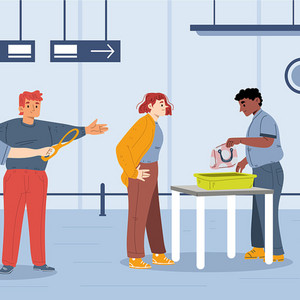
Imagine yourself in a hurry to catch a flight, and the passenger in front of you insists on meticulously laying out and aligning their personal belongings on the tray in strangely refreshing patterns that you are in no mood to appreciate.
What would you be your course of action?
Would you expect the airport authorities to intervene and say, Sir, can you do something about it?
I mean, such a hurry.
Hello, I'm Lai Ming, and this is Round Table.
Today with Li Yi and Steve Hatholy, we get you up to speed on a new viral trend on social media.
And so I think I'm getting too old for this.
I mean, kids, young people.
I was laughing. Influencers.
Li Yi, I was laughing because I just, I mean, we didn't even explain what the trend is yet, but I was just imagining Lai Ming and the airport in line actually doing this.
I'm going to confront that person if he or she is really holding up the line.
That thought brought a chuckle to me.
Let's talk about what this is so our listeners aren't left in the dark.
Online creators now, TikTok and other online social media platforms, they've really taken to this new trend.
So what they're doing is they are turning these gray, dirty airport bins into a canvas of sorts.
We know what the airport bin is, right?
When you go to security, they ask you to take your electronics out of your backpack or what have you.
Powerbacks. Yeah, put your keys in there, maybe your wallet in there, your passport in there, things like this.
And it's always the same.
It seems like it's an international thing.
They're always gray and they're always exactly the same size.
And so that's what they're doing.
They're putting all of their stuff in these bins and they're arranging them meticulously to create an aesthetic.
And Gen Z has fallen in love with this new trend.
So they're arranging their things in the bins, they're taking the pictures and then they're posting them online with the hashtag TSATrayAesthetic.
And TSA means? Transportation Security Administration.
When you go through the airport and you go through security and you get the beep, beep, beep, you walk through that thing and then they metal check you or whatever, those are TSA agents.
That's what they're called in the west.
Okay. That's what they're calling in the west.
In the US. In China, maybe an airport security might be responsible for that so they might be called differently.
I don't even know how they're called in Chinese, but it's just a tray that you use to carry to keep your stuff before they are transported to the scanning machine to see if there's explosive or batteries.
This is incredibly popular on the internet.
16 million related posts, drawing thousands, if not millions of views.
Apparently, Leiming's not one of the posters online, so need not look for him.
But don't expect these plastic bags stuffed with toothpaste and heartburn medicine, things that you typically have.
No, no, no. This is aspirational travel.
They're putting things like a 35 millimeter film camera between vintage loafer shoes and maybe a first edition copy of Journey to the West, if you happen to have one on you.
All very pretty things, a lot of big brand names.
A lot of color matching involved as well.
And do I think the trend is worthy of the attention it's getting?
Not necessarily, but do I think it's kind of cool looking?
I do. I think it's kind of cool.
Right? I'm into organization, you know, because I'm the kind of person who would take the time to organize my stuff before I put them in the tray.
So for passengers behind me might feel something to complain about, but then to go to that extreme of arranging them according to specific patterns and to be creative about it, I'm not sure.
But I think it's beyond organizing.
It's more about expressing yourself, yeah, in my opinion.
Bragging about what you have.
Yes, because in those trays and attract those pictures online, those things are beyond what you are told by the security staff to take out of your bag, right?
You don't have to take them out exactly, but they just decide to take them out.
I thought you were supposed to take everything out of your pocket.
No, I think only like PC phones and keys.
These are something that you have to take out.
You don't have to unpack your whole bag when you go through security at the airport, right?
But you're right. They are exactly doing that.
They're unpacked and they're preparing at home, by the way.
I mean, this is not get to the airport security line and then suddenly you come up with your idea.
No, no, this is prepared well in advance.
And so when they get to that place, then they know exactly what to do.
We're talking about things like makeup and sunglasses and jewelry and compact cameras and flower themes.
Different themes are going along with this as well.
And by the way, it's not new.
This goes back to 2015, Emily Abey Tarabate.
She was a former magazine editor and she's a podcast host now, as a matter of fact.
And she began traveling for work a lot back in 2015.
And she wanted a unique and quick way to kind of capture her adventures.
So she started taking pictures of her flat lay arrangements in airport bins and then she would include items that were representative of where she was going.
So if she was headed to a beach location, then she might have, you know, like a beach read book in there, a pair of sunglasses, maybe some sunscreen all in the airport trip.
And it's kind of a it's kind of a unique and fun idea.
That's where this all started.
But for one reason or another, in 2024, it's really picked up again.
I think we had a similar trend here in China a few years ago.
When you go out for picnics, people will just take pictures of everything you think that they take for picnic, like sandwich, even a basket of coffee machine.
And the most important thing is that those food look good.
They are not really only tasting good, but also looking good.
So so they carefully select.
I mean, and also curate those things like an exhibition.
Almost like a mini exhibition, you're right.
And the curating trend has been popular as of late as well.
Laiming, have you ever heard of fridge escaping?
Mm hmm. Like escaping from a fridge?
No, it's when you open your fridge door.
And why would you need to escape?
Never mind. Never mind.
It's a different episode of roundtable.
This is when you open your fridge door and inside next to your eggs, you'll put a little tiny plant or you'll put a mini picture frame next to the milk.
Oh, so it's like landscaping inside your fridge.
Fridge escaping. Again, curating.
I don't want to open my fridge.
You kind of a fun. It's it's poorly managed.
A fun little trend.
Now we might think, oh, this is a big joke.
Who cares? It doesn't matter.
It doesn't have any impact on anything, does it?
Wrong. Actually, big brands have responded to this very, very well because it's basically free advertising for them.
Remember, I said, you know, people aren't putting their discount three dollar pair of shorts or a T -shirt in the bin.
This is luxury stuff if they have access to it.
So marketing teams around the world are absolutely loving this.
Brands getting involved like clothing and homeware retailers.
Also, book publishers are getting in on this game as well.
And they're posting their own stylized trays.
And in fact, the most interesting company that I thought was excited about this was a storage solution brand, a company that makes bins.
It totally makes sense.
It totally makes sense.
The airports could update their choice of bins.
And I will. Well, I couldn't promise that I'll go to the airport more often.
But they said this trend, this is a quote from the storage solution brand.
They said this trend specifically aligns perfectly for us.
Curating an aesthetic selection while focusing on our travel friendly products.
It makes a lot of sense.
It does make sense.
I actually saw one travel magazine called CN Traveler.
I guess it's a luxury travel magazine.
And they're they're organizing their own airport tray, a fatigue photography competition inside their company.
So they're just asking their editors to really take pictures of something that they cannot travel without.
And also, there's a very good disclaimer saying that no airport queues were delayed in making of this article.
So they're just literally buying certain trays and they're asking their editors to do this photography.
And you can see different different people, different travelers.
They carry different things, which totally tell what kind of person they are.
That begs the question, what do you travel with?
Well, that's a very good question.
And I think about that before the show.
What would be in your aesthetic tray?
Well, I think first of all, I need to have my pillow and then I need to have a U -shaped pillow, which I carry on the airplane.
Two pillows. Yeah, two pillows.
And then I need to have my thermal bottle to have hot water.
And then I need to have sunglasses so that I don't really have to do any makeup during trips.
So you can tell I'm a really lazy person who really want a comfortably quiet trip anytime, anywhere.
What would be in your office?
I'll be traveling with the electronic reader and a AI learning machine, a AI working machine, noise canceling, wireless ear pods and then perhaps a laptop that I have to do.
I can't do without when I'm traveling.
And also something for a kiss.
Come on. You have to take your kiss during the trip.
Right. They go into the luggage.
I don't want to brag about that.
We should mention and this is a really, really important point because we're making it seem like these influencers are doing this while they are in the security line.
Yeah, this is painful.
But they're not. Generally speaking, they're not doing that at that specific location.
You know, when you get through security and they give you back your tray, your bin, and then you empty it out and then you go on your way.
Well, you'll notice that there's a spot around that area where they have tables.
And so what the influencers are doing getting investigated by TSA for questionable stuff you bring on board.
If hopefully it doesn't happen to you.
But yeah, it can be used for that as well.
But oftentimes those tables are empty.
So therefore the influencers are going through security, getting their tray back, going over to an empty table and then taking their time to arrange all of their items.
So it's not like they're bothering anyone else in the line and they're not bothering TSA either.
Well, the only risk is them taking over too many trays, leaving those who follow without a tray to work with.
Yeah. I mean, that's the nuisance that people can tolerate.
The nuisance, you're right.
I mean, plenty of people are bothered by this.
The New York Post called it a time consuming trend.
The UK's Metro newspaper said the anxiety inducing trend in reference to it.
And this is the end of the UK Metro's quote.
The anxiety inducing trend that risks you becoming the most hated person in the airport.
Yeah, instead of a TSA.
Another TikTok response said this.
Interesting. But if you do this in New York, they're probably going to tase you for this.
Joking, but maybe not.
Now, what does TSA have to say about this?
The Transportation Security Administration, the authority who is in charge of that location in the airport?
What do you think before I share their response?
They have responded.
What do you think their response would be?
I can imagine them being welcome about this.
Really? Because it encourages people to travel.
And it also helps them highlight what are and aren't permissible in carry -on luggage.
But I think it really interfere with the normal, I mean, passenger flow at the airport.
So I think they should be angry with it.
They're actually not, but not for the reasons that Leiming suggested.
This was a spokesperson from TSA talking to CNN.
The TSA has become aware of this trend recently, as long as the staged glamour photos are not causing delays or issues with other passengers in the checkpoint.
We don't have issue with it at all.
Reminder, travelers should take care to secure their IDs and passports or any light items on top that could be swept out of the bins when they go into the machines.
I was surprised. I thought TSA would have something more strict to say about this, but they seem like they're very much not bothered at all.
I see. Sounds like somebody has some serious attitude about TSA.
But this time they are they're acting quite, you know, why a reasonable response?
You're listening to a Roundtable coming up.
What can we learn from special tricks to engage children in a conversation?
Looking for passion?
How about fiery debate?
Want to hear about current events in China from different perspectives?
Then tune in to Roundtable where East meets West and understanding is the goal.
Welcome back, and we are talking about whether you there is any skills to be required when you initiate conversations and hope to find out more about their lives in school.
And this is already happening to me.
My son can talk, but he goes to school and I have that curiosity about what he goes through in school.
But somehow I haven't found the right approach to get him to talk.
I asked, are you happy in school?
What have what have made you happy in school?
And what did you have for lunch?
And very specific questions.
But he seems quite distracted.
I mean, he has his own agenda.
So the question is at four years old.
He's got a very scheduled life.
I worry that I will be one thing among others in a tray of my father.
And we know not everybody has a kid, but I think the skills that we obtain or the skills that we talk about on the show might have some help if we were to initiate a conversation, a meaningful conversation with adults, because let's face it, some adults, they never grow up.
Hmm. And they don't like talking sometimes, right?
But, yeah, I guess the lead here for this story is getting your kids to open up to you and so that you can have a conversation with them regularly.
But you're right. I mean, these these lessons could be applied to adults in their lives as well.
So let's see what we can learn here.
All right. Pamela Lee is a bestselling author, and she's the founder and editor of chief of something called Parenting for Brain.
And she said almost all preschoolers and early elementary schools are able to recount every detail of what they have seen during the day.
But that being said, it's very hard for them to start a narrative on a broader topic.
So if they know the answers to your questions, then it must be the way of getting to them that has to change.
The questions that adults ask might just be too vague for kids to respond to.
So I was reminded of this when I was going through this topic of my childhood and my dad when I would come home from school, my dad would ask me, what did you learn today?
And I would always say nothing.
The next day, my dad would ask me, what did you learn today?
And it was kind of our fun little routine.
And I would say nothing.
And dad's response after that was always quite funny.
He didn't push me or force me to have a chat.
He just said like, hmm, I think we need to change your school.
Seems like you're not learning anything there.
That's a nice approach.
Yeah, it's a cute and funny approach.
But these are these are examples of questions that may be too vague for a child to answer.
And again, remember the context of this situation.
The the context is you're wanting to engage with your child, you're wanting to have a conversation with them, but they're not really responding.
So questions like, what did you learn today?
That's considered to be too vague.
A question. How was school today is considered to be too vague a question.
And it's not that these questions are bad questions.
It's just that you're asking about something that's too open ended or too broad to answer easily.
What do you think about that?
I don't know. I feel like they're pretty good questions, actually.
I would show that you care about this kid.
I could use some vague questions because as a child, I used to be interrogated for every detail that I go through.
If I were to go out and play with a fellow classmate, my grandpa would come and say, who did you go out with?
What does his father do?
What does his mother do?
How old is this person?
Family background check.
I know. I know. I would say, I don't care.
I don't know. I don't know.
I'm not interested in the same things as you are.
What the experts suggest is that when you ask these broad open ended questions and you don't get an answer or you answer like I did when I was a kid, I don't know, then you can ask more specific questions in the beginning and that can open up the conversation to broader questions.
So, for example, did you see the football match last night?
OK, that would be a very specific question.
How about this question?
Did the teacher ask you a question today?
Yes or no? Right. Or did you raise your hand in class today?
Yes or no. These types of questions can elicit a yes or no answer from a child.
And this is a good way, or an adult, to be fair, a good way to get someone to open up at least a tiny little bit.
Whereas if you ask, what did you learn today?
I don't know. Nothing.
It's not specific enough.
It doesn't require a yes or no answer.
And that's where you can run into that.
That wall is tantamount to asking your colleague.
What did you achieve at work today?
Yeah, right. Yeah. Yeah, exactly.
I don't know. I don't know.
Yeah. All right. So what are some good questions to ask your kids to get them talking then?
Because it's not just school.
We're not just talking about when they come home from school, right?
When you want to have a chat with your kid, how about this?
This would be related to your home.
Maybe you can ask your child, what's your favorite space in our house?
And they'll think, hmm, and they'll tend to answer a question like that because it's a specific answer.
Or this weekend, you have to choose one family activity.
We go shopping at the mall, we go hiking, or we go to the theme park.
Give them three choices.
Let them choose one.
And then you can ask, oh, really, you choose number one?
Why do you think that?
Or why not number two?
Why did you not choose number two?
Getting them engaged in conversation like this is a very effective way, according to the experts.
So when you're trying to approach your colleague at work, then try to avoid questions like, how was your day?
But rather, how's that thing going on?
How's that project going for you?
Any obstacles, any challenges you need to deal with?
Yeah, I think the key of raising the right so -called right question to initiate conversation is to include something.
I mean, include something that showing that you cared feeling of that person, right?
Same thing with this, I mean, conversation question as well.
Did you like the meeting last night?
Yes. Or do you enjoy the lunch today instead of asking what did you have for lunch today?
So in that way, the children can learn, of course, to observe his or her feeling at the first place and then to learn how to express the feeling in the correct way to really let the baby know that somebody else really cares about your feeling.
How do you feel about everything?
Yeah, it's important.
And they talk about, there's a lot of information online about the importance of talking to your children.
In 1995, there was a study that found that children from higher income families, they hear about 30 million more words during their first three years of their life than children from lower income families.
They call it the 30 million word gap.
And it correlates with significant differences in tests of vocabulary and language development and reading comprehension and things that will come just a little bit later in the child's life.
MIT, the Massachusetts Institute of Technology in Massachusetts in the United States, they're cognitive scientists.
They found that conversation between an adult and a child appears to change the child's brain and that this back and forth conversation is really critical to language development much more so than the word gap that can take place between economic disparity in families.
So if you were to engage your children more, even though you have poor vocabulary, chances are you can improve him and give him a head start.
But it's not just talking to your child or talking at your child.
It's talking with your child.
And they call this conversational turns.
They studied children between the ages of four and six and they found that the differences in the number of conversational turns accounted for a large portion of the differences in brain physiology and language skills that they found among the children.
And this finding applied to children regardless of parental income or education.
And that study suggests that parents can have a really, really big influence over their child's language and brain development by simply engaging them in conversation.
And again, the key point here according to the researchers is that you're not talking at your child, go do this, go do that, clean your room, go to bed, brush your teeth.
It's not that. It's the conversational turn.
Mommy or daddy speaks, then the child speaks.
Then mommy or daddy speaks, then the child speaks.
Back and forth, back and forth.
It has a big, big impact on their brain development and other cognitive development as well.
In that sense, I guess it's not important to talk to your kids about school.
I mean that certainly is important for you to learn what he or she has gone through in school, but in that sense, in the sense of carrying out multiple turn conversations, I think it's more important in fact to talk about engaging issues that he or she cares about.
Instead of school, perhaps maybe a best friend that he or she has in school, what has he done?
What has she done? And any funny business with Tom that you've noticed?
Any suggestion that Ms.
May has introduced to you, that kind of thing?
Yeah, and again, going back to the first part, now that we know this, now that we know the importance of talking with your child, having those conversational turns, now we can go back to the first point of our talk, the effective questions to ask your child to get them talking with you, right?
So if you do have a young child and you're having trouble getting them to open up about their day, they're tired, or they just don't wanna talk with you, then try some of those very specific questions because now we know getting them to have a talk with you and talking with their child about anything.
I think you're right, Liming.
It doesn't really matter what the topic is.
Yeah, I could start with a conversation with did a dinosaur visit your school today?
Yeah, exactly, why not, right?
That would be a great day.
I have a question, actually.
Well, when you're talking with your baby or children, do you treat him or her like a baby or an adult because that can be hugely different, right?
I know, I know. I mean, in terms of the topics, then I treat him like a baby because he's only interested in specific topics like.
Dinosaurs. Blocks and dinosaurs and geology.
Surprisingly, yeah.
That's a very specific list of questions you need to prepare.
Now that's kids. What about teenagers?
I'll just go over this very quickly.
This is a whole different game, right?
If you are the parent of a teenager, here's a list of what to do and what not to do.
We'll start with the not to do.
Don't ask your child, your teenager, is everything fine?
Because if you ask a teenager, is everything okay?
Then you're giving them the message that you want everything to be fine and they don't want to disappoint you.
So they'll probably just say, yeah, everything's fine even if it's not.
Also don't ask questions that are too general.
That's on that list as well.
But here's what to do.
Ask specific and open -ended questions like, how was your get together with your friend at the movie theater?
Or how was your test?
Was it difficult or was it not?
And also do give your kids the same sense that you're open to anything they have to say, whether it's positive or not so positive.
And try to avoid giving unsolicited advice because they say that they are more likely to share.
A teenager is more likely to share what's going on in their lives if they're relaxed and they feel that you're open even if the information is going to be a little bit negative.
Yeah, relaxed is the word that I quote on, and that is you have to do everything you can to help the person that you're talking to feel relaxed.
And until they feel that way, probably you wouldn't get anything that you hope for from them.
So yeah. And also I think you need to show that you are authentically carrying the response.
Well take notes after talking to them.
People are only like throwing questions, but they don't actually care the response and they don't really have very good followup conversation.
I think that's also very important.
So talk to your children and your colleagues like you're interviewing them, trying to get some - Stop talking about work.
Okay, work is finished.
That's all the time we have for today.
Thank you for listening.