Discussion keeps the world turning.
When was the last time you turned on the TV in a hotel room?
If it isn't smart enough to automatically turn on upon your entry?
For that matter, do you even care about whether there is a TV in the room?
Hello, I'm Lai Ming and this is Roundtable.
Today, with Yushan and Steve Hathaway, we assess China's recent policies encouraging hotels to renew their TV sets and how that might affect the economy and our travel experience.
So back to our question at the very beginning.
When was the last time you turned on the TV in a hotel room?
The last time I was in a hotel room was the last time I turned on a TV.
So you do turn on the TV.
It seems like I'm in the minority these days when I'm the one who's turning on the TV.
Now, I don't stay in my hotel room all day long and watch TV.
But what I do is go out, do my things during the day, come back when I'm getting ready for bed, before I go to sleep.
I'll flip through the channels.
And part of it is because I'm looking for something to wind down to.
But oftentimes, I'm just looking to see what television is like. in the country that I'm in.
It's a big screen.
Yeah, yeah.
With a few channels.
So I still enjoy it.
So to answer your question, the last time I used the TV in a hotel room was the last time I was in a hotel room, which was about three, four weeks ago.
My answer will pan back to maybe last year when I was traveling down in southern Chinese cities and my friend even brought HDMI cord just to connect the TV in the hotel room with his computer so that all of us can gather in one room and watch movie at night it was such an experience and when we switched hotel the second one didn't really have the tv that qualifies with the with the you know didn't match yeah that didn't have the hdmi matching you know the joints and everything so we were so disappointed but it also proves that you know while people are traveling it's such a and relaxing experience to just sit down in the hotel room and watch tv and spend some time time together The last time I watched the TV in a hotel room was last Saturday, and I didn't turn it on because the TV was turned on automatically upon entry.
Fancy room.
And then, like Yushan, I didn't use it to watch a TV program.
I used it as a screen upon which I played my favorite on-demand program.
Because there's the Miracast service that you can – whatever you show on your tablet can be cast on the big screen in front of you in the hotel room.
So that's how I make use of TVs in the hotel.
My definition of watching TV is still what you said.
TV programs.
Well, no.
See, that's where it gets a little bit of a gray area for me these days, because I guess when we say watching television –
It implies to a lot of people you're watching cable television where you flip from channel one to channel 12, to channel 38.
But for me the definition of watching TV is, even if I'm watching through a paid platform, even if I'm connecting my tablet or my computer through HDMI to the, to the big screen.
For me, for my definition, I'm still watching TV because, technically speaking, I am looking at the television on the wall.
So I am watching the TV.
So what happened the last time you were in the hotel turning on the TV?
You were on demand or were you watching the live TV programs?
Well, first of all, I went to the computer store in the shopping mall about six times back and forth and back and forth, trying to get the Kinect TV the correct cables to attach it, because I didn't have the same brand of computer as the TV was.
So it was a lot of back and forth.
But then I was screen mirroring from my computer to the television to watch an app, to watch my favorite shows.
So that really well creates a question.
Not a lot of people watch TV online.
In their own homes or when they're traveling, which is why I think this factors into our discussion about this new policy.
The National Radio and Television Administration, the Ministry of Commerce and the Ministry of Culture and Tourism issued a notice on including hotel TV terminals in the scope of local consumer goods trading program on July 26, 2024.
So what did they say then?
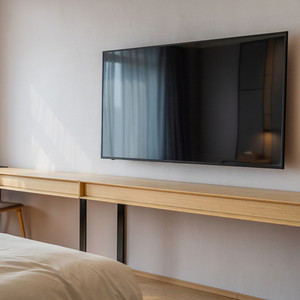
Well, according to the notice, departments of broadcasting television, culture and tourism in various regions should implement the requirements for the special governance of complicated hotel television operations, guide and promote hotels within their jurisdiction to upgrade and update old televisions to ultra high definition equipment in order to improve consumers' TV watching experience.
So the three bodies of government involved in this, the National Radio and Television Administration, the regulators for broadcasting industries in this country, The Ministry of Commerce.
They watch over businesses in this country.
And the Ministry of Culture and Tourism, they oversee tourism and the hospitality business.
And that explains why they are together in this.
And they're each in this for different purposes.
The National Radio and Television Administration obviously, as a regulator of the broadcast industry, would like to see the industry retaining its competition against the onslaught of on-demand viewing and video streaming.
And we know I think we can say worldwide that television cable is really up against it now, competing with streaming platforms worldwide.
It's not the way that it used to be.
The way people consume their content these days their television programs because of streaming platforms is very, very different.
And this puts cable companies in a tough spot.
Right.
So the administration for national radio and television.
They have been pushing the agenda to make smart TVs much easier to use.
They're not only doing this to TVs in a hotel room.
They're also doing this to smart TVs that people buy and put in their own homes, in their living rooms.
For many years smart TV was well, it has been the fashionable product to buy because it's very easy to use and you can watch on demand.
It's got a catchy name.
Yeah, you can also connect wirelessly or with a cable to your other devices like the tablet or your personal computer, which is why it was all the rage in the consumer market, but it was not exactly very easy to use for people who wanted to watch good, old-fashioned television.
Well, let's talk about that for me for a second.
Do we find or did we find smart TVs difficult to use, difficult to navigate our way around?
I mean, I was just about to mention that.
When Lai Ming said we're trying to upgrade the TV sets to ultra-high-definition equipment, especially for hotel usages, it reminds me of a news back in this June.
I think you probably have seen it too, Lai Ming.
It's a CCTV news reporting that it takes up to 11 steps to pick up the remote control and go all the way to watch live programs.
In extreme cases.
Of course that's an extreme case, but just imagine you have to spend all that time just to try to figure out the technical process of turning on the TV and watching.
Well, not only that, but I think if we were to ask who's watching cable television these days, is it the people in their teen years and early 20s, or is it people in their 50s 60s 70s, 80s and higher?
If we take that into account, that it's probably the latter group that's watching more cable television equipped with a smart television, and it takes up to 11 steps to find that favorite TV show.
In extreme cases.
In extreme cases.
Well, that's probably going to deter a lot of people from trying at all.
I know.
I mean the smart TV manufacturers in this country almost always cooperate with a license-holding streaming platform.
I think CIBN has a license for that.
Sohu may have a platform.
Well, I'm not the expert in this, but I know for a fact that there's only a limited number of broadcasters that has the license to operate live streaming platforms.
And smart TV manufacturers oftentimes choose one of them to cooperate with.
And the cooperation is well presented to consumers in the sense that, when you turn it on, users are introduced to the interface powered by the live stream platform, rather than a very old fashioned choice for you to choose the input.
I mean, the old-fashioned TV is, well, it comes with a cable solution.
I mean, when you turn it on, you are automatically presented the different channels, TV channels.
Yeah, it just automatically comes up.
Well, whereas smart TV, because of its enhanced functionality, allows you to choose the source of the input.
It could be an HDMI cable, could be wireless, could be an old-fashioned VGA cable.
Yeah, but even all of that that you just explained to someone who's not used to using those things is a very, very confusing thing, which is why they're looking to simplify the process.
But for the hotels, I'm curious to know.
So the hotel operators, they're going to be required to upgrade their televisions, or at least suggested, I suppose, to upgrade their televisions.
Are we looking at like a star rating?
I'm curious to know.
Is it all hotels across the board?
Is it one star, two star, three star, four star?
Is there a line at all?
I'm curious to know.
Well, there is like a sequence for who is to be replaced first.
Of course, those with the bigger brand and the most chains they're getting to.
This say trade-in stage equipment updating campaign first, but the ultimate goal is to replace all of the old TV sets into the more fancier ones.
And here are some data to back that.
Because, according to Beijing Daily, as of May 14th this year, Beijing had finished the hotel TV upgrading work in nearly 78000 rooms in 350.
54 hotels, accounting for 66% of the overall mission.
And, in principle, the TV upgrading work like we were just talking about earlier, is scheduled to be completed in hotels all over China by the end of September.
So supposedly... They're moving quickly.
Yeah, like in a month or so, it's going to be all done.
I mean, theoretically.
And if every room of the 78000 rooms in 354 hotels in Beijing had a TV and they were replaced, and if each TV were to cost about 1000 yuan in most cases they're probably costing more than that.
But let's say they only cost about 1000 yuan, then we are talking about a 78 million yuan business.
That's already been done before May 14 2024.
And it's going to be a bigger number by the time the project is completed.
It's kind of an interesting comparison when we compare what we see going on in the West versus what this is all about here in China.
Just looking up some different countries to see if they had rules about having televisions in hotel rooms or not.
Egypt was the first stop on my tour to find out information.
Mm-hmm.
And I found the story of Samir Haman, who's the owner of a lodge in Egypt.
And he was talking about in his interview how in Egypt, the government is involved with hotel licenses and certain stipulations.
So in Egypt, if you're what's called an eco-lodge, which...
Judging from the article, I assume means no stars at all.
You're not required to have a television in your hotel room.
If you have any stars in Egypt on your hotel hotel with one star, two stars, three stars you are required by the government to have a television in your room.
Now, what kind of television does that have to be?
From what I found, it's not really stipulated.
It's just of some sort you are required to have one in your room.
That's quite interesting.
When you say start hotels, you think that there might be some kind of standards involved because well, how you evaluate the stars, how do you tell one hotel from the other in terms of their star quality?
Sleep there one night, you probably know.
Okay, the quality of the mattress and then perhaps the hygiene situation.
Yeah.
But, you know, it's not just that, though.
I mean, if we look at France, for example, on the grounds of the Palace of Versailles, it's called Le Grand Control.
And it's a 13 room hotel in a 350 year old building.
Sounds really old, right?
The hotel.
It's not.
It's just a few years old, maybe four years old.
But it was constructed by Louis XIV's favorite architect.
The building was really fancy, probably ultra expensive.
No TVs.
No TVs.
No TV in that hotel room.
How were people watching the Olympic Games?
Oh, in France?
Well, I guess maybe it was like a blackout service.
In the stadiums, perhaps.
Encourage ticket sales.
Yeah, I suppose that hotel in that antique of a building is probably located in one of those busier streets as well right,
Yeah, perhaps, perhaps not.
I mean, I think the idea with some fancier hotel brands is that it's nice enough inside the room and maybe outside the room as well.
Jamaica, 1950, called the Jamaica Inn.
They open their doors with no TVs in their rooms.
Now there's a bit of a backstory to this hotel, because this is where they filmed one of the famous James Bond movies called.
So their idea was the outside beach and Caribbean Sea is your television.
You don't need one in the rooms.
But if you do really want to watch something, they had what they called Bond on the Beach.
And they showed that James Bond movie on the beach once a week.
And that's great.
So my point is that was 1950.
That was in Jamaica at probably a pretty nice place at the time considered to be.
And they didn't have hotels or rooms with TVs either.
So this concept isn't necessarily new.
I mean, I was just reading about this morning that what's the point of putting a TV in a hotel room?
At the end of the day, the hotel room is just there for people to rest and have a temporary room for them during their trip or out of whatever reason they're traveling outside of their home.
And people from the hotel replied in some interviews that I was reading, that In most of the cases the hotel equip a television inside the room just because it looks good and comfy.
Because we're so used to it as consumers that it's supposed to be there.
Yishan is probably too young for this, but there was an age when people's idea of relaxing was to watch TV when they hit home.
When they relax at home by watching TV, there is no reason why they shouldn't relax by watching TV when they stay in a hotel room.
But again, that begs the question, why?
I still do that.
Which begs the question of what?
Which begs the question, how old are you?
No, that wasn't the question that I was asking.
In fact, I think the question is, I think people now travel for various reasons.
We don't necessarily travel for fun.
Right.
On some level.
When we think of vacations, we think of well, sunshine beaches and volleyball on the beach, that kind of thing.
I mean, that certainly is relaxing.
But unfortunately, when we travel, we don't always... you know, look for fun.
We sometimes have to go on business trips, and on that occasions I almost never turn on the TV.
I turn on my personal computer and start working, that's what I do.
And also when people travel to, even when they look to relax, like the example Steve shared earlier.
If it's a seaside resort, You would assume people would like to go swimming, go to poolside parties, whereas who would want to watch TV?
I mean, it's a good thing that people no longer want to cling to TV as the only means of entertainment.
I think it's just an expectation that people used to have.
And you said Yushan, that the policy here or maybe not the policy wrong choice of word but the initiative here is to start with the higher graded hotels, which to me that makes sense.
Because if you're paying let's say you know 1500 yuan for a hotel room for a night, maybe in a nicer part of the city.
When you go into that room in the city and you see an old television in there.
Does that make sense?
It doesn't really make sense because the cost of the room versus the visual kind of disappointment of the TV.
I know.
You know what I'm trying to say, right?
It doesn't make sense, but sometimes it is the case.
You pay a handsome amount of money into a prestigious hotel and you're walking and you see everything beautiful.
I mean, it's famous.
It's been there for quite a few decades.
But more often than not, you see a very old TV there.
The TV.
I think still and this is just my opinion is an important part of a hotel room, especially if it's a nicer hotel room.
Why?
I said before that I like to wind down at the end of the night.
But televisions in hotel rooms now.
Smart TVs are not just for watching your favorite TV show before you go to sleep at night.
They're equipped with guides on what services the hotel provides.
Sometimes they'll even have the restaurants there and they'll have the menus.
You can click on that.
So they provide much more than simply watching cable TV before you go to sleep at night.
It's like digitalizing so many services onto that big screen that used to fit up the place of a TV, but now we just gain access to more services and functions, and all that's provided through a hotel, through the idea of TV, I think.
To me that's the case because the TV in my home and to wherever hotel room that I might stay or had stayed in the past are all just decorations in a way, or just a screen that I use to connect my other portable devices.
So, yeah, maybe for our generation, it's like a brand new idea for using and watching TV.
I went into a hotel room one time where I was only staying for a night and the TV was on when I went into the room.
And on the screen, it said, welcome, Mr. Hatherley.
And I thought, what are the fancier hotels?
It's a nice touch though, isn't it?
Don't you think that's a nice touch?
But again, it's just another example of the TV screen providing a different purpose or a different service.
I know, yeah.
So the demand from customers have changed over the years and the hotels are yet to provide the kind of service that the consumers need.
Come to think of it, other than TV, what else do you expect the hotels to renovate and upgrade?
I can think of the first thing in my mind is the internet, ethernet cable.
You walk into a hotel room and the first thing you look for is the internet connection cable?
Because, no, I don't necessarily use it.
But more than that, I travel on business trips.
I lay down my personal computer on the desk and then there is a cable there, Ethernet cable.
But I don't use it.
I mean, come to think of it, the most modern...
Laptops, they don't come with a socket for that cable.
But the hotels, they still provide that.
So that made you feel comfortable, I guess.
No, it doesn't make me feel comfortable.
It makes me feel like the hotels aren't necessarily paying attention to the services they provide in their rooms.
That's the first thing I would like to replace other than the TV.
Just get Wi-Fi.
Good ones.
So then what you're suggesting then is that hotels need to keep up with the modern times.
Nobody's going to use that Ethernet cable anymore.
It's not necessary to even have it in the room.
There's no point in having it in there.
By that logic, should hotels not be required again?
Wrong choice of words.
Suggested to upgrade their televisions to keep up with the times.
Because these days, a smart television has become the norm, not just something unique and special that is only for the rich.
You can find homes with smart TVs all over the world.
Well, the initiative is a move aimed at multiple purposes, like I explained earlier.
On the one hand, the National Radio and Television Administration is hoping to encourage more people to watch TV and make it easier for them to watch TV.
By TV, I mean the old-fashioned cable TV.
And then the Ministry of Commerce would like to see more business opportunities afforded to the manufacturers of smart TVs.
And then the Ministry of Culture and Tourism would like to see the quality of service being provided at hotels upgraded.
This is a complicated situation we're talking about, but if we were solely focusing on improving the quality of the hospitality service, then I could think of, for instance, other things that they can do.
For instance, improving the curtains.
Last Saturday, the first time I walked into the hotel room, the TV turned on automatically and the curtain was drawn automatically as well.
Wonderful.
That's a fun little toy to watch the blinds go up and down.
I know what you mean.
Yeah.
I mean one big side of this campaign we're talking about that's occurring in China, that's replacing the TV sets in hotel rooms is well an initiative that's covering, as we discussed earlier, the entire nation.
So how to conduct that, how to implement that, is up to the responsibilities of local authorities, because China is such a vast land, right.
And the hotels, televisions has been included in this trade-in for new initiative.
That's my translation in Chinese.
So you get the old ones out and replace for new ones, during which process it's creating such a market for local authorities to encourage and combine the idea of local trading market services, the enterprises that's taking in, recycling these old televisions, and also like online commercial side that's providing new televisions to collaborate with the hotels under the local fund and subsidies, and everything that's working together as a mechanism to reach the goal of replacing such old TV sets.
Maybe they won't even need hotel rooms with TVs in the future.
I conducted an offline and online survey.
Offline on the fifth floor of our building, on the east side specifically.
That's what you did.
Online.
That's what I was doing on the online.
It was my social media networks.
I asked people, you go into a hotel room.
It doesn't have a television.
Okay or not okay?
Very quickly, what do you think was the overwhelming result?
Not okay.
Okay.
What do you think, Yushan?
Okay.
Everybody said okay.
17 to 6 out of the 23 respondents.
There you go.
So there's still a point in updating these TVs in hotel rooms.
Okay.