NPR.
There is a paradox going on in Silicon Valley right now.
There is this absolute fire hose of cash pouring into the AI build out from companies like Amazon and Microsoft.
But at the same time, young tech workers are finding it hard to land a job.
Jasmine's son is a tech writer who's been following this trend.
She used to work for Substack and various tech companies.
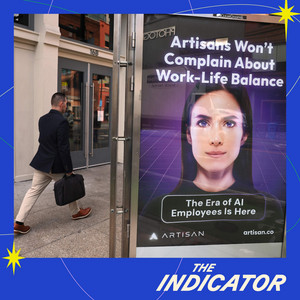
One thing she's observed is a new dialect among tech workers in San Francisco that reveals a dog-eat-dog mindset.
If the world is going to split into the techno kings and the techno peasants, I better prove that I'm going to stay on top because I am high agency enough.
I have the taste.
I am 996ing hard enough. that I'm going to make it.
High agency?
996ing?
What do these terms mean?
Jasmine's essay on the way Bay Area developers talk went viral recently, not just as a curiosity, but because many of these workers believe what they're experiencing could be a preview to what's coming for the rest of us.
This is The Indicator from Planet Money.
I'm Darian Woods.
Today on the show, San Fran slang.
We comb through the jargon, the argo and the etymology of Silicon Valley in the AI era and what it says about our present and our future.
What's in your wallet?
Terms apply.
See CapitalOne.com slash bank for details.
Capital One N.A., member FDIC.
Support for this podcast and the following message come from Recorded Future.
Every day, millions of cyber threats compete for attention, but only a few truly matter to your business.
As a leading threat intelligence company Recorded.
Future cuts through the noise with precision intelligence.
That's why top banks and governments trust them.
Because security leaders don't just react.
They foresee, spotting the signals that others miss and acting before threats become setbacks.
Recorded future.
Know what matters.
Act first.
What happened in Iowa today?
Probably a lot.
Hey, I'm Megan McKinney.
It can take a while to follow all of the news, but it doesn't have to.
Have you tried Hear First?
It's a daily news podcast from Iowa Public Radio, part of the NPR network.
It's your quick stop for Iowa news, culture, and community.
Listen where you get your podcasts.
Jasmine Sun calls her writing about the Bay Area tech community an anthropology of disruption.
And to set the scene, I asked her where she actually did her anthropological observations.
She said Twitter slash X, of course, but also house parties and spas.
Shortly before writing the piece, I was in Archimedes Banya, which is the Russian sauna on the outskirts of San Francisco.
There are a lot of, I guess, old Russian guys in there, but it's also become a bit of a tech hotspot for tech workers to go to decompress, to socialize.
And so I was there with probably nine or 10, 20 something investors, founders, like AI people.
It's clothing optional.
So it's kind of an interesting vibe in 80% male.
Okay.
And they kind of just sit around and talk about AI.
Wow, that's quite an image.
So among all this, we're hearing a new language emerge.
These terms themselves could be an indicator of the economic climate in Silicon Valley right now.
So Shall we dissect a few of them?
Let's do it.
First of all, high agency.
What does this one mean?
High agency is a fun one.
I'm hearing it everywhere these days.
I think a person is high agency if they have a lot of personal initiative, they're very resourceful and they're really good at getting what they want and not even thinking about what roadblocks might be in the way.
I think it also has an element of contrarianism in it.
It's high agency to be able to define your goals for yourself, to not listen to what other people say is the default path or the good job, to not sort of put your resume in in this Dropbox with 1000 other applications and competing, but actually it's very high agency instead to show up to the office with a box of the CTO's favorite chocolates or something like that.
That is what it means to be high.
Agency is like I'm going to figure out a creative way to get what I want from the world.
It's interesting because we're reaching a world where intelligence is almost becoming commodified with artificial intelligence.
And so this is something that chatbots don't really have, which is the drive to do something.
Right.
Next term, NPC.
Tell me what NPC means.
An NPC is a non-player character.
It's a term that comes from the world of video games.
An NPC is the opposite of being high urgency.
It's somebody who has no grand missions of their own.
They can't really deviate from the script they're given.
They just are background characters.
You are automatable is essentially what you're saying.
You can be coded.
You can be automated by a game designer.
You don't have goals or ideas or creativity of your own.
Yeah, it's pretty brutal.
Almost like you don't have a soul.
That is basically what people are saying.
I think it's pretty mean to call people NPCs.
I think in the essay I joke that the NPCs are stuck playing LinkedIn games and watching Marvel movies, totally blind to the technological tsunami that's going to come for them.
Which brings us to the next term, permanent underclass.
Permanent underclass is a crazy one.
It is just so bleak.
So there are all these tweets that I saw joking about the permanent underclass.
And they usually went something along the lines of like we only have five months to escape the permanent underclass.
You better work hard because you're going to get stuck in the permanent underclass.
This guy, Nick Carter, on Twitter said everyone i know believes we have a few years maximum until the value of labor totally collapses and capital accretes to owners on a runaway loop.
This is the permanent underclass thing, and everyone i know subscribes to it.
And so if that's true, then you are in a world where capital is the only thing that matters.
And so all of these jokes.
They are really jokes about the permanent underclass, but they sort of reflect this, I think economic anxiety that people don't know whether their skills are going to survive what they think of as AGI.
And can you explain AGI?
AGI stands for Artificial General Intelligence, and it's the notion of an AI that can do any cognitive task that a human can is the definition.
You think that AI will get to a point where there is nothing intellectual or cognitive connected That it cannot do?
So excluding robotics and sort of like physical tasks, but any level of coding, any level of economics research, any level of illustration or creative coming up with ideas for articles and stories like AI will be able to do.
So this foreboding of a potential permanent underclass leads us to our next term, 996.
Yeah, 996 stands for 9 a.m. to 9 p.m., six days a week.
It's a work culture where the idea is that you were working those hours 9 am to 9 pm, six days a week.
That doesn't sound healthy.
No, it doesn't.
It's a lot.
It's a lot.
It's funny because Silicon Valley used to.
There was a time where people were playing ping pong at work and advertising work-life balance and remote work.
But no, everyone's back to the office and they're adding Saturdays too.
996 is interesting because it came from China and Chinese big tech companies that mandated a 996 schedule during the 2010s until so many employees started experiencing health problems and going to the ICU that the government instituted policies to formally ban 996, but it continues in informal ways.
And San Francisco this year has, I suppose, decided that if they want to compete with the Chinese tech companies, they too should adopt this work practice.
So, to recap, we have people being described as either high agency or opposite NPC, which might or might not affect whether they end up in the permanent underclass.
Some of the ways to avoid that are by working 996 hours.
What does this discourse tell you about the hopes and fears of tech people in San Francisco and Silicon Valley right now?
I think there's a lot of interesting dissonance going on, where people do believe that there will be inequality that's created by AGI, that there will be some people who are the automators and some people who are the automated.
But rather than this leading to any sort of political consciousness or interest in activism or slowing down, I think the way that tech culture is reacting is by everybody working as hard as they can to prove that they are going to end up on top of that divide.
I think that this is super important because when you take a step back, you'll notice that a whole lot of behaviors in the corporate world are following what other people are doing.
I think back to when Elon Musk cut thousands of staff at X or Twitter back then, and then suddenly all the other tech companies were doing the same thing.
And a lot of it just seemed to be following what other people were doing.
And so, if this is the language and the culture and the narratives being built up, it might explain some of the trends we're seeing around hyperscaling of AI, data centers and the ways that are People are choosing to forge their careers and the companies they found.
Yeah, I totally agree with that.
It is funny how much people are trying to prove that they're not an NPC by all going to the same parties and the same berries classes and drinking the same Celsiuses.
And so there is a bit of irony in that, I think.
Well, Jasmine Sun, independent writer, thank you so much for joining The Indicator.
Thank you so much for having me.
Jasmine Sun writes at jasmine.substack.com.
This episode was produced by Angel Carreras with engineering by Kweisi Lee.
It was fact-checked by Sierra Juarez.
Kate Kaganen edits the show and The Indicator is a production of NPR.
This message comes from Mint Mobile.
At Mint Mobile, their favorite word is no.
No contracts, no monthly bills, no hidden fees.
Plans start at $15 a month.
Make the switch at mintmobile.com slash switch.
That's mintmobile.com slash switch.
Upfront payment of $45 for 3-month 5GB plan required.
Equivalent to $15 a month.
New customer offer for first 3 months only.
Then full price plan options available.
Taxes and fees extra.
See Mint Mobile for details.
This message comes from BetterHelp.
To mark World Mental Health Day, BetterHelp is thanking the therapists who change people's lives all around the world by providing accessible mental health support.
With over 12 years of experience matching clients with therapists, and one of the world's largest online therapist networks, BetterHelp can help you find the right therapist.
Visit BetterHelp.com for 10% off your first month.
This message comes from Capital One.
Banking with Capital One helps you keep more money in your wallet with no fees or minimums on checking accounts.