This is the indicator from Planet Money.
I'm Wayland Wong here with Mary Child from Planet Money.
Hi, hello. And Adrienne Ma.
Hey there. So we are here for our weekly Indicators of the Week segment.
And before we get going, we wanted to welcome Adrienne back because you have been away from show for the past three weeks and Adrienne the floor is yours if you want to say hello and talk about why.
Yeah. If you listen to NPR you might already know this, but I recently lost somebody that I loved.
Her name was Kia Douglas.
She was an incredible person.
You should actually look her up if you get a chance.
Kia was my girlfriend and, unfortunately, she was also one of the 67 people who died in that American Airlines plane crash in January.
Um, needless to say, I have been going through it lately.
Uh, the past several weeks have been incredibly tough.
During that time, though, I've also gotten a lot of messages from listeners who offered condolences and words of encouragement, and even wanted to share their own stories of loss and what they've learned from it.
And so to all the people who reached out and offered words of support, I just want to say, thank you.
Adrian, we're glad to have you back.
Yes, we are with you.
And we are, it's really nice to be back in the booth.
Thank you, it is a good to be back.
And apologies in advance if it's a little while until I am my normal self again.
I don't think you have to be funny for like a long time.
Yeah, there's no requirement to feel or act normal.
Oh yeah? Okay. Well in that case, you're just going to get Goth Adrian for the rest of the year.
Goth Adrian? Yeah. Okay, Emo Adrian.
We're here for it. Mary Whalen and Emo Adrian, we're going to do what we do most Fridays which is highlight numbers from the news, crack a few jokes and help people make sense of what's happening in the economy.
This message comes from Bombus.
Socks, underwear, and T -shirts are the top three requested clothing items by people experiencing homelessness.
Bombus makes all three, and donates one item for every item purchased.
Go to Bombus .com slash NPR and use code NPR for 20 % off.
This message comes from ServiceNow.
People should do the creative work they actually want to do.
Not boring, busy work.
Now, with AI agents built into the ServiceNow Platform, you can automate millions of repetitive tasks in every corner of your business, IT, HR, and more, so your people can focus on the work that they want to do.
That's putting AI agents to work for people.
It's your turn. Get started at servicenow .com slash AI dash agents.
Weylin, kick us off with your indicator.
My indicator is 513.
that is the number of lawmakers in Germany's lower house that voted to approve huge new defense spending plans.
These plans, you guys, are so big they required a change in the Constitution to happen.
Change in the Constitution requires a 2 .3 majority in the lower house, and these 513 votes, that was enough.
It still has to be voted on by the upper house, but it looks like they will also approve.
They're changing the Constitution?
Is that like an amendment event here, or is this a bigger deal than that?
Well, it is a pretty historic moment for Germany, I will say.
The country's constitution has something called a debt break.
That's B -R -A -K -E, and it's a limit on borrowing.
And what the lawmakers would, a yes on, was exempting most defense spending from this limit.
How much are they talking about spending here?
Well, hold onto your butts.
there is talk of up to 1 trillion euros, which honestly a staggering amount, and this will go into military and infrastructure.
Like part of these plans is a 500 billion euro fund to modernize hospitals, schools, roads, that kind of thing.
A chunk of this fund will also go toward climate related spending.
This is something that Germany's Green Party insisted on and the other two political parties, you know, they needed support from the Greens as they're called to get all of these votes.
okay, money for climate, for infrastructure, but also a lot, a lot of money for the military, right?
Because it seems like European defense is a very hot topic right now.
You all have done a couple of episodes on it.
We have. That's the definition of when it's hot.
Everybody has their indicators on the case.
It's obviously a huge change to be talking about German rearmament.
This is a very sensitive subject, the country you might remember had to demilitarize after World War II, And then it wasn't until the Cold War in the 50s that it was allowed to build up its military again and join NATO But you know we have war in Ukraine we have nervousness about Russia's moves in Europe We have rapidly deteriorating relationships between the US and its allies in Europe So this vote in Germany fits into this bigger Geopolitical shift we're seeing and we'll have more on that in an episode next week.
That's exciting. I can't wait to learn more Adrien What do you got?
Turning things to the US, my indicator of the week is 894 deals.
That is how many corporate mergers and acquisitions were announced in February.
That makes this past February the slowest month for deal activity in the US in at least a couple of years, and a big reason for this slowdown in corporate matchmaking is uncertainty, a lot of it caused by President Trump's tariff policies.
Yes, it seems pretty obvious we are in a trade war.
There's all the back and forth of Mexico and Canada.
There's tariffs on China, the European Union, Japan, and the White House is promising more to come.
Yeah, totally. And this is creating a lot of uncertainties for CEOs about how to run their businesses, right?
Because if you're a company that imports stuff from other countries, you are probably wondering right now, should I raise the prices of my products to account for those tariffs?
Or should I stock up on a lot more imported stuff before the tariffs go up.
So with all these companies trying to navigate these kind of day to day micro business decisions, it's kind of hard for them to think macro, to think about big strategic moves like buying, or merging with other companies.
Yeah, and like if you have officials in the Trump administration saying, maybe we'll have a recession, I mean, then you don't want to hire, you don't want to spend money, you want to buy a factory.
Totally. Business uncertainty has all these ripple effects.
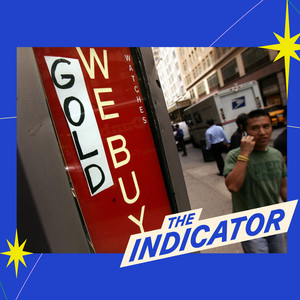
Well, Adrienne, speaking of business uncertainty rippling, ooh, my indicator of the week, I'm pleased to announce, is 3 ,000, as in dollars, as in that's how much you'll need for one Troy ounce of gold.
What's a Troy ounce?
I've never known what a Troy is.
Me neither. I'm so glad you asked because I did Google it.
It is an ancient way from the Middle Ages that we measure precious metals.
And supposedly it originates from Troy, France.
So, I guess it could be a Try Out.
It is a little bit more than a normal ounce.
It's 31 .1 grams for a Troy ounce, versus 28 .35 grams for a regular ounce.
It's very specific.
The price for gold per Troy ounce has risen 14 % this year alone.
That is like the opposite direction as the stock market, which has dropped, I think, like 10 % this year.
Yes. It dropped 10 % from its peak in February, although it has clawed some of that back, but as you know, and as Adrienne just relayed, there is a lot of uncertainty, a lot of fear.
Of course, you know, when things are getting a little fearful, gold suddenly becomes a really attractive investment for a lot of people.
Like, historically, it's been seen as a safe haven investment.
That's exactly right, and it just so happens that I saw this in real life the other day.
So I was coming home from New York, and I took a lift from the train station, and the guy who drove me, his name was David, super nice guy, David if you're listening, hello.
He asked what my job was, I told him.
He was like, oh, so what do you think of this gold rush?
He just got right down to business.
He did. Because he is out there buying gold.
I'm paraphrasing but he basically thinks that the world order has been upended, is being upended.
Governments around the world in upheaval without exception, he wants a store of value.
I think part of it is like, gold is this traditional and trusted and ancient way of opting out of financial markets in a way.
Because even if you hold cash, you're still kind of playing in the arena because you have to pick which currency to hold.
When it comes to holding gold, we're not just talking about individual people like David, right?
No, yeah. It's not just David alone causing this search. It is also central, although I wish that for him, it is also central banks for years, and recently, investors have started outpacing central banks in their gold buying, which is remarkable.
And this surprised me.
The fact is, gold delivers.
So since we left the gold standard in 1971, gold has somehow generated annual returns of more than 8 % according to the World Gold Council.
That beats the bond market, commodities, emerging markets, cash, everything but US stocks.
Which is salient right now because the picture for US stocks is really changing.
Investors cannot flee fast enough.
A Bank of America survey this week showed that fund managers have cut their holdings of US equities by the most on record by 40 percentage points.
40 percentage points.
That is a wild bonus indicator you just brought us.
Thank you. More where that came from.
Well, Mary, thank you so much for joining us today.
Always fun to have you.
Thank you for having me.
It's always a delight to be here.
And great to have you back, Adrienne.
Thanks, Wylie. This episode was produced by Angel Queras.
It was engineered by Gilly Moon who we will miss so much. Good luck at your new adventure gili.
It was fact -checked by Sierra Juarez and edited by Kate Kincannon, the indicators of production of NPR.
Are we overlooking the challenges facing men without college degrees?
Richard Reeves thinks so.
There are a lot of guys out there who are actually poorer than their dads.
Reeves heads the American Institute for Boys and Men.
Have we updated our view about the role of men as quickly as we change the economy around them?
And the answer is no. That's from a recent planet money bonus episode.
a look at the economic and cultural struggles of working -class men.
To hear it and get sponsor -free listening, sign up for NPR+.
Just go to plus .npr .org.
Shortwave thinks of science as an invisible force showing up in your everyday life.
Powering the food you eat, the medicine you use, the tech in your pocket.
Science is approachable because it's already part of your life.
Live. Come explore these connections on the shortwave podcast from NPR.
Support for NPR comes from the Wallace Foundation, an independent nonpartisan research foundation collaborating with grantees and partners in the arts, school leadership, and youth development.
More at WallaceFoundation .org.