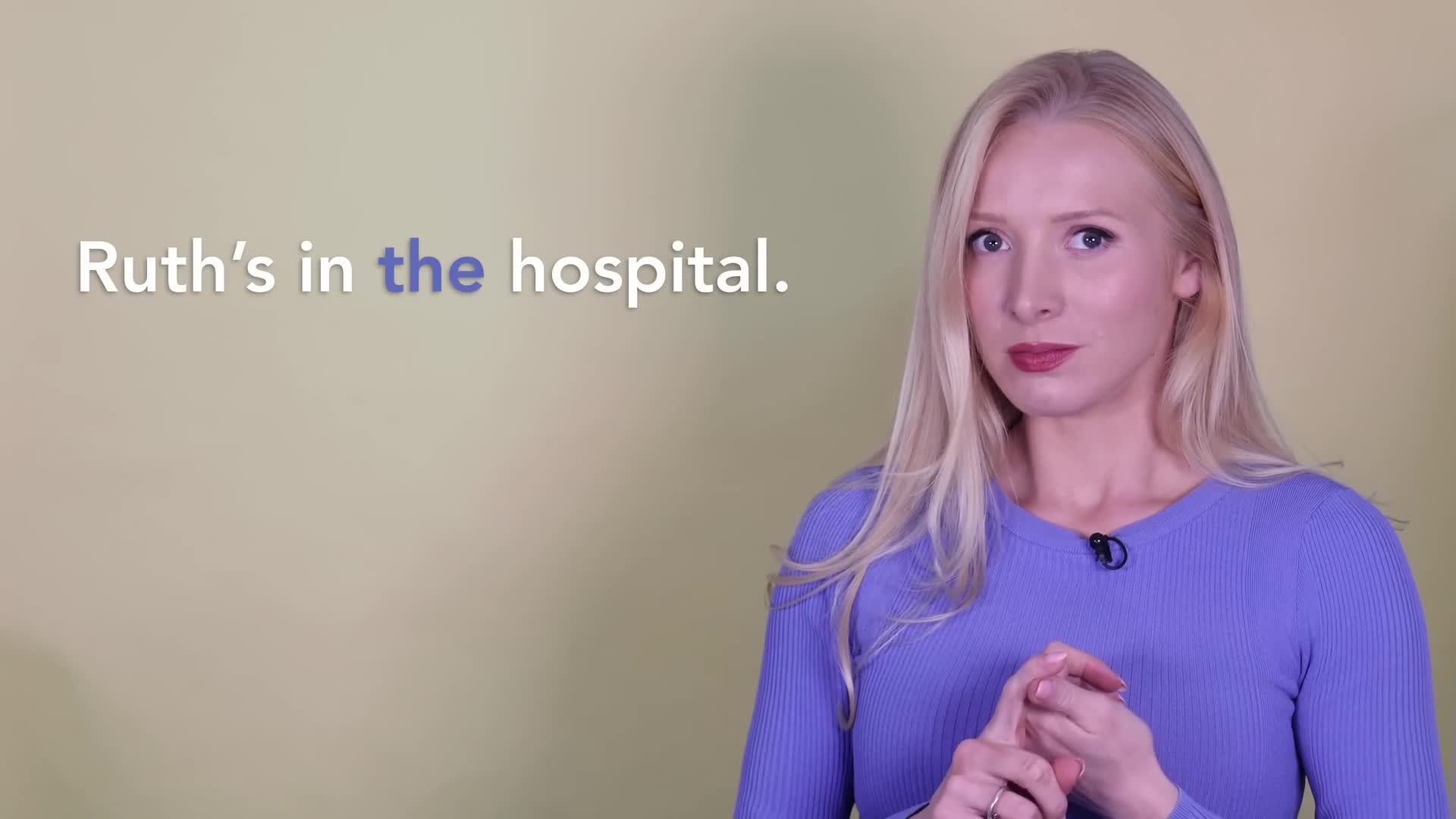
Ruth's in the hospital.
What are you doing for the Christmas?
I always eat the breakfast.
Is the in these sentences correct?
In this video, I will teach you about when we never use the.
Before you do anything, first I want you to download my ultimate The Guide.
This is a PDF ebook.
It contains everything we're going to talk about in today's lesson, plus lots of extra information about when we do use the.
To download this PDF ebook for free, just scan the QR code there or click the link in the description.
Sign up to my mailing list and I'll send it right to your inbox.
Let's start with the lesson.
First, we do not use the. before people's names.
So it's not, the Lucy is my teacher.
It's just, Lucy is my teacher.
We also don't use the when we have a title and a person's name.
Dr. Keens is on her way.
Mr. Lawson has just left.
Now, are there any exceptions to this?
Of course, there are always exceptions in English.
Take this example.
Andy just got a new dog.
Do you mean the Andy who lives down the road?
Now, when we're identifying a specific person or thing, we use the, and this is true in many cases throughout this lesson, and I've put examples in the PDF, the guide.
So, if you're confused at any point, go and have a look there.
The link is in the description.
But in general, we don't use the before names.
Next, we do not use the before the names of continents.
For example, Asia is a very large continent. or Botswana is in Africa, not the Asia, not the Africa.
And did you notice that we didn't have the before Botswana either?
We don't use the before the names of most countries.
I'd like to visit Canada.
Brazil produces a lot of coffee, not the Canada, not the Brazil.
Now some country names usually take the like the United States, the United Kingdom and groups of islands like the Philippines.
I've put lots of information about that in the PDF.
Next, we don't use the before names of towns and cities.
He lives in London.
Tokyo is my favourite city.
Not the London, not the Tokyo.
Street names.
Squares and parks usually do not have the.
I live on Cherry Tree Avenue.
Times Square is one of the most famous places in New York City.
Let's rent a bike and ride through Hyde Park.
There are exceptions.
High streets. for example, often carry the.
I'll see you on the high street.
What about natural geographical features?
Is this correct?
The Lake Como is in Italy?
No, we don't use the before the names of most lakes and mountains.
Lake Como is in Italy, climbing Mount Everest is very dangerous.
Next, we don't use the before the names of public buildings or institutions, especially if the first word is the name of a place or a person.
For example, I'll meet you at Manchester Airport.
St.
Pancras is a beautiful train station.
She's at Yale University.
We also don't use the before shops and restaurants named after people.
These names tend to end in S or apostrophe S. Do you want to grab a burger at Wendy's?
Harrods is an expensive shop in London.
In fact, most company names, including airlines, don't take the. most.
Apple makes phones and other electronic devices.
I flew to London on British Airways.
Not the Apple. not the British Airways.
Getting these details right, like when not to use the, takes more than just exposure.
That's exactly why in my courses, we focus on what matters most.
So you make real progress without wasting time.
And this Black Friday, I am maximizing your savings too.
You will get access to my most effective programs with the biggest discounts and most value I've ever offered.
Join the waiting list now by clicking the link below or scanning the QR code on screen.
You will be the first to know when these deals are available.
We don't generally use the with the word school prison, university and church when we are referring to those places as a general idea, particularly when we're talking about a student, a prisoner or a person who regularly attends church.
For example, I went to school in a small town.
He's in prison.
We often use the before those words when we're visiting.
For example, we went to the prison to see Tate.
They're visiting prison, they're not prisoners.
Or she's going to the church to find Reverend Marks.
She's visiting the church on a special occasion.
Okay, hospital.
We saw this at the beginning.
And in the same way as with school and prison, we don't use the when talking about the general idea of a hospital and someone as a patient in British English.
American English is different and I'll explain that in a second.
In British English, we say, Ruth's in hospital.
In North American English, they're more likely to say Ruth's in the hospital.
You can use whichever you prefer.
I don't think it will limit your communication if you say the hospital in the UK or just hospital in the US.
Now one more place-related group.
We don't tend to use the in expressions with the words home, work and bed.
These are often with verbs like go, stay, start, and finish.
Jo starts work at seven.
She's staying at home tonight.
I'm going to bed.
Not to the bed, to bed.
Now, let's talk about meals.
We don't use the before breakfast, lunch, dinner, or supper.
So at the beginning of the video, I asked you about this sentence, I always eat the breakfast.
And now we know it's generally incorrect, so remove the.
There are occasions where it could be correct.
This is when you're not talking about a specific breakfast, it's breakfast in general, no the.
Some more examples.
What do you fancy for lunch?
I usually have fruit for supper.
You also saw this sentence at the beginning of the video.
What are you doing for the Christmas?
That is incorrect.
We don't use the before many festivals and celebrations, including Christmas, New Year's Eve or New Year's Day Easter Hanukkah, Eid Diwali.
For example, what are you doing for Easter?
Or Diwali usually falls in October or November.
Using the before months is another no-go in general.
June is my favourite month.
We usually celebrate Easter in March or April.
Not the June, not the March or April.
What else do we have?
Well, we don't use the before some times of day, which is correct.
We went in the morning, we went at the night.
So the first one is fine, in the morning, but the second isn't correct.
We don't usually use the if we can use the preposition at before the word.
And this includes night, dawn, and dusk.
We went for a walk along the beach at dawn.
We waited until dusk before lighting the campfire.
We also don't tend to use the before languages.
English is hard.
I'm studying Japanese, not the English, not the Japanese when referring to languages.
The English or the Japanese can refer to groups of people, the English people, the Japanese people.
Let's finish off with some more general categories.
We don't usually use the before general plural or uncountable nouns.
They love animals.
I play tennis on Tuesdays. not the tennis.
I often hear my students use the before sports games and other forms of exercise, but we don't tend to
We like football.
He does yoga.
She plays chess.
Another example with uncountable nouns, do you take sugar in coffee or tea?
Not the sugar, the coffee or the tea.
But you might have heard the animals or the tennis, and it probably wasn't wrong.
Check the PDF for examples, QR code there, link in description.
I'll go into that in more detail.
Similarly, when speaking generally, we don't use the before uncountable abstract nouns such as love hate, hope and peace.
Love makes people do strange things.
Peace is important for a happy life.
Okay, now it's time for a quiz.
Let's check what you've learned.
Share your results in the comments.
One.
Do we need to add the anywhere in this sentence?
American Airlines is based in Fort Worth.
No, that sentence is correct.
We don't use the before names of airlines or cities.
Two.
Is this sentence correct?
Tomorrow, I'm helping at the school where my son works.
Yes, it's correct.
Remember, we use the before school when we're talking about visiting a specific one.
Three, what about this sentence?
Is it correct?
Cocoa beans are grown in the Africa.
That's not correct.
We don't use the before continents.
Cocoa beans is fine without the as it's a general plural noun.
Four, are you more likely to hear this in British or North American English?
Marco is in the hospital.
This is more common in North American English.
British English speakers tend to say in hospital.
And question five, do we need to add the in this sentence?
Manila is the capital of Philippines.
Well, if you put the before Manila, that's wrong, but we would usually say the Philippines.
Okay, let me know your score out of five in the comments section.
There's lots more to cover on this topic, including when we definitely do use the.
All of this information is in the e-book, the PDF, the e-book.
You can download this for free by clicking on the link in the description box or scanning the QR code there.
I hope you enjoyed the lesson.
I will see you very soon for the next one.