Hello and welcome to a real conversation between two native English speakers.
I'm Adam Navis.
With me is Liz Waid.
Hello, Liz.
Hi, Adam.
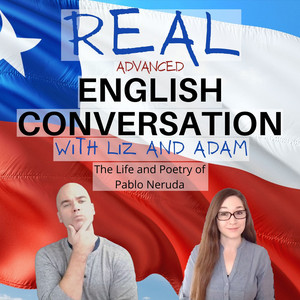
If you are new to this channel or this is your first time, we are going to be discussing the program The Life and Poetry of Pablo Neruda.
Now, if you haven't listened to that program, make sure you go into the description of this video and check that out, and then come back And watch this, because we are going to be talking about the poet Pablo Neruda and his life and work.
So if you just want to hang out with us, you're always welcome.
While you're here, make sure you hit that like and subscribe button.
As you are engaging in your English learning journey.
We have a couple options that we love to share, which is you can get our scripts by email for just a couple bucks a month, a couple dollars a month.
I remember Liz.
Told me don't use bucks.
That's just another word for dollars.
Or you can join our YouTube channel, become a member.
Both of those are great ways to support us and get more stuff and improve your English.
Yeah, I like to think it's the cheapest English class that you can take.
Yeah, the best investment in your English learning that you could make.
Super easy.
Yeah.
So let's talk about poetry, Liz.
Let's talk about Pablo Neruda.
So this is a style of program that really focuses on an individual person and their work.
And in this case, he was a poet, right?
Right.
Yeah.
He was actually a very accomplished poet and very famous worldwide.
So he is a Chilean poet.
And now that I say that, I'm like, oh, no, did I get that wrong?
But no, you're right.
He is from Chile.
And, um, He started writing very, very young.
And over his lifetime, he traveled around the world.
He continued writing.
He was a very successful poet.
And yeah, still famous in a lot of places today.
Yeah.
And I think it's it's hard.
I mean, if you're famous as a poet, you're pretty famous because there are.
Yeah.
It is not like sports stars or actors.
I mean, poetry is faces all over everything.
Right.
Right.
So before, were you familiar with Pablo Neruda before this program?
Because I felt like I had heard the name, but I honestly didn't know a lot about him or his work.
I knew a little bit about him.
I did study a lot of literature as a student in both high school and college.
And so in studying literature, you definitely study something by Pablo Neruda at some point in your student career.
Right.
And so I knew a little bit about him, but I actually did write this program and learned a lot more.
So there's it has.
When you write about anyone's life people, especially really interesting people, live very full lives.
So somebody like Pablo Neruda, he traveled all around the world.
He had big ideas.
He talked to important people.
So how do you put all of those life parts into one short program?
It's impossible.
It's impossible.
We always have to leave a lot out of any program.
But a program like this, we had to cut out a lot.
But he does have a very interesting life.
So if you are listening or watching right now, I would really encourage you just check out.
I mean, even do a Google search if that's your ability.
Or read a book about Pablo Neruda because he is a very, very interesting person in general.
Right.
Well, and I think...
I think a lot of our people who are watching this really enjoy poetry as a way of learning English, or they have poetry in their country that they enjoy in their own language.
Yes.
Of course, now Pablo Neruda's poetry was not written in English.
Right.
It was written in Spanish.
But this is also an interesting concept, right?
How do you take the essence or the important parts of a poem that's made beautifully in one language and make it similar in another language?
Because there's in each language there's rhyme and cadence and even words that don't actually have a one-to-one translation, right?
So you have right, it's almost a is as much a creative act of translation as it is of writing the original poem, right?
So all of our poems, our sorry, all of the poems in this program are translated by other people.
We did not translate these poems because you need to be a uh very, very good speaker, fluent speaker of both languages, to be able to do that.
And I am not a fluent speaker in, uh, in Spanish though.
I can get around a little bit, but you're not, you're not at that level of translating.
Uh, yeah, no.
So we did list who translated each poem in our um, in our program, and each of these translations is a more famous translation of each poem.
But if you're looking for a poem with the English title, you might have a difficult time because some translators might translate a title differently.
Right.
So, for example, there's a poem in here called I'm Telling You Something or I'm Going to Tell You Something.
But I don't even know the name right off the top of my head because I know that people have translated it differently.
It's I'm telling you something.
I am about to tell you something.
I am going to tell you some things.
There's all sorts of different ways that people have translated even just this title.
That's fascinating.
That is true in any time you're translating or trying to understand.
You have to make those kind of choices.
I do have a question for our listeners, though.
If you want to write in the comment below, especially if you are a Spanish speaker, if you know about Pablo Neruda and if you have read his poetry in Spanish or even tried to read the English translation, and how you think they compare, I would be really interested in hearing that.
Yeah.
Or, if you don't know Pablo Neruda, do you have a favorite poet that we should do a program on to explore in the same way we've kind of explored his life and work?
So put that in the comments.
Before we go, I want to note that Neruda had some strong political beliefs.
Yes.
Which is not uncommon.
There is a history of writers, whether they're poets or writers of prose, and the government coming into conflict.
That often when a new government comes in, they kind of well, in the worst case they kill all the writers.
Yeah, that's true.
Journalists or poets, because people who write and I'm going to use Neruda they do a lot of seeing and thinking.
And then I know there's another aspect about how they give voice to certain things, right?
How they the voice of the people or the voice of Like in the Machu Picchu poem at the end of this program, where he's giving voice to the people who built Machu Picchu.
Right.
So you can kind of give life your words, give life to things, which is, I mean, what I would hope certain spotlight programs do that if you would listen to this, that Pablo Neruda would come to life a little bit for you and seem alive through his own words.
But I think it's important to value that.
And if you... are watching this and consider yourself a writer of any kind, you have our support.
We think that is a good thing to keep practicing, whether in English or in your own language.
So that's my two cents, as they say.
Yeah, that's a good one.
Yeah, I do think it is important to say that Pablo Neruda was not always liked by the government.
And so even when he won his Nobel Prize, there were many people who said that he did not deserve it because of his political beliefs.
Some other people said that because his poetry was so good, he did deserve it.
So just another recommendation to really read more about Pablo Neruda.
And, of course, if you liked this Pablo Neruda program, we have a lot of other programs about people on our website.
Artists. artists or activists, people who are really passionate about something.
So check those out.
Go to our website, spotlightenglish.com.
If you've never done that, I promise you're going to be blown away by all the things you find there, all the resources you can use.
That's spotlightenglish.com.
And Yeah, check out this program.
We actually have advanced versions.
If you found this program, you're like, hey, I understood it all.
We offer an advanced version that is faster.
It's not as fast as we're talking in this program, but it is more along the lines of the way a native English speaker would speak.
And you can check us out on social media.
You know how to do that.
Like and subscribe to this video.
And on behalf of Liz and myself, until next time, make sure you listen, watch, practice, and learn.
Spotlight out.