N. P. R. This is The Indicator from Planet Money.
I'm Waylon Wong here with Adriene Ma.
Good morning! Okay, Bela Lugosi.
And also from Planet Money we have the inimitable, the formidable, the corporeal, Keith Romer.
I'm incredibly corporeal today.
Uh, hello. I'm glad to be here with you and Bela.
It is Friday, the end of the week, and with Friday comes indicators of the week!
Today we'll be digging into how much one banana could possibly cost.
Ten dollars? I mean maybe.
We'll also talk about why it's difficult to get price information from funeral providers, and just how much Elon Musk has profited off Trump's election.
This is Ira Glass with This American Life.
Each week on our show we choose a theme, tell different stories on that theme.
Alright, I'm just gonna stop right there.
You're listening to an NPR podcast.
Chances are you know our show.
So instead I'm gonna tell you we've just been on a run of really good shows lately.
Some big epic emotional stories, some weird funny stuff too.
Download us, This American Life.
I'm Rachel Martin, host of NPR's Wild Card Podcast.
I'm the kind of person who wants to skip the small talk and get right to the things that matter.
That's why I invite famous guests like Ted Danson, Jeff Goldblum and Issa Rae to skip the surface stuff.
We talk about what gives their lives meaning, the beliefs that shape their world view, the moments of joy that keep them going.
Follow Wild Card, wherever you get your podcasts, only from NPR.
Some of our favorite planets aren't even real.
But could they be? Here on Shortwave, we journey to other planets, distant galaxies in our universe and in our favorite works of science fiction.
Listen now to the Shortwave Podcast from NPR.
Before I tell you what my indicator is, I want to tell you what it's about.
Which is death. Favorite topic heading into a weekend.
Lay it on us, Adrian.
My indicator is about the funeral industry, which is a business where putting prices on things can be difficult.
Because think about it, how often do you drive by a funeral home and they have a big sign outside that says, This weekend, cremations, $9 .99.
Five million served.
But this is all part of the issue, right?
It's like funeral homes are not known for advertising their prices.
And to make matters even worse is like, when people need funeral services, they're usually grieving, right?
The shopping around for the best deal is not the first thing on their mind a lot of the time.
And this means some consumers can get taken advantage of.
You know, they could get overcharged or hit with hidden fees or upsold things they don't need.
Like the fancy lights around the rim of the casket kind of vibe?
I mean, that is a necessity to me.
It's honestly shocking how much all of this costs.
Like when you hear how much, you know, like a standard kind of funeral costs, it's really mind boggling.
And so a few decades ago, the Federal Trade Commission actually realized that this was an issue.
And they came up with this thing called the funeral rule.
And in short, this rule says that funeral homes have to be transparent about their prices.
And last year, the FTC did this sort of random audit to get a sense of whether funeral providers were following this rule.
They called about 280 of these funeral homes and they just released the results of this audit this week.
And any guesses as to the success rate they had on getting price information from funeral providers on the first try?
I'm going to do, let's say, 40 percent, like less than half the group.
I'm going even lower.
I think it's like 20 percent.
So the actual number is 30 percent.
So that is my indicator of the week, 30 percent.
That is about the rate of success they had on getting information on their first attempt, which is, I would say, not a great number.
Because that means 70 percent are not complying with this rule at all.
At least not right away, first try.
Well, eventually, they did have more success like they would get.
They would make up to three calls.
Because that's what a grieving person wants to do, is make multiple phone calls to the same place to get some basic information.
Precisely. So they did say that this is a problem, like having to make multiple phone calls to places.
And actually, here's another telling detail from the report, which is that for many of the places they called, they weren't able to get any pricing information at all, even after multiple calls.
So the results of this report suggest that despite having these rules, a lot of funeral providers are still being cagey with customers.
Okay. Natural transition from funeral parlors and death to really anything.
My indicator... What do you got, Keith?
My indicator is 67 billion dollars, which is Bloomberg's estimate for how much Elon Musk's net worth has increased since Donald Trump was elected.
How many funerals will that pay for?
We'll never know! Even if you asked, they wouldn't tell you.
That 67 billion dollar number, that is an estimate.
But Elon Musk, one guy is now worth around a third of a trillion dollars.
I find this like almost hard to believe.
Is this just from the value of Elon Musk's like...
I mean, this is net worth, this is net worth, so it's everything, right?
Like everything he owns is their estimate.
So think of all his companies, he's got rocket ships, he's got satellites, he's got brain implants, he's got AI, he's got a failing social media company.
And the big one, right, is Tesla.
And he owns pieces of all these.
In the last two and a half weeks since the election, Tesla itself, the stock, has gone up about 35%.
It's one of these stocks that's really benefited from the post -election bump.
So I've got sort of three explanations for what's happening here.
The first one, the most cynical one, is that essentially crony capitalism, right?
Like markets are thinking, you know, Musk spent over 100 million dollars supporting Trump's campaign, and now, you know, Trump owes him and that's gonna like help his businesses.
Not a bad return on investment.
Yeah, it's like 600 something X return on investment.
You put in 100 million, you get 60 billion back, it's a great deal.
My second, slightly less cynical explanation is that all of the deregulation that Trump is promising is just gonna be helpful for somebody who like Musk, who a lot of his companies are kind of on or across or skirting around regulatory lines anyway.
Maybe with a little more freedom from regulation, they can really, you know, take off.
Yeah, and there were reports this week, for example, that the Trump administration might take over regulatory control from the states for self -driving cars, presumably in a way that helps Tesla's big push into that space.
And then explanation number three is just that Elon Musk and everything he touches is a meme stock.
All right, so GameStop 3 .0, 4 .0, I don't remember what iteration of GameStop for on.
Sometimes markets are just vibes, right?
Things associated with Elon Musk, they are having their kind of line go up moment right now.
Do you know what else is way up since the election?
Musk's favorite joke, cryptocurrency, Dogecoin.
Oh, I haven't thought about Dogecoin in a long time.
Well, you should have.
It has more than doubled since the beginning of the month.
Okay, so you're saying this run in Dogecoin wasn't about the fundamentals?
Not as far as I can tell, though.
Hmm, curious, okay.
Speaking of curiosities, here's my indicator.
Gentlemen, I present to you one of the most talked about contemporary artworks in recent years.
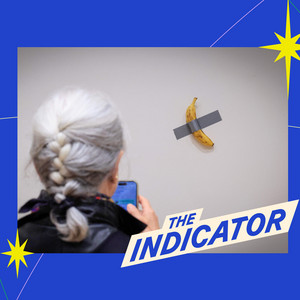
Comedian by the artist Maurizio Catalan, it is a yellow banana attached to the wall with a length of duct tape.
Let's start the bidding at $1 million.
Do I have $1 million?
Can we do this like a reverse backwards auction until we get down to what we're going to pay for it?
Because I'm not going up.
Well, banana beauty is in the eye of the beholder because comedian went up for auction at Sotheby's on Wednesday, and the bidding went up and up.
These are words I never thought I'd say.
$5 million for a banana.
Ultimately, the winning bidder paid $6 .2 million for this piece of art.
That is my indicator, $6 .2 million.
And this is a real honest to God, perishable banana, duct taped to the wall.
It debuted at Art Basel Miami Beach in 2019 and caused a sensation.
I mean, one function of art is to provoke, and this definitely did.
I'm feeling FOMO just like hearing the description of it.
Now, to be clear, the winning bidder is not getting the original banana from Art Basel.
There's actually been three editions or versions of this art, and they are long gone when even got eaten.
The new owner gets duct tape, a banana, installation instructions, and a certificate of authenticity.
So this is like the art equivalent of a meme stock.
Yeah, like what is stuff worth?
It's worth whatever people are willing to pay for it, whether you think it has fundamental value or not.
The winning bidder for comedian is a crypto entrepreneur and art collector named Justin Sun.
He said the banana links the worlds of art, memes, and crypto.
So maybe everything's just an expensive joke now?
I don't know. The artist has described the banana as a reflection on what we value.
And this week we saw what that value was.
We value a banana taped to a wall and Dogecoin.
To paraphrase Arrested Development, there's always money in the banana art.
This episode was produced by Cooper Catt's McKim with engineering by Quasey Lee.
It was fact checked by Sierra Juarez.
Cake and Cannon edits the show in the indicators of production of NPR.
This week on our podcast Here and Now Anytime.
Have you had a frustrating conversation about politics with someone you disagree with lately?
Most Americans have, according to a Pew survey from before the election.
So I'm going to guess that number has only gone up.
We're kicking off a series on finding common ground, called Conversations Across the Divide.
Listen now on Here and Now Anytime wherever you get your podcasts.
Arguments happen, and our body's automatic response to conflict doesn't always help.
We may start to feel anxious or angry, making it even more difficult for us to see eye to eye.
Over time, that becomes contempt.
And contempt is a very destructive interpersonal process.
Hear how science can help us reframe and make the most of our conversations.
On the Shortwave podcast from NPR.
The ocean floor is abundant with minerals needed to power electric cars and other green technologies.
But mining those minerals may harm coastal communities.
These metals that are going to dig out of our ocean will not benefit anyone from here.
On the Sunday story from Up First, a look at the opportunity and dangers of mining the ocean floor.
Listen now on the Up First podcast from NPR.