Our robots are on vacuum duty.
Our apps are delivering feasts and AI is writing our greetings.
The most traditional holiday of the year is being powered by what they call the lazy economy.
Is tech saving the spring festival or just replacing it?
Coming to you live from our studios in Beijing, this is Roundtable.
I'm Steve.
Thank you very much for being with us today.
And for the show, I'm with Yishun and Feifei.
First up.
As we find ourselves once again in the heart of the season, it is the perfect time to explore the tradition and customs that define it.
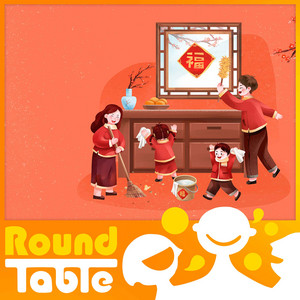
With the spring festival just around the corner, The ancient ritual of spring cleaning is in full swing, a practice rooted in sweeping away the old to welcome new luck and fresh beginnings.
But this year, the tradition is getting a high-tech upgrade.
We'll dive into the why behind the deep clean, look at how robots are taking over the heavy lifting and explore what sociologists are calling the lazy economy a booming market fueled by our love of smart, convenient and automated help.
Is technology really helping here with the traditions or is it simply reinventing them?
We'll talk about all of that stuff today, Yushin and Feifei.
Good afternoon to you.
I guess today...
Today, today, today is the actual cleaning day.
Yeah, exactly.
It's called Xiao Nian, or Little New Year, which is basically marking the beginning of the countdown to the Chinese New Year.
And so there are a lot of traditions and rituals surrounding this day. and cleaning is one of them.
So Xiao Nian typically happening today, which is the 23rd day of the 12th month according to the Chinese traditional calendar, and can also be tomorrow, which is the 24th of that day, depending on the places that you live.
And for this particular day, the Little New Year or Xiao Nian, the core ritual really surrounding about a god called the Kitchen God.
The kitchen god.
The kitchen god.
The god that oversees and protects the kitchen of every home.
And this day, the Xiao Nian, is the day where the god, the kitchen god, will go up to the heaven and report to his boss about this family's behavior of the year.
Wow.
And because of this there are other traditions, for example, offering sweets to the gods, so that During his report to the heaven he won't say anything bad about you.
Oh, you're bribing, you're bribing the God.
Sort of bribing them, and it includes that offering them sweets, not only because, for example, sweets makes him happier, and also they have the meaning of stick his mouth shut so that he can't speak, so that he can't speak.
Oh, some of the like snacks can be really, really sticky and um yeah, we celebrate this little new year uh differently according to different um locations that you're living in, and in southern china is uh, which is where i was born.
Um, we like this.
Things kicks off around like 24th you just mentioned.
It's a bit more of a relaxed, food-focused to this big spring festival.
And there are also some regions like Jiangsu, Zhejiang and Shanghai area, which is also my hometown, where the little New Year falls on the day before that exact day of Chinese New Year's Eve.
Because we call that Chinese New Year's Eve as The big night.
That's the night where you have maybe the most important meal of the year, right?
That's when all the family members have to be home for dinner.
There's no excuses.
Everybody's got to be there, right?
And it's a huge feast.
Yes, that's why we call it the big New Year's night.
And so the day before that is the small New Year's night.
So we celebrate that day as well.
And in terms of customs, there aren't many that special uh rituals either.
Um, i asked my parents actually uh, and my mom's answer was just, we don't do anything.
Oh, there are like, we kind of people celebrate it very, very differently, but still um, in terms of eating, because there's so many festivals that people eat different things and in this, like A little new year, people may have things like nianggao or the sticky rice cake.
Also tangyuan, the sweet rice balls.
This is more like common in the southern part of China.
Yeah, for northern people, we eat dumplings pretty much for every festival.
Any opportunity to eat a dumpling, you'll take it.
So the cleaning, just one more question about the cleaning.
So this is like, Not just tidying up around the house.
Right.
This is I guess in the West we have something called spring cleaning.
Right.
I don't think it happens this early in the year.
I think it's more when the weather starts to get a little bit warmer.
But in Canada and in Western culture, that's like a deep house clean.
Like everything.
You'll steam your carpets.
You'll vacuum the tiniest corners.
Get every little bit of dust out of everywhere.
That's a deep sprinkling.
Kind of the same concept?
Yeah, I would say about the same concept.
It's also because of you know, the New Year's come, so we need to clean off everything of the last year so that we can prepare and welcome the new year.
And also for the new year, we need to have a lot of decorations, we need to have the couplets, the paper cuttings.
So before we really decorate the house, we also need to deep clean it in, just like a deep clean in canada that we clean pretty much every corner of the house clean a wash, anything possible that can be pushed into a washing machine.
And also just reaching to the corners that you normally haven't noticed on a daily basis or ignore yeah, the ones that you know it's there but you just kind of turn a blind eye to.
For the other yeah, 364 days of the year, from ceiling to the floor, from indoors to outdoors if you have a backyard, It basically cleans every part of that.
And this tradition has ancient roots.
This goes back a long way.
And there's a connection to the language too, yes?
Yeah.
In Chinese culture, the word for dust or 沉 sounds like the same as the word for old or outdated.
So or Chen in Chinese.
So they sound exactly the same.
So, because of this homophonic connection, sweeping away dust also symbolizes sweeping away the troubles, the bad luck and hardships of the past year and then making room for good fortune, health and hope in the year to come.
And that's where Canadian and Chinese culture go in two different directions.
We don't have that deep rooted meaning behind our cleaning.
Ancient texts, this is represented there too, which is kind of cool.
Yeah, it goes back around more than 4000 years ago in a book called Lu Xiu Chun Xiu where they sort of detailed about the practice of Chinese New Year cleaning.
And also in ancient texts, it tells about how people used to clean in the ancient times.
For example, people used long brooms made of straw and tied to wooden poles taller than one person, so that they can reach to high places such as the roof beams and wall corners.
And also the dust, cobwebs and debris were carefully swept away so that, as you mentioned, they can clear up the old and welcome the new.
But that happened in traditional ancient times, where we don't really have a lot of help, so we need to spend, i think, in some cases more than one day for this deep clean, but for modern times, for today, i don't think we need to spend that much long and to to clean it, and that's a good opportunity to transition to modern times and how we're taking care of our homes.
Now i want to start, And with this, homes have changed in terms of their interior and in terms of the smart home penetration rate, particularly here in China.
I found a chart from a consulting group, and it talked about the years 2018 to 2025.
Back in 2018, the smart home penetration rate was 9.6.
Fast forward, and it's gone up every single year to 2025, where it's 25.4.
2019 was 11, 2020, 12.6, 2021, 14.5, and so on all the way up until last year.
It is consistently growing.
And it's changing how we take care of the interior of our homes.
Yeah.
And I also have a new different set of data from iResearch.
And they look at the 2025 to 2026 Spring Festival.
Goods consumption trends and tech products are expected to account for over a third of the New Year goods purchases in 2026, which is this year.
And among them smart home and health tech products, enjoy a rate as high as 90, with intelligent cleaning appliances.
Emerging is one of the dominant categories.
Smart home cleaning appliances.
Like robots, like window cleaning robots, like floor scrubbers and robot vacuum.
I think.
According to Douyin, their number suggests that orders for window cleaning robots surge more than 200 year on year.
According to in February in this year well, floor scrubbers and robot vacuum also grow by 100 percent or 60 percent year on year.
And so that means people are buying more and more of this robot helpers to make their lives easier.
Yes.
Lazy economy.
We haven't used that word just yet.
Yuxin, you're our tech guy.
You love these types of toys, even if they are about cleaning.
What are some of the standouts for you?
Exactly.
And what we can see is that some of these are really, really helping our lives just so much easier.
And it is kind of integrating into some of the traditional gadgets that we used to have.
For those who still prefer a handheld approach, The tools have become much more scientific in some way.
The new smart floor washers now use things like electrolyzed water, which turns just regular tap water into a sanitizing solution, as you can clean.
Ooh, that's useful.
So they also feature kind of zero water strike technology that dries the floor almost instantly.
So if you spill a bowl of cereal, a modern smart washer like specific model will help you suck up the mess and then immediately use that magnetic, dynamic fast drying tech so you can just walk over that spot two seconds later without slipping.
Before your mom walks in the room.
That's called the before mom comes technology upgrade.
Drone level vision and navigation has now found its way into our homes.
It's kind of a interesting transition because companies that build drones they're putting high-speed sensors and 3d path planning algorithms into floor cleaners and these are for the robots and this lets those robots see the room in three dimensions and what that means is these robots can recognize exactly what objects are in their way with drone level precision.
Yeah, that's that helps a lot.
You know, back a couple of years ago, when people just start to to see such robot cleaners in their homes, i think one of the complaints is that these robots get confused very easily, like if you put too many chairs in your room, They're constantly bumping into them.
Yeah.
And they're sort of acting like they're lost.
And for example, if you have a lot of cables in your home and they sometimes get tangled.
So right now, these kind of 3D, these drone level vision and navigation technology are allowing robots can sort of, quote unquote, see these wires from a distance so that they so that they can map a path perfectly around them without getting tangled like before.
They see the object in front of them and rather than bumping into it, they move around it.
They see them and also starting to understand them.
First of all, of course, with these sensors, they map out your home and they will identify which room is the kitchen, is the bedroom or which room is the living room.
You can name them, and then they start to use that kind of large language models that the owners can use.
So you can talk to these robots now.
Yeah, you can talk to the vacuum machine and tell them, okay, I'll need to do a very big cleanup.
Wait, let's think about the sentence that you just spoke.
Oh yeah, you can talk to your vacuum machine.
Goodness me.
Sorry, I interrupted you, but those words just kind of screamed out in my ears when you said them.
Yeah, so how does that work then?
So you program the machine, the vacuum machine, to know which room is which, and then just with a simple command like go clean the bedroom or go clean the kitchen, something like that.
Yeah, and what I said that they're starting to understand is that because they start to realize and recognize that key words that you're saying and then actually think about what you're implying, but not just specifically or clearly stating that I need you to clean the bedroom, but probably just say okay, I have a big party today.
And then they will probably just focus on the grease in the kitchen, because they kind of guess that you are going to have a big party and it's going to be a mess in the kitchen.
This will be my new year gift for my friend.
I have a friend.
She's panicking about her parents coming and her mom will nagging her about, you know, not cleaning your house properly.
And now she can have one of these robots and tell them, you know, my parents are coming.
And that's all you have to say.
Yeah.
Yeah.
My parents are coming in and your house will be spotless.
Um, we talked about this next one um, during I think it was CES.
You should the robots that can climb the stairs and also the robots that have a mechanical arm.
Yeah.
That can pick up things on the floor, like your socks, your shirts and everything.
So um, the biggest weakness of a robot vacuum machine for a long time was that single step.
But that's um history now, because some of these robots can actually climb up stairs and also, on the way, climb clean the stairs and then climb to other, maybe floors, if you have different floors at your home.
So they built with these climbing systems that use tracks or bionic limbs to move between different floor levels.
Yeah, i was watching some videos about that.
For me it's a little.
I mean, what am i criticizing here?
It's amazing, but if i am criticizing, it's a little clunky.
Their movements right now they're a little awkward.
I mean, they can still accomplish their task, but when they approach the stair it stops and then it kind of, you know, does whatever it does to stand up a little bit and then slide onto the stair in front of it and then pull its body up.
It's kind of like a human with zero energy the way they would climb a set of stairs.
Slowly and step by step.
But then once it gets on to that step, then it goes back and forth, left and right, to clean that particular level of stairs, and then it goes through the process again.
The mechanical arm also...
I don't know if this one impresses me as much, because we've seen mechanical arms on robots for a really long time now.
So it doesn't seem that difficult.
I guess that they could incorporate it into a robot vacuum cleaner.
But still, it's kind of cool to watch the robot arm lives inside a compartment and then it walks up to a or rolls up to a sock or whatever.
And then the compartment opens, the arm comes out, it picks it up and then it carries it over to a wastebasket.
Ah, so it also sort of help you organize your house at the same time as it was cleaning it.
Yeah, decluttering.
That's my dream helper at home.
Yeah.
Well, let's get to.
I mean, we've already kind of touched on it a little bit, but let's go further deep into it.
The lazy economy.
First, let's find out exactly what that means.
Okay.
Honestly, the term lazy economy or, in Chinese, is a bit of a misnomer, because it's not actually being lazy.
It's just in the way that we are starting to use these machines, and for the purpose of being lazy, but actually we're doing more things, or the scientists or the manufacturers are doing more things about inventing things for us, right?
Yeah, I think the core of this lazy economy isn't just about relaxing and avoiding working altogether.
It's more about... Outsourcing.
And also optimizing efficiency and reconstruct your time, your schedule, so people can choose to pay for services or for the tech products that we just talked about to handle some of their tasks, so they can spend more time on other things that they really enjoy or really matter to them.
To be honest, a lot of people don't find joy in cleaning or organizing around the house.
Yeah, I always find those people to be really weird.
I had a roommate a long time ago and he actually enjoyed cleaning.
Cleaning it was.
It was a stress release for him.
I i actually think so.
Do you?
Do you agree with that?
I do agree with this, but maybe i'm in the minority here um, but i'm not in favor of cleaning.
But we always have that, you know, once a month, the time that you need to do the cleaning right, and whenever that is coming i find okay now, so i'll do this anyway.
But The process of cleaning things and seeing everything is shine and clean is quite therapeutic.
And also the process of doing things, you are not like thinking a lot of things.
You are doing that physical labor thing, not using your brain.
Yeah, I think that helps.
I'm more of on the fence of that.
It depends on, you know, my recently, my working schedule or my personal life.
If I have the time and energy, I do enjoy sitting down or working around the house for like two or three hours.
Just do a deep clean.
But if I'm really tired I just don't want to clean.
You know, lifting every socks and putting them away and then cleaning under the desk.
So in this case, I believe to have the option that when I don't feel like cleaning for two hours, then I can go out hire help or buy a robot to help me clean.
The concept of the lazy economy I don't think is brand new, or at least not brand new to people.
I don't know how old the term itself is.
There was a 2022 consumption survey done by a domestic consulting firm.
I think it was called GMO.
And one of the stats said this 75 of respondents and these are people born after 1995 75 of respondents said that they relied on services to save time on cooking and cleaning.
So to me, it's not that The concept of outsourcing or the concept of buying back your time is a new thing for humanity.
I think we've been doing that for a long time.
The invention of the knife allowed us to cut our potatoes and carrots and onions and whatever.
A time saver.
The remote control for a TV, so you don't have to stand up and walk across the room and change the channel.
Again, a time saver.
We're outsourcing things that we don't want to do to things that, or to appliances nowadays that can do it for us, or to people that can do it for us.
So I don't think that part is new.
It's just like you said, Feifei, you said, if I have the option.
And I think the options are growing now in number.
Yeah, according to domestic media center news.
It's a massive economic trend worth more than $600 billion in 2025.
And we also have data from the China Research Institute shows that the size of China's lazy economy is expected to exceed 2020.
35 trillion yuan, which is more than 500 million US dollars, by 2025, which is growing at a 12 annual rate every year.
So that we are seeing, sometimes these outsourcing sector of the economy are in a sense outpacing traditional retail.
I'll give you an example of one that I think is kind of cool.
So they have something called door-to-door cooking here.
I found this from a sixth tone story.
Door-to-door cooking is like hiring a chef at home who offers their clients anything from festive cooking around spring festival time to dishes for daily consumption.
That service, according to Sixtone, is being widely shared on Xiaohongshu.
And it costs about 68 yuan to 128 yuan.
That's about 10 to 20 for up to four dishes, with some service providers even promising to clean up after they cook the food.
And that's just proof you you, you go to the service or on the app or wherever you find these people, you say please come cook dinner at my house.
You have all the ingredients there in your fridge and they just come in and they cook your dinner and they clean up and then they leave.
Yeah, sometimes you don't have the ingredients, so give them money.
They will go to the grocery shopping for you.
You shop before you and then start cleaning everything.
So i could cook everything and then clean everything.
So you just sit down at your home, enjoy the meal without having to worry about the grocery shopping, the cleaning up, and also you don't need to worry about a lot of the kitchen appliances that sometimes you don't have at your home but you feel like you need it for a special feast for the New Year's Day.
I read a report in Some cities I think it's in Ningbo in eastern part of China that they have a whole team of chefs that can come to people's door and help them to cook a real feast for I don't know six or eight people.
And it can cost up to 1,000 yuan or even more.
And that may include groceries, includes all the kitchen appliances and also cleaning up afterwards.
I don't want six strangers in my house.
Do you know?
But you also don't need to spend energy and time to cook for like eight people.
Yushun's cleaning is my cooking, though.
I find therapy in that.
Oh, really?
And I should hire you.
Yeah, maybe I should get on Xiaohongshu and advertise my cooking services.
Another one which I thought was kind of interesting is not the house cleaning service but the house organizing service.
Yeah.
Many young people are outsourcing the decluttering of their homes to some of these really professionals.
Compared with that traditional housekeeping and cleaning services.
They come to your home and clean the floor, maybe the wall and everything.
But what they do is that they help you organize the things maybe your wardrobe, your closet and everything.
They teach you the techniques of organizing things.
So they're actually helping you to understand the theory of making your home clean.
They're not just doing this for once.
They're trying to teach you actually.
There was a TV show that was popular on Netflix many years ago.
I remember that one.
Yeah.
And I watched... In the beginning, I thought... this is ridiculous.
Why are you paying someone to come in and go through your t-shirts?
I mean, is that, is it that difficult?
But after watching a couple of episodes I realized it actually is difficult for for some people, for a lot of people actually.
And when I was watching that show, she kept saying the the lady who was um, you know, the decluttering expert.
She kept saying the same, asking the same question to people.
And she would pick up like a T-shirt or a teddy bear or whatever, whatever.
And she would ask them, does this have any emotional value for you?
Does this bring you joy?
And if the answer was no, it doesn't bring me joy, get rid of it.
Yeah.
So that's the tip that I learned from her.
After that, I was walking around my house looking at forks like, does this fork bring me joy?
I don't know.
Yeah.
All right, so the people involved here in this lazy economy and, by the way, there are a million other examples, but we'll leave it at that.
The people involved with the lazy economy, it's mostly 18 to 35-year-olds, correct?
Yeah, because they grew up in an internet era and they're used to solving problems with a few taps of their fingers.
And so also according to Sina News, these young people aged between 18 and 35 years old usually live in bigger cities, earn a decent living, often have between 6000 to 10000 yuan a month of income.
And they often work long hours and or have a lot of overtime during their work.
So paying for convenience. is basically a survival strategy to keep their lives running smoothly.
And also, I think, to help their emotional, as you said, to help them sort of lower their emotional burdens on some levels as they go through this.
Or sometimes it is a technique that can just maintain your relationship.
They are trying to use these outsourcing services to fix or resolve some of the problems, because I've seen a lot of discussions online saying that many conflicts between couples can actually be resolved by something as simple as a dishwasher or even a professional organizer.
Because so many arguments stem from the question of who should be doing the housework.
And then, once the tools or service like these come into play, those problems seem to just neatly resolve.
Yeah.
I mean, I don't know if I love the term lazy economy, because it automatically has a negative connotation, right?
I'd prefer to call it the outsourcing economy, because it can come in so many different shapes and forms and look like many different things.
For example, if you go to the grocery store and you buy potatoes that are already peeled.
Well, that's an example of outsourcing, right?
Someone else peeled those potatoes for you.
And they said in the story that I was looking at you know, even that little tiny amount of time, saving yourself the trouble of peeling some potatoes.
If you do that here in this case, and here in that example, and here in that example too, those minutes will add up, where you can save yourself a significant amount of time.
Now the downside to that, of course, is that you're going to pay for all of those things that you outsource to other things or other people.
I want to finish this discussion with a philosophical question, if we could.
Is this a good thing or is it not?
If we're constantly outsourcing the things that we don't like doing or don't want to do and eventually we will get to a point you know we said, now you can hire a person.
You shouldn't have said it.
You can hire a person.
They will go to the grocery store, pick up your groceries, come to your house, cook your dinner, clean your dishes and then leave.
If we can eventually outsource every task in our lives, Is that going to be good for people?
Because it seems like that's what we want.
And it seems like that's the direction we're going.
I'm just not so sure if that's a good thing.
I think as Feifei just said, we are glad to see there is an option like that.
Some people are still thinking that cleaning house is a therapeutic process.
So some people, they just hate doing things like that.
So When people have an option, I think just up to you.
We can always have that kind of mindset of yes, it is something that can cost you a little bit of money, but thinking about it as creating jobs.
It's not that solid yet.
Steady job that we're creating, but it is creating that occupations, that a lot of people can maybe earn a little money and like I feel like it is a wing-wing situation when the buyers is Get relaxed.
And the seller, they enjoy things like that.
Yeah.
So I guess we can kind of pick and choose.
It doesn't mean we have to outsource everything to a robot in our future.
It's just some of the stuff, some of the time, if we so choose.
Well said.