Hi! It's Alexa Ybell from New York Times Cooking.
We've got tons of easy weeknight recipes, and today I'm making my five ingredient creamy miso pasta.
You just take your starchy pasta water, whisk it together with a little bit of miso and butter until it's creamy.
Add your noodles and a little bit of cheese.
Mmm, it's like a grown -up box of mac and cheese that feels like a restaurant quality dish.
New York Times Cooking has you covered with easy dishes for busy weeknights.
You can find more at nytcooking .com.
Hey, it's Michael. A quick reminder, as we said last weekend, we're gonna be changing some things up here on Sundays to bring you something a little bit different, but something we think you're gonna appreciate.
And that is modern love.
Every Sunday for the next few weeks, you're gonna hear episodes from our phenomenal colleagues who make that show.
If you don't know the show, every week host Anna Martin and that team explores the world of our relationships.
relationships. How we fall in love, how we fall out of love, sex, betrayal — the trouble spots in relationships.
They're stories inspired by the long -running NYT column called Modern Love, and we think it helps make sense of this other essential part of our lives.
So, we hope you'll spend time with these episodes.
They are great, and as always, we'll see you right back here on Monday Morning for The Daily.
Take a listen. Hey it's Anna.
Just a quick warning, there's a bit more swearing in this episode than usual.
So if you're listening with kids, maybe wait until later?
Love now and always.
Let's do it now. Love of love.
I love you. Love. And I love you more than anything.
Love. For the New York Times, I'm Anna Martin.
This is Modern Love.
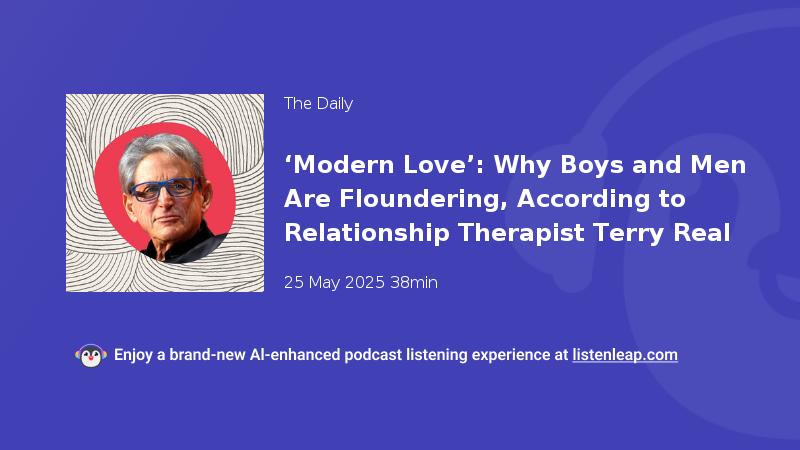
Today, I'm talking to marriage and family therapist Terry real.
Uh, Dan, this is what I think you mean to be saying right now.
Fuckin' bullshit. No matter what I do for you, it's never enough.
This is Terry, reenacting one of his marriage counseling sessions.
And uh, yeah, he said yeah.
Terry has just asked one of his clients, named Daniel, about the feelings he has during what have become typical but explosive arguments with his wife.
Terry asks, If the feelings could talk, what would they say?
And Daniel says back, kind of meekly, But Terry thinks there's a deeper feeling there that Daniel's not letting onto.
So he says it back to him, only stronger.
Fucking bullshit. I amplify emotion, particularly in men.
They feel them initially, very faintly, but the feelings aren't faint.
It's just they're not used to honoring them.
It's a bit unconventional, but this is something Terry does often.
He holds up a kind of emotional mirror to the men that he works with, trying to get them in touch with what's underneath.
I'm loving Dan and telling the truth to him in the same breath.
You deserve better than this.
You're a good guy. Let's get you out of this.
Terry is well -known for this direct, confrontational, but still quite loving approach. In this conversation, Daniel actually wrote about it for the New York Times magazine, in a piece called how I learned that the problem in my marriage was me.
And Daniel learned that because, unlike a lot of couples therapists, Terry takes sides, tries to get to the truth of what's going on, what's behind a couple's behavior.
I started off, my beat were couples on the brink of divorce that no one has been able to help.
These women would drag these guys in and I would lean in and tell them, She's right, you're wrong.
This is what's gonna happen if you don't shape up.
This is what you could get if you do.
You're a good guy. This is terrible behavior.
Let me reach in and help you, man.
I mean, this, you can do better than this." And the men would say, okay.
And the women would just fold over and start to cry.
They had dragged this poor sucker, the record so far was eight therapists and not one person backed up the woman and confronted the man.
Not one. We're taught not to in therapy school.
Not only are we not taught how to, we're actively taught that you don't do that.
You don't tell truth to power under patriarchy.
Terry's been doing this for more than 40 years.
he calls his approach relational life therapy, and he's written several bestselling books about it.
And that whole time, he's kept a particular focus on men, because for Terry, the things he sees men struggle with, from the most mild problems to the most extreme behaviors, it all stems from something fundamentally broken about the way our culture defines masculinity.
So, today, Terry Real tells me what he's learned about masculinity that drove him to break the rules of therapy.
He'll tell me how his own childhood showed him that our current models of masculinity don't work, and what it will take to build new ones.
And during our conversation, we talked a lot about what it means to be a man right now, because to Terry, despite his 40 years with hundreds, if not thousands of clients, he says his mission of reaching men has never felt more urgent.
Stay with us. So the assistant's going to The YouTube, that one's my favorite.
I can also save my articles easily in this area.
Right under the byline it says, click here if you'd like to listen to this article.
I like that the cooking tab on top is really easily accessible.
So on my way home, and I'm just thinking, oh, what am I going to make for dinner?
I'll just quickly go on to cooking and say, oh, I've got this in my pantry.
I'm going to try out some of these recipes I see in here.
I go to games always.
Doin' the mini, doin' the wordle.
I loved how much content it exposed me to.
things that I never would have thought to turn to a news app for.
This app is essential.
The New York Times app, all of the times, all in one place.
Download it now at nytimes .com slash app.
Terry Real, welcome to Modern Love.
Thank you. It's wonderful to be here.
Terry, you are, I think it's fair to say, an institution in your industry.
you've been a marriage and family therapist for how long?
For 40 years? Yeah.
That's a lot of, what's the exact number?
Is it 40 exactly? 42.
About two years more than my marriage.
Okay, let's not round down, let's say you've been a marriage and family therapist for 42 years.
How do couples end up in front of you?
I have to be honest, I don't really feel like a guy would be calling you up and being like, hi, I need help with my marriage.
So how do people end up in your office?
Yeah, I like to say my books appear under pillows all over America.
Here honey, if you want a little action tonight read this book.
So yeah, no a lot of the men that I see are what I call wife mandated referrals.
And I don't mean to be that marginalizing same -sex marriages.
But the men I see...
Here's a quote from Terry Reel.
Shame -based people have pain.
Grandiose -based people have trouble.
They're not in pain, the people around them are in pain.
And they come to see me when the trouble gets so great that either the people around them are dragging their butts into seeing me or the crisis has opened up and they're desperately trying to save their relationship.
That's mostly how it goes.
And as I know from reading your work shame -based people in a relationship are often women in a relationship and then the grandiose based people are often men.
Is that right? Often, two out of three.
Look, here's maybe more nuanced, and this too is broad generality so take it with a grain of salt but women in our culture is changing with feminism but traditionally women in our culture lead from the one down accommodating shame position and have covert grandiosity whereas men lead from the one up superior position and have covert shame.
And with women, they're depressed.
They're depressed with men.
They're depressed. No, they're not, they're drinking.
They stuff it down, yeah.
Yeah, and you don't see the pain.
You see the flight in the medication or grandiosity that avoids the pain.
And so, many of the difficulties we think of as quote unquote typically male, the substance abuse, rage, affairs.
I'm not saying all of them are fueled by depression, but many of them are.
And underneath the depression is trauma.
And the way we traditionally, quote -unquote, turn boys into men in underpaid, is we teach them to disconnect.
Disconnect from vulnerability, disconnect from their feelings, disconnect from others.
The toxic individualism, yeah.
Yeah, we call that learning to be independent.
And the consequence of a disconnected boy There's a disconnected man.
We're not invulnerable, we're human.
I tell the guys I work with, pretending to escape your own vulnerability is like trying to outrun your rectum.
It's… I actually read that line in your book and I was hoping you'd say it out loud because it's just too good.
Outrun your rectum.
Perfect. Put that on a shirt, unless you have. It has a way of following.
And of course we're all vulnerable but trying to live up to that superhuman code leads every man vulnerable to anxiety and shame that they then don't admit because that would be weak.
So the whole thing is just a mess.
And the work I do I feel like a surgeon reattaching nerves.
You write about that process in, I think it's your first book which was about male depression men.
That book is really fascinating.
You write how male depression as you describe it often comes from these unacknowledged feelings and is often the root cause of many problems in marriages and families.
I want to talk more about that.
But first, I want to know more about why you decided to focus a lot of your practice on working with men specifically, and just to start at the beginning, when you were growing up, what did you think it meant to be a man.
I thought what it meant to be a man was to be raging and dominating and abusive like my father.
And I wanted to know part of it.
My father used to beat me, I mean, he pissed my father off and he'd get out a pretty thick belt and whack the shit out of you.
And one of the things I've realized 30 years after the fact was unfortunately my vulnerability or sensitivity was a trigger for my father.
If he saw me being vulnerable or sensitive, he would go into a rage just when I needed him most. But he was very contemptuous of weakness and vulnerability.
So he would never talk about his childhood.
I knew it was very difficult.
He lost his mother when he was eight.
His father and he and his brother lived through the depression in America.
His father was kind of the black sheep of the family, who couldn't find work.
They moved in with another relative.
The relative was mean to my dad.
And I got my dad to tell me, gosh, I was close to 30, that when he was, what, 11 -ish, His father brought he and his brother, younger brother, into the garage and turned on the car and told them to go to sleep.
And my father knew that there was something wrong.
And he went back and forth with his dad and finally physically fought him.
And he says his shoe cracked the window.
And he and his brother got out, and then he was banished the next day.
When he told you this story, did that change anything about how you saw your father?
What did it, did it shift something in your understanding?
Did it make you understand something about him?
Yes, of course. It softened my heart, and I felt bad for him, and I understood immediately.
And he said, my father was a passive man, my father was a weak man.
Your father said that about his father.
That's right. And so he became the anti that.
And the anti that was a macho asshole.
But I could understand why he would be contemptuous of what he deemed as weakness.
Because it reminded him of his own father?
Because his father's weakness threatened to kill him.
It was murderous. The way that you opened up space, as it were, encouraged your father to share, Was that sort of the beginnings of Terry Reel's approach to therapy with men?
Like did you seed anything in that conversation that we now see in your practice today?
That's a beautiful question.
We don't have to go into a lot of detail, but for two years, Belinda and I and my kids and - Belinda's your wife.
Yeah. Yeah. A great family therapist in her own right, I want to say.
We were followed by a documentarian, and there's a docuseries that's coming out about us.
And one of the beginning scenes, astoundingly enough, I was 34 years old, not married yet to Belinda, and my parents came for a week of family therapy with me.
Wow. Whoa. And we filmed it and the film survived.
And what you see in that, I hadn't seen it for 40 years.
were you, was someone doing family therapy on you, your mom and your dad or were you doing family therapy on the three of you?
No someone was doing family therapy with us.
Gotcha. And what you see is after 10 minutes I sidelined the therapist is pretty irrelevant actually and I move in to my dad and mom and I am doing relational life therapy with my parents it's a 34, you see it.
What are you seeing yourself doing?
Well, one of the core principles of R, L, T is what we call joining through the truth, confronting people, but in a way that's precise and loving so that they can hear it.
One of the things that therapy school says about grandiose people in general and men in particular is, don't tell truth to power.
We, I believe my field colludes with patriarchy and protecting perpetrators.
We have done a great job of helping people for 50 years come up from shame, but we've been ridiculously ineffective at helping people come down from grandiosity and I knew that I had to do that.
So, there was a moment with my dad, he started crying, I get it, forgive me.
He talked about his mother who died, he talked about his exile and he started crying and he said, I haven't felt any of this, I haven't thought about this my whole life until you started probing Terry.
And as he was crying I put my hand on his shoulder, and I said, You cry old man, every tear you cry is a tear I don't have to.
That was pretty wise, that third at war.
Just watching yourself say those words, now 30 years later?
Yes. Do they have new meaning to you?
Yes. Can you tell me about that?
Here's my most famous quote if I, I hate the pretension to quote yourself, but I will.
You can do it. Thank you.
Family pathology, family pathology, rolls from generation to generation like a fire in the woods, taking down everything in its path until one person in one generation has the courage to turn and face the flames.
That person brings peace to their ancestors and spares the children that follow.
And you were doing that in this moment?
You were facing the flames, or your father was facing the flames, or both of you were?
We both were. It was a rare moment.
We both were. That's a remarkable scene you just shared, and I really appreciate you telling us about it.
And it is remarkable.
I mean, you say it's wise for 34.
This is the beginning of your practice.
Like, you were just starting to develop this approach to working with men.
And I find it pretty remarkable that one of the first men you practiced this on or did this with rather was your own father that feels apt and healing and quite difficult.
Apt and healing and difficult.
I'll tell you this.
I am the son of a depressed, angry father.
He was the son of a depressed angry father.
I have two boys, 35, 37.
Neither of them say that and neither will their children.
And that is the greatest accomplishment of my life.
Can I ask you, Terry, like as you developed developed and honed in on this relational approach to therapy and developed this focus, is it right to call it a focus on men as a specialty?
Is it right to call the focus?
Sure. No, I consider myself a relationship expert and an expert on male psychology.
As you developed this focus on male psychology, you've talked a bit about the sort of therapeutic community but how did your colleagues respond?
I feel like it's, just speaking for me, I feel like it's easy to look at men, especially white men, and say comparatively, this group of people has way more privilege as you've noted, than other groups in society.
So did anyone say like, you know, did you ever get pushback on that focus?
That sort of, I don't know, privileging as it were, of that experience?
Am I mansplaining? No, I more so just mean, like, did anyone say, like, why focus on this group of people...
...who already has so much power?
What I'm hearing you say is, because this group of people has so much power, that's why I'm interested in focusing on them.
Well, yes and no. I mean, power, yes.
Miserableness also.
I think one of the revolutionary things I said, and I really wanna give a shout out to some beautiful early feminist psychologists, the folks at the Stone Center, Jean Baker Miller, but most of all, Carol Gilligan, my dear friend, who are man -loving feminists and they as well, I was really and to some degree am one of the few male male voices saying, patriarchy is a system that does damage to everybody.
Yes, men are on top and women are on the bottom, but, oy, oy, oy, if that's your idea of what's on the top, not to whatever, but there was a, I won't say who, but there was an expert on TV talking about aspirational masculinity and how all these young men are looking at Elon Musk.
Yeah sure richest man in the world, send people to Mars, fantastic.
You wanna be married to that guy?
Most people don't and if that's what you wanna aspire to, I don't wanna get too close to you.
Well, you're bringing up something that I wanted to ask you about, which is like, I'm really curious, your perspective on what masculinity means right now.
We talked about your early understandings of it and this is a concept certainly.
I feel like human society has wrestled with since maybe the dawn of human society.
It does feel to me though that we are at a kind of flash point culturally, at least in the United States, where men who hold on to traditional values of masculinity are lashing out, they're reasserting those values, they're ascending to power in some cases.
What are you seeing?
In the year 2025, what is going on with men?
Big question, Terry, but I feel like you're the person to ask this to.
You know, not to be grandiose myself, but I want to take ownership.
I am the person to ask this to, and I'll tell you why.
There are no models.
There are no models of healthy relational masculinity.
None. Yeah. And, you know, boys and men are floundering.
Everybody knows that, but look, someone described my work as women have had a revolution and now men have to deal with it.
The response to the challenge that women are presenting to men in their marriages, in the job market, in education, has largely been blowback.
A resurgence of the most traditional and frankly, unappealing aspects of traditional patriarchy, just dominance and bullying, that ain't it.
And so I don't want women to stand down from their demands, I want men to stand up and meet them.
What women are asking for from men is relationality, is learning to be intimate, is opening up your heart and sharing your feelings.
Being vulnerable, being soft when your partner's vulnerable, Being responsible.
These are all wonderful things for guys.
Stop whining and let me teach you how to do it.
And the conundrum for men is what you learned about what it means to be a strong man as a boy guarantees you'll be seen as a lousy husband as a man.
You cannot be in vulnerable and intimate at the same time.
So, when I help men move into open -heartedness, connection, the expression of feeling, compassion, responsibility, giving, I am explicitly reconfiguring masculinity with them.
I mean, you're talking about these models of masculinity, and I'm thinking about the models that are out there right now, especially kind of ascendant ones that are very different from what you're laying out.
I'm thinking specifically about the manosphere as it's called these are podcast YouTube channels, online forums, influencers that are really pushing traditional masculinity.
Do you ever see that kind of stuff and what do you feel when you do see it?
You want my mature therapeutic self or you want my New Jersey self?
You can give me your New Jersey self.
I want to throttle them.
And what would the therapeutic self say?
People with the simple ideas will not have a hard time getting an audience.
But these are carnival barkers who are leading our young men down the path of suicide.
You know, the TV show Adolescence, right?
Yeah, it's big right now.
And all the press have got.
You cannot reassert your masculinity through dominance and bullying and violence.
That is not the answer.
It's just not. We're gonna take a quick break.
When we come Come back, Terry Reel's hope for the future, and what he thinks it will take for men to get there.
It's exciting. reaching men feels more urgent to you now than it has before?
Oh my god. I mean, I would say the house is burning.
That's not a metaphor.
Our planet is burning.
I start off my last book, Us, with the father of family therapy, the great anthropologist, Gregory Bates and Margaret Mead's husband, who is truly the creator of family therapy, basin called our Western civilizations philosophical error.
And that's this, that we stand apart from nature.
That's individualism.
That's what the word individual means.
We stand apart from nature.
That's what I call toxic individualism.
And we control nature.
That's patriarchy. And whether the nature we think we can and should control is our bodies, our marriages, our kids, our country, the planet, the delusion of dominance is suicidal at this point.
JILL, I mean, you've written before about some of the progress you've seen men make You wrote once that millennial men, in particular, were the most gender progressive generation, maybe, ever.
And given what we've been talking about, the resurgence of traditional masculinity, the manosphere, I just wonder, like, does that trend feel like it's reversing for you right now?
Yes, it does. 100 percent.
It's a backlash. It's a resurgence.
And frankly, I think it's sort of the death, it's the last gasp of a model of power and masculinity that look, relationality is the card I've got in my back pocket.
And that's what we're born for.
That's what we're designed for.
And that's what will keep us in this planet alive.
The dominance model makes for miserable people, miserable marriages, miserable families, and will choke the planet Earth.
Man, I mean, but it seems like that is the direction that we're headed.
I mean, you said that this is kind of the last...
Gasp. Gasp, but I don't know.
It doesn't feel like a last gasp.
but feels like perhaps this approach to the world is gaining steam.
Well, it is gaining steam in the moment.
I believe that an accurate reflection of reality will prevail.
The dysfunctionality of this approach will become more and more clear and people will move into something more mature and nuanced.
The issue is how many generations is that gonna take and what kind of shape will we be in?
What I work with with the guys I work with is what I call learning to become family men.
And what I say is a boy's question of the world is what do you got for me?
It's gratification.
What do you got, what do you got for me?
A man's question of the world is what do you need?
What do you need? And being a family man means what's central here is not you and your needs.
What's central here is the team and what they need from you.
I talk to many of the men I work with about the distinction between gratification and what I call relational joy.
And gratification is just what you think it is.
It's a short -term hit of pleasure, taking a drink, smoking a joint.
A pretty girl flirts with you, you make a killing that day in the stock market.
Your kid gets an A.
Great, I like pleasure in its place.
Relational joy, which I have to teach so many of the men I work with even what it is.
Relational joy is a deeper down pleasure that comes just from being in the relationship and being connected.
And sometimes it's gratifying, sometimes it's a pain in the neck.
You know, I tell the story of my beautiful Alexander, now 35.
When he was little, I was giving him a time out and we didn't have locks and so I was holding his bedroom door shut.
I mean this guy was like maybe two foot three.
And that door on the other side trying to get over, I mean, it was like poultry.
Lightning was coming out of that, the earth - You were holding the door shut because he was inside because he needs to be in timeout and you didn't have a lock on the door.
I can see the scene in my head.
That little guy is trying to get it open and I'm telling you, it's all.
So a part of me wanted to just thrump, I'm truly, I talk about normal hatred in families, a part of me wanted to just throw them through the window.
I was so mad. Yet a deeper down part was like, you mighty little spirit.
Wow. You're gonna do great.
And so many of the men in our culture don't understand is the simple joy of being and connection.
Terry I have just a couple more questions for you.
Here's a big one. Why should men listen to what you have to say?
Men should listen to what I'm saying because it's in your interest too.
You will be happier.
Your marriage will be happier.
You will change the legacy that you pass on to your children.
And listen, I know how important that is to you out there, whoever's listening, that guy.
The American Dream, everybody talks about what is the American?
The American dream is the dream that our children will have it better than we did.
When we think about that, we almost always think about that in terms of material success.
But I want you to think about your children having a better legacy than you had.
I think man will listen.
You know, the thing is that I'm right.
You know, who's right?" The thing is that I'm right.
I love, I mean, I love it, yeah.
Terry, you've mentioned your wife, Belinda, who's also a family therapist. Brilliant.
Brilliant therapist, yes.
Can I ask you like, a thing I find really remarkable and frankly soothing about talking to you is you have an answer and usually like a phrase or you've written a book as an answer to so many of my questions.
But of course, you know, no one has all of the answers and we are constantly working on ourselves.
And I guess really to close, like, what is something that you are working on in yourself and in your marriage to Belinda?
No this is hilarious.
So there, you know, in families, there are famous stories.
And here's one that it was true then and I'm still working on it.
and my kids were teenagers they're in their 30s now, they both joined hands and kind of bounced up to me and said, dad are you aware of the fact that when we confront you with something we're critical about that you're dismissive of us?
And I looked at it, this is absolutely true, and I looked at them and I said that's ridiculous.
I don't do that, stop it, yeah.
So let's just leave it there.
That is so sweet. Terry Reill, thank you so much for this conversation.
It gave me a lot to think about, and I'm grateful.
I am very grateful.
It's been a blast talking to you.
I really appreciate it.
Terry Reill, everyone.
This episode was produced by Davisland.
It was edited by her executive producer Jen Poyant.
The production management by Christina Giossa.
The modern love theme music is by Dan Powell.
The original music in this episode by Diane Wong, Pat McCusker, and Dan Powell.
This episode was mixed by Daniel Ramirez with studio support from Matty Masiello and Nick Pitman.
Special thanks to Paula Shuman, Lisa Tobin, Wendy Dore, Emily Lang, Mahima Chablani, and Jeffrey Miranda and to our video team, Brooke Minters, Felice Leon, Michael Cordero, and Sawyer Rokay.
The Modern Love column is edited by Daniel Jones.
Mia Lee is the editor of Modern Love Projects.
If you'd like to submit an essay or a tiny love story to The New York Times we'll have the instructions in our show notes.
I'm Anna Martin, thanks for listening.