Chapter 6.
The Pequod The next few days were spent preparing the Pequod for her voyage.
Sails were mended, food was brought on board, and the whole ship was checked for leaks.
The Pequod would be gone for three years, so we had to be very prepared.
Then, one morning, as we approached the Pequod, we saw men walking along the deck of the ship.
They were not regular crew members.
They were wearing officer's jackets.
At this point, we met Starbuck, the first mate.
We also learned that Captain Ahab was aboard the ship and that we would set sail the next morning.
We all worked hard to finish the preparations.
We did not see the captain, though.
He did not leave his cabin.
The next morning, we raised the anchor.
The Pequod moved very slowly from the dock.
The ship creaked and sighed as it pulled away.
We seemed very sluggish in the water, as if we would never leave.
For a brief time, I thought that our three-year voyage would end in the first ten minutes.
All of the crew rallied together, though, and we made it into the harbor.
At this point, Peleg made a short speech.
He was not going to travel with us.
He was only going as far as the harbor before heading back to Nantucket.
Good luck, men, he shouted.
All the crew was gathered on deck.
You're heading out for a long voyage, but you're in good hands.
Captain Ahab will lead you well.
Peleg then gave orders to the men on deck.
Starbuck should keep an eye on the supplies.
Stubbs should keep the sails in good repair.
Flask should watch for weak spots in the ship.
Then Peleg climbed down to a small boat at the side of the Pequod and headed back to shore.
I soon became an admirer of Starbuck, the first mate.
He was a tall, quiet, and sensible man.
He was born in Nantucket and had a great deal of experience on whaling ships.
He saw it not as a great adventure like others did, but as hard work.
For Starbuck, his was a job that required care and respect.
He often said, if a man is not afraid of a whale, I do not want him on my ship.
I did not understand this until after my first whale hunt.
Then I learned that if a man thinks he can do anything when fighting against a whale, he puts everyone in danger.
He must always be cautious.
Starbuck put the safety of others first.
He was not interested in impressing people.
Knowing these things about him, as I do, makes it hard to tell the story.
Starbuck was a good man.
I worry that you might not think well of him when you learn this entire tale.
I hope you will remember that I admired him a great deal.
Stubbs was the second mate.
He was a happy-go-lucky man who did his job, but never more than was expected of him.
Nothing seemed to bother him.
His mood was the same if we were in a terrible storm, fighting a whale, or sailing in calm waters.
There was no difference.
Flask was the third mate.
He was gruff and grumpy.
Flask was very capable in his job, but seemed to find no joy in it.
He did not marvel at the wonders of the sea.
He did not consider the whale a majestic beast.
It was just something he needed to capture.
Nothing more, nothing less.
The fact that the whale did not want to be captured only made him grumpier.
When a whale was in sight, the Pequod would send out four boats with a small crew in each.
We were told Captain Ahab always led one.
Starbuck, Stubbs, and Flask would take charge of the other boats.
They each had their own harpooner and a crew of men to row.
Starbuck chose Queequeg to be in his boat.
Since he was first mate, he had first pick and he knew that Queequeg was the best harpooner on board.
Several days into the voyage, we still had not laid eyes on Captain Ahab.
I was very curious to see him.
The strange man on the dock had stirred my interest about old Bunder.
Every time I was on deck, my eyes scanned for someone new.
I looked for Starbuck, thinking Ahab might be with him.
I had no luck.
The captain remained in his cabin.
It was almost a week into our voyage before I finally saw the captain.
One evening, I was called to watch on the upper deck.
When I turned around to look over the ship, shivers ran down my back.
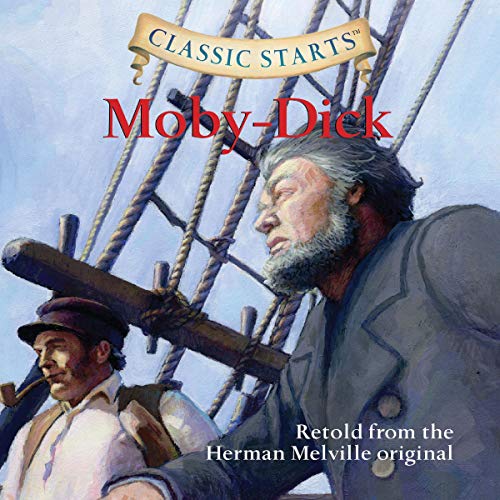
Standing at the very front, gazing at the sea, was Captain Ahab.
He looked like a statue carved from stone.
Strong, firm, and solid.
His skin was tanned and leathery from so many years in the sun.
Along one side of his head was a long white scar.
I never learned where this scar came from or if it was old or new.
Members of the crew sometimes guessed about how he had received this mark, but no one knew for certain.
I was greatly affected by the sight of the captain.
He was a grand figure.
It took me several moments to notice that he had a peg made of ivory where one leg should be.
He stared straight out to sea, lost in thought.
He did not speak.
He did not pay attention to the other men on deck.
No one spoke to him.
Captain Ahab looked like a man very troubled by what he saw, but I could not tell you what that was.
I could only see endless water.
Ahab stayed on deck for a short time before leaving.
He slowly climbed back down the ladder, moving his ivory leg slowly down the rungs.
He returned to his cabin without saying a word.