This video was made possible by Brilliant, a math and science problem solving website that makes learning fun and rewarding.
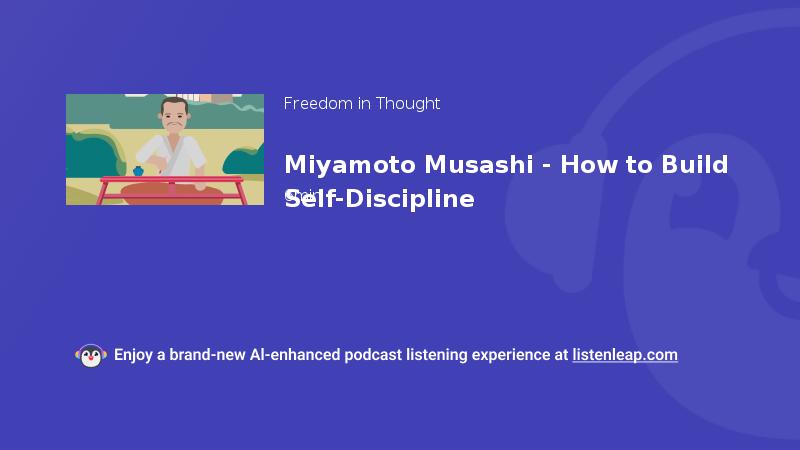
Miyamoto Musashi was a samurai who went undefeated in 61 duels, so it's safe to say that he knew something about building self-discipline.
And a week before he passed away he wrote a short work called Dokudo, which roughly translates to the way of walking alone.
And in it, Musashi laid out 21 principles for living a life of discipline.
In part one of this series, we'll go over the first five principles in Musashi's Dokudo.
Musashi's first principle states, accept everything just the way it is.
When you refuse to accept things the way they are, you become delusional.
And when you become delusional, you lose the ability to act effectively in the world.
And when you lose the ability to act effectively in the world, life becomes more painful for you, because everything you do results in failure.
Success requires us to see the world clearly.
And to see the world clearly, you have to start by accepting reality as it is.
A disciplined person accepts reality as it is so they can learn to work with it, not against it.
Musashi's second principle says, do not seek pleasure for its own sake.
Making pleasure your highest goal is one of the quickest and surest paths to degeneration.
That's because the quickest and shortest paths to pleasure are often found in cheap, shallow and unhealthy vices such as junk food drugs porn, mindless entertainment and so on.
Things that are immediately pleasurable are often bad for our health and conversely, things that are painful at first, such as running, working out or studying, are often good for us in the long run.
A disciplined person doesn't seek pleasure for its own sake, but rather they seek out activities that challenge them to grow, activities which may be painful at first but yield greater and deeper pleasure in the long run.
Musashi's third principle states, do not, under any circumstances, depend on a partial feeling.
If you feel partial about a decision, it means you feel some doubt in your mind about how to truly proceed.
So the best course of action is to not make a decision.
Reserve your judgment and not jump to any conclusions.
Keep exploring and looking for evidence of the truth until the feeling of doubt is resolved.
A disciplined person listens to their body.
They measure twice and cut once.
They act only when they feel certain that the time for action has arrived, and so they don't make hasty and rash decisions.
Musashi's fourth principle states, Think lightly of yourself and deeply of the world.
Thinking of yourself too much is often a fruitless activity.
What will you get from thinking of yourself?
Will you become smarter?
Will you become more loving?
Will you become more competent?
Will you even know yourself better?
No, you will only become more vain and prideful.
The way to intelligence, love, competence and even self-awareness comes through acting in the world.
You will understand yourself better and grow by seeing how your actions manifest themselves in the world.
You will understand yourself better when you see how your actions affect those around you, not by spending time thinking about yourself.
A disciplined person does not obsess over themselves, which is often a fruitless activity, but rather they think deeply about the world and how their actions affect it.
Musashi's fifth principle states, Be detached from desire your whole life long.
The Buddha said that attachment was the source of suffering.
When you are attached to something that you don't have, you suffer the feeling of not having it.
And when you lose something that you were attached to, you suffer the feeling of losing it.
A disciplined person has desires and wants things from the world, but they don't have any attachments to those desires.
If they can't have what they want, they accept it.
And so because they have no attachments, they don't suffer any more than they need to, to grow.
So, by living out the first five principles from Musashi's Dokudo, Accept everything just the way it is.
Do not seek pleasure for its own sake.
Do not, under any circumstances, depend on a partial feeling.
Think lightly of yourself and deeply of the world and be detached from desire your whole life long.
If you follow these five principles, you can build up your self-discipline.
This was just my interpretation of Musashi's principles, and if you're interested in hearing more of my interpretations of his work, check out part two to this series when it's released.
And if you're looking for a free and easy way to cultivate your skills in science and math, I recommend checking out this week's sponsor, Brilliantorg.
Through their course on scientific thinking, Brilliant taught me how to think more like a scientist.
In their course on scientific thinking, you'll learn to think like a scientist and make better predictions, and you'll get to do it through Brilliant's signature, fun and interactive style.
But if scientific thinking isn't your thing, Brilliant has thousands of other lessons with new exclusive content added each month for different areas of study, such as math, logic or computer science.
To try everything Brilliant has to offer for free, for a full 30 days.
Visit brilliantorg, slash freedomandthought or click on the link in the description below.
The first 200 of you will get 20% off Brilliant's annual premium subscription.
As always, thanks for watching and I'll see you next time.