Welcome to Spotlight.
I'm Megan Nolet.
And I'm Patrick Woodward.
Spotlight uses a special English method of broadcasting.
It is easier for people to understand, no matter where in the world they live.
This is the sound of a tuk-tuk, or auto rickshaw.
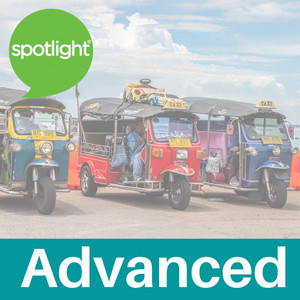
These small, brightly colored vehicles have only three wheels.
Some tuk-tuks have no windows.
Their engines are not very powerful.
But the humble tuk-tuk has a broad appeal.
For millions of people, the auto rickshaw is the most important form of transportation that they have.
Today's spotlight is all about the tuk-tuk.
We look at how these vehicles have helped countries improve their economies.
We examine the important role tuk-tuks play in transportation.
Together, we will explore the huge power of the small tuk-tuk.
Before the auto rickshaw, there was the rickshaw.
These human-powered carts usually had two wheels.
A person would sit in a seat at the back while another pulled the cart behind them.
A strong rickshaw driver could pull two or three people.
But pulling a rickshaw is hard on the body.
Rickshaw drivers once worked 17 to 18 hours a day to survive.
They ran tens of miles a day.
Many countries have banned this kind of transportation because it is so bad for the driver.
Tuk-tuks were first invented in Japan as a less expensive form of car during the 1930s.
But these quickly found business applications after World War II.
A tuk-tuk could carry four or five people, many more than a rickshaw.
But they cost less than a car or truck.
These vehicles used less fuel.
They were easier to maintain.
Most importantly, tuk-tuks were easier on drivers' bodies.
Tuk-tuks soon became popular all over Southeast Asia, especially in large cities like Bangkok.
Cities like Bangkok have heavy traffic.
It is difficult for big cars and trucks to move.
Tuk-tuks are a perfect solution to this problem.
These smaller vehicles can get into places others cannot.
Tuk Tuks can turn more quickly and get out of dangerous situations where traffic signals are not clear.
Cam Wiers is a travel writer.
He rode in a Tuk Tuk while visiting India.
He said, Most places where vehicles cross do not have lights.
Traffic rarely stops.
Street signs are just a guide.
Tuk Tuks also have other advantages in large cities.
These take up less space than bigger vehicles.
It is easier to park and store them.
Drivers do not have to pay as much for the space.
It is so easy to repair an old tuk-tuk that someone good with an engine can do it on their own.
As time went on, they became a cheap alternative for transport.
Auto rickshaws are less expensive for drivers and for those who ride.
Dr. Sujai Sunitha has lived in Hyderabad, India for over 30 years.
He and his wife started a small hospital 20 years ago.
Many of the Sunitha's patients are poor.
They do not own cars or motorcycles.
They must walk to the hospital.
But they cannot walk if it is too far.
They can only afford a ride in a tuk-tuk or a bus.
Dr. Sunita says, Tuk-tuks are one of the cheapest and most helpful ways to travel in India.
Some patients are tuk-tuk drivers themselves.
They store their vehicles outside of the hospital when they come for treatment.
I also take a tuk-tuk to the hospital each day.
People visiting these cities also like to use tuk-tuks.
Today, the bright coloured tuk-tuks of Bangkok are famous.
Some people visiting the city prefer to use these vehicles instead of cars.
A tuk-tuk driver must know the best way around the city.
Sometimes drivers share the history of the city with travellers.
Or they tell stories about experiences they have had in the city.
They are friendly and welcoming.
This adds to the enjoyment of the trip.
The tuktuk's design also makes the ride more interesting.
There are no doors.
Travelers can see, hear and smell everything around them.
Many visitors wish to take at least one tuktuk ride before returning home.
Their trip would not be complete without experiencing it.
The tuktuk has become a symbol of South Asia's culture.
Today, a person can find a tuk-tuk in almost any country they go to.
They are popular in Egypt, Pakistan, China, South Africa and Italy.
In 2022, there were 92,000 tuk-tuks in Delhi, India alone.
Even the United States of America has some auto rickshaws in its larger cities.
Peter Meitzler is the creative director of the Manhattan Rickshaw Company in New York City.
His auto rickshaws are built like electric bicycles.
He told the Smithsonian magazine, When technology met the rickshaw, everything changed.
Modern tuk-tuks have liquid brakes.
They have devices to stop harmful movement.
They have complete lighting systems, seat belts, full weather coverings, steel frames and lightly made bodies.
One issue that tuktuk's have is the pollution that their engines create.
Many auto rickshaws are still quite old.
The people who made them did not know about the harm that pollution could cause.
Some countries have had to ban certain tuktuk's from their cities because of these problems.
Others have begun replacing traditional tuktuk's with electric ones.
These new tuk-tuks are a little more expensive for drivers.
But one day these more energy efficient vehicles may become the future of transportation in many countries.
People in many nations depend on tuk-tuks every day.
They make money with tuk-tuks.
They ride in auto rickshaws to work or to school.
They discover history and culture on these vehicles, and they do it all while riding on three wheels.
Have you ever ridden in a tuk-tuk?
Did you like or dislike it?
You can leave a comment on our website at www.spotlightenglish.com.
You can also find us on YouTube, Facebook, Instagram, Blue Sky, and X.
You can also get our programs delivered directly to your Android or Apple device through our free official Spotlight English app.
The writer of this program was Pete Anderson.
The producer was Dan Christman.
The voices you heard were from the United States and the United Kingdom.
All quotes were adapted for this program and voiced by Spotlight.
This program is called The Mighty Tuk Tuk.
We hope you can join us again for the next Spotlight program.
Goodbye.