Discussion keeps the world turning.
This is Roundtable.
You're listening to Roundtable with myself, Hyah Young.
I'm joined by Steve Hatherly and Li Yee in the studio.
Coming up, this is a prime example of the saying, where there's demand, there's opportunity.
Amateur biographers from all walks of life are writing commissioned memoirs for ordinary older adults was behind this phenomenon and new research shows that dogs can picture their favorite toys when they hear their names, proving just how clever and connected they are to us.
What does this mean for the way we cherish and communicate with our four -legged best friends?
Want to be part of Roundtable's Heart to Heart segment?
Share your thoughts, questions, or hot takes on news, tech, and life by sending us a voice memo at Roundtable Podcast at qq .com.
You might hear yourself on our live show.
Our podcast listeners can find us at Roundtable China on Apple podcast.
Now, let's switch it up and explore another intriguing topic.
With the passage of time, our hair might gray, but the stories we carry are timeless.
A fascinating consumer trend is emerging.
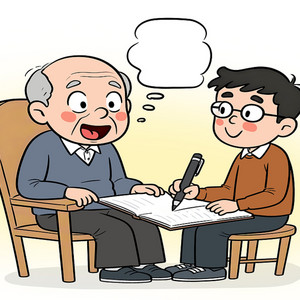
Amateur biographers are stepping up to help seniors tell their stories.
For a fee. This trend is part of what's being called the silver economy.
What are you expected to do in writing a memoir as such?
I think it's very interesting because when you look at this writing memoirs for the elderly, of course, we know they're writing for seniors, but who are writing the stories?
And it turns out that there isn't really a very strict criteria in terms of who will be engaged with quote unquote business because many individuals from diverse backgrounds, including white collar workers, social media influencers, and professionals in the elder care industry have started to join this field.
And they have a pretty clear process when it comes to writing a memoir.
First of all, they need to have some initial communication with their clients.
And usually, there are elderly individuals or their family members to understand what they are expecting from this memoir.
And also, they're collecting the life stories and all the experiences from the client through interviews, recordings, videos, and also written questionnaires.
And then they will conduct these interviews with not only the client, but also the client's family, friends, and other relevant individuals to collect more comprehensive information.
And in the end, they will organize and analyze the collected oral histories and written materials to compose the memoir.
And also very interesting thing is that they have a very clear division of labor, meaning that usually, the interview process is conducted by professional interviewers with the clients.
And after they're having this talk with a client, usually, they will have different sessions and lasting from one or two hours.
And then they will just deliver those information they have collected to writers who will compose the whole memoir.
Yeah. The meetings with the clients, if we can call them that, or with the person who wants to have their story told, they tend to last about an hour or two.
And that's because older people, elderly people, they have decreased stamina.
They get tired. So you have to limit the amount of time.
So they meet multiple times over and over again until their story is complete.
And they say that for about a 50 ,000 word memoir, they meet with the people for about 10 hours in total gathering different stories.
And how much money?
If I may ask, from the business side of the story, are we talking about here?
Sure. Well, I don't think it's a pretty cheap service because this industry is pretty new and relatively with fewer competition and pricing typically based on the word account of the memoir, including type setting and printing.
And the fee can range from 3 ,000 yuan to 6 ,000 yuan.
That's from 420 US dollars to about 840 US dollars per 10 ,000 words.
So that means if you want to write a 50 ,000 word memoir, you can be paying for 30 ,000 yuan, not very cheap actually.
However, especially as the market is developing prices have decreased.
Now a memoir of 60 ,000 to 70 ,000 words, spending over 200 pages on average, generally charges between 10 ,000 to 30 ,000 yuan.
That's about 3 ,000 or 2 ,800 US dollars.
Yeah. Which considering the amount of content that's being written and you're paying someone to do it, 10 ,000 to 30 ,000 seems like a relatively reasonable price to pay someone to do that for you.
And I feel like I'm asking just all the difficult questions.
Do these memoirs or books ever get published or am I ever going to be able to see them on the bookshelves of a bookstore?
I don't think that works in the way.
Okay. Wrong route ago then.
Yes, I think it's more like a personal collection.
So the client or, well, in this case, the elderly people, they want to really have this printed memoir.
Of course they can do that, but I don't think you can get the access to really publish in a very formal way, right?
Yeah. And remember the point of writing these memoirs is not to be on the global bestsellers list of novels or something like that.
This is a way for the elderly to, it's almost like a form of therapy.
I think retelling their old stories to maintain a connection to their past, to continue their life narratives through telling these stories.
Are these stories always authentic?
Well, we know from science that as we get older and we think back to our previous times, we might recall things a little bit differently.
That's for younger people too.
So again, it's more about the experience of the storytelling and is it going to be read by a global audience?
Probably not. The Chinese audience, more than five people?
Maybe not. But here's who it could be important for.
For the elderly person themselves, this is a form of therapy.
But also for their friends or their family, I think especially their family members, particularly their children or their grandchildren being able to read the stories, hear the stories about what happened to grandma and grandpa when they were young, when they were their age.
I think this is a really nice thing.
Is it going to sell well?
Probably not. But I'm not sure that's the point anyway.
What do you see as the reason that this can become a business that you've seen people actually put aside what their original line of work were and they're now engaged in writing memoirs for these everyday seniors?
Well, in general, of course, we're talking about an aging society.
So we're talking about writing those biography or memoirs for more senior people.
Of course, that is a very practical reason.
But on the other hand, actually, I agree with Steve.
I think for not only for the client themselves, but also for their families and especially the younger generations in the families, that can matter a lot because I'm just thinking about my personal story.
Actually, I don't really have the luck to spend my childhood with my grandparents, but I do.
Actually, I'm pretty curious about their personal stories, especially while I'm aging.
I'm increasingly curious about their stories that shape their lifetime, which can not only be important to them, but also to my root as well.
I feel like there is a connection between me and my grandparents if I can know more about them, not only as my grandparents, but also as individuals.
Well, they are not my grandparents who are they, what they were doing.
I think those information can be extremely interesting.
I'm sure, I'm not an expert on Chinese history, but I'm sure China was a very different place when your grandparents were in their teens or 20s or 30s.
So to hear that, part of their story, I think would be really cool too.
Well, that's a really great point, actually, over the, let's say, past 40 plus years.
China has transformed in ways that took Europe and America centuries.
For many Chinese people who lived through that period, their life stories are epic sagas, making the act of recording them invaluable.
I've seen some comments regarding this topic online saying that for those born in the 1980s and 1990s or younger, the Gen Z generation, actually our life stories aren't all that interesting because you didn't go through that dramatic change.
Sometimes it's from rags to riches, sometimes, well, most often than not, from the countryside to urban city life.
Those kind of drastic changes and then how that reverberates through the human mind in every individual's experience, that could be very interesting.
But also, could one argue, as some critics might do, I'm just imagine, Steve, okay, in X amount of years, we both have gray hair, and I hand you my personal memoir and I didn't even write it.
I commissioned somebody to write it for you.
Isn't that a little narcissistic?
Well, I would read that book.
You would? Oh, thank you.
Up until 2024 because then I'm probably in the book after that.
So I can stop at that chapter.
Yeah, I mean, I get what you're trying to say.
But if we... I think what we're doing here is we're trying to apply this to the book publishing industry, where I see this more as a personal exercise.
I was looking at a story from the Harvard Health website and Matthew Solon is the executive editor of Harvard Men's Health Watch.
And he was talking about how as people age, they might begin to feel irrelevant to those around them, less important to their family members and to their friends.
That can lead to lower self -esteem.
We don't think about that.
When we think of the elderly, we don't think, oh, they have really low self -esteem.
It's possible. Greater isolation, greater risk of depression in older years too.
But when someone can engage themselves in an endeavor like this, hiring someone to tell their stories too, that can really be rewarding for them.
But again, it can also be a form of psychological therapy as well.
They call it reminiscence therapy.
It's a treatment actually.
It's a method for the elderly where they look back on, they reflect on when they narrate their life stories.
And it gives them a sense of self -efficacy.
It improves their life satisfaction.
It boosts their self -esteem.
The things that we mentioned before, it can really help with those things.
So I really do see the value in this.
Am I going to be reading these stories?
Probably not. But from their point of view, I absolutely see the value in this.
Right. Sorry, can I just quickly interject since we're on this topic.
You're not going to read it.
Are you going to write one for yourself?
I think I have a few chapters.
Well, hopefully I have, knock on wood, I have a few chapters left to go before I start putting pen to paper.
Yeah. Well, if you ask me the question now, it is definitely a no, because I can't imagine myself doing that.
I don't like attention on myself.
And I don't know how I got into this business, maybe because it's radio.
I don't need to show my face.
But still, I suppose for an older person, maybe you start thinking about, okay, touch on wood, what I'm going to put on the gravestone or my quote unquote legacy.
Maybe you haven't achieved, I don't know, anything like mega important in history, but you think about what might I leave if one day I do not live.
But I think that it doesn't have to be that you were a world leader or something like that.
And had a ham and cheese sandwich for lunch.
It's not like that either.
But things like it was 2024, when AI really started to take over in various industries and incorporate itself into daily life.
You know, for us now, we're in the middle of this.
So it seems like, yeah, okay, nothing really that special.
But for a generation that comes after us, that might be kind of a cool thing to read about because at that time, once we get there, well, AI will probably just be it won't be in the news anymore, I would assume.
Yeah, definitely. I think compared, I mean, we can compare this personal memoir to history books, because we also last year, I think I believe in August, we talked about local chronicles here in China, meaning that, you know, actually, we will just write a very detailed document for each county or each
city here in China to document very landmark years, where landmark events happened.
And so that's a local chronicle.
I think this in this case, it's more like a biography in a more personal narrative, where you can see not only a detailed stories of this person, but also I mean, you can see through the change of time as well.
And more importantly, as we are talking about writing memoirs for seniors, I personally think the more important thing for them is to get this opportunity to be hurt by somebody.
And during that whole process, because the interviewers, they need to collect detailed information, so they need to ask questions and they need to listen really carefully.
This is something that a lot of senior people they're looking for, because maybe in reality, their kids can be so busy, they don't already have this routine time to have such a deep conversation, especially with their personal stories.
But they do want to share this memory with the person they do care about.
And it's also therapeutic for them, I think.
Yeah, I think it's a great pity that their kids aren't the ones who are keeping them company to listen to or record, you know, what happened.
And we see that apparently sometimes as the grown up children who are commissioning or with agreement with the client, obviously, but they're sort of giving this as a gift to their elderly parents.
So, okay, I've hired somebody to write your memoir with you.
And also there's another interesting thing that I sort of picked up as we're doing research.
Some of the interviews regarding the folks who actually, the amateur biographers, so to speak, they have resorted to AI as well, to help them write the memoir.
How so? Well, so easy.
You collect the information and then you put.
Oh, right. So, I don't know if that's a good thing or a bad thing.
I don't know how the client feels about it.
And then one of the amateur biographers who used to be somebody who works in social media company or something like that, he said, if I'm completely honest, only 30 % of what I've put down is AI generated.
I was like, only 30 %?
Yeah, that's a pretty large section of your material.
Yeah, but he was saying, because AI isn't all that sufficient yet, he said that he wrote all this huge passage about the older folk saying that, oh, we had to make the best out of a really difficult situation, but through AI generated content, it completely misconstrued what it was about and made it
into a really happy scenario.
And it was like, oh no, I cannot use that.
So it's really interesting how this, can we say business?
I think it's hardly an industry yet, but the business is booming and is evolving.
Yeah. And they say that there's still significant room for growth as well.
Chengdu is a good example.
The city with over 3 million residents aged 60 and above, they say that the proportion of elderly individuals willing to pay for someone to write their memoirs is about 0 .05 % and 0 .1%, which isn't a large number, but it's a number that has a lot of growth potential as well.
We might see more and more stories out there.
Sure. And also those memoirs, they really can be broadened to not only include their personal stories, but also I think include their family stories, maybe like a family memoir as well.
I mean, you can really collect all those stories of each individual in the family.
So it's more like a collective memory of this family or a in a more traditional way, which is also interesting.
The roundtable memoirs coming to you in 2063.
Yeah. Well, I love the way you put it, Li Yee, and I'm sorry, but that's just what one can do with their personal diary.
And I guess there are folks are willing to pay for it more and make it more economy.
This is no to that, right?
Coming up. Recent research suggests dogs can picture things when they hear their names, flipping our ideas about how smart they are.
What does this mean for how we interact with our pups?
Stay tuned. Looking for passion?
How about fiery debate?
Want to hear about current events in China from different perspectives?
Then tune in to Roundtable, where East meets West and understanding is the goal.
It's the hour of Roundtable with myself, a young I'm joined by Li Yee and Steve Hatherley in the studio.
You look at your dog and ask, want to go outside?
They bark. You ask, do you want to treat the bark again?
You ask, do you want to take a bath?
And you're met with silence.
It seems like they understand exactly what you're saying, but do they?
A study conducted earlier this year, tried to find the answer to that question, but this time they did it a little differently.
Do you think before we get into it, do you think a dog can understand what you are saying to it?
I would like to think so.
Yeah, I think maybe some very simple instructions they can really understand, but for really complicated conversation.
No, your dog isn't going to write your memoirs for you.
Yeah. So for certain sounds and certain outcomes, then there's a pretty clear association, right?
If you say sit, for example, then the dog will sit because they know that a treat is on the way for complying.
But this understanding of words as kind of just triggers for actions.
They say that it might only scratch the surface of how dogs process our language information.
As it turns out, all dogs seem to be capable of forming mental representations of words, demonstrating a deeper level of linguistic comprehension that is not really that different from how human beings understand and process language too.
This is according to a recent study published in Current Biology.
So here's how the science works in humans.
So when we understand language, an effect called N -400 plays a crucial role.
N -400 is a response in our brain that happens around 400 milliseconds.
It's a very brief period of time after a person hears or reads something that doesn't match up with what they were expecting based on the context.
For example, if you're reading a sentence about a cat playing with a shoe, but then suddenly the word apple pops up instead, then your brain may show that N -400 response because apple doesn't fit what your brain expected the sentence to say.
Follow us so far. That's how a human brain works.
That response is pretty well established as a marker for semantic processing, meaning it shows how our brains deal with meanings and associations between words and concepts.
The really fascinating part of this recent study is that it applied this concept, which again has been well studied in humans, but not before studied in dogs.
And by using a similar approach, comparing their brain responses to matched or mismatched words and objects, the researchers were able to observe an effect in dogs that resembles that of the human N -400 effect.
That means that when a dog hears a word that they expect to be linked with a certain object, but then they see something else, their brain shows a very distinct response.
They hook them up to EEG machines and measured their brain activity.
And this is what they discovered.
I think it's really interesting, really shows that how dogs can be pretty good in the human environment.
I was also reading another research saying that dog's brain can actually detect human speech and really distinguish languages without any simple training.
This really shows how much dogs, they're really fine -tued to human environment.
So that's why we should really cherish those little beings.
Right. But what they did before with studies is, they'll put two objects on the other side of a room and say to the dog, get the toy.
And the dog would sometimes bring the toy, but then sometimes not bring the toy.
So there wasn't really any clear indication as to whether the dog was understanding what you said or whether it was just chance that they happened to pick up the right thing.
But in these experiments, they took the 18 dogs, the owners of 18 dogs would say the name of a toy that the dog was familiar with.
And then they would either show that toy or they would show a different one.
So for example, the owner might say, look at the ball and then show them an apple.
And then they measured the dog's brain activity to see if anything fired, to show that, wait a minute, you said ball, but that's not a ball.
And what they found was, there was brain activity in the dog, the same as humans would respond saying, wait a minute, what you said doesn't match the thing that you're showing me.
They do. And the conclusion is they do understand.
Right. So do you think this should change a little bit the way we interact with dogs?
No, no, I don't think so.
Because now that you have confirmed information that yes, they do know what you're, well, signaling.
Yeah. But I mean to say that it will change our interaction, probably not.
You're still going to, you know, dog lovers love their dogs.
They treat them like they are a member of the family because they are a member of the family.
They already treat them like kings and queens.
So I don't think it's going to change how we interact, but it might change how you look at your dog.
Meaning, oh, you're a little bit smarter than perhaps I gave you credit for before.
And you know, you can play some games with your dog now, knowing that they, you can, you can try this out.
You can conduct your own study with your dog and see if they can tell the difference when you say one word, but then show them something different.
Just, just know that there's something happening in their brain when you do that.
I think that makes sense because when you look at these studies, actually you will find that dogs can be even more smart than we expect they are.
And especially when you look at how they process those information and also human language in their brain, you can just think how much interest they have in their surroundings as well, because not only you can give them instructions, maybe they're also listening to your conversation, you know, going
on in a family. So there are actually some excellent researchers say that that's why you should really involve dogs more in your social activity.
I remember my little dachshund that I had before Heidi, she knew what was going on.
She knew that I took a shower in the morning and at night.
So if I turn on the shower in the middle of the in the early evening and then looked at her, she would look at me and stand up and leave the room because she knew that was for her and she didn't like taking a shower.
Oh, so cute. Yeah. Anyway, to put a bow on this topic, scientists are now left with the question, is this just limited to dogs or can we see this N -400 response in other animals brain in terms of responses too?
Well, I know what's next in the experiment, cats, if not already, because, you know, it's a constant, I wouldn't say battle, but you know, dog lover and cat lovers and also just pet owners in general, you know, we're all just very, very serious about our companions.
And that brings us to the end of today's roundtable.
Thank you Steve Hatherly and Li Yi for joining the discussion.
I'm He Young. We'll see you next time.