Discussion keeps the world turning.
This is Roundtable.
You're listening to Roundtable.
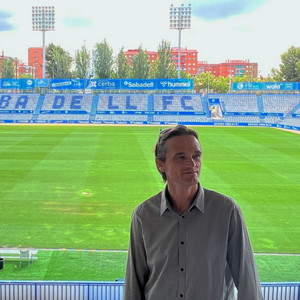
I'm He Young. Coming up next, we'll be hearing from Sandor Nagy, a former Hungarian football star who's been living here in China for almost two decades.
After his career on the field came to an end, Sandor didn't hang up his boots.
He found a new way to make a difference in the world of football.
He founded his own football club in China's east coastal city of Qingdao, and has become a true hotspot for young football enthusiasts in the region.
In just a moment, we'll dive into his journey, talk about his football career, and explore what keeps him so connected to his second home in China.
Trust me, this is one story you won't want to miss.
Sandy beaches, beer, and football On China's east coast lies Qingdao a city renowned not just for its bustling ports but also hailed as the city of football With a population of 11 million people, this seaside gem pounces with the passion of football enthusiasts and entrepreneurs shaping the football
industry. This is also the place where Sandra Naj, a former Hungarian football player, has found his second home.
In April, 2024, the international 5 -a -side league kicked off its 10th year in Qingdao.
Primarily embraced by the city's expatriate community, this football event is a celebration of diversity and passion.
Behind this initiative stands Sunder, who sought to foster camaraderie among his fellow football lovers.
What began as a gathering of friends has blossomed into something truly extraordinary.
Now, with an ever -growing roster of domestic and international players as well as grassroots enthusiasts.
The league has earned itself an affectionate nickname the mini World Cup in the city's amateur football scene.
Sunder's connection with China goes way back to 2004 as a pro footballer.
His career was boosted when an agent spotted his talent and offered him a chance to play in China.
First year, I think, yeah, I played in Nanjing.
It's also a huge city, big buildings, big roads, so it's much more different than in Hungary.
Even our capital in López, there are not that huge, tall buildings or big roads.
Towering buildings and bustling roads are the first impressions Sunder had upon setting foot here in China.
That year, the 30 -year -old competed in the China League, a major professional competition organized by the Chinese Football Association, and he scored eight goals for the team that season.
Standing tall at 6 '6", this young Hungarian player wowed Chinese football fans and coaches alike with his fast footwork and skillful maneuvers on the field.
Soon enough, a coach from Qingdao took notice and snapped him up for the team.
Over the next three seasons, Sunder proved himself a crucial scoring asset for the squad.
To be honest, I never thought about to become a pro.
It's just I like to play.
I think since I'm 10, I joined some local club near my hometown.
It's a little village, and nearby there is a city called Shaiu St.
Peter where I just joined the local club to train with them and play matches.
And then I went to high school to a little further, another little town called Kaczynskowski where I played a few or four years more.
Growing up in the northeast of Hungary, Sander's passion for football blossomed at a young age.
Upon completing high school, he received an offer that kick -started his professional football career.
He primarily played in his homeland before making the move to China.
Due to injuries, Sandro wrapped up his career as a professional footballer in 2008.
He then headed to Beijing to seek new business opportunities.
During his stay in this bustling metropolis, he met a charming Russian woman who later became his wife.
And then I came back to Qingdao because it's a lovely city.
There are sea, mountains, so for families, for me, it's much better than Beijing.
The coastal charm, clean air, and family -friendly atmosphere of Qingdao drew Sander back to the city.
Together with his wife, they decided to make Qingdao their new home.
Despite transitioning away from professional play, Sander's love for football never waned.
He went on to launch his own football academy in the city, hoping to ignite a passion for the sport among local youth.
I started to work with one or two international schools first, so I just started alone.
I just did some balls, some equipment, and I just went to the school after school activities to coach the kids.
And then from then, there I started to build up.
In 2013, The Great Football United was founded.
Sander shares a fun tidbit about the club's name.
It's actually inspired by his own last name, Nudge, which translates to great in English.
And from there on, some Chinese friends told me how should we translate the great into Chinese.
And they came up with the weita.
So weita to choo. With this shift, Sander transitioned from being a star player on the field to nurturing young talents and Qingdao couldn't be a more perfect setting.
Since the first city -based football team was established in 1924, the people of Qingdao have long held a deep passion for the sport.
Today, the city proudly hosts two teams in the Chinese Super League, the pinnacle of professional football in the country.
In early 2022, this coastal city was selected as one of the first nine cities to spearhead football development in the country's five -year plan until 2025.
Currently, around 500 ,000 individuals actively participate in football in the city, with a whopping 300 ,000 of them being teenagers.
For Sunder, transitioning from a player to a coach marked a significant shift in perspective.
He says, when you are on the field as a player, your main focus revolves around personal performance and contributing to the team's success.
However, stepping into the role of a coach entails a whole new dimension.
Playing football, you are kind of in an artificial bubble where you do what you love and you get paid.
And it's just great.
But the disadvantage of that, that it doesn't really prepare you after you retire because usually players, they don't really think about what's going to happen after.
And I want to help the young players and the youngsters when they're developing themselves or we develop them and going up.
That's great. That's a good aim to become a pro.
But in the same time, we have to remind them that what's going to happen after when they retire.
When it comes to coaching, Sunder certainly has his own philosophy.
In addition to some fundamental football skills, he emphasizes the importance of nurturing well -rounded abilities in his players.
Because when a player or a young kid is joining a team, first they don't really know what this is about.
They just want to kick the ball and enjoy themselves, which is good.
And we have to let them enjoy football.
But in the same time, as a coach, we have to teach them all of the social skills, all of the values what make them a good team player, like empathy, communication, respect.
All of this all together is what makes a player a great player.
Reflecting on the early days of the club's development, Sandhu remembers a time when a majority of the kids were international.
But as the years have gone by, he has seen more and more Chinese kids joining the football training sessions.
Throughout the years, the football club has guided countless Qingdao youngsters to develop a love for the sport and begin their journey of playing it.
Among them, there's one who left a lasting impression on Sander.
He was a little chubby boy and he had self -esteem issues and shy.
and his father used to come and then from the sideline when we're coaching them he was trying to help him but of course when a parent is talking from the sideline during the training it doesn't help at all.
Apparently the father's sideline coaching screaming instructions at his child during training disrupted the sessions quite a bit.
In the following coaching sessions Sander took it upon himself to address the issue with the boy's parent.
He tried to persuade the father to let the child learn independently without constant interference from the sidelines.
And after four years I think we played a match and I also realized that the boy he become much more confident and he was doing things what he would never even imagine before a few years ago.
and his father was watching the game.
After the game, he came to me, and he just shake my hand and told me that he couldn't believe that his son, how much he changed, how much confident he got through these years.
And that was a super thing to hear from a parent.
The transformation wasn't easy for both the kid and the parent.
But moments like this are incredibly fulfilling.
They fueled Sundar's determination to dedicate himself to the cause of youth training.
When asked about the challenges of managing a football club in China, the 50 -year -old founder highlights a prevalent aspect of Chinese football culture, an emphasis on quick results.
They think if we win the tournaments, it means that we are a good team or we are a good coach.
But the problem is the player development is not just about the winning.
If you concentrate on tournaments, then we have to keep the kids on their peak.
It means we have to coach them every day very hard.
And you can burn out the kids in this way.
And they're going to lose interest.
They're going to lose the love of this game.
They won't have passion.
And if you don't have this intrinsic motivation, this desire to play, you cannot reach your full potential because from outside this motivation from the coach, it's not the same as it comes from inside.
Changing this mindset overnight is a challenge, but Sander notes a positive shift in recent years.
He has noticed more open -minded parents who understand the importance of values and social skills alongside academic achievements.
These parents are exploring new ways to support their kids, fostering a more balanced approach to their development.
Qingdao is making significant strides towards achieving comprehensive development across various aspects of football, including professional, mass, youth and campus football, as well as the football industry.
At the heart of this effort lies talent cultivation, a fundamental pillar of the city's football ambitions.
As a pioneering hub for campus football reform nationwide, Qingdao boasts over 200 national -level football specialist schools dedicated to nurturing youth talent.
These institutions cater to students across primary, middle, and high school levels.
Meanwhile, the city has witnessed a remarkable expansion in its youth football infrastructure since 2009.
The number of youth football training institutions has surged from 8 to 62, accommodating a growing student population that has soared from 300 to over 2500.
100. Despite residing in China for nearly two decades now, Sender admits that one of his biggest regrets is not dedicating more time to learning Chinese.
While initially daunting, he found that language proficiency wasn't a barrier to thriving as a foreigner in the country.
For him, the key is to be open -minded.
it. If you come to another country with open minded and think that you can accept, you can see the differences and accept the differences, then you won't have really a cultural shock.
You can get used to it and leave.
Of course, if you are judgemental and you don't like change, it's you can struggle in a different country, not only in China, but other foreign country if you go, but if you are open -minded, then it's easy to adapt.
As his football club continues to expand, welcoming more students and coaches, Sandro finds himself shouldering increasing responsibilities.
He acknowledges that he's still in the process of learning and striving to improve continuously.
That was the inspiring story of Sandor Naj.
His journey from the pitch to founding a football club is truly a testament to the power of passion and persistence.
Thanks for listening today.
Don't forget, you can always catch our latest episodes on Apple Podcast at Roundtable China.
I'm Ha Young. We'll see you next time.