This is the Global News Podcast from the BBC World Service.
I'm Janet Jalil and at 16 Hours GMT on Monday the 5th of January, these are our main stories.
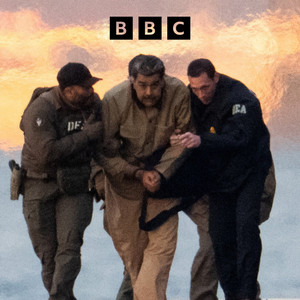
The Venezuelan president, Nicolas Maduro, and his wife have been transferred to a court in New York to face drugs charges, two days after they were seized by US troops in a raid on Caracas.
The UN Security Council is holding an emergency meeting on Venezuela.
A French court finds 10 people guilty of spreading lies online about President Macron's wife Brigitte, also in this podcast.
It's a struggle to get myself how I was, because I was a very outgoing and open and loved people.
But after the war, when I came out, I changed completely personality.
The Auschwitz survivor and stepsister of Anne Frank, Eva Schloss, has died at the age of 96.
And taken to a detention center in New York.
On Monday morning the pair were flown by helicopter to a Manhattan court, both in handcuffs and escorted by heavily armed police.
A group of Maduro supporters outside held signs saying, USA hands off Venezuela.
USA out of everywhere!
USA out of everywhere!
Your troops on the ground, no bombs in the air!
The veteran judge presiding over the case of Nicholas Maduro and his wife is 92-year-old Alvin Hellestein.
Our correspondent outside court, Claire Richardson, told us more about him.
He's spent 25 years in this role already and has a long history of handling high-profile cases, including on drug charges, terrorism charges.
So he'll be no stranger to taking on this case against the Maduros.
Now, he is an Orthodox Jew.
Jew, 92 years old.
The Israeli press have been making a lot out of this, looking at his outspoken Jewish identity, which he says does not interfere with his work as a federal judge, but how that could potentially influence the way that he looks at things, given Venezuela's connections with Iran.
The choice of the presiding judge that would have been randomly assigned to this case is interesting and we will see what arguments are made by the Trump administration, by the government prosecution.
Also outside the courtroom is our correspondent, Neda Torfik.
There will be the image of Nicolas Maduro appearing as a criminal defendant in front of a federal judge here at this court in Lower Manhattan.
He is being transported here from that detention center in Brooklyn.
And above me, there is a helicopter circling, trying to capture every inch of that journey here.
It is what is known as an arraignment.
It's when Nicolas Maduro will be formally read the charges against him that are in that 25 page indictment, accusing him of narco terrorism, of weapons offenses.
It is that indictment that was the justification that the Trump administration used to seize Nicolas Maduro, to depose him as president, to seize him from his home on a military base and to bring him here to the United States to, as they say, face the full force of American justice.
He will have the opportunity to enter a plea.
He'll be read the charges, informed of his rights.
But for the most part, there are so many questions.
Will his lawyer, for example, argue that as a head of state, he has immunity and that his seizure was illegal?
Legal analysts I've spoken to say that there are parallels here to 36 years ago actually, when the Panamanian military dictator, Manuel Noriega, was also brought to the United States and convicted.
And he lodged those same arguments in a federal judge, but they didn't work.
In fact, US courts largely defer to the executive branch and find that no matter how a criminal defendant got to the United States, that the court does have jurisdiction to hear and decide the case against them.
And Neda.
The UN Security Council is also meeting in New York to discuss the US intervention in Venezuela.
Yeah, it's a real kind of split-screen moment.
On one hand, the U.S. criminal justice system at work.
On the other hand, the international legal system at work.
Of course, it is the UN Security Council that decides matters of international peace and security.
You had Colombia and China and Russia, allies of Nicolas Maduro, calling for this emergency meeting, accusing the Trump administration of breaking international law, of violating Venezuela's sovereignty, because they say Nicolas Maduro didn't pose any threat.
There was no justification to use a self-defense argument to go into Venezuela.
On the other hand, we hear from allies of the United States who, quite frankly, have been reluctant to criticize the Trump administration.
They have instead emphasized the need for peace and stability in any transition in Venezuela.
They have also stressed that they don't view Nicolas Maduro as a legitimate president either another key US point in all of this
And then we will hear from a few briefers from the UN.
Keep in mind.
The UN Secretary General has said that he is deeply concerned that international law was broken here.
Nedda Torfik in New York.
So what do we know of Delcy Rodriguez, the woman who, at the time of this recording, is being sworn in as the interim president of Venezuela at a ceremony in Caracas?
What influence does she wield in the military and business elites of Venezuela?
And how will her appointment as leader go down with the voting public?
During the last election, they're widely believed to have overwhelmingly voted for the opposition candidate, Edmundo Gonzalez, who stood in place of Maria Corina Machado, who was banned from running.
Ivan Briscoe is Senior Director for Policy at the International Crisis Group and has met Ms.
Rodriguez on several occasions.
Unlike many of the other senior Chavistas, she is a very pleasant and courteous person.
With a number of the other figures in Chavismo Chavez, some of the military figures that were close to him.
They can be a little bit rough, a little bit tough.
Some might say thuggish even, and that's the way they play their politics.
But she was always in the times I met her, and this was a few years ago now.
Impeccably turned out, she speaks absolutely fluent English, which was obviously an attraction to the US officials, and decided to go with her as sort of the next president, it would seem.
So she is seemingly someone, a chavista, with whom the US government can have a working relationship.
They can perhaps impress on her the need for cooperation.
And yet, because she has come from the heart of the movement and has been extremely loyal to Maduro over the last decade, the idea is that she can guarantee stability.
It is a bit of a balancing act, though, isn't it?
And I did mention that in the last elections, which were widely sort of debunked internationally, the opposition came out best.
In that
It's an extremely difficult balancing act because she's been so involved at the heights of government over the last decade.
She has been party to a period of great authoritarian drift, heightened repression, which has only got worse after the electoral fraud of 2024, in which she was obviously fully participating.
So, I mean, it's difficult to see her separating herself from that history.
She's also been very antagonistic towards countries across the region.
She is extremely outspoken.
She has got a hard line in ideological terms, but she's pragmatic.
And her pragmatism has come through most notably in the way she's been an important player in the economic liberalization of Venezuela since about 2018.
You may remember that Venezuela had tremendous food shortages at that time.
Hyperinflation the economy was tanking very badly.
And she helped support the process of removing price controls, dollarising the country, removing a lot of the subsidies for the poor.
And that helped the economy to stabilise and it's even grown a little bit in recent years.
But her pragmatism is notable for one thing.
It's pragmatism so that the government can survive, so that the government can live for another day.
Ivan Briscoe, who was speaking there to Rebecca Kesby.
Well, while international criticism of the US abduction is growing, and some of it is being voiced at that UN,
Security Council meeting that Nedda Torfik just mentioned.
The news of Nicolas Maduro's ouster has also been celebrated by many of the millions of Venezuelans who fled their country because of the long-running economic crisis there.
Bernd Busman reports from Florida, home to one of the largest Venezuelan communities in the U.S.
This is Doral, a leafy green Miami suburb considered the heart of South Florida's Venezuelan community.
Over 40% of people here are of Venezuelan origin, the largest concentration in the U.S.
Many fled to seek a better life during Nicolas Maduro's presidency or that of Hugo Chavez before him.
For them, Maduro's fall is something to celebrate moment.
There are several hundred people here handing over Venezuelan flags, listening to music, dancing and occasionally breaking out into chants of liberty, liberty.
Police have blocked the area off with tape, happy to let Doral's huge Venezuelan population celebrate.
So far, the parties lasted two days.
Since news of Maduro's capture came out, hundreds of others have passed by at times, creating a snarling traffic jam of flag-waving cars.
Many of them still can't believe it.
It was the best news that we could have ever received.
We do have a lot of family in Venezuela.
So just to know that we have a communist that is out of the country, it's just great news.
Just another step closer to freedom.
When I first saw it, I couldn't believe it.
I'm going to be honest with you.
And then we kept seeing them develop and develop.
And then we saw that at one point they had captured Maduro.
I was too stunned.
Started crying when I saw it, because it's like when we came here it was uncertain when we were going to be able to go back.
And this is like the starting point.
Do you think a lot of people will go home?
A lot of people want to go home.
We didn't want to come here in the first place.
We're going to run the country until such time as we can do a safe, proper and judicious transition.
We don't want to be involved with having somebody else get in and we have the same situation that we had for the last long period of years.
So we are going to run the country until such time as we can do a safe, proper and judicious transition.
While Trump was speaking about Venezuela, other residents, particularly Cuban-Americans, hope it has a ripple effect and that the US could topple other leftist leaders in the hemisphere.
Among them is Irina Villarino, a restaurateur and one-time congressional candidate.
If there was ever a situation in which the US was willing to do that, would you like to see something similar happen for Cuba?
Yes, by any force necessary.
They should have been removed a long time ago, because they have been the head of the snake that has caused a lot of misery all throughout the region.
But for now, most people here are just happy to take in the moment.
Every day we imagine that moment.
So thank you so much for President Donald Trump and the United States for making those actions.
And we have so, so hope right now for being our country completely free.
Venezuelans in Florida speaking to Bernd de Busman.
Mr Trump has made it clear that part of his justification for the military action in Venezuela is to allow US oil companies in to, as he puts it, fix the country's badly broken oil infrastructure.
Venezuela has the largest proven oil reserves in the world, but the amount it actually produces is tiny by comparison.
And experts say it would cost billions of dollars and take years to ramp up production.
Venezuelan journalist Mariano Parago covers South America's oil industry for Reuters.
More than 60 billion are needed in general for making it work again and just recover the capacity the Venezuelan industry had 20 years ago.
So why is the Trump administration still so keen on Venezuelan oil?
One explanation might lie with the world's biggest buyer of the nation's black gold, China.
Here's the US Secretary of State Marco Rubio speaking to NBC.
We don't need Venezuela's oil.
We have plenty of oil in the United States.
What we're not going to allow is for the oil industry in Venezuela to be controlled by adversaries of the United States.
You have to understand, why does China need their oil?
Why does Russia need their oil?
Why does Iran need their oil?
They're not even in this continent.
This is the Western Hemisphere.
This is where we live.
And we're not going to allow the Western Hemisphere to be a base of operation for adversaries, competitors and rivals of the United States.
We want to see the oil proceeds of that country benefit the people of Venezuela.
Gideon Long, who's reported from the country for many years, told Rahul Tandon more about the largely untapped resource in Venezuela.
Well, it's a staggering figure.
300 billion barrels of oil.
That's the official reserves figure for Venezuela.
And this is not a figure that Venezuela has made up.
It is the official figure that's been ratified by OPEC.
That's bigger even than Saudi Arabia.
And just to put that into context, 300 billion barrels is about 17% of global oil reserves in total.
So it is an astonishing figure.
The other crucial factor is what type of oil is it?
It's all very well having the biggest oil reserves in the world, but if you haven't got the infrastructure to get that oil out of the ground, it's not much good to you.
And Venezuela doesn't really have that infrastructure anymore.
It's been so decimated after decades of underinvestment.
Secondly, you have to think about what that oil is.
It's very heavy crude.
And the crucial thing about it as well is that...
This oil is in the east of the country in the Orinoco Basin and it's relatively inaccessible.
A lot of it is jungle.
So it's not very easy to get out of the ground.
And then the final consideration, Rahul, is that this is very heavy crude.
So there's a lot of it, but it's not the best quality oil in the world and it needs extensive processing.
And the crucial thing is that there are only a few places in the world that are capable of processing that very heavy Venezuelan crude.
Exactly, may give us another clue as to why President Trump is so interested in Venezuelan oil, because some of those refineries which can deal with this sort of oil are in the United States, around Texas in particular.
They are, in the Gulf of Mexico.
Until fairly recently, when Nicolas Maduro came to power in Venezuela in 2013, the United States was actually the biggest buyer of Venezuelan oil in the world.
It used to buy around 40% of Venezuela's oil each year.
And that was precisely because they had the processing capacity.
It was a marriage made in heaven, really.
The United States had access to heavy crude nearby in Venezuela.
It didn't have to go to the Middle East or to Russia for it.
And it had the processing capacity.
Gideon Long.
For more on this story, we've also been speaking to our Latin America correspondent, Ione Wells.
You can go on YouTube search for BBC News, click on the logo, then choose podcasts and global news podcast.
There's a new story available every weekday.
Still to come.
In this podcast, South Korea hopes to boost trade with China and overcome a ban on K-pop at a summit in Beijing.
Following years in which France's first lady, Brigitte Macron, has had to endure fake and scurrilous claims about her gender and sexuality, a court in Paris has found 10 people guilty of cyberbullying her.
They were convicted of spreading unfounded claims that she had been born a man and linking the 24-year age gap between her and her husband to paedophilia.
In a recent French television interview, Mrs Macron summed up what the online conspiracies claim about her.
There are two versions.
Either I was born a man or I was born Brigitte and died in 1960, and it's my brother who became a woman.
Needless to say, they can't touch my genealogy.
It's something impossible.
A birth certificate is not nothing.
It's a dad who, one day, or a mum, declares their child and who declares who he or she is.
We don't play with that.
Our Paris correspondent, Hugh Schofield, told me more about those on trial.
They've all been found guilty, these ten people, eight men, two women.
I mean, none of these people have any kind of profile.
No one's heard of any of them.
But when Brigitte Macron filed suit a year or so ago and made a formal complaint to the justice system that she was being cyberbullied, these were the people who were found first by the investigators.
Three of them were people who had sort of instigated rumours online, and the others were people who'd picked them up and run with them and spread them themselves.
They've all been found guilty.
They've all been given suspended prison sentences, pretty much in line with what the prosecutor was asking.
There were reports that one of them has got a firm prison sentence.
It's not entirely clear why.
And one person who expressed remorse has been let off with just the requirement to go on some kind of course on cyberbullying and misuse of the internet.
Mrs Macron had initially tried to ignore these false claims, but we've heard from her family about the big impact this has had on her, her health and even her relationship with her grandchildren.
Yeah, I mean.
Clearly there's been a decision made which has turned this whole story into a bigger media story.
I mean the advice in the past I would say to leaders and their wives who've been subject to this sort of stuff has always been ignore it, it'll go away.
But that's changed.
The world has changed.
The backgrounds have decided no.
This has got too big, in particular because of the American connection.
And Candace Owens, the influencer over there, who's who's really key to all of this story, because there's a lot of her tweets in America which are being relayed, being spread by the people who have been convicted today.
So the backgrounds are going on the offensive.
They're going to law.
They've taken Candace Owens to court in America.
And here they've sued a couple of people who held a big discussion online three or four years ago.
And now this case of the ten, eight men, two women who've been spreading the rumors.
So, yeah, I mean, I think it's a sign of the times.
Leaders are no longer saying we should just ignore this stuff and let it go away.
They're saying to each other themselves no, we've got to act, to stamp on this and show that we won't put up with it.
Hugh Schofield in Paris.
Even as tensions in East Asia are mounting, the Chinese and South Korean leaders have reaffirmed their ties at their second meeting in two months.
Following a grand welcoming ceremony at the Great Hall of the People in Beijing, the Chinese President, Xi Jinping, said that China and South Korea share common interests and shoulder important responsibilities in maintaining regional peace.
President Lee Jae-myung is the first sitting South Korean leader to visit China since 2019.
And Mr. Xi visited South Korea in October for the first time in more than a decade.
Our China correspondent Stephen McDonnell told us more about these latest talks.
Well, apart from the two leaders meeting themselves, there are these big business delegations as well involved.
So, for example, on the Chinese side, you've got Alibaba, battery giant CATL, ZTE, the phone maker.
And then on the Korean side, the chairman of Samsung, the executive chair of Hyundai Motors.
So big name companies all involved in these discussions.
And the idea is to boost communication. trade between the two countries.
They're speaking about AI, rare earths, computer chips and the like.
Interestingly, though, there is still this sticking point over cultural stuff.
Now people will remember that when the South Koreans brought in this THAAD missile system to defend themselves against North Korea, China objects to this because those missiles can actually reach into Chinese technology.
And one of the punishments for bringing these in was to stop K-pop bands and the like performing here.
And the president's team had hoped that maybe this visit might smooth the way for that to have been removed.
However, the president's chief of staff said that it's not likely.
So, funnily enough, despite all this other cooperation on the cultural front, there may still be a big blockage.
And this comes as tensions are once again high between South Korea and North Korea, after Pyongyang fired two ballistic missiles into the Sea of Japan a day ago.
Yeah, I mean, it's straight out of North Korea's playbook.
They must drive the government in Beijing crazy, seriously.
So, in the hours before this meeting between Lee Jae-myung and Xi Jinping, there they are testing hypersonic missiles.
The timing of it.
Obviously it's to try to put pressure on both of them to pay attention to North Korea.
Although what they really want in the long run from all of this is hard to know.
And this visit also comes at a time when China's relationship with Japan is pretty fraught over Taiwan and that poses problems for South Korea.
Yeah well, there's South Korea, stuck in the middle of this fight between China and Japan over Taiwan.
People remember the Japanese president said that if China was to try to take Taiwan by force, Japan couldn't rule out being involved militarily.
Now, this has upset the government in Beijing.
What President Lee has tried to do is to stand clear of this and sort of say that look, we're not part of this fight.
And so I guess they're hoping that, while China's busy fighting with Japan, it might be a good time for them to mend relations, especially on the economic front.
Stephen MacDonald.
In the 1930s.
Eva Schloss was a little girl in Vienna when her Jewish family were forced to flee after Austria was annexed by Nazi Germany.
They escaped to the Netherlands but were later arrested and deported to Auschwitz.
Much of her family was murdered.
Eva survived.
She spent decades speaking publicly about what she'd lived through.
She also became Anne Frank's stepsister and co-founded the Anne Frank Trust.
Eva Schloss has now died at the age of 96.
Here she is speaking to the BBC programme Woman's Hour in 2013, reflecting on how her perspective shifted years after publishing her memoir Eva's Story.
It's a struggle to get myself how I was, because I was a very outgoing and open and loved people.
But after the war, when I came out, I changed completely personality.
I was shy.
I didn't dare to open my mouth if two people were around.
And I was unhappy who I was.
And...
So it's really important to tell that you.
But now, after so many years I mean perhaps 20 years now already I'm a very happy person.
I realized how lucky I was to get out, to get through and have a life.
Gillian Warnes-Perry, co-founder and honorary vice president of the Anne Frank Trust, told us more about Eva.
She actually didn't speak at all about her experiences till 1986, when she opened the first Anne Frank exhibition that came to London from Amsterdam.
And she kept it within herself.
She hadn't even really spoken to her husband or her three daughters.
And since then, she never stopped.
She was just tireless until really COVID came in.
She was traveling the world even into her late 80s, early 90s.
I heard her speak probably over a hundred times.
Every time she spoke, she had a different message.
She imparted something different.
She and Anne were friends, but she never said we were bosom buddies.
They were very different.
And Eva described herself as a tomboy.
And Anne was very much, she was very almost precocious.
She was into boys and fashions and what have you.
So they were never that close.
However, she had a great respect already when she was young for Anne's father, Otto Frank.
And she actually recognized him as they were coming back from Auschwitz after liberation and introduced him to her mother.
Oh, this is my friend Anne's father.
And several years later, they married.
They fell in love.
And really Mr Frank and Eva's mother Fritzie, who I had the privilege of knowing as well.
They devoted the second half of their lives to promoting Anne's diary as a force for good.
Eva would speak about Anne. because everyone wanted to know, you know, you knew Anne Frank.
But Eva also spoke very much about her own teenage brother, Heinz, who she absolutely adored.
And he was multi-talented and would, like Anne, would have had a phenomenal life ahead.
And so really, she was telling the story.
She was telling her story, what happened to her and her mother in Auschwitz, for Heinz, as well as Anne, and for all young people who are victims of persecution.
Julian warns Perry looking back on the life of Auschwitz survivor Eva Schloss, who has died at the age of 96.
And that's all from us for now, but there will be a new edition of the Global News Podcast later.
If you want to comment on this podcast, you can send us an email.
The address is globalpodcast at bbc.co.uk.
This edition was mixed by Sid Dundon.
The producers were Stephanie Zachrisson and Chantal Harple.
The editor is Karen Martin.
I'm Janat Jalil.
Until next time, goodbye.