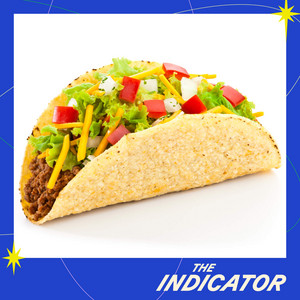
N .P .R. On a summer's day, I met Robert Armstrong at a Mexican restaurant in Brooklyn.
So should we order some tacos?
Robert Armstrong writes for the Financial Times.
He hosts the Unhedged podcast, and we were there for one reason.
I'm going to have three tacos.
Robert is famous for this acronym he coined, TACO.
Trump always chickens out.
Al pastor, grilled shrimp and fish.
I got mushrooms, spinach and veggies.
So you might remember TACO is basically this idea that Donald Trump threatens super high tariffs and also things like firing the chair of the Federal Reserve.
But then he backs down on the more extreme policies when the markets freak out.
So for a while, Taco and I were the darling of tariff policy.
And this is one explanation for why the stock market has been reaching new heights, despite a chorus of economists and many business leaders saying that President Trump's tariffs will hurt growth.
This is The Indicator from Planet Money.
I'm Darian Woods. Today on the show, why is the stock market doing so well?
Aside from some recent bumps in the road, Wall Street seems to be shrugging off chaotic economic policymaking.
We chew the whole enchilada after the break.
All right, here are our tacos.
Thanks very much. These look beautiful.
This is very self -referential.
I enjoy this. You know, it's like my own tiny version of that scene in Being John Malkovich where he climbs inside of his own head and so forth.
This message comes from Dell Technologies.
Supercharge your studies during Dell's back -to -school event with AI PCs starting at $749 .99, like the Dell 14 Plus featuring an Intel Core Ultra processor.
Shop now at Dell .com slash deals.
This message comes from Capital One.
Banking with Capital One helps you keep more money in your wallet with no fees or minimums on checking accounts.
What's in your wallet?
Terms apply. See CapitalOne .com slash bank for details.
Capital One N .A. Member FDIC.
This message comes from Ritual.
What makes Ritual Vitamins different?
Ritual Vitamins are made with bioavailable, clinically studied key ingredients, as well as the essence of mint.
Get 25 % off your first purchase when you visit ritual .com slash NPR.
are. There are a few hypotheses for why the markets don't seem to be that spooked by steep tariff threats and savor rattling by Donald Trump anymore.
Away from the hot sauce in Mole, the FT's Robert Armstrong ran through a few of them.
The first and possibly the most important is that the stock market is not the economy.
This is the chestnut we always keep in mind when we're checking in on the health of the economy.
So the economy is the sum of all our buying and selling and saving and borrowing and so forth.
The stock market is something much more specific.
It's a price that discounts the future profits of the publicly listed corporations.
And those things can come apart.
So the fortunes of companies like Target or Eli Lilly are part of the economy, but they don't say much about everything else, like sales at my corner store or whether nurses are getting jobs.
So the stock market is not the economy.
It's also not the economy.
It does cover a large swath of American businesses.
So maybe that's a partial explanation.
I'm not sure if I see it as the whole explanation.
Yes. And when things are very bad or very good, the stock market and the economy tend to come together.
In other words, in a great boom, everybody has a job and is feeling good.
And the stock market tends to be high.
In a recession, everybody feels lousy, everybody's out of work, and the stock market is down.
It's in those in -between periods that one can be tracking one direction while one goes the other.
And that brings us to hypothesis number two, enthusiastic investors.
In the short term, the market becomes very emotional because it's made of human beings who are emotional things.
We kind of get good vibes.
We get excited. Things are sort of tonic and bubbly and fun.
Stock markets will go up even in an unrealistic way.
So enthusiasm seems to be building on enthusiasm at the moment.
Yeah, we are in what they call a risk -on period in markets.
The vibes are good.
There's a little FOMO too, a little fear of missing out.
There's a flavor of that right now for sure.
I can buy that's a big explanation.
However, company earnings have been okay.
Like there are some fundamentals that could justify this.
Artificial intelligence, AI might indeed create a whole amount of new value that the U .S. is on the frontier of.
Quite right. In fact, just recently, we had the reports from some of our largest banks, JP Morgan, Citigroup, and the news so far has been really pretty good.
You know, they sort of hemmed and hawed and said we can't see the future, which of course they can't.
But the hard numbers they put out suggest a pretty resilient economy.
The fundamental picture, to me, looks okay.
What about whether Trump's policies will actually supercharge growth?
Corporate tax cuts are good for business investment, for example.
What do you think? Let's start with deregulation.
I'm in favor of it.
That is helpful and hooray for it.
We didn't see a lot of it in this particular budget bill, but to the degree you deregulate a somewhat what overregulated American economy, good news.
Second point, the budget bill itself, it creates bigger deficits, right?
And in general, for a while, deficit spending is quite good for markets.
What is the government doing when it's doing deficit spending?
It's taking dollars and it's shoving them into the economy.
And it should come as no surprise that some of those dollars will show up in investors' pockets or on corporate balance sheets.
So deficit spending, markets generally like it.
Until the moment that they really, really don't like it, which comes when the debt becomes unmanageable, interest rates start to rise, the country is either forced into austerity or has to inflate its way out of its debts.
That is on a day that we don't know sometime in the future.
Until then, deficit spending, markets like.
So there is some wind puffing up the sails of the stock market.
There is still the question of tariffs, though.
There have been really big announcements that have been almost universally condemned by economists.
In April, the stock market had fallen around 20 % from its peak.
Then Trump paused the biggest tariffs and markets recovered.
And yet the deadline for the big tariffs is coming up soon, August 1st, and Trump keeps announcing new tariffs.
What does the market do?
It dawdles on. What gives?
Next hypothesis, my personal favorite.
it. Markets don't believe the president.
Okay. This is the Trump always chickens out hypothesis that he makes all this big.
And this is why we got those tacos together.
Yeah, indeed. So this is this quite stupid acronym I came up with.
Don't be so self -effacing.
Trump always chickens out.
The idea is the guy talks big and then he doesn't follow through.
And so far, that's been the pattern.
And the markets are basically saying, yeah, buddy, tell me me another one, right?
And of course, this creates a risk, right?
That at some point, maybe he does mean it.
And, you know, I can't read the guy's mind.
I don't know where that point comes or if it comes, but I'll tell you this.
We're in a kind of weird dynamic or paradox, I would say, between, in the relationship between markets and the president, right?
Where the markets not believing the president's statements make it more likely that those statements will turn out to be true.
Because he's not being cautioned by the markets.
So he might actually go for it in the end.
That's quite a paradox and really a reason to be a bit more cautious.
I would think so. I would think so.
I mean, I don't know what's going to happen on August the 1st. But the market is giving the guy quite a lot of leash right now.
Well, Trump sometimes chickens out.
It's not quite as catchy.
Indeed. But I will say it's been a good bet so far.
But, you know, any market trend has a beginning, a middle, and an end.
and the end sometimes comes up on you more quickly than you might expect.
Taco Tuesday may be over soon.
Yeah, it's tariff Thursday, maybe.
This episode was produced by Angel Carreras and engineered by Robert Rodriguez.
It was fact -checked by Sierra Juarez.
Kate Kincannon edits the show and The Indicator is a production of NPR.