Just listen and learn.
Okay, this will be a little bit different than our normal style, right?
Normally we do like a repeat after me or shadowing.
Now, of course, you can repeat after me, you can shadow me, that's fine, but i'm not going to stop, i'm just going to keep going.
I'll pause every once in a while, of course.
Here we go Today.
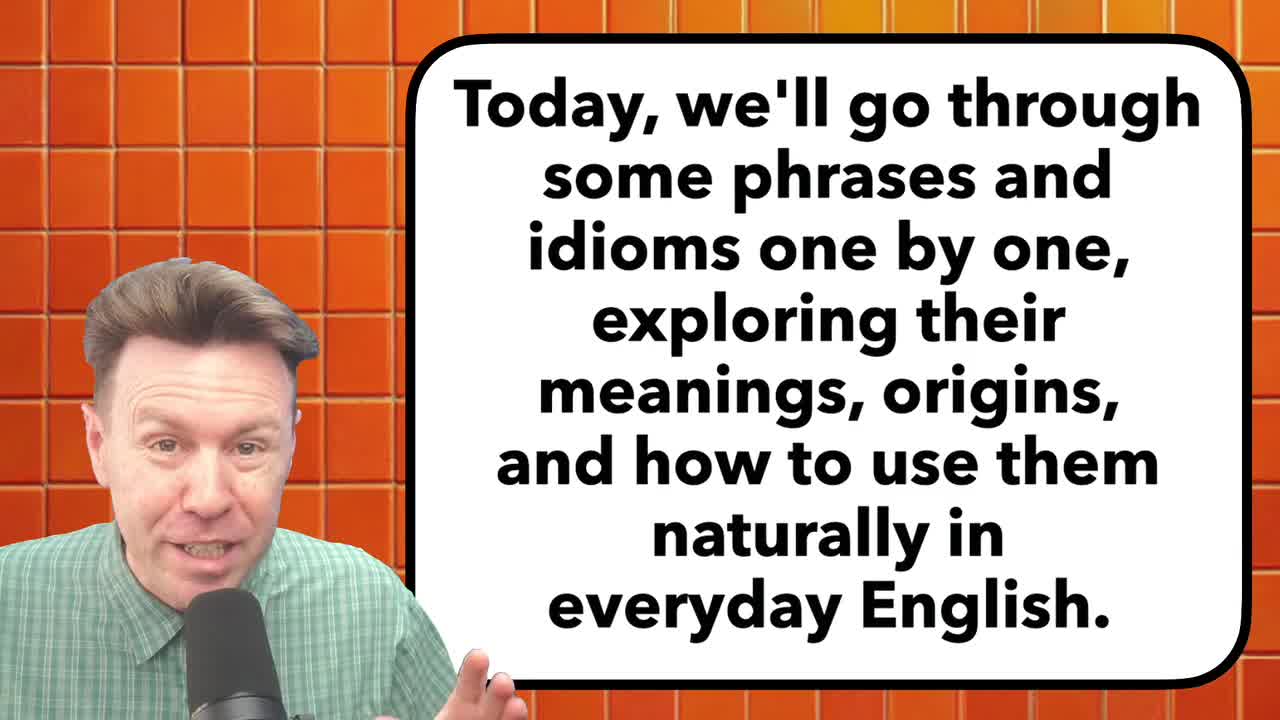
We'll go through some phrases and idioms one by one, exploring their meanings, origins and how to use them naturally in everyday English.
All right, does that sound good?
Let's do it.
Here we go.
The first one is Rise and Shine.
This cheerful expression means to wake up and start the day with energy and enthusiasm.
So for example, come on, rise and shine, or you'll be late for school.
This is typically said in the morning, often by parents trying to wake up their children or by anyone encouraging someone to get out of bed.
Get out of bed, rise and shine.
All right, the word rise means to get up.
And shine suggests being bright and energetic like the sun.
It's a positive, upbeat way to greet the morning.
All right, so next we have let one's hair down.
Let one's hair down.
This idiom means to relax and have fun.
To stop being formal or serious and just enjoy yourself.
For example, after exams, the students went out to let their hair down.
Not literally let their hair down, but figuratively let their hair down.
All right, well, let's see what it means.
The origin of this phrase comes from a time when women would wear their hair up in formal styles during the day, but would let it down when they were at home and could relax.
Today, it means to drop your guard, be yourself and have a good time without worrying about being proper or professional.
Let your hair down.
Our next phrase is, all bark and no bite.
This describes someone who talks tough, makes threats or sounds aggressive, but doesn't actually follow through with any real action.
For example, Don't be scared of the boss.
He's all bark and no bite.
Don't be scared of the boss.
He's all bark and no bite.
Think of a dog that barks loudly and sounds fierce, but wouldn't actually hurt anyone.
That's exactly what this idiom means.
The person might sound intimidating, but there's no real danger or consequence.
They're all talk and no action.
All talk and no action.
That's another way to say all bark and no bite.
Next, we have to buy a lemon.
I bought a lemon.
To buy a lemon means to purchase something, especially a vehicle, a car that turns out to be defective.
It's no good or constantly breaks down.
For example, he bought a lemon of a car.
It broke down in a week.
This idiom most commonly refers to cars that have hidden problems and require constant repairs.
The sour taste of a lemon represents the bad experience of getting stuck with a faulty product.
All right.
If someone says they bought a lemon, they're expressing disappointment and frustration with their purchase.
All right, so our next phrase is pull the wool over someone's eyes.
This means to trick, deceive or fool someone, preventing them from seeing or understanding the truth.
For example, the salesman pulled the wool over her eyes with false promises.
The image here is of literally pulling wool over someone's eyes so they can't see what's really happening.
It suggests deliberate deception where someone is being manipulated or misled.
This idiom is used when someone has been tricked or when you want to warn someone not to be fooled.
All right, next one is, how about this one?
Everyone's dirty laundry.
This means to reveal private problems, conflicts, or embarrassing personal issues in public.
Mmm, don't want that now.
For example, they always air their dirty laundry on social media.
Dirty laundry represents private, embarrassing matters that should be kept confidential, secret.
Just as you wouldn't hang your dirty clothes outside for everyone to see.
You shouldn't share private family or personal problems publicly.
This idiom is often used when people complain about others who overshare their personal drama.
That's all of YouTube, oversharing personal drama.
All right, our next phrase is, Big task on one's hands.
I got a big task on my hands.
This means to have an important or difficult responsibility that requires significant effort.
For example, the teacher has a big task on her hands with 40 noisy students.
That's a big task on her hands.
When something is in your hands, it's your responsibility to deal with it.
A big task emphasizes that it's challenging, time consuming, or difficult.
This idiom is used when someone faces a substantial challenge that will require serious work and dedication.
Next, we have the idiom, get one's ducks in a row.
Get one's ducks in a row.
This means getting organized, prepared or having everything properly arranged before starting something.
Get your ducks in a row.
For example, she needs to get her ducks in a row before starting the new project.
The image comes from the way ducklings, baby ducks, follow their mother in a neat, orderly line.
When your ducks are in a row, everything is organized and ready to go.
This is often used in business or when planning something important.
You need to have all the details sorted out and everything in proper order.
Get your ducks in a row.
Do you know what an oddball is?
What's an oddball?
Well, this describes a strange, unusual, or eccentric person who doesn't quite fit in with the norm.
They don't fit in with the normal.
For example, he's an oddball, but everyone likes his unique ideas.
While this can sometimes be used negatively, it's often affectionate or neutral, describing someone who's quirky or different in an interesting way.
In an interesting way, they're a little different, but they are interesting.
An oddball is someone who stands out from the crowd because of their unusual behavior, interests or personality.
They're not like everyone else.
She's a bit of an oddball.
All right, our next phrase is to drive one bananas.
You've heard this one.
I know you have.
This means to make someone feel crazy, extremely frustrated or annoyed.
For example, that loud music is driving me bananas.
When something drives you bananas, it's so irritating or overwhelming that it makes you feel like you're going insane.
The word bananas here is slang for crazy.
This is a colorful way to express extreme annoyance or frustration with a situation or a person.
How about this one?
A barrel of laughs.
This describes someone or something that is very funny, entertaining, and enjoyable.
For example, the comedy show was a barrel of laughs.
A barrel is a large container, so a barrel of laughs suggests an abundance of humor and fun.
This idiom is used to describe people who are naturally funny or highly entertaining events.
Sometimes it's used sarcastically to describe something that's actually not fun.
Well, that was a barrel of laughs.
So that means it was not fun.
Because it's in sarcasm.
That was a barrel of laughs.
It was not fun.
Next, we have up to par.
All right, you up to par?
This means meeting the required or expected standard of quality or performance.
For example, her work wasn't up to par, so the manager asked her to redo it.
It's not up to par, redo it.
Par comes from golf where it refers to the standard number of strokes, hits, expected for a hole.
If something is up to par, it meets expectations.
If it's not up to par, it's below standard and needs improvement.
This is commonly used in professional settings to discuss quality and performance.
How about you?
Is your English up to par?
All right, our last phrase today is a no-win situation.
This describes a situation where there's no possibility of a good outcome no matter what you do.
For example, arguing with him is a no-win situation.
In a no-win situation, all possible choices lead to negative results.
You're trapped between bad options and there's no way to come out ahead.
Come out ahead means to be successful.
Oh, come out ahead means to end up in a better position.
Oh, I added it.
This one's even better.
This is a better definition than what I just gave you.
End up in a better position.
Come out ahead.
All right.
A no-win situation expresses frustration about being stuck in an impossible position where success isn't possible.
It's just a no-win situation for me.
No matter how hard I try to make a good lesson, I end up not feeling like I did it.
All right, I'm just trying to search for an example sentence.
Not a good one.
All right, boom, good workout.
What do you think of this style of lesson where I'm just talking the whole time, listening for you?
I don't know if I should keep doing it like this or not.
I'm a little, I don't know.
My course, Practice Paradise, is all about speaking practice.
I never intended to make listening lessons, but I've noticed that so many people want them that I thought well, I might as well give in and make them.
Then ask you is this what you want?
I can make more, let me know.
All right, keep moving forward one step at a time, and i'll see you in the next english speaking practice video.