Discussion keeps the world turning.
This is Roundtable.
The Lantern Festival on February the 12th lights up the sky.
Join us as we explore this glowing festival, its meaning, celebrations, and how it's connecting people worldwide.
And with soaring hotel prices and the holiday rush making flights harder to come by, home swapping has become an appealing alternative for those looking to explore a city from a local's perspective.
Is the convenience and savings worth the risk?
Coming to you live from Beijing, this is Roundtable.
I'm He Young. For today's program, I'm joined by Steve Hathaway and Ding Heng in the studio.
First on today's show, February 12th.
This year marks the Lantern Festival, or Yuan Xiaojie in Chinese.
It is celebrated on the 15th day of the first month of the traditional Chinese calendar.
This day coincides with the first full moon of the year, symbolizing hope, renewal, and the promise of brighter days ahead.
And let's dive into how this beautiful tradition has evolved and how it continues to bring people together, whether in China or across the globe.
So, Ding Hong, let's go to you first.
What does the Lantern Festival truly signify for the Chinese people?
Well, it is a traditional Chinese holiday for sure, and it is called Yuan Xiao Jie in Chinese language.
It falls on the 15th day in the first lunar month on the traditional Chinese calendar.
Because the first month was traditionally called as the Yuan month in ancient times, and night is called Xiao in Mandarin Chinese and Jie means festival.
So Yuan Xiao means the first night because it is the first time in a lunar new year to see a full moon at night.
Chinese people believe that this very day somehow represents the awakening of everything, the coming of spring, for example, and a sense of fullness.
And really, it's a celebration.
It's a day for celebration.
Therefore, we have its Chinese name, Yuan Xiao Jie.
And then, because lantern watching and lantern riddle gassing are two main features, two main characteristics that people will do, these kind of activities to celebrate the day.
Therefore, we have its English name, Lantern Festival.
Lantern Festival. So the spring festival period is quite a long time, right?
It's for weeks and weeks.
and the lantern festival signifies the end of the spring festival is that correct yes so basically the 15th day and it's like okay the celebrations come to an end okay uh got it um here in beijing and i'm assuming in other parts of the country if not all over the country the red lanterns can be seen
hanging and they have been hanging in the streets for quite a long time here's my other question, though.
For the Spring Festival, people adorn their doors, the front of their homes with the couplets, right?
I did that as well.
We were excited to do that to celebrate, you know, with some of the traditions.
When do the couplets and everything come down?
Is it at the conclusion of the Lantern Festival?
Oh, no. Oh, really?
Steve, please write this down.
Don't ever get this wrong because you don't want to mess up with your good fortune and luck in the new year.
Okay. You leave them on for the whole year.
Oh, really? Until this time, well, actually the Chinese New Year next year.
Oh, and then you just change it with different couplets?
Yes. And also keep the fuzi, right?
The fortune character, the single character in the middle.
Don't take it down until next year.
Oh, see, this is very important information.
And this solves a problem I was having with my wife, because I said, shouldn't we take this off the door now?
And she said, no, don't take it off.
And she's Korean, by the way she said no i don't think you take it off yet and i said but isn't it kind of like keeping the christmas tree up in july no i don't think you can draw the western comparison and she was right i was wrong and now uh now i know for sure thank you for that information you are welcome
listen to the wife always that's just good advice in general and also um it's cool that you mentioned christmas tree in a way maybe not in such a prominent way but the red lanterns could be seen as maybe a Christmas tree kind of a little bit and you don't keep the red lanterns on the whole year either
so maybe there's a small comparison there.
Got you, thanks. And what about the origin story of the Lantern Festival?
Well, there are actually more than one supposed origin or at least more than one legend.
One legend goes like this.
Once in ancient times, a celestial swan came into the mortal world where it was shot down by a hunter, by a human hunter.
Then the Jade Emperor, who is basically the highest level of God in the heaven, he vowed to avenge the death of the swan.
He started making plans to send a troop of celestial soldiers and generals to Earth on the 15th day of the first lunar month, with orders, of course, to try to destroy or incinerate all humans and animals.
However, there are other celestial beings who disagree with this particular course of action, and they somehow risked their lives by warning the people of the Earth.
So as a result, before and after the 15th day of the first lunar months, every household on Earth hung red lanterns outside of their doors.
And they set off fireworks, firecrackers, in order to give this very impression that their homes were already burning.
They were tricking the god of fire.
Oh, I get it now. Okay.
That is really interesting.
And yes, there are also other myths or stories presumed to be associated with this particular festival.
Yeah, another story goes like this.
It is about a true historical figure, Dongfang Shu, who served as a kind of half -entertainer, half -political adviser to Emperor Wu of Han Dynasty Han Wudi, who is basically the seventh emperor of the Western Han Dynasty.
He ruled China from 157 BC to 87 BC.
Now, this story is more legendary compared to the previous one.
So one day, Dong Fang Shu saw a courtesan in the imperial garden And tears were streaming down her face He inquired about the girl's name And found out that the girl was named Yuan Xiao And since she came to the palace She had been living in a kind of isolated state And she missed her parents very much
So she was sad and in tears So having learned about the situation Dongfang basically came up with this plan.
He went to the streets of the Changnan, which is the capital city of the Han dynasty at the time, to sell this gossip that the fire gods would burn the city, would burn the capital city.
As people were panicked, Emperor Wu rushed to ask Dongfang Shu for a solution.
So Dongfang suggested that people hang red lanterns on the streets, alleys, courtyards, etc., etc., pretending to be full of blazing fires.
Once again, to deceive the fire god that the city was already being burning.
So there is some level of resemblance between this lantern and the earlier version of lantern.
and because the fire god's favorite food is a special kind of dumpling something that this girl Yuan Xiao is very good at making so there came the day when the whole capital city of Chang 'an was decorated with lanterns and Yuan Xiao made a lot of her special dumplings to serve the fire god In this way,
the god of fire did not inflict disaster onto the city, and Yuan Xiao managed to get reunited with her family.
And in memory of her, this special, this round -shaped dumpling was named as Yuan Xiao.
Oh, and they're still called that today, and people still eat that on the day of the Lantern Festival.
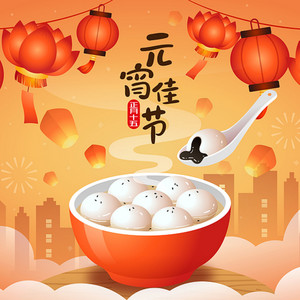
Yes, indeed. These round, gluttonous rice sticky balls with all kinds of fillings, and they're called Yuanxiu in the northern part of China.
But I know Ding He is from the southern part of China, so he probably prefers Tang Yuan, but maybe we'll get into the differences in a second.
So these are some really fantastical tales, and it shows the very long history of the festival.
And also, every year at this particular day, and it's usually when we're doing this show, I'm reminded that the Lantern Festival, alongside being all the completion of the Chinese New Year's celebrations, it used to be in ancient times, in the olden days, to be the Chinese Valentine's Day.
Oh, really? And it's not qixi, in fact.
So in our like popular culture in China, like we tend to say, oh, qixi is actually the Chinese Valentine's Day when de facto we could be wrong.
And it's just really interesting, you know, with such a long history and how it evolves and is passed on generation to generation.
And there are some variations to our understandings.
So historically, this was the quote unquote Valentine's Day.
Was there romance connected to this day at all?
It's got to be. Yeah, I guess one of the main reasons is that because in ancient times of China, young females, young girls, they were usually not allowed to go out in normal days.
So the Yuan Xiao Festival was one of the exceptions, one of the few chances available For girls to go out in the evening To do the lantern riddle gassing And find love when watching lanterns So that was a good occasion for them to meet romance Oh, this would have been a very, very exciting time At that time
You're not allowed to go out in the evening typically So it would have been super exciting for people Yeah, a chance to mingle with the boys Yes.
Yeah. And before today's live broadcast, I had the pleasure of chatting with Hazels Tan, a news presenter at Radio Television Malaysia.
And she has shared some fascinating insights into how the Lantern Festival is celebrated in Malaysia and how it's embraced by people from all cultures.
Let's listen to my conversation with Hazels.
What does the Lantern Festival mean to you?
And how important is it in Malaysian culture?
I think in Malaysia, because all of us are Chinese, we celebrate Chinese New Year like the biggest festival ever in a year for us.
So every year is like almost when it comes to October or November, all of us, we are waiting for January or February to come.
So the Lantern Festival, it is actually like an end to the Chinese New Year.
It's kind of like say goodbye to all of the celebration.
And it's time for us to really work hard.
Because like in Malaysia, we celebrate Chinese New Year not only on the first and the second day.
We celebrate like 15 days long.
And even in Johor, Johor is like the south part of Malaysia.
We celebrate it even 21 or 22 days long.
so during the chinese new year we normally visit people's house we play along we have a lot of celebration we have a lot of events going on so when it comes to lantern festival is like the last day of chinese year for us so basically for us it's like um the end of all the celebration the end of holiday
say goodbye to the happiness and hi monday blue Yeah, what I call the post -holiday syndromes might kick in.
You said that it's such a long extended holiday and we don't really necessarily have that luxury here in China.
Do you get many days off or what do you do during that 15 days?
Not really that long kind of holiday.
We do resume work normally on the 4th or the 5th day of Chinese New Year when we mention it as So when we back to our work, we still work as usual in the morning But in the evening or night, we do date our friends, we do visit people's house as well It is like Chinese New Year for us as well So it's
like today, even it is the public holiday in Malaysia of another culture, of another race But for us, it's like another day off for us to celebrate Chinese New Year.
So when this morning we visit the restaurant, I can see a lot of Chinese families sit together.
When we meet our relatives, the friends, we'll be like, oh, gong -si -fang -cai, gong -hi -wak -cai, things like that.
And we will pass a gift to each other.
We pass the ang -pao.
So in Malaysia, we don't really have that long kind of holiday, that many days of holiday for us.
But we treat it as holiday because during the morning work, We don't really go all out.
But we do what we naturally have to do.
And after work, we celebrate as usual.
And what about the Lantern Festival?
On this specific day, what do you guys do to celebrate?
On the Lantern Festival, it is called chap gourmet in Malaysia.
Chap gourmet is like the 15th night.
From what I can remember all the time, when it comes to Lantern Festival, we always wait for the moment where every of the single ladies and the single man they go to the lake or maybe a place where everyone will gather that together then we throw the mandarin oranges with our name and our phone number
on top of it this is like they say a matchmaking kind of event but this is not really that we want to find a good match from that event it's just like it's our tradition to do that yeah for some reason maybe not all Chinese people are familiar with the concept, but actually in ancient times, the Lantern
Festival was meant to be the Chinese Valentine's Day.
So it's really interesting to see that tradition kind of still alive and well in Malaysia.
Yeah, because we celebrate each of the festivals like a very big day for us in Malaysia.
Every of the Chinese festival, because we think that it's very important for us to preserve the culture and to inherit it.
Because when I was a child, I actually don't understand why we have so many events going on, so many different festivities going on.
But when I grow older, I do understand that it's actually some kind of culture for us to hold.
And we have to root for it because if we don't really pass the meaning or we don't really preserve the culture, then the next generation wouldn't get the meaning of it.
So, we have to do it.
And we celebrate it like something very, very significant for this.
Speaking of culture and preserving it, in China, it's a tradition to enjoy Yuanxiao on this day.
And those sweet rice balls filled with a variety of fillings, such as sesame or red bean.
And I've actually heard this year that Malaysian Musang King Durian flavor Yuanxiao is becoming a popular choice.
Do Malaysians have a similar tradition of enjoying yuen xiao on this day?
And are there other special foods that you guys would put on the table?
Yes, I think yuen xiao or tan yuen is actually one of the food that we enjoy on the Lantern Festival.
But yuen xiao is not only the food that we enjoy on the Lantern Festival because normally we have it during the winter saucepaste as well.
My mom taught me that when we celebrate the winter saucepaste, when we eat the yuen xiao it's like we're entering the new year so when it comes to winter sausage it's like we are waiting for the new year to come and we eat the yuen xiao is to wish us that we are going to grow one year or other and you're going
to grow wisdom you're going to grow wisdom in you and when it comes to the lantern festival if you eat yuen xiao it means that family members everyone that you love is beside you we are actually having this kind of a reunion it's just like The concept of the Yuan Shao is like Tuan Tuan Yuan Yuan.
So we got to be together.
It's round, it's a symbol of unity and everything going smoothly for the new year.
Still, you know, so much shared across countries.
And how do traditional festivals such as the Lantern Festival and Chinese New Year contribute to fostering intercultural understanding in Malaysia, considering that Malaysia is such A multicultural diverse country I think celebrating this kind of Traditional festival in Malaysia Is actually a very big
event Where you can gather everyone Not only Chinese Where you can see Malay You can see Indian Even Orang Asli Like different different races Of all walks They visit our event And when they have Hari Raya Or when they have Taipuzom We'll be there as well So it's like actually an event To promote and share our
culture so that they understand what we are celebrating like in penang uh every year during chinese they would have this kind of a tamper fair uh where we called it miaou hui so during miaou hui we have a lot of exhibition and we have a lot of performances going on let's say we have friends of malay
or indians they don't really understand what is going on they can actually visit the roof or they can visit a display to read some of the articles and they can sit down and listen to the MC talk about the performance coming up next, what is the performance about.
So I think that this is actually a very good event to gather everyone together so that we respect each other's culture and we accept their culture and we embrace it together.
As we celebrate the Lantern Festival, what's one message or wish you would like to share with people around the world during this special time.
I would say it's time for us to remember there are a lot of people who love us and the people that we love is always there for us to say, I love you.
Don't be shy that you can just give them a hug and say that I'm really thankful to have you by my side.
In this celebration, I really hope that you stay healthy and stay as happy as you are today for the whole year.
Yes, and I'm just thinking about all the lanterns that's going to be lit during nighttime, and may we all find light in our hearts and share it with others.
Thank you so much, Hazelz Tan, for joining our discussion.
You're welcome. Thank you for having me.
That's my conversation with Hazelz Tan from Radio Television Malaysia, shedding light on the Lantern Festival celebrations in Malaysia.
It's inspiring to see how cultural traditions bring people together across different communities and cultures.
Sounds like they take their celebrations quite seriously as well in Malaysia.
She mentioned that point about how she thought it was very important for Chinese Malaysians to remember that part of their culture and so that they can pass it on and it remains, even though they live in Malaysia, which is quite far away from China, itself, it's still important to them.
I think that's kind of a cool thing.
Yeah. Also, considering Malaysia is very diverse in the sense of their major population are Malays, which makes up more than 60 % of the population, and Chinese Malaysians make up like 20 -something percent of the population.
And then they have so many different other races as well.
So, um, one thing of sort of a side takeaway, um, after speaking to Hazel's, did I realize that there are so many festivals in Malaysia or some of these cultures, uh, these countries of multinational, multi -culture, and therefore we get a lot of public holidays.
Anyhow, anyhow. That stood out to you, did it?
It did. Nice. Uh, she had a great energy.
Um, about, we mentioned it just briefly before, the lantern riddles.
So correct me if I'm wrong.
I heard that the lantern riddles, sometimes there are various ways you can play these games, but sometimes they'll be in a park, the lanterns will be hanging in a park, and there will be a man or perhaps a woman, a riddle master, and they'll give you the riddle.
And then on the lantern, there's various answers hanging from the lantern.
And then you pick the one that you think is correct take the answer the paper to the riddle master if you're correct you get a prize if you're incorrect you get nothing is that is that accurate does that still happen these days well i think that's uh this kind of occurrence happens but it's not um it's
not everywhere uh -huh yeah some places do it some places yeah some some places they they are probably this kind of activity are probably organized by local authorities to try to bring more atmosphere about this very holiday to the local people.
And actually nowadays, because in China, it feels often like a digital first economy and society, therefore there are some online riddles.
Everything's online now.
And that's just easier to get to and come by.
Yeah, and speaking of that, I think we're seeing, for example, e -commerce giant Taobao launching an online lantern riddle gassing activity around the lantern festival from February the 8th to 12th.
Basically, if you are a user on this platform and you search, quote unquote, gassing lantern riddles during the lantern festival on Taobao's app, and if you can get the correct answer, then you can get a gift, whatever it may be.
Yeah, and in the meantime, some local cultural venues have also organized a rental gassing activity on their official WeChat account or mini apps.
What was I talking about going to the park?
You just open up your phone and that's how you do it these days.
Yeah, well, instead of going to the park, well, actually, maybe some of the parks are also hosting lantern shows And that's kind of nice to get people out of their homes, away from their phones a little bit and really enjoy some of these on -site, offline events.
And that's also going to be available in many places across China and sometimes even overseas.
Because, you know, seeing these Lantern shows, that is one good part of the holiday.
And as we celebrate the Lantern Festival, my message to you and people around the world is one of hope, unity, and renewal.
I wish you for peace, understanding, and joy to touch every corner of the world.
And may this festival remind us to keep hope alive, to pursue our dreams, and to cherish the bonds we share across cultures.