From The New York Times, I'm Michael Barbaro.
This is The Daily.
Today.
Over the past few years, members of the Supreme Court's liberal minority have voted over and over again to oppose the court's conservative majority, offering what might look like a united front of resistance.
But behind the scenes, my colleague Jodi Kantor has uncovered growing tensions between those liberal justices over the best way to fight back.
It's Wednesday, December 10th.
Jodi.
Michael.
Good to have you back in the studio.
Great to be back with you.
You are very well along in a line of reporting that, in my estimation, has pulled back the curtain on the unseen decision-making that goes on among the nine justices of the Supreme Court at a hugely consequential moment for the court.
Yes, we want to understand not only the legal decisions they're making, but we're asking who are these nine people who hold this much power, and how do they function together as a body?
How do they influence one another?
How does power flow inside the Supreme Court?
And we're doing it at a time when the court is deciding these major questions about how much power President Trump will have.
Who can he fire?
Can he go around Congress to defund an agency?
Can he end birthright citizenship?
What is going to happen to his tariffs program?
The court is literally looking into almost all those questions.
They're determining the contours of his power.
And the liberal justices who, as you know, are badly outnumbered, see President Trump as a threat to the constitutional order.
And they want to persuade their conservative colleagues of that point of view.
No simple task.
Exactly.
This is a wing of the court that holds very little power right now and it's trying to use what little power it has to mitigate the rightward lurch of the court.
But the liberal justices are split on the best way to do that.
Okay.
Based on your reporting, what exactly does this split on the left look like?
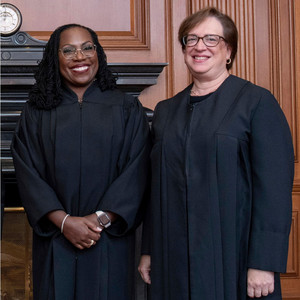
Well, the starkest split is between Justice Elena Kagan and Justice Katonji Brown Jackson, who have taken very different approaches to countering the conservative dominance of the court.
And you see a real tension between their two different approaches emerging.
Okay.
And where should we begin to tell that story?
Well, let's go back to the first moment when one of these people arrives at the court.
Justice Elena Kagan, appointed in 2010 by President Barack Obama.
Now, she is appointed specifically to be a diplomat.
Interestingly, I found out she was recommended to President Obama by Justice Antonin Scalia.
So you've got the kind of— A very conservative justice recommending a pretty progressive one.
Oh, you've got this duke of conservative legal thought saying, send us someone smart.
Send us Elena Kagan.
Send us a former dean of Harvard Law.
Who had a reputation for treating conservatives well, inviting them in being a good diplomat at Harvard Law School, getting conservative faculty appointed.
And at the time that she gets to the court, Thank you.
What is its ideological mix looking like and what kind of decisions are coming out of that court?
Well, it's a 5-4 court.
It leans conservative, but not by that much.
And right at the center you've got Justice Anthony Kennedy, who was appointed by a Republican but sometimes voted with his liberal colleagues.
And the Chief Justice, John Roberts, definitely conservative, but had a desire to be independent.
So a conservative-leaning court where surprising things can happen.
Things were still up for grabs.
And so she comes to the court and she's never been a judge before, but she's very strategic and she comes up with a methodology of her own for how to operate on a 5-4 court.
I love the stuff where we can all really engage each other, try to persuade each other.
Where it's an uphill battle for her, but she has some chance of prevailing.
And we're an institution.
We're a very collegial institution, notwithstanding the fact we have all these opportunities for disagreement.
And her methodology is to form relationships and look for areas of agreement.
So she becomes a confidant of Chief Justice Roberts.
Who's part of the conservative majority.
Exactly.
She also keeps a really close eye on Justice Kennedy.
She is following his moods, his concerns, his inclinations.
And people who worked with them at the time even joked to me that she knew what he had for breakfast every morning.
There are some things that we do where almost nobody is persuadable.
But there are a lot of things we do where folks are.
She took notes on what her colleagues thought in conference meetings.
And what she's trying to do is find common ground with them, build consensus.
And she's trying to win outright, which she does in some cases.
How so?
So, for example, President Obama's health care law was challenged over and over by conservatives, and several times the cases made it up to the Supreme Court.
And at least in two of those cases, it was close.
People did not know which way it was going to go.
And the law survived in part because Justice Kagan and others on the court helped build liberal and conservative coalitions.
So let's call those, on balance, victories for liberals.
They were complicated, but they were victories.
That she helped achieve.
Exactly.
And she's also doing this other thing, which is winning by losing.
How does that work?
Well...
Now, within a particular case, there is often an ability to compromise things out.
If you're a Supreme Court justice and if you're a Supreme Court justice in the minority, and if you can't win, what you want to do is make the outcome less bad from your perspective.
The way that often happens in the courts business is by sort of redefining issues a little bit.
Like if you narrow the issues, it tends to be that you'll have greater consensus.
People who worked with her said that she would say things in private like let's make this opinion 30 better.
You have to keep talking.
And you have to find ways of readjusting the issue or of convincing each other.
So there's this 2018 case called Masterpiece Cake Shop.
This is the Colorado— Yes, the Colorado cake baker case.
And there's a baker who says, because of my religious beliefs, I should not be required to bake cakes.
For a same-sex wedding, right.
For a same-sex wedding.
So what happened in this case is that it looked like a loss for liberals.
The court decided in the baker's favor—
However, thanks to Kagan and others behind the scenes, they decided on grounds so narrow that the result was pretty meaningless.
The whole point of the Supreme Court is to set precedent.
That applies broadly to cases that are comparable.
Exactly.
And in this case, it was such a restricted decision that it barely applied to others.
It was a very hollow victory for conservatives.
So in this era of a 5-4 court where Kagan and the liberals know for the most part they're going to lose the biggest cases, she has clearly found a way to make legal lemonade out of lemons.
She's getting business done.
It's an atmosphere in which a dealmaker can get... some traction.
And that requires sacrifice, by the way.
It requires discipline.
Because Justice Kagan did object to some of the court's decisions and she is fully capable of punching hard.
And there are a couple of decisions in which she lets loose on the court.
But for the most part, she decides that it doesn't serve her mission.
Right.
If you're Justice Kagan and you want to keep getting business done with a conservative majority, a little bit of honey is going to go a long way.
Totally.
These people serve for decades together.
A slight can last a lifetime.
And in fact, in my reporting, I even found an example where she wrote a very strenuous dissent.
Kagan.
Disagreeing exactly with the court's decision and with the chief justice's opinion.
Right. but she took lines out of it.
Her original draft really had gone hard after the chief justice.
But before the decision became public, she softened it.
She took those lines out.
So that's the approach that Justice Kagan takes.
Keep the peace, make deals, and then about a decade into her service, everything changes.
We have breaking news right now.
Ruth Bader Ginsburg has passed away.
In September of 2020, Justice Ruth Bader Ginsburg dies.
A loss rocking the political universe tonight.
The battle lines over the court's future already being drawn.
Today, it is my honor to nominate one of our nation's most brilliant and gifted legal minds to the Supreme Court.
She is quickly replaced, as we remember, by Justice Amy Coney Barrett.
There have only been 114 Supreme Court justices in history, so every one is important.
But this one is especially important because it will put six conservatives on the court.
And all of a sudden, it is a 6-3 court.
And Amy Coney Barrett is not just any conservative justice.
She's put there by President Trump pretty explicitly to deepen the conservatives' hold over this court.
Correct.
The perception is not that he has appointed just some regular conservative justice, but that she has been put there to complete the 50-year conservative legal revolution.
Woo!
A post-war America!
A post-war America!
Confirm her now!
Confirm her now!
She is heralded on the right as kind of a conservative judge of their dreams.
She's a very religious woman.
She's got seven kids.
The right and the left both decide they know exactly what that means.
Hey, hey, ho, ho!
Everybody's got to go!
Hey, hey, ho, ho!
She is derided on the left.
She is a fulfillment of a very long dream of the bishops in the United States to overturn Roe, to deny people contraception and ultimately just to control women's fertility.
She is called a handmaid.
She is called a throwback.
We know why he picked Amy Coney Barrett.
We know what she's sent to do, and we know what she's going to do.
Things just look hopeless for the liberals.
It looks like they're going to be locked out for a generation.
Right, there's kind of a liberal death sentence air to this moment.
Correct.
It's just not clear if they're going to have any opportunity to win.
And, sure enough, pretty soon the court overturns Roe v Wade and completes that 50-year conservative legal revolution.
Right.
It didn't take very long.
No.
And so I have to imagine that for Justice Kagan, that strategy of trying to build consensus and win influence with the conservatives in the court— that doesn't really seem like it's going to work anymore.
Yes.
And just to give you a sense of how despondent the liberals were in that moment, think back to the dissent they co-wrote in the Dobbs case.
The three liberal justices including, of course, Justice Kagan, explicitly stated their sadness at the court's ruling.
They wrote, Hmm.
So this is a real low point.
But something interesting is also happening in this moment, which is that Amy Coney Barrett turns out to have an independent streak.
She's voting with the liberals sometimes, especially in smaller cases.
And when she votes with the conservatives, she sometimes says that she doesn't fully agree with them.
For example, she says very clearly that she disagrees with Justice Clarence Thomas's use of history in several important opinions.
She says, you're going too far.
I don't agree with your methodology.
And then it turns out behind the scenes she had not even wanted to take Dobbs.
The case that overturned Roe.
Just explain that.
She told colleagues, this is too soon, this is too fast.
So here President Trump has cast her in this position of this mother with seven children is going to be the capstone vote to overturn the federal right to abortion.
And in fact, she walks into the court and says, I'm not so comfortable playing an assigned role.
So, even though she ultimately does vote to overturn Roe, we learned that she was ambivalent, especially about the timing of doing that.
Exactly.
She did not want to take that particular case.
So what does Kagan do with that information?
She's a little bit of an opening, perhaps, with Justice Amy Coney Barrett.
But for the most part, she's just going to keep losing.
Well, my understanding is that she was very torn.
On the one hand, you're right.
She does see a little bit of an opening.
She and Justice Barrett are forming something of an intellectual bond.
But I think the question that Justice Kagan has at this point is whether Justice Barrett not to mention Chief Justice Roberts— are ever going to vote with the liberals on the really big cases in this era, the game-changing ones.
And if not, is it worth continuing to hold back, trying to find common ground?
So at this point, Justice Kagan is struggling to figure out what her best strategy is.
What she tells people close to her is that she's agonizing.
She's saying to herself, things are changing.
Is diplomacy still going to work?
Or do I need to get more confrontational?
And just as she is trying to puzzle that out, a new liberal colleague arrives on the court who is far less torn about those questions.
We'll be right back.
So, Jodi, talk about this new justice who arrives on the court.
As we all know, it's Katonji Brown Jackson and what she does to this dynamic that you have been describing.
So Justice Jackson arrives at the Supreme Court in 2022.
I am humbled and honored to be here.
And first of all, she's got a different biography, a different set of influences than Justice Kagan.
How so?
Listen, she's got a lot of the markers of membership in this club.
She's got double Harvard degrees.
She was a clerk at the court.
But in some ways, her experience is very different.
All of my professional experiences, including my work as a public defender and as a trial judge, have instilled in me the importance.
She's a former public defender.
Needless to say, she's the first Black woman on the court.
And she turns out to be kind of an outsider figure.
I have dedicated my career to ensuring that the words engraved on the front of the Supreme Court building equal justice under law are a reality and not just an ideal.
Thank you for this historic chance to join the highest court.
But also the court she arrives on is very different from when Justice Kagan arrived in 2010.
This is a 6-3 court that has just overturned major precedents.
Right, Kagan arrives on a 5-4, even if she ends up in a 6-3.
As one of my sources puts it, the difference between four votes and three votes is more than one.
The difference is so, so, so big.
And Jackson comes onto a court where she just knows she's going to be in dissent for much of her career.
She doesn't feel the same possibility that Justice Kagan did.
So she begins to explore different ways of making her voice heard.
Such as?
Well, for one thing, she's more outspoken in oral arguments.
Justice Jackson?
Yes, sir.
Two questions.
Is there any indication from?
Seniority is a really big deal at the Supreme Court and there's kind of this tradition that the junior justice defers.
So I'm sorry, can I just help?
I don't understand.
Are you saying that?
And according to public tabulations, Justice Jackson is really exceeding everybody else in airtime.
I don't think so.
I think it's to show that you have racial segregation...
There's this great quote from her where she says, I am not afraid to use my voice.
All right, I have little time.
I'm sorry.
No, I'm sorry.
Yeah, but you say they've changed the process, but now at least they're not looking back.
And then she's doing kind of the same thing in opinions writing separately.
Meaning the way it works on the Supreme Court is that Michael, if you and I are in the same coalition and if you're writing the opinion, I usually just go with whatever you're going to say, even if I don't like agree with every word.
Mm-hmm.
Offer a few edits and swallow hard.
Yeah, the traditional attitude is like, Michael is taking this one.
He's going to speak for the coalition.
It's not exactly the article I would have written, but I'll stick with you.
She wants to be a little bit more specific.
There are some times when, even after the principal dissent is written, I have a slightly different perspective or a different take on something or
And she speaks up in a way that's a little unusual for a junior justice.
Where I will say, forgive me, Justice Sotomayor, but I need to write on this case.
It took the chief justice 16 years after he arrived on the court to do separate writing like his own little separate side dish of his own legal reasoning.
Justice Jackson starts doing it immediately.
And she is striking a different tone.
She's willing to go there in terms of being critical of her colleagues and critical of the institution.
We see this very early in the affirmative action decision.
For instance, she basically says that her colleagues are clueless about racism.
Justice Jackson, you know, it's interesting.
She is a very warm person, and she's very cautious in interviews.
But on the page, she can scorch.
And remember, to say that this world is formal and polite is to put it mildly.
If you say, I dissent instead of I respectfully dissent, that is like a burn.
So she's quickly establishing herself as kind of the anti-Kagan.
She has a different theory than Justice Kagan of how to be an effective justice.
She feels she has to be blunt.
You know, like associates of hers have described her thinking to me and her strategy is deliberate.
She has basically reasoned that on a 6-3 court she's not going to persuade her colleagues and any gains that would be exacted would be so small that they wouldn't be worth the price of staying silent.
And so in her opinions, she's often speaking to the public.
She's saying, you need to know about this.
I want to raise your awareness.
I find this troubling.
And you know, it's a kind of writing for history in which you're betting that even if nothing happens immediately, it will result in long term change.
And then, after Trump gets back into office and she sees the barrage of President Trump's legal actions, she decides she has to warn the public about what's happening.
And so we start seeing these opinions from Justice Jackson, in which she's writing from inside the House.
And she's saying things like, this court is beholden to moneyed interests.
She says this court is enabling our collective demise since President Trump has gotten back into office.
Sound to me like she's saying I'm sitting here inside the Supreme Court and I know these colleagues.
I see what's going on on the inside and it is really bad.
And how is this being received by Kagan, given her approach?
Things start to get tense among the liberal justices.
There is just this existential dilemma and this split in strategy, because you have to realize – that Justice Jackson going for it is potentially very threatening to Justice Kagan's strategy.
Look in practical terms, the only way for liberals to win on this court is for Justice Barrett and Chief Justice Roberts to vote with them.
So the risk that Justice Jackson is taking is that she could alienate these people, and then the liberals don't have any chance at all.
That is not the path to Kagan's metaphorical 30 percent better ruling.
No, it's not.
But the Jacksonites, and remember that Justice Jackson has a lot of adherents who believe that what she's doing is very important.
What they would say is, Justice Kagan, what are you holding back for?
What do you think you're going to gain from this?
And they have some evidence to back up their position.
Such as what?
For example, go back to Colorado and the question of who's going to serve these gay couples who want to get married.
The Baker case.
Yeah, exactly.
Another case comes along.
This is like a carbon copy of the Baker case, except that it's a graphic designer this time, who doesn't want to make wedding websites and invitations for gay couples.
And so this time, the conservatives just win full out.
And that little compromise is wiped away.
And the principle is established that yes, a religious person can refuse to serve a gay couple because it doesn't comport with that person's religious beliefs.
So basically, this would be fuel for Justice Jackson's argument of what is the point of pretending that we're going to get something from this conservative majority.
You're not getting your 30 because this court just wiped out the 30 you even thought you got back in 2018.
Yeah.
Correct.
But my sources debated this, to be honest, again and again, because there were Kaganite sources who said, just as Kagan won five years of protection for these gay couples, don't knock it.
That's a lot of real people who benefited from this decision.
And on top of that, Justice Kagan has still gained some victories on the 6-3 court.
Last term she had a win on federal agency power and she won three votes from the center of the court, three votes from the chief justice Justice Kavanaugh, Justice Barrett.
So there is still potentially some case for compromise.
So you can go—I mean, the liberal—
Law arati, the law professors, the Supreme Court.
That's a new phrase.
Thank you.
The Supreme Court advocates, they are lit up by this question of what is the best strategy.
And then, in the most important case of last term, Justice Jackson finds herself in a real clash with Justice Barrett.
This was a case called Trump v Casa, in which the court decided that federal judges could no longer issue nationwide injunctions.
And by doing that, they're really limiting the judiciary's power to stand up to President Trump.
And so what happens in those opinions is that Justice Barrett and Justice Jackson have a giant public fight.
Justice Jackson, in her dissent, writes that quote And she signs off by saying quote And those words are a direct criticism of Justice Barrett, who has written the majority opinion for the conservatives.
And Justice Barrett, who is usually a pretty mild writer, she hits back in the opinions.
She says we're not even going to consider some of what Justice Jackson says here.
So this kind of brings to the fore the fear we mentioned, which is that Justice Jackson could alienate Justice Barrett and the Chief Justice.
So what we're seeing, clearly, is both approaches finding their limits in this moment.
Kagan's compromises are getting washed away by the sheer severity of the court's rightward turn, and Jackson's Sharply worded dissents are beginning to alienate the conservatives in a way that might even further marginalize the court's liberals.
So I guess the question then becomes which of these strategies is most likely to work out in the longer term.
Yes, that is certainly a debate.
Justice Jackson appears to have chosen a stance and have chosen a tone.
And maybe that will change.
But at least recently, she's been very forceful.
The justice who really has a decision to make is Justice Kagan.
Because remember, she is the one who's agonized all these years over whether she's doing it right.
People close to her who saw her over the summer they said she was despondent about what was going on, that she is really worried about the state of the country and the law.
Right now Michael, as we sit here, this is when the Supreme Court is making the real, lasting decisions about President Trump's power.
The decisions from last term were very consequential.
They were also mostly temporary.
Right.
Cans were kicked down the road to now.
Exactly.
So the question is, does Justice Jackson remain on this path?
And for Justice Kagan, who does she ultimately want to be?
And how will the strategic decisions by both of these justices affect how much power President Trump ultimately gets?
And what will that mean for the court, the country and the future of our democracy?
Jodi, thank you very much.
Michael, it's always a pleasure.
We'll be right back.
Here's what else you need to know today.
On Tuesday, the Democratic governor of Illinois, J.B.
Pritzker signed a law that restricts immigration enforcement outside state courthouses, limits the information that can be given to immigration agents and makes it easier for residents of the state to sue immigration agents if they believe their rights have been violated.
The law is a direct response to President Trump's crackdown on undocumented immigrants in the Chicago area, which has resulted in thousands of arrests and repeated clashes between agents and residents.
But it's unclear if the Trump administration will observe the new law.
In response to it, the Department of Homeland Security said that arresting immigrants in courthouses is legal and quote is common sense.
Today's episode was produced by Rob Zipko, Mary Wilson, and Ricky Nowitzki.
It was edited by Devin Taylor.
Contains music by Brad Fisher, Will Reed, Marion Lozano, Dan Powell, Rowe Nimisto, and Pat McCusker.
And was engineered by Chris Wood.
That's it for The Daily.
I'm Michael Barbaro.
See you tomorrow.