Welcome to the show.
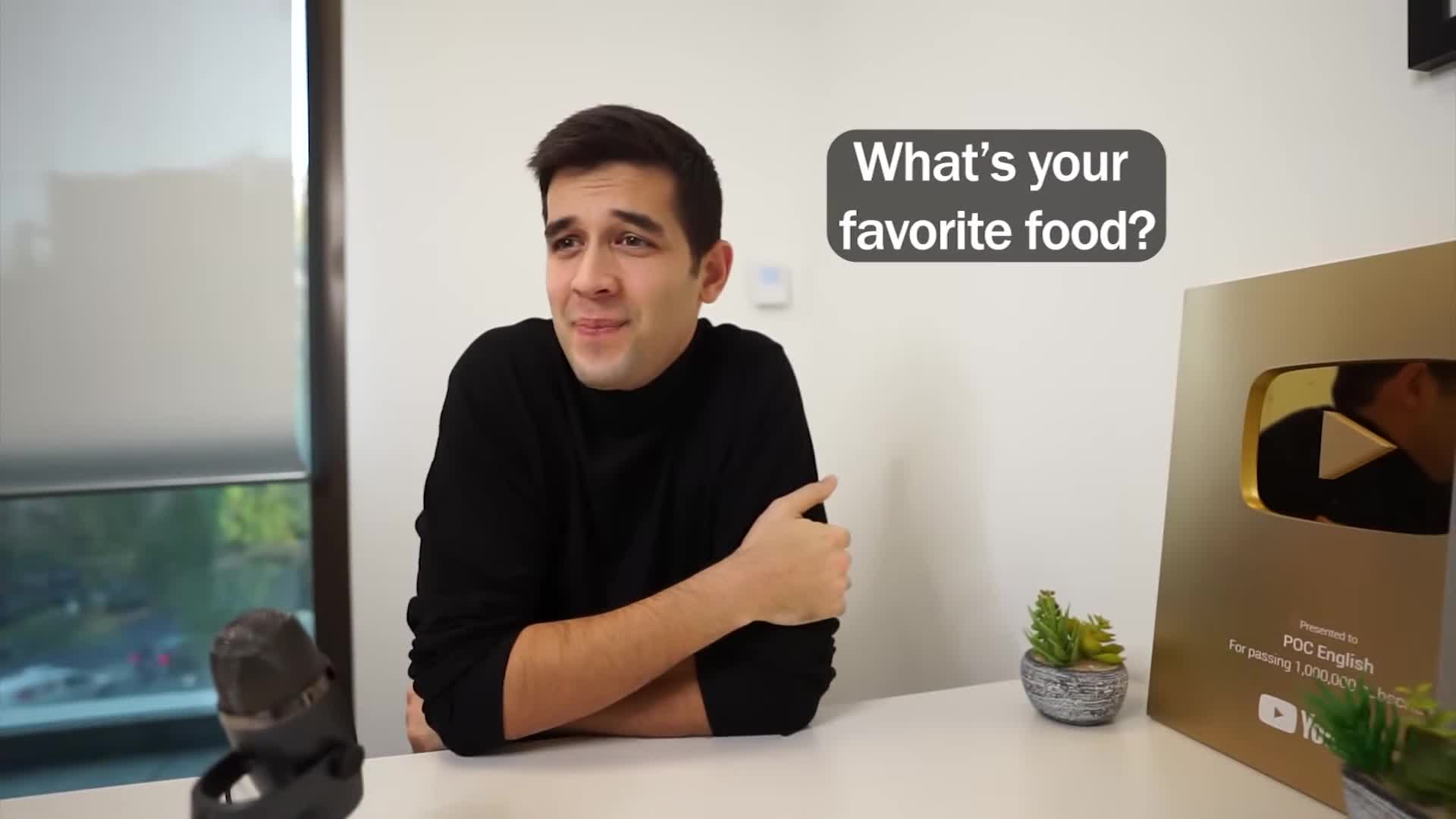
What's your favorite food?
I like chicken and I hate fish.
Candidate number two.
Same question.
What's your favorite food?
I have a genuine liking for seafood and a huge aversion to poultry.
Yeah.
When you talk about likes or dislikes, you can simply say, I like.
I like apples.
Or if you don't like it, you say, I don't like.
I don't like oranges.
It's totally fine.
These are very good phrases, simple and useful.
But if you want to level up your English and sound more advanced, you need to improve the level of phrases or words you use to talk about your likes and dislikes.
And that's what we're going to do in this lesson.
This video has three parts beginner, intermediate and advanced ways of talking about your likes or dislikes.
Part one, beginner level.
The most common way is to say, I like, after I like.
You can either use a noun or a gerund.
A gerund is a verb with ing.
So you can say, I like tennis.
I like ice cream.
I like cookies.
Or you can say, I like playing tennis.
I like eating ice cream.
I like baking cookies, so I like.
With a noun or a gerund, to make it a bit nicer, you can say I really like, I really like ice cream, I really like eating ice cream.
To level it up, if you really like something, you can say love instead of like.
Again after love, you can have a noun I love tennis or a gerund I love playing tennis.
So I like, I really like, or I love.
What if you don't like it?
Simply say I don't like.
Again after I don't like, use a noun or a gerund.
I don't like tennis.
I don't like playing tennis.
To make it nicer, you can add a really to it.
I don't really like ice cream.
I don't really like eating ice cream.
And if you don't like it at all, you can say hate instead of don't like.
I hate cookies or I hate baking cookies.
What do you do in your free time?
In my free time, I like reading books and I really like watching movies.
I like playing sports with my friends.
I don't like staying at home all day and I don't really like noisy places.
I hate wasting my time.
So I always try to do something fun.
Intermediate level.
Enough saying I like or I don't like.
Let's level it up. with a few very interesting and useful phrases.
But before we start this part, let me tell you one thing.
All of these phrases need to be followed by a noun or a gerund.
One of the two, all of them.
I will give you examples for each one.
The first phrase you can use instead of I like is I'm fond of.
Now you can use it with a noun.
I'm fond of classical music, or I'm fond of historical novels, or I'm fond of outdoor activities, or you can use it with a gerund.
I'm fond of spending time with my friends, or I'm fond of exploring new places, or I'm fond of trying new foods.
The next phrase is I'm keen on.
Again, you can use it with a noun or a gerund.
I'm keen on modern art or I'm keen on team sports or I'm keen on digital marketing.
I'm keen on improving my English.
I'm keen on playing the guitar.
I'm keen on taking part in group projects.
Another way to talk about what you like is to use this phrase.
I'm into or you can also say I'm really into.
It can be followed by a noun.
I'm really into fitness training or photography.
It can also be followed by a gerund.
I'm really into learning new languages or I'm really into listening to podcasts.
A very fun and interesting and advanced way of saying I like something is to use this phrase I can't get enough of, and then a noun or a gerund.
I can't get enough of good coffee or I can't get enough of Italian food.
I can't get enough of traveling around Europe or I can't get enough of watching comedy movies.
So these are the phrases with which you can express what you like.
But what about phrases about not liking things?
You can say I can't stand and then a noun or a gerund.
I can't stand dishonesty or I can't stand heavy traffic.
I can't stand repeating the same task or I can't stand dealing with rude people.
Another way to say I don't like is to say I can't bear.
I can't bear extreme heat or I can't bear loud arguments.
I can't bear working under pressure or I can't bear being interrupted.
This one's my favorite.
If you don't like something, you can say that is not my cup of tea.
It means I don't like it.
It's not my cup of tea.
Heavy metal music is not my cup of tea.
Or fast food is not my cup of tea.
I don't like it.
You can also use gerund.
Waking up early is not my cup of tea.
Or waiting in long lines is not my cup of tea.
What kind of activities do you enjoy and which ones do you usually avoid?
I'm fond of classical music and I'm really keen on playing the guitar.
I'm really into fitness training and I can't get enough of Italian food.
But crowded places are not really my cup of tea and I can't stand waiting in long lines.
I also can't bear being interrupted when I'm working.
Advanced level.
Before we continue to the advanced level, let me tell you something.
If you are really serious about improving your English and, more importantly, if you are serious about finally becoming fluent and speak English fluently, then this is your chance to join the POC English Academy during our Cyber Monday offer.
For a few days only, you can use our biggest discount ever, which is a 60 discount, and join our academy.
But what will you get?
You will get four courses of general English, IELTS, pronunciation, and English for leisure.
All four courses.
Plus, you will have access to our AI tools for speaking and writing.
You can practice 24-7. and unlimited practices included.
We have daily live lessons on Zoom.
That's right, every single day.
So you can see your teachers, talk to the classmates, and actually work on your speaking skill.
And finally, we have a very big global community of other students where you can meet them, make friends and find study partners.
All of this included with a 60% discount during our Cyber Monday offer.
So go ahead, click on the link above this video and don't miss this chance.
This is the only time we're offering our academy with a 60 discount.
Don't miss it.
Okay, let's get to the advanced level of expressing likes or dislikes.
Now, we're going to have a lot of phrases with the word liking.
What does it mean?
Liking as a noun means a feeling that you like something.
The first phrase to say I like something is this one.
Have a liking for.
You can also use some collocations to make it more advanced.
Have a genuine liking for.
Have a great liking for.
Or have a particular liking for.
I have a particular liking for classical architecture.
I have a genuine liking for independent cinema.
I have a great liking for international cuisine.
Now, the next one is very interesting.
Take a liking to something.
That means start liking something.
You didn't used to like it, but now you're beginning to like it.
Take a liking to something.
Again, you can use some adjectives to make it very interesting.
Take an instant liking to something or take an immediate liking to something.
She took an instant liking to her new colleague.
He took an immediate liking to the city.
It means he started liking the city.
Wow, it's a nice place.
Now, if you want to say that you don't like something, you can use this phrase.
Something is not to my liking.
The new layout is not to my liking, or the design of the room is not to my liking, it means i don't like it.
Now, what if you hate something?
Instead of i hate it, you can use this phrase have an aversion to something.
Have a strong aversion to something, that means you really hate it.
I have a strong aversion to dishonesty.
Or i have a strong aversion to chaos.
It means i hate it.
I don't like, i can't stand it.
Or here's another phrase you can use have a deep hatred of something.
Or you can say have an extreme hatred of something.
I have a deep hatred of injustice.
I have an extreme hatred of wasting time.
How would you describe your likes and dislikes when it comes to work or activities?
Well, i have a genuine liking for working on complex ideas and I have a particular liking for discovering new methods.
I took an instant liking to my current team because they are open-minded, but some things are not to my liking, especially noisy environments.
I have a strong aversion to dishonesty, and I have a deep hatred of wasting time.
And that's it, guys.
I hope you've enjoyed this lesson.
I have a homework for you.
Go to the comments section of this video, and I want you to do this.
Describe your likes and dislikes using the beginner, intermediate or advanced vocabulary that you have learned in this lesson.
I'm going to have a look at all your comments, so go ahead, start expressing your likes and dislikes.
See ya.