This BBC podcast is supported by ads outside the UK.
The Dakar Rally is the ultimate off-road challenge.
Perfect for the ultimate defender.
The high-performance Defender Octa.
626 horsepower twin-turbo V8 engine and intelligent 6D Dynamics air suspension.
Learn more at LandRover.ca The interview.
The best conversations coming out of the BBC.
One of the greatest tennis players in history, Martina Navratilova.
People shaping our world from all over the world.
Music icon Stevie Wonder.
From global leaders.
The Brazilian president, Luis Inacio Lula da Silva.
The president of Poland, Karol Nowrocki.
US president Donald Trump.
To cultural icons.
Two-time Oscar-winning actor Sir Anthony Hopkins.
The interview from the BBC World Service.
Listen now wherever you get your BBC podcasts.
Social media companies are under the spotlight once again.
The industry of social media is very closely watching how this case goes.
Meta are passing the buck and putting it on the shoulders of parents yet again.
It's World Business Report from the BBC World Service.
I'm Rahul Tandon.
The woman who says social media damaged her health as a child has given evidence in court.
We'll hear from our correspondent who was there.
And Instagram is to inform parents in several countries if their child searches for content about self-harm and suicide critics are unimpressed.
Hello, how are you?
We're going to start the programme by talking about one of the stories of our time, and that is the impact that social media has on kids and how addictive are those algorithms of the tech companies that run them.
And today is a significant one in that debate because the woman who says social media damaged her health as a child has given evidence in a court in the US.
Her case is against two social media giants, Meta and YouTube.
Peter Bowes, our correspondent, was watching those proceedings.
This is definitely being seen as a test case that could have far-reaching implications for all social media.
This is a case that is focusing right now on YouTube and Instagram.
But there are more than a thousand people who are in a similar position.
They say to the claimant the plaintiff in this case making the allegations against social media, who want to bring their cases to court as well.
So this has been described as a bellwether case really essentially to see how it goes and how the jury responds.
It was actually chosen by the judge in this case to use as an example.
But far-reaching consequences.
Perhaps initially, if it goes against social media, Instagram and YouTube in particular, it could be financial implications, but also implications in terms of how they operate in the future.
Which could have implications for all of us.
We know, don't we, that TikTok and Snap settled before this case came to court.
You've been inside court where the plaintiff, the woman she's now a woman, isn't she at the centre of this case has been giving evidence.
Describe what that was like.
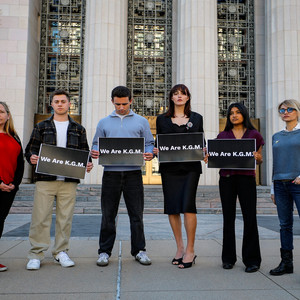
It was about two hours of very intense testimony from the woman who is being known as Kayleigh GM not her full name, because the harm that she says was done to her happened as a child.
So her full identity is being protected.
But she gave in some considerable detail an account of how she's used social media from a very young age.
She opened, she said, her own YouTube account at the age of eight and, shortly after that, Instagram as well.
In fact, she said she had several accounts and the reason for that was that she said she used the other accounts that she had to like posts on her other accounts.
And she said that getting likes was incredibly important for her that she would feel depressed, she would feel upset, she would feel as if she wasn't worthy if she wasn't getting those likes.
So that was her mechanism to try to boost the number likes.
She had dozens and dozens of different posts on especially YouTube, by the age of 10, and she talked about how, by the age of 10, she had started to on occasion cut herself.
It wasn't a suicide attempt, she said, but she had cut herself as a coping mechanism to deal with her depression.
And the depression came from, as I say, not getting enough likes or indeed the bullying that she says that she experienced in social media, and a feeling that she wasn't worthy that she was.
Her appearance was being criticised and that she felt ugly.
All of those issues played into how she felt about herself then.
And interestingly, when asked about how she feels about her life now as a 20-year-old, she still has some of those feelings and still uses social media.
One example, she says it takes her three to four hours to get ready to go out in the morning.
That's because she puts so much attention to how she looks.
This is a hearing that started at 9am.
She said she got up today at 3.45am just to prepare to be here.
We had Mark Zuckerberg giving evidence last week.
We've had the plaintiff now giving evidence today.
Are we going to see her back in court later?
And where exactly are we in this case now, Peter?
She will continue on the witness stand when she will face cross-examination from the lawyers representing Meta and Google's YouTube channel.
They will blame her upbringing.
They will blame aspects of her childhood and perhaps the way that she related to her mother, especially during those very early years, for the ill health that she suffered.
The case itself still has several weeks to go.
We expect to hear from other witnesses, potentially from whistleblowers who've come forward to talk about what they know about how these social media companies operate.
And this won't be the only case.
There are a number of other cases in the pipeline, aren't there?
Yes, there are.
There are potentially dozens and dozens of other cases.
But the industry of social media, if you can put it like that, is very closely watching how this case goes in terms of, I think, especially the jury's reaction to the claims and also the counterclaims.
And that could determine how all of these future cases go.
Let us bring in Kerry Leahy to react to what Peter has heard in court.
The economist at Columbia University in New York.
And Kerry, Peter used the word social media industry.
This is a case that the business world is watching, parents are watching, children are watching as well.
It has huge implications, doesn't it?
Yes, it's an industry that's extremely powerful and extremely pervasive.
The famous expression, move fast and break things, certainly applies here.
And it's hard enough growing up and just being a kid, with all the demands of social media that's being – outlined in this court case.
And it is a lot of money because the platforms themselves have said it's not our fault or our problem.
It's what the third party vendors are doing.
So we don't need to really police that or we're already policing it fine.
It's just being it's still not our problem.
Yeah.
And it's important because these are billion dollar companies, but it's not just the scale of them.
It's how quickly they're growing as well.
That's right.
It's not only that they're making a lot of money now, but they continue to make even more money and they're even more pervasive.
I mean yes, there is backlash and there are parents apparently quite a few of them in the IT sector who won't let their kids be on social media.
But still, net-net, the overall industry is growing very rapidly and is very profitable.
Yeah.
Let us stay with this story because, as we've explained there with that court case, tech giants are coming under increasing pressure around the world to do more to protect those children who use social media.
Now one social media company Meta, which of course owns Instagram and Facebook, says it's introducing an important new safeguard to regulate self-harm or suicide on the platform in a number of countries.
Here's our technology editor, Zoe Kleinman.
Instagram has made a number of changes to its teen accounts recently and the account is by default linked to the parent's account.
And now, as of next week, parents will get an alert, either as an email or a text or a WhatsApp, or on the Instagram app itself, if they have it, to alert them if their teenager has been searching for this content repeatedly in a short space of time.
OK, that sounds like a good idea, but some think the company should be doing more.
Ian Russell's daughter Molly, took her own life at the age of 14 after viewing harmful content online.
Imagine being a parent of a teenager and getting a message at work saying your child's thinking about ending their life.
I don't think that's a very sensible way of doing things.
And the biggest problem of all is that, instead of taking responsibility for the harms that they provide to young people, Meta are passing the buck and putting it on the shoulders of parents yet again.
There we go, Ian Russell there.
Meta, of course, say that it is not all their fault.
Parents have to take responsibility as well, and that they are putting safeguards in place for children.
Kerry, I suppose the big point here is...
How do we regulate these tech companies that are becoming so big?
Are we going to see it done by governments the EU's trying to do that or are we going to see it done through the courts?
Well, I think in the States it'll be done through the courts, because the current administration is probably not going to apply a great deal of pressure to these companies.
So I would expect it to be more a judicial outcome than a political outcome.
Yeah, we will continue to keep a course, of course, across that particular court case.
Let us now turn. to what is a real-life Hollywood drama.
And that is the battle for control of Warner Brothers Discovery, which of course owns franchises like Harry Potter, which my children love, and Superman, which they don't love that much.
There are two bidders Paramount Skydance, led by the tech billionaire Larry Ellison's money and family, and Netflix.
And its CEO, Ted Sanderoth, is heading to the White House as we speak.
And this is a story that keeps changing.
And we've seen this week, haven't we, Kerry, Paramount increasing their bid for the company.
Yes, this is a situation where the three companies, both Paramount and Netflix, stock price went up.
Many investors who own Netflix really don't want to be any further involved with Warner Brothers.
And Paramount's making a sweeter deal and many investors think that's a better fit.
So both stocks went up, one that may lose the deal and the other that may make the deal.
Let's see what happens.
And Netflix does have the ability to come back and match that deal if they so want to.
This is not, though, just about money.
It's about politics as well, which is why it's been grabbing so many headlines.
Speaking to the Stay Tuned for Preet podcast, Netflix board member Susan Wright recently had this to say about President Trump
It's not going to end well for them, for those that decided that they would act in their perceived very narrow self-interest which I would underscore as very short-term self-interest and, you know, take a knee to Trump.
I think they're now starting to realize, wait a minute, you know, this is not popular.
Trump is not popular.
What he is doing, whether on the economy and affordability or on immigration now, is not popular.
President Trump not surprisingly responded to those comments earlier this week by calling on Netflix to sack it.
Not the best news for them when they're in the middle of a bidding war.
And, speaking to the BBC earlier this week, Netflix's CEO, Ted Sarandos, had this to say about those comments
This is a business deal.
It's not a political deal.
This deal is run by the Department of Justice in the US and regulators throughout Europe and around the world.
It's quite weird, isn't it, for a president to be weighing in on this stuff?
Yeah, he likes to do a lot of things on social media.
Well, the CEO of Netflix there, Ted Sarandos, and he is expected to be at the White House very, very shortly, though he is not expected to meet with President Trump.
He will meet with other White House officials.
A lot to unpack here.
Let's bring in Guy Petty, former Paramount executive.
He's now head of the consultancy firm Fulcrum Media.
I mean, this is a Hollywood.
Someone's going to make a film about this, aren't they?
Oh, absolutely.
It is pretty interesting.
The process is really, it's actually moved very methodically, but it does keep moving.
It does keep moving.
So who has the upper hand at the moment?
You were at Paramount, they've put in a much better deal, haven't they?
It seems like there's a lot of people at Warner who like that.
So are they in the driving seat at the moment?
I'm not sure they're in the driving seat, but I think that they're pretty close to the driving seat again for the moment.
It took a long time.
It took several months to even get here.
And so now we've got what we think is Paramount's maybe not their best and final, but got to be pretty close to it.
And then we'll find out what Netflix comes back with, if they come back.
Yeah, they may not.
They may not come back.
I mean, there's the money side of it.
And the deals are on the table for both of them.
Let's see if Netflix decides to come back.
What do you make of the politics of this, particularly what President Trump has had to say about Susan Rice, who is a Netflix board member?
Will that have an impact here?
It shouldn't do, should it?
I don't think so.
I mean, I think Ted kind of summed it up pretty well.
It is a business transaction.
This is a high stakes deal.
And, just given the nature of it, I do believe that all the regulatory bodies around the world, for that matter, including the Department of Justice, are going to be allowed to do their jobs, which is to review the transaction and see if there are any issues.
And then What does each company need to do to resolve those issues?
Why do both companies want Warner Brothers so much?
And which one do you think would benefit the most from having it?
Actually, I think both of them would benefit.
I think over the short term, I think Paramount would benefit the most.
They just need scale.
They're the smaller company compared to its own peers, right?
Just from a revenue standpoint, Disney and Comcast are much bigger.
Warner Brothers is also bigger, but not to the magnitude that Comcast and Disney are.
But Netflix would love to have them too, because it basically strengthens their leadership position around the world for, I think, for the foreseeable future.
It's a deep library with known franchises.
And in the world of AI, no one knows what that really – kind of the impact of AI is going to have down the road.
And having those franchises, I think, is a great asset.
Final thoughts from you.
This is an issue that's causing a lot of debate within the industry as well.
James Cameron, very famous director.
People remember the Titanic.
He's come out quite categorically saying this cannot go to Netflix.
Yeah look, I think that just looking at it, you've got three major media companies that are going to become two.
No matter what happens.
So there's one less player.
There's one less person, one less company that James Cameron can pitch.
And I think that's a bit unsettling because it's already happened when Disney bought 20th Century Fox.
So I think there's a little bit of concern there.
It certainly is.
Guy, long way to go in this story.
I think we may be talking to you again with more twists and turns.
Thanks so much for joining us, Kerry.
Let's bring you in here.
And that is a concern, isn't it?
The fact that we're having everything becoming consolidated in the hands of just a few companies now.
Yes, everyone is supersizing.
And, in the case of Amazon, Amazon is keen on Warner Brothers because of their library and their ability to stream new movies.
One of the reasons why the old guard doesn't like this is that Netflix doesn't want to actually release new movies.
And they've been very hesitant to do that.
I think if they change that, there'll probably be reduced pressure from the old guard.
But right now, anybody that wants their movie to be shown the old-fashioned way, with the screen going up and down, isn't going to like Netflix.
No.
Let us see what happens here.
The Interview The best conversations coming out of the BBC.
One of the greatest tennis players in history, Martina Navratilova.
People shaping our world from all over the world.
Music icon Stevie Wonder.
From global leaders.
The Brazilian president, Luis Inacio Lula da Silva.
The president of Poland, Karol Nowrocki.
US President Donald Trump.
Two-time Oscar-winning actor Sir Anthony Hopkins.
The interview from the BBC World Service.
Listen now wherever you get your BBC podcasts.
Now, if you were listening to the programme last night and of course you were we spoke to Susan Schmidt, one of our regular markets guests and portfolio manager at Exchange Capital Resources in Chicago, because we were all awaiting those NVIDIA results.
They came out just before we came on air.
They look pretty good.
And Susan was one of those who was impressed with the results.
NVIDIA came back with a great report, incredibly strong, talking about how much the business has grown, that net income doubling over a year ago.
So a really strong quarter.
And importantly...
Nvidia's management talking about the continued strength that they see.
And that should assuage investors' concerns that are we in a bubble with AI?
Where are we on this?
How far can it go?
This certainly implies that there's a lot more runway ahead.
So we all thought this was good news.
Markets were all going to go up.
The AI bubble debate would disappear.
That's not happened.
CJ Muse joins us now.
He's Senior Managing Director at Cantor.
Fitzgerald closely looks at NVIDIA.
Great results, not the market reaction that many or NVIDIA would have hoped for.
Yeah, I mean you know, ever since the Big Bang back in 2023, where they, you know, demolished numbers.
You know what they reported last night actually was far better than even that beat.
Yet, you know, as we saw today, the stock sold off four or five percent.
You know, I think the fear, ongoing fear, just remains the sustainability of hyperscale capex And you know that is showing itself in NVIDIA's performance as well as, you know, most AI infrastructure related stocks today.
Okay.
CJ, explain this to our listeners.
Many of them hear how AI is the next industrial revolution.
Companies are earning more and more money from it.
So why do we think there might be an AI bubble?
You know, when we start talking about numbers that make you blush, i.e.
$500, $600, $700 billion of budgets, you start to worry that, is this sustainable?
Are there the return on invested capital opportunities?
And we're in the bullish camp.
We think we're just in the early second or third inning of agentic and physical AI.
We think plenty of ROIC opportunities will emerge.
And that AI will be transformational to how we, you, me live our lives.
But, you know, it's going to take time for the market to gain confidence in that.
OK, stay with us.
I want to bring Kerry back into the conversation here.
Are you bullish here, or does this remind you of the dotcom boom, where you know a lot of companies got through it, but a lot of companies disappeared?
Well, I'm an economist and always want to find the gray among the silver clouds.
I would be nervous about a bubble.
It's hard to say if you're going to achieve the actual bubble, but this is probably time when you want to back away and take some of your chips off the table.
As some of our listeners know, NVIDIA is actually not done as well as the Dow Jones the last six months.
It's only up about 8%.
So investors are backing away.
I mean, they're still enthusiastic and they're hopeful that it will provide the kinds of transformative changes that people are talking about.
But for the moment maybe it's a good time to just pare back a little bit and watch a little more closely, but with less stock under your belt.
Okay.
Final thoughts from you, CJ Muse.
If you're in the NVIDIA boardroom, are you sort of banging your head on the table saying that we keep outperforming?
What more do you want us to do?
Yeah, well, I think that, you know, number one, they added stock based comp to their expenses.
I think they're trying to show that that is kind of a normal expense for their business and they're trying to be shareholder friendly.
I would expect they will become more aggressive with share buybacks.
OK, well, let us see.
You know, people can make up their own minds out there.
We never give any information about what you should be doing in those circumstances.
I want to go back Kerry, because we're just getting some reports now on the story we were talking about before.
Netflix rejects matching Paramount offer for Warner Brothers.
That's significant, isn't it?
Yes, it seems like they're backing away and aren't going to make a counteroffer, because they probably think they're spending enough money and they're satisfied with that.
And if that doesn't work, they'll let the other guy win.
Yep, let us see.
More details as we get them.
We will, of course, cover that story here on the BBC World Service.
Tesla and the German union IG Metall have agreed for now to set aside their dispute over a Labour meeting at the carmaker's plant outside Berlin.
Tesla filed a criminal complaint against a member of the union it accused of secretly recording the meeting on the 10th of February, which IG Metall described as It gives you, I think, a sense of the fact that all is not well between the union and Tesla.
So I have been speaking to Marcus Revis.
He's from the union and he's been telling me about what has been going on.
We have agreed to a settlement today of Tesla not to repeat certain accusations.
And there was an incident at the workers' council two weeks ago.
And then people from the workers' council which are close to the management, accused a colleague from me from IG Metall that he had recorded the workers' council's meeting.
Which is not allowed, is it?
This would be a crime in Germany.
And of course, we say he didn't record it at all.
But then the dispute escalated and now we agreed not to repeat certain quotes.
We have the elections, don't we, for the Workers' Council next month.
And those are important.
Before we go into that, just explain to our listeners why they're important.
Well, the Workers' Council has a lot of influence in German factories to improve the working conditions.
And there's a lot to improve at the Giger factory here in Brandenburg, close to Berlin.
What is that that concerns you?
Yeah.
There's a lot of pressures on the workers.
Our candidates from IG Metall, they want to improve.
They want to have more people on the working line.
They want to have more possibilities to plan their vacations, their holidays.
They want to... have better health security in the factory.
They have a lot of demands and there's a lot to do to improve the working conditions.
And so far we had a workers' council which is very close to the management.
But that is elected by the workers though, isn't it?
That was their choice.
That is elected by the workers.
And at the last election two years ago, IG Metall came out as the largest single group, but we didn't get the majority.
And obviously, we want to change this next week.
It's due on Monday to Wednesday, the election.
So we're very close to the election.
It's a very important step for us.
Is it right that this factory, which is Tesla's only factory in Europe, is the only one in Germany where wages are not set through collective bargaining agreements?
Is that correct?
That is correct.
Yeah.
And we're not talking about collective bargaining deal yet, but the majority in the workers' council would be a major step forward also in this issue.
You made a lot of points there about what you think Tesla should be doing better when it comes to workers rights.
But the honest truth is these are difficult times.
Tesla needs to increase productivity.
Their sales have fallen in Germany.
If you push too hard on this, we could see the factory closing down, not expanding.
That's not going to be good for workers, is it?
That's true.
And it's very important to know that we as the union of the workers support the factory.
We want the factory to prosper and the jobs are getting secure.
But we say the main problem for Tesla is now to get models which are attractive for the customers.
And it's not depending on the workers' council whether the factory is being held on here in Germany.
It depends really on the economic situation of Tesla and the attractivity of its models.
Markus Reves there of IG Metall Union.
We have approached Tesla for their comments on this particular story.
We have as yet not received a response from them.
Kerry Leahy still with us.
And Kerry.
This issue Tesla and the unions is not one that we're seeing playing out just in Germany.
We've seen it in Sweden and the US as well.
That's right.
You have a company that's been very successful, is running into hard times and clearly is less enthusiastic about unionized labor and is trying to find a way to cut costs.
And those who are going to get their costs cut.
Think that maybe Tesla needs a new and better lineup of cars to sell, and they'll help them make money on their own.
So it's not just labor's problems, it's labor's and management's problems.
Kerry, as always, thank you so much for guiding us through the issues that we've been looking at here on World Business Report.
Remember that story that is breaking as we have been on air.
Netflix, according to the AFP agency, has rejected matching Paramount's offer for Warner Brothers.
Vish will have a lot more on that story on the programme tomorrow.
The interview.
The best conversations coming out of the BBC.
One of the greatest tennis players in history, Martina Navratilova.
People shaping our world from all over the world.
Music icon Stevie Wonder.
From global leaders.
The Brazilian president, Luiz Inacio Lula da Silva.
The president of Poland, Karol Nowrocki.
US President Donald Trump.
To cultural icons.
Two-time Oscar-winning actor Sir Anthony Hopkins.
The interview from the BBC World Service.
Listen now wherever you get your BBC podcasts.