What if I told you that it's possible to read something once and absorb it immediately?
What if I told you that it's possible to show up in class and absorb a topic so fast it feels wrong?
Like, holy shit, I get this topic in just one read.
And believe it or not, it's actually possible given the right mindset.
And no, it's not spaced repetition or skimming the textbook or all these techniques that get you to absorb a topic really fast.
In this video, I will show you the actual actionable steps that you can take in order for you to absorb a topic really fast, instantly.
Now, the first step is to lessen your cognitive load.
What does that mean?
Before you even start learning or studying, you need to understand the concept of cognitive learning or the concept of our brain processing information.
Our brain can process so much information at a specific time.
This is what you call your cognitive load.
Your brain has a limited working memory and it can only hold up to around four to seven chunks of information at once.
Your brain's memory is fast.
The problem is that it's limited.
And the problem is if you overload it with a lot of information at once.
Your brain can only handle so much information at a time.
So much so that whatever is in excess gets discarded.
Now, obviously you need to eliminate all distractions and set your environment right.
Okay, obviously those are kind of basic tips.
However, there's one specific routine that is talked very little about, but it's actually very, very effective.
And that routine is to meditate.
Meditation before studying.
Let me explain.
Your cognitive load isn't just about processing information or your brain memory, but cognitive load also factors thoughts running into your head.
And think about it, this makes sense.
Whenever someone breaks up with someone before an exam, they tend to have a lot harder time in the exam because their mind is obviously somewhere else.
Their mind is obviously thinking about the breakup.
Or let's say you're in class and you had the thought of playing with your friends later.
Or let's say you received a package that you're excited to open later at home.
Those thoughts and that excitement of wanting to play with your friends or opening that package takes cognitive load in your brain.
Now, in order to absorb topics like a sponge, you need to first empty out what's here in the first place.
Joke's on you.
My brain is already empty all the time.
So before learning, try to output your emotions somehow.
Now, I would recommend meditation or journaling.
Those two are quite great ways in order to regulate your emotions and to, more importantly, output whatever is residual up here.
I recommend doing this in the mornings before school or any session before studying, because this sets up your day quite well and you're able to clear your mind before entering school or before studying.
Now, the reason why I'm talking about this first is because a lot of people tend to apply a lot of external solutions like OK, you have to do active recall, you have to blurt, you have to blah blah, blah.
They give all those advices but they don't take into factor that what if the person is thinking of something else already, which affects your absorption of information?
Before you apply certain solutions and techniques, you need to ask yourself why not tackle your brain first, before doing those techniques?
Alright, now that you've cleared your mind, step number two and this is where you're actually in class or when you're actually learning something, by studying by yourself or with friends, whatever is to stop skimming the whole thing, but rather skim the subtopics.
A lot of people will tell you to skim the entire chapter of a topic in order for you to grasp a good image of the subject.
And okay, I agree that to some degree this will help you form a sort of context around whatever you're about to learn.
Now the problem with this is especially in the medical field, because I'm in dental medical school is, as you skim, you're going to be bombarded with so much terminologies, especially if you're skimming the whole thing.
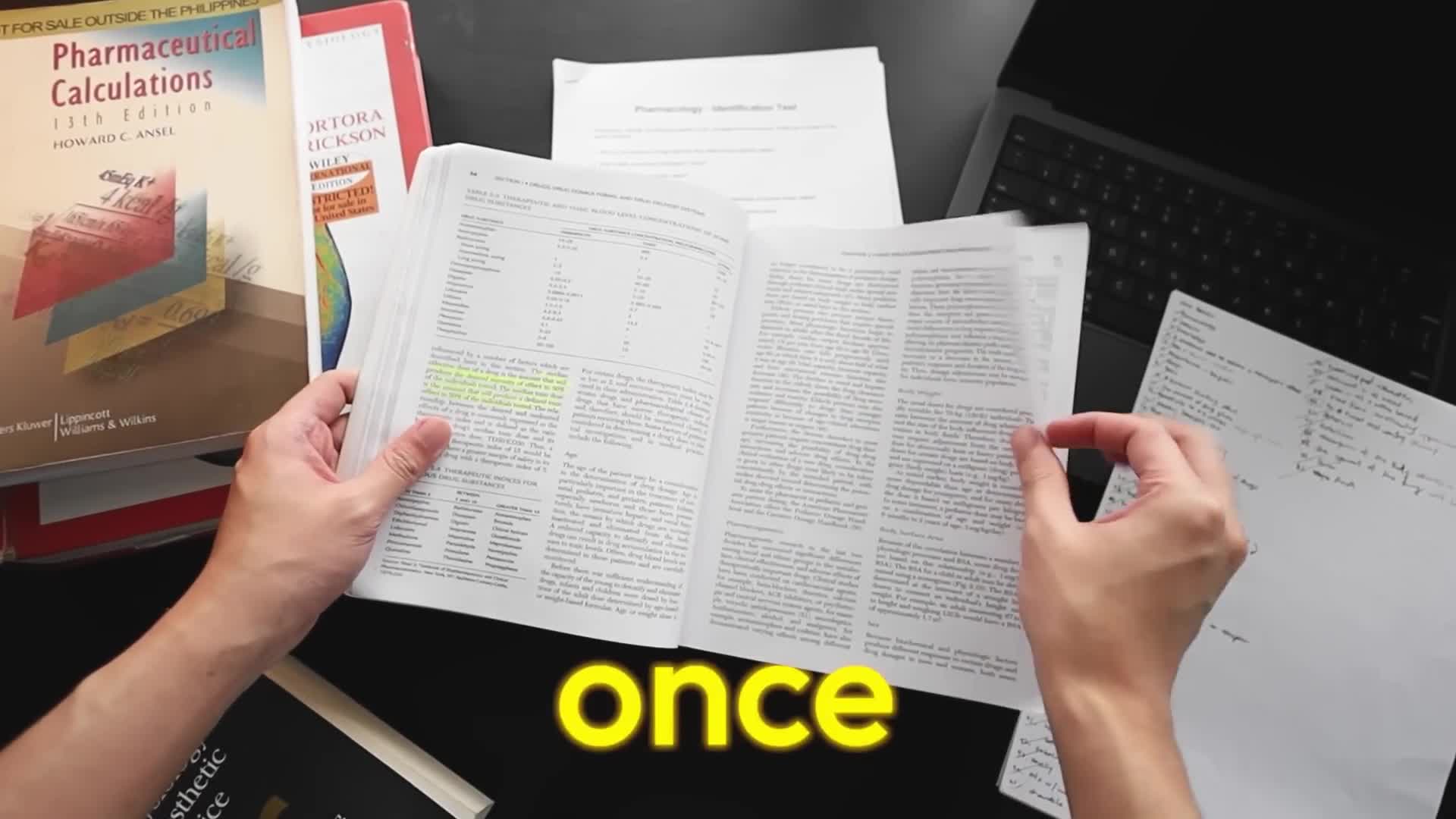
For example, I'm studying pharmacology right now and it is the bane of my existence and it is very, very factual, heavy with a lot of drugs that I need to memorize.
And the problem is, if you told me to skim the whole chapter first before I study, I'm just going to see terms like diazepam or benzodiazepine, which will just end up making me more confused because I don't know those drugs yet.
I don't know how they relate to the entire subject in general.
So after skimming, I'm just left with these terms like benzodiazepine diazepam morphine codeine, like so instead of focusing on the entire thing or skimming the entire thing, i would recommend skimming the subtopics or the chapter titles, or literally the contents, the table of contents, not the contents in general, i mean the table of contents.
So instead of reading the entire thing, read the sub chapters of the topic, for example, like i said in my pharmacology lesson, instead of reading the whole thing and then seeing all these drugs and terms.
Instead I just simply read the subchapter titles, because a lot of times those titles pretty much describe what we're going to be learning.
So in my case, reading the chapters would be okay.
This chapter is about drug administration routes, drug efficacy and potency, drug absorption, and you notice, just reading those sub chapter titles gives me a better picture of what i'm going to be studying rather than just randomly reading.
Codeine is metabolized, becomes morphine, like what the does that mean?
So the next time you are skimming through a chapter or a topic, try to focus more on reading the topic outlines or the sub chapters instead of skimming the whole literal thing.
Alright, the next step whenever you prime your mind in order for you to absorb topics faster, is to simply do a pretest.
And the reason why I'm putting this tip right now is because, at this point of time of making this video, AI is literally so accessible.
Like as much as I am against AI to replace learning.
Wholeheartedly, I endorse AI as a tool for learning instead.
And this is where creating your pretest comes in.
So what's really great about ChatGPT is you can literally just upload your syllabus or your textbook and a chapter and you can just ask it to make a pre-test for you.
Like literally, that's it.
It's that simple.
So, before studying, I recommend creating a pre-test of at least five to 10 questions, keeping it nice and short.
Now you may be asking me but Kai, didn't you just mention that you don't want us to bother skimming through the details?
But now you're quizzing us on those details.
You fucking hypocrite.
I'm unsubscribing right now.
No, okay.
The point of the pre-test is not about you finding out what the specific terms or the specific answers to these questions, but rather it will prepare you of what kind of questions you can expect.
And no, I'm not talking about the format of the question, but rather what is the question asking you in general?
And this gives you a good idea of what kind of terminology that you'll be having to look out for when you're studying for the subject itself.
For example, in my general pathology subject, one question came into my pretest, which was what kind of dense connective tissue absorbs forces from all directions?
And while honestly I didn't know the term because there was a pretest and obviously I didn't study the whole chapter which the answer is actually irregular connective tissue.
If you guys were wondering, at least from the question I knew that number one.
Okay, there are different types of connective tissue.
And number two, I will have to identify these characteristics of these connective tissues.
In essence, Pre-tests and skimming help a lot when it comes to giving your brain context.
And finally, the last tip that I want to give you is to literally take your time.
I know I just said that you could save a lot of time, but you're gonna waste much more time if you're gonna try and rush learning.
And I know it's very tempting to just speedrun through your subject or topic.
But trust me, it is so much more efficient in the long run to just take your time to learn everything at once rather than having to relearn everything again when the exam comes up.
Because think about it.
Let's say you do a speedrun through your subject of the topic.
Eventually, you will realize that you haven't really learned anything and you will end up re-studying when the test comes up.
And the thing is, you end up taking the same amount of time learning as if you had just studied the first time.
If you want to absorb topics like a sponge, you will really have to take the time to learn the information.
This is how I'm able to take exams without studying.
I don't typically study on the day before exams because I already have it in my head.
Usually I just revise information like flashcards and everything.
But in general I don't generally study that much before exams and I still get pretty high marks in med school.
So when studying, this is where chunking and blurting comes in handy.
Essentially in order to incorporate information much more efficiently.
Chunking and blurting every time you read a passage or learn a new passage is the way to go.
Try to look away from whatever you're reading and try to regurgitate that information in your own words back to yourself, without really looking at the book.
Once you're done regurgitating the information, especially in your own words, check the book and see if you're correct and repeat.
This is very effective because blurting and chunking takes advantage of two key characteristics of your brain.
The first characteristic is that your brain retains memory much more effectively when it is recalled.
So blurting in your own words will not only allow you to understand the topic even more, but to literally retain that information.
Your second characteristic is that your brain actually learns better through chunks.
This is why, if you give a person a string of numbers, they will have a hard time remembering the whole thing.
However, if you split the numbers into chunks, it'll be much more manageable for the person to memorize that string or chunks of numbers.
This is why phone numbers are in chunks and that goes the same for studying as well.
Instead of studying straight through an entire topic, break down your topic into separate chunks.
Now, the last thing I want to talk about is that these methods that I've been telling you is not a cheat code.
It's not something that can just instantly get you to learn something.
It is efficient methods for you to learn.
It is not a cheat code.
And I'm going to be honest blurting, chunking.
All of these methods that I've taught you today are things that you have to put effort into.
You can't just apply an external system and expect it to work, expect it for you to immediately understand whatever you're learning.
At the end of the day, you have to learn.
You have to learn the topic.
You have to go through the topic and understand the contexts and everything and to try and regurgitate in your own words.
That is truly what learning is.
A lot of people tend to try and find the cheat codes around it.
Oh, if I just do this and that, I don't have to put as much effort.
You will still have to put effort, but this is just more efficient.
Anyway, I hope you guys enjoyed today's video.
As you notice, I finally have a mic stand.
The mic used to be there, but I transferred it over here.
So now I don't have to hold the freaking mic while I'm talking.
So that is a great upgrade as well.
I remember in the last video I mentioned that I was gonna put the emoji of the day in the middle of the video, but clearly I was too much in the flow state to put that in the middle, so instead comment down brain, down below, like the brain emoji, and it will signify, of course, that you read or you've watched to this part of the video.
I still am doing exams right now.
I don't know why I'm recording all of this during my exams.
I should be studying right now.
But like I said, I don't really need to study.
Like everything that I've learned in classes are still here.
I just have to regurgitate some terminologies and flashcards again to myself.
But other than that, I'm not really pressured or anything.
Anyway, I hope you guys enjoyed today's video and I'll see you in the next one.
Don't forget to drink your water.
Bye.