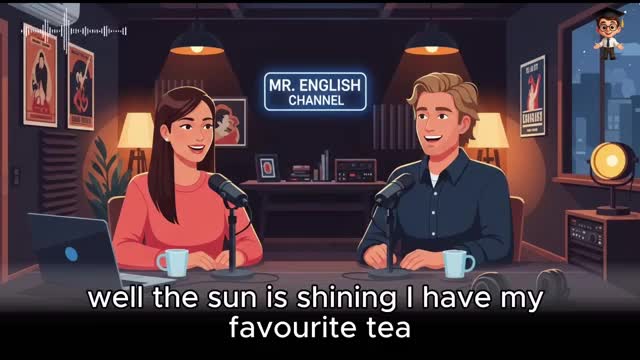
Hello everyone and welcome back to Mr. English Channel, where learning English is easy and fun.
I'm Emily.
And hello to all our friends listening.
It is so wonderful to be back with you today.
I am feeling very happy.
I can see that big smile, Paul.
Why are you so happy today?
Well, the sun is shining, I have my favorite tea, and we have a very important topic to talk about.
It's something everyone needs.
You are right.
Today we are talking about small talk, those little conversations we have with neighbors, colleagues or even people at the supermarket.
Yes.
Small talk is like a bridge.
It connects people.
But sometimes for English learners, it can feel like a very scary bridge.
It doesn't have to be scary, Paul.
We are going to show everyone how to do it in a very easy way.
We have tips for beginners and some for more advanced practice, too.
That sounds perfect.
I'm ready to learn.
Me too.
But wait, Paul, before we dive into our stories and tips, we should say something to our listeners.
Oh, yes.
Friends, if you enjoy our conversations, please take a second to click the like button.
It really helps our channel grow.
And don't forget to subscribe to Mr. English Channel.
We want you to be part of our family so you never miss a new episode.
And if you have a friend who is also learning English, share this with them.
Learning with a friend is always more fun.
Exactly.
Okay, Paul, let's start at the beginning.
Level one, basic small talk.
Level one.
Okay, this is for when you see someone and you don't know what to say, right?
Yes.
For example, imagine you are in an elevator or waiting for the bus.
It is very quiet.
Sometimes that silence feels a little awkward.
Oh, I know that feeling.
Yesterday, I was in the elevator in my apartment building.
A neighbor got in.
We just looked at the floor.
I wanted to say something, but I was nervous.
That is the perfect moment for basic small talk.
You don't need big words.
You just need a starter.
A starter?
Like a key for a car?
Yes, a key to start the conversation.
The easiest one is the weather.
Everyone talks about the weather because it's always there.
So I could say, it's a very hot day today, isn't it?
Perfect.
Or if it's raining, you can say, I hope the rain stops soon.
It's simple and friendly.
I tried that once at the bus stop.
I said to a lady, it is very windy today.
And she smiled and said, yes, I almost lost my hat.
We both laughed.
It felt good.
See?
That's a small victory.
You made a connection.
And the secret to Level 1 is to keep it short.
You don't have to talk for an hour.
Just a greeting, a comment about the environment, and a smile.
I like that.
Comment about the environment.
So if I'm at the supermarket, I can talk about the long line?
Yes.
You can say, it's very busy here today, isn't it?
Ah, okay.
I will try that next time.
But Emily, what about level two, when you want to talk a little bit more?
Level two is intermediate small talk.
This is for people you see often, like a colleague at work or a regular person at your gym.
Okay, so we already said hello and talked about the weather last week.
What now?
Now you ask about their day or their plans.
But here's the trick, Paul.
Ask open questions.
Open questions?
Are there closed questions, too?
Yes.
A closed question is one where the person only says yes or no.
For example, if I ask, did you have a good weekend?
You say yes.
Then the conversation stops.
Oh, I see.
It's like a wall.
Exactly.
But an open question starts with what, how, or why.
For example, what did you do this weekend?
Ah, then I have to say, I went to the park or I watched a movie.
Precisely.
It gives the other person a chance to share a little story.
And when they share, you listen and ask one more question about it.
Let me try.
Emily, what did you do on Saturday?
Well, I went to a new bookstore in the city center.
It was very cozy.
Oh, wow.
A bookstore.
What kind of books do you like to read?
Good job, Paul.
That was a perfect level two follow-up.
You listened to what I said and asked for more details.
That felt very natural.
It wasn't like a lesson at all.
That's the goal.
Small talk should feel like a game of catch.
I throw the ball to you with a question, you catch it, and you throw it back.
I like that.
A game of catch.
But wait, Emily.
I have a little story from this morning.
It was a bit of an unexpected moment.
Oh?
Tell me.
I went to the coffee shop, the morning cup.
There was a man there with a very beautiful dog, a big golden dog.
Oh, I love dogs.
Me too.
So I wanted to use my small talk.
I walked up and said, Wow, your dog is so beautiful.
What is his name?
That's a great starter.
What happened?
The man looked at me.
He looked very serious and he said, He doesn't have a name.
He is a secret agent.
What?
A secret agent dog?
Yes.
I didn't know what to say.
I just stood there like a statue.
I was so confused.
Was he joking?
Was he serious?
My brain stopped working in English.
Oh, Paul, that is funny.
Sometimes people are a little strange, or they have a very dry sense of humor.
In that situation, you can just laugh and say, Oh, I see.
Very mysterious.
Very mysterious.
Okay, I will remember that for the next secret agent I meet.
It's okay to be surprised.
Even in your own language, that would be a weird moment.
Don't let it stop you from trying again.
You are right.
Later, I saw a woman reading a travel magazine.
I said, are you planning a trip?
And she told me all about her dream to visit Italy.
It was a lovely five-minute chat.
That's wonderful.
See, one strange moment and one beautiful moment.
That is real life.
It really is.
So we have level one, the weather and environment, and level two, open questions and listening.
What is level three?
Advanced small talk?
Level three is when you start to share a little bit of your own opinion or a small reflection.
It's for when you feel more comfortable.
Opinions?
Like politics or religion?
Those are scary topics.
No, no.
Stay away from those in small talk.
I mean opinions on light things.
For example, if you are talking about a new movie, you can say I thought the ending was a bit sad, but the music was amazing.
What did you think?
Ah, so I share my feeling first, then I ask them.
Yes, it shows you are being open.
It builds trust.
You can also talk about goals or learning things like I'm trying to learn how to cook Italian food, but my pasta is always too soft.
Do you have any tips?
Oh, people love giving tips.
Everyone wants to be a teacher for a minute.
It's true.
It makes people feel helpful and important.
Hmm.
I have another story about Level 3.
It's a small life lesson I learned last week.
I love life lessons.
Please share.
Well, I was at work.
My colleague Sarah looked a bit stressed.
Usually we just say, hi, how are you?
And we both say, fine.
The fine trap.
Yes, the fine trap.
But this time I stopped.
I said, Sarah, you look very busy today.
Is everything okay?
Do you need a hand with anything?
That is so kind, Paul.
She stopped working and looked at me.
She sighed and said, Thank you for asking, Paul.
It's just a big project and I feel a bit overwhelmed.
We talked for 10 minutes.
I couldn't do her work, but she felt much better just talking about it.
Wow, that is the power of moving past level one.
You noticed her feeling, you offered help, and you gave her a moment to breathe.
That is advanced because it requires empathy and the right words.
It made me realize that small talk isn't always small.
Sometimes it's the start of a real friendship or just making someone's day better.
I agree 100%.
Small talk is the front door to a big house.
You have to go through the door to see the rest of the home.
That is a beautiful way to say it, Emily.
Now, Paul, I have a question for you.
If someone says something to you and you don't understand one word, what do you do?
Does the conversation die?
Oh, that happens to me a lot.
Last week, someone said the commute today was a total nightmare.
I didn't know the word commute.
And what did you do?
Well, at first I just nodded and smiled, but then I realized I didn't know if a nightmare was a good thing or a bad thing in that sentence.
So what did you say?
I was brave.
I said, I'm sorry, what does commute mean?
Perfect.
And? the person was so nice.
He said, oh, it's the journey to work.
The train was late.
Then I understood everything.
It was so simple.
Exactly.
Don't be afraid to ask.
Most people are happy to explain.
It shows you are actually listening and you care about what they're saying.
Yes.
It's better to ask than to just smile like a robot while you are confused.
No robots allowed in small talk.
Okay, Emily, I think I'm getting better at this.
We've talked about a lot of things.
We have.
Friends, if you are still listening and enjoying these tips, please comment conversation below.
We want to see who's practicing with us.
Yes, comment conversation.
It's a big word, but you can do it.
Now, Paul, let's talk about a very important part of small talk.
The beginning?
No, the end.
Oh, the exit.
That is the hardest part for me.
Sometimes I don't know how to stop talking without being rude.
I just stand there until it gets weird.
I think we've all been there.
Ending a conversation is a skill.
You need a polite exit phrase.
Like, goodbye, I'm leaving now.
No, that's a bit too direct.
You can say something like well, it was great catching up with you, but I should probably get back to work.
Oh, catching up.
I like that phrase.
Yes, it means talking about what has happened recently.
Or you can say, I don't want to take up any more of your time, but it was lovely talking to you.
I don't want to take up your time.
That is very polite.
It sounds like I am being nice to them.
It is.
You're saying their time is valuable.
And then you can add a future wish, like have a great afternoon or enjoy your lunch.
Okay, let me practice an exit.
Well, Emily, I have to go buy some milk, but it was wonderful to chat with you today.
Have a fantastic day.
Perfect, Paul.
You are a natural.
Thank you.
It feels much better to have a plan for the end.
It really does.
It takes the pressure away.
So, Emily, we have covered a lot today.
Let's think back to what we discussed.
It's like we're remembering our walk through the Park of Smalltalk.
I like that.
The Park of Smalltalk.
Well, we started with the basics, didn't we?
Yes, level one.
We talked about using the weather or the things around us to start, like the long line at the store or the hot sun.
And don't forget the smile.
Right.
And then we moved to level two.
That's where we use those open questions.
What?
How?
Why?
We catch the ball and throw it back by listening carefully.
And I told my story about the secret agent dog.
That taught us that sometimes people are a bit funny, and that's okay.
We just stay friendly.
Yes, that was a great story.
And then level three, where we share a little bit of ourselves, our opinions on simple things, or even a little life lesson, like your talk with Sarah.
Yes, and we learned that asking for the meaning of a word is actually a good thing.
It keeps the conversation alive.
And finally, we just practiced the polite exit.
No more awkward standing around.
No more awkward standing.
This has been so helpful, Emily.
I feel like I have a toolbox now for talking to anyone.
That makes me so happy, Paul.
And remember, everyone, it's okay to make mistakes.
A mistake is just a sign that you are trying.
Yes, like we always say, communication is more important than being perfect.
Exactly.
Just be brave.
Say hello and see where the conversation takes you.
Well, I think that is all the time we have for today's episode of Mr. English Podcast.
It is.
We hope these tips help you feel more confident when you go out tomorrow.
Yes.
Go out and try one small talk today, even if it's just one sentence.
And before you go, please remember to subscribe to Mr. English channel.
It means so much to us.
And give this video a like if you learned something new.
We also want to hear from you in the comments.
Tell us, what is your favorite topic for Smalltalk?
Is it the weather, hobbies, travel?
Or tell us about a funny or strange conversation you had.
We love reading your stories.
We really do.
It's the best part of our day.
Thank you all so much for listening and practicing with us.
You are doing a great job.
Yes, keep going.
Your English is getting better every day.
Until next time, goodbye Emily.
Bye for now, Paul.
Bye everyone.
See you in the next episode.
Bye-bye.