Are you learning English?
Well, in this video, you're going to learn new vocabulary in English using the comprehensible input method.
All you have to do is watch and listen and you will learn new vocabulary.
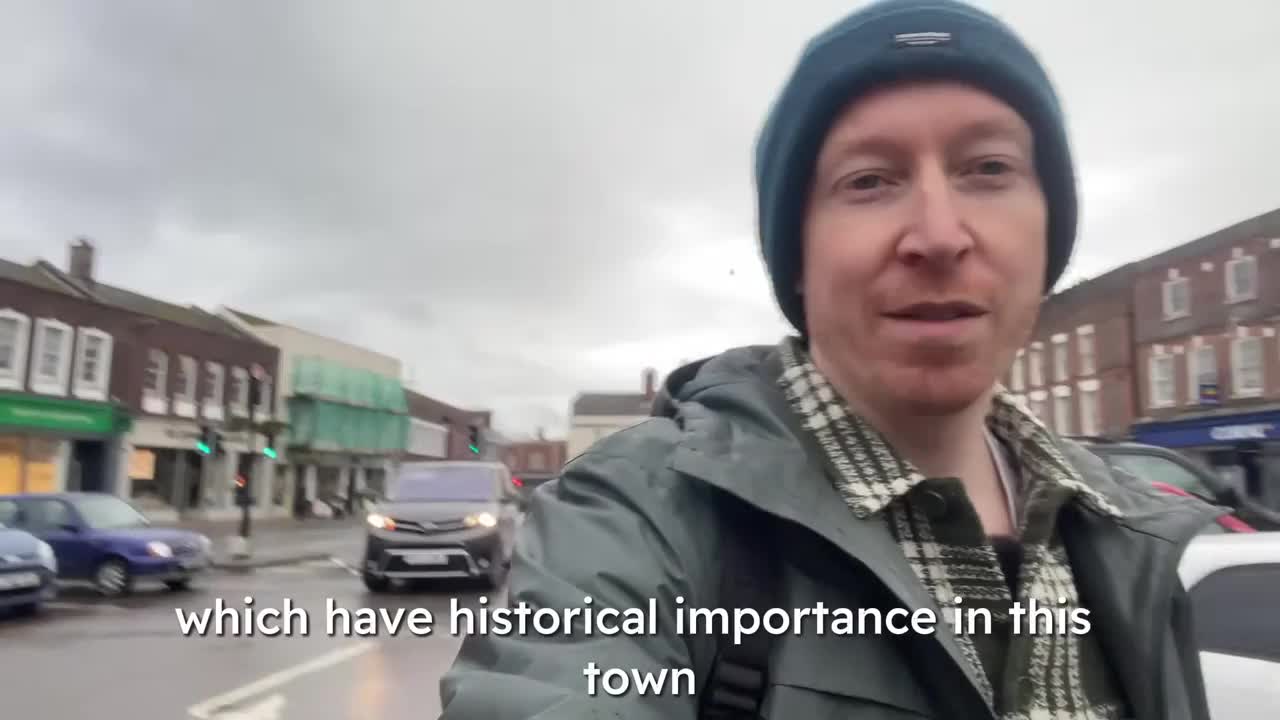
Today, I'm in the town of Wantage.
The Wantage is a pretty small town.
It's a typical small town in the UK, but there is a fair number of places.
There are a fair number of places which have historical importance in this town, including that statue behind me.
So let's go and take a look at the statue right over here.
Let's go.
Now behind me here, right in the center of the town, this is an important statue.
This is the statue of Alfred the Great, and he was one of the most important kings of England.
He was a really important king of England.
And I'm going to walk off and I'm going to tell you why this guy was such an important king of England and why he was one of the best kings that England ever had.
So Alfred the Great was one of the most important kings in English and British history because he was the one who defeated the Vikings.
The Vikings invaded England and Scotland in the year around 800 AD.
Now the Vikings had managed to invade around most of the country actually.
They had invaded all of the North of England, most of England, except for the County of Wessex or the Kingdom of Wessex.
Now King Alfred the Great was the King of Wessex.
And he, against all odds really, the Vikings were known for being vicious killers, strong warriors.
And they were really, it felt like they were unbeatable, the Vikings.
It felt like they were completely unbeatable.
But after many battles, King Alfred the Great and his army managed to defeat the Vikings.
Now this is actually a very important moment in terms of the English language.
Because actually, if King Alfred the Great had not defeated the Vikings in the year 800 AD, The English language would not exist as it does today.
If the Vikings had invaded the whole country, English as we know it today would not be the same.
It would be very different.
But because King Alfred won that battle, because he won that important battle, he managed to save the English language.
He managed to keep it as it was.
If the Vikings had invaded, if they had invaded the whole country, English may not exist today.
So, in terms of the English language, King Alfred the Great in a way, actually saved the English language because without him, without him winning that battle, the Vikings would have invaded and they would have brought their own language, which would have replaced English as it was.
So if you like the English language, if you like the way it sounds, you can thank King Alfred the Great for saving the English language, and you can see here that this pub here, This little pub, is named after King Alfred.
It's called King Alfred's Head.
So yeah, a lot of stuff in Wantage is sort of named after King Alfred, because I believe this is where he was born.
King Alfred was born in Wantage.
Actually this is his birthplace.
Over here is a hair and beauty salon.
So if you want to get your hair done or get your nails done right, you can go there.
If you're feeling a bit ugly today yes, if you're feeling a little bit ugly, you can go to the hair and beauty salon to get your hair done or get your nails done, or whatever you want to do.
So you see, even in a small town like Wantage, you can go to a Thai restaurant and you can eat Thai food here.
Even though Wantage is such a small place, you can still get food from all over the world.
This is kind of how it is here in the UK.
So over there, you can see a chippy.
See, it's called the Wantage Chippy.
So a chippy in the UK is where you can get traditional fish and chips.
We call them the chippy.
So if you want fish and chips, go to the chippy.
The British Red Cross is a famous charity in the UK.
They have been going for a long time.
The British Red Cross are very famous and they have been a charity for a very long time.
I think they are quite well known around the world.
I think the British Red Cross this is an estate agents here, so this is called an estate agents and this is if you want to buy a house, you can look at the properties that are available.
You could maybe buy this house or this house.
But yeah, this is called an estate agents and you come here if you're interested in buying a house.
I know that I'm not interested in buying a house because I can't afford a house.
Who can?
So we are at the supermarket.
This is a Waitrose.
Waitrose is a more upmarket supermarket.
And of course here we have some trolleys.
In British English, we call these trolleys.
I believe that in American English, they call them shopping carts.
But here in the UK, these are trolleys.
So this is a trolley.
And this is a trolley.
And here is, a load of trolleys all stacked together.
So yeah, when you're done with your shopping, when you have finished in the supermarket, you need to put your trolley back.
Yes,
You've got to take your trolley and you've got to put it back here after you're finished shopping.
And over here we have Cancer Research, and Cancer Research are a very famous charity as well Cancer Research UK.
As you can tell what they do is they help to cure cancer.
So another really famous charity shop.
Right there and, of course, behind me, you can see the church.
Like I say in each video, there is always a church.
Every town, every village you go to, there's usually a church.
You can usually find a church, and this is the Wantage Church.
So let's go a bit closer.
Let's take a look now.
Outside every church you can usually find a notice board like this.
There's a notice board with lots of stuff on it.
There's one down here about bell ringing.
So if you want to go and ring the church bells, you can join this group and you can ring the bells in the church.
This one is called trinity tots, some kind of event for small children looks like.
They meet at 9am to 11am.
So yeah, basically outside most churches you can find a notice board here with events and things like local events that you can go to and things like that.
Let's see if we can go inside the church now.
Here we have some candles, some candles that are lit.
So this candle is lit here it's a lit candle and these candles are lit as well.
And this candle is also lit here.
See, hanging down from the ceiling here.
This is called a chandelier, so there's a big chandelier hanging down all the way from the ceiling there.
So this with all these candles.
Now these candles are not lit, these candles are not lit, but i'm sure sometimes they light the candles.
Yeah, this is called a chandelier hanging down from the ceiling here.
There's here a candle either side here.
These candles also are not lit, So this candle isn't lit.
This candle also isn't lit.
And at the front, I'm going to zoom in for you.
This is called an altar.
In every church you will find an altar.
Now I believe I'm not supposed to go past this bit here.
I think you need to be a member of the church to walk up here.
I think I think usually you are not supposed to go next to the altar Unless you belong to the church.
So I'm going to stay here and not go past this line.
I don't think I should go over there.
Here you can take a little cross, a palm cross probably, because it's made out of palm wood or something.
Obviously this is the symbol of Jesus Christ.
This is the cross that Jesus Christ died on.
This is obviously the symbol for Christianity.
So if you want, you can take one of these little crosses and if you want to donate, there is a place here you can tap your card and you can choose how much you want to donate.
You can donate £10 £15 £20, £30.
You can donate whatever you like here and it says on this sign donations.
It says please make a donation to help us to maintain this beautiful building.
So the money from these donations will be used to help maintain the building.
You know, to stop the building from falling down over time.
They will use the money to help maintain the building.
You can see two stained glass windows up there as well as a painting.
Looks like a very impressive painting.
And here is the picture frame.
This is the picture frame yes, around the outside.
This is the picture frame that goes around it and, of course, in the middle we have the painting and we have a candle here, a candle here, both of which are not lit right now.
Okay, i think we've seen enough of the church, so let's head back outside.
So i'm just going to walk now in the direction of betjenim park, because i know it's down this path.
Here somewhere, i think it's at the end of this path you can find the betjenim millennium park down there.
You can see here that people have drawn, they have drawn some nice art on the wall.
I think this is just a face, just a face and uh, typical.
I think you know what this is, I know what.
I think you know what this is that someone has drawn here.
So you can see here, they have named this lane after the famous poet uh, Sir John Bet Jemen.
So this is Bet Jemen, Bet Jenim Lane.
This is a difficult name to pronounce, and over there is Bet Jemen, Bet Jenim Park, so the lane is named after him there.
So this is the Bet Jemen Millennium Park and they built this park in honor of the poet, the famous poet, bet jemen, in the year 2000.
It was built in the year 2000, that's why it's called the millennium park, that's what we call it.
One millennium, if you don't know, a millennium is one thousand years right, that's what a millennium is.
So in the year 2000 they built this park in honor of the famous British poet.
So I'm just going to have a little wander, I'm just going to wander around this park for a little bit.
Just wander around, because it's a very peaceful park.
There's lots of wildlife around, lots of wildlife.
I'm just gonna wander around for a little bit in here.
Now, as I'm walking around this park, I'm just gonna tell you about one of the landmarks that you can find here in Wantage.
On the side of a hill, quite close to here in Wantage, you can find the Uffington White Horse.
So the Uffington White Horse is this big horse on the hillside, and it's made of white chalk, okay?
So the horse is made of this white chalk.
So why is it famous?
Or the reason that the Uffington white horse is famous is because of how old it is.
It's around 3000 years old.
So that white horse has been there for 3000 years.
Got a branch in my face there.
The horse has been there for 3000 years or more.
So when the Romans were here in the UK, that white horse was there.
When we were invaded by the Vikings, the horse was there.
When the French invaded.
When the Normans invaded the UK, that white horse is there.
And for generation and generation, people have re-chalked the horse to keep it there.
So it's incredibly old.
It's more than 3000 years old.
And it looks pretty cool on the hillside there.
And if you thought that that was old, if you think that's pretty ancient, then you should hear about the Weylands Smithy.
Quite near to the Uffington White Horse you can find something called the Weylands Smithy which is about five or 6000 years old.
It's really just a small group of stones, like a stone circle, and they think.
They think it's an old burial site where people buried there they're dead.
It's what we call a barrow, an old burial site.
But the Weyland-Smithy is around five or six thousand years old.
So if you thought the Uffington horse was old at 3000 years old, you can go to the Weyland Smithy, which is around twice as old, five or 6000 years old.
The truth is, when things are that old 5000, 6000 years we don't really know much about that society, who they were, why they built that there.
So it's a bit of a mystery when you come across things that are that old.
It's a bit of a mystery, you know.
We don't know who these people were.
They left no records for us.
All we know is that they left some stones in a circle, but we don't know what society it was or who they were.
It's a bit of a mystery, you know.
You see here this is an interesting bench here.
You can see it's kind of like a big tree trunk, it's a part of a tree trunk, but what they have done is they have carved.
They have carved out a bench to sit on.
They have carved a bench out of the tree trunk.
So they took a tree trunk from a tree and they carved out a bench.
They carved it into a bench and now you can sit down on this as a bench, although it looks a little bit wet, so I'm not going to sit on this bench.
However, it's a pretty cool little bench here that they've carved out of a tree trunk.
And what you can see carved into the path is some of the writing, one of the poems from Sir John Bet Jemen, who this park was created for.
So just here, carved into the stone, carved into this stone is some of the some of the lines from some of his poems and you can find this all over the park and you can also see it in this wall, in this little stone wall over here.
You can see there's a little stone wall and you can see that carved into the wall are some of the lines from Sir John Betjemen, all the way across the wall there.
So the lines from the poem are carved into the wall.
Anyway, I think we have looked around here enough.
I think that I have wandered around enough in this park.
So let's get back into the market square, let's go back into the town of Wantage now.
So I'm walking along here and there's a little stream here to the left.
This is a little stream and the stream is flowing.
It's flowing in this direction down there.
It's flowing quite quickly in this direction, but you can see that it has been raining a lot.
It's been raining a lot because the stream is, the water level is very high, see?
The water is nearly coming over the bank here.
If you look over here, you can see here that the stream is actually overflowing a little bit.
You see, right here the stream is overflowing a bit, and the stream's overflowing because it because it's been raining so much we have had heavy rain recently and so the water level has risen.
The water level has risen up, it's risen and now it's overflowing.
Here here we have a map of Wantage.
It says welcome to Wantage and it says the birthplace of King Alfred.
That's what I was talking about.
This is where King Alfred was born.
This is the birthplace of King Alfred, and you can see here.
We have here illustration.
This is called an illustration of the statue that we saw in the center of Wantage.
So that's the statue of King Alfred.
In fact, it's an illustration of the statue of King Alfred.
This is the church that I visited before.
That's the church.
There's the statue in the center of the town again, the statue in the center of the in the market square there.
And this is Bet Jemen Park, which I also went to before.
Yeah, it's a pretty cool map because there are illustrations of every part of the town.
See, every little part of the town has a little illustration to to go with it, which is pretty cool.
So there's an illustration of the park.
This is an illustration of the court hill center.
Everything has an illustration next to it.
It's a pretty cool map actually for just such a small town, a small town of Wantage.
They put a lot of effort into this map.
It's pretty cool.
So what do you think of the weather today?
Well, what do you expect?
We're in the UK.
It's February.
As usual, the weather is terrible.
It always is terrible.
In fact, every single video that I have made so far for English Sponge, the weather has been like this
Rainy, cloudy.
Drizzling, right?
It's just drizzling with rain.
It's not raining heavy.
We don't have heavy rain, but what we have is this light drizzle.
It's just drizzling.
Just a little bit of rain.
Not much, just a very small bit of drizzle hitting my face right now.
Can I be honest?
I really hate this time of year.
I hate this weather we have in January and February.
It's kind of depressing the weather, But what do you expect?
This is England.
This is what you need to expect if you come to England in January or February.
Every day is cloudy.
There's no sun.
The sun does not exist at this time of year.
Every day is cloudy, drizzly, rainy.
This is just how it is at this time of year.
Okay, I'm gonna stop moaning now.
I'm gonna stop complaining about the weather.
I'm being a typical Brit right now, complaining about the weather.
But you know, to be honest, it is pretty bad.
So I think I have the right to complain.
I think British people have the right to complain about the weather.
When every day is like this, every single day, it sucks, looking forward to spring, when it finally comes.
So we've just come inside this museum here, so I'm going to have a look around the museum.
Down here we can see a rather creepy doll.
This is a little doll.
It's a little bit creepy.
Yes, it's a bit of a creepy doll.
It's got a creepy face there, but yeah, this is a little doll.
Here we can see a really old-fashioned camera.
This is a really old camera actually.
It says down here that the camera was is from 1903, so this camera is more than 100 years old here.
It's one of the first cameras to exist right, really old-fashioned.
This is an old-fashioned clock.
Here, a really old-fashioned clock.
It says the time is about seven minutes to nine.
Seven to nine.
That is not the correct time, of course.
I don't think this clock is working.
This style of clock it's called a grandfather clock.
That is what we call it.
So this is called a grandfather clock.
It's really old fashioned.
This one is actually from 1824.
So this clock was made in 1824.
So it's over 200 years old.
Over here we have a kind of a work bench, a really old-fashioned workbench with loads of old tools.
Look at all these tools here so many different kinds of old tools, probably used by a blacksmith.
So yeah, lots of tools on this workbench and, for some reason, a little giraffe.
What's that doing there?
Giraffes don't belong in this kind of place.
Bad giraffe.
Very bad.
Down here we have a miniature railway.
So this is a miniature railway because it's really small.
You can see we've got the train track here and the train, the train itself, on the train track, so it's a little miniature railway and it goes all the way along here.
See miniature cars.
There's a little fence there.
So yeah, it's really long.
It goes all the way along here And there is another train there on the train track.
And finally a platform with little people, miniature people standing on the platform.
So yeah, this is a miniature train set here.
And you can see on this screen over here.
They are showing a video of the Uffington White Horse over there.
So that is a video of the white horse.
It's turned off.
And on here we have some nearby towns.
There's Abingdon, Wantage, that's where we are today, Wantage, and Farringdon.
These are all nearby towns.
Okay guys, I just left the museum back there and this is going to be the end of the video.
Guys, if you do like this kind of video where you learn English with comprehensible input, on EnglishSpongecom we have hundreds and hundreds of videos like this where you can learn English just through listening and you can learn at each level.
So if this video was a bit easy for you, then you can go to the higher level, the B2 upper intermediate videos on our website.
If you felt like this video was a bit difficult for you, on the website we have hundreds of videos at the A2 upper beginner level.
If you want something a bit easier, a bit slower and with more simple vocabulary.
Anyway guys, I hope you enjoyed watching me walk around the town of wantage today and if you like this kind of video, check out this playlist here to see more comprehensible input videos in english.
Anyway, thank you for joining me today and i will see you in the next video bye.