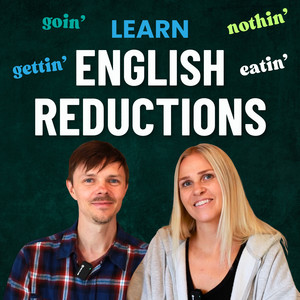
Cheers to another English video with Camille.
Welcome back to Learn English with Camille.
I am Camille. And I'm Calvin. And we're here for another video with English reductions.
Let's do this. So English reductions are...
Commonly used in speech. Yeah, we normally don't write them.
You will not see them in any formal textbook or We don't always use them in formal settings either, but just in our natural rhythm of speech, you will hear them. in the movies, in series, in music, talking with friends, listening to natives, podcasts, all of that.
And so we wanted to go over ones where we don't say the G sound.
So we'll go ahead and say it how... You probably have learned it.
And then we will say it how a native says it.
And we'll each do an example sentence and we'll try to put it up on the screen so that way you can follow along and practice saying these out loud from your home as well.
Really quick before we get started, I teach English online.
I've written a bunch of cool books that will help you improve your English.
You can find them on Amazon or my website.
So go ahead and learn with my books. Yeah.
Yeah, I think, you know, in American English classes, like for us in high school, yeah, we don't learn reductions.
We just say them. But if we did like really start saying them in an English class, they would probably correct us too, you know, because it's not like, you know, correct English.
Yes. That is true. But you go on the streets and it's everybody, you know, and depending on where in the United States Like in the South, you're getting a lot more, I think, a lot more reductions to the point that it's pretty extreme.
What is a reduction? It's just a reduced way of saying the word.
So some of the most common ones you've probably heard like, because we sometimes say cuz.
So it's just shortening the word because it makes it quicker and more naturally flowing in native speech.
Yeah. Yeah. It's because we just want to communicate as quickly as we can and we're lazy.
So we just shorten words. So this first one is something.
So something, we often drop that G. So if you learned it in class, you might hear, I need to buy something for dinner. native more quickly I need to buy something for dinner yeah I need to buy something for dinner yeah exactly I need to buy something I need to What another?
Yeah, there's another example. Did you get something from the store?
Did you get something from the store? Mm-hmm.
Yeah? Yeah. The next one would be anything, anything, where we drop that G. So in school, you would learn I
Don't have anything to say. You might hear locals say, I don't have anything to say.
It's just really quickly in there dropping the G. I don't have anything to say.
Is there anything I should know? Anything?
That's one that's, yeah, I guess it depends on the situation.
Or the person. Or the person. You're not wrong if you say the G. You're correct.
You can say the G sound. Yeah, but I will say that the G in... i-n-g words like anything like it's very subtle it's not like anything yeah anything it's anything Like kind of your tongue stops anything, you know.
So it's just kind of a little more subtle like anything.
Anyways, yeah. That's true. That's true.
Okay. So nothing, nothing you might hear people say.
There's nothing I can do about it. Nothing.
Yeah. I think a very common one is like, oh, what are you up to today?
Ah, nothing. Yeah. We use that a lot. Nothing.
Oh man, I got nothing to do today. That's a very common word that we shrink a lot to take off that G.
Mm-hmm. Yep. Also with doing. Mm-hmm. What are you doing?
Yeah. That's a very common one. Very common.
Yeah. What are you doing? Mm-hmm. I'm not doing much.
What are you doing? We're doing fine. Doing fine here in the South.
Oh, okay. Going. Yeah, this is another very, very common one in English.
I'm going to the store. Where are you going?
I'm going. It just sounds like it takes up so much time.
So we just say I'm going. I'm going to the store.
Where are you going? We're going out for dinner tonight.
We're going. We're going out for dinner. mm-hmm exactly it might sound weird to you or it might sound natural to you.
It'll be weird at first, I think, when you're saying it out loud, Because it's like, am I saying it correctly?
So you need to listen to how natives say it a lot and then practice. shadowing you can shadow this video which means repeating what we say trying to copy it exactly So the next one is also very common.
Getting. We say getting. I'm getting a bit tired.
He's getting a new job next week. Are you getting something?
Are you getting something out of this video?
We hope you're getting something. Give us a like.
Okay, and then looking. Looking, yeah, yeah.
Whatcha looking for? Yes. That's very common.
So you got whatcha, which is what are you?
Oh, yeah. Whatcha looking for? So we say that very fast.
You'll hear that in stores. Whatcha looking for today?
Anything special? We're sorry. Reductions, I think they're a little hard to teach.
I think that's why... Well, if you're teaching English as a second language, You probably don't hear many people teaching these.
It's true if you're a teacher. If you're like an ESL teacher.
That's what I want to say. Yeah, you know, there's so many other things that you have to work on like verb conjugations and, you know, gerunds. that to talk about reductions, it's not as common, but it's very useful in understanding spoken English.
What are you talking about? Talking. Talking.
Talking. Or adding that other word, what you.
What you talking about? What you talking about?
What you talking about? What you talking about, Willis?
That was a very famous old phrase. What from what movie?
It was a show, I guess. Yeah, I don't even know what show, but it's such a common, like, cultural thing that, yeah, we say it.
Okay, running. Running. Running. Yeah, you could say I've been running all day.
Yeah, I've been running around all day. Yeah.
Yeah, that's very common. We're always running late.
They got me running all over the place. Yes.
Oh my gosh. I don't know if we ever say running.
Today I was running. Today I went for a run, but that's different.
Yeah. Today I was running when I saw a whale.
Wow, you must have been running by the ocean.
Oh my gosh. Running by the ocean. Yeah, that's true.
We do it. We do say run-ins. It's very common.
Here are some more with some INGs. So WAITING.
Waiting. Waiting. Waiting. Yeah. I've been waiting here for 10 minutes.
Yeah. What are you waiting for? Very common.
Do it. Yeah. what you're waiting for what you're waiting for yeah two reductions in one sentence Yeah, that's true.
We hope we're not killing you. Killing. Yes.
That's not even on my list, but we do say that too.
What you talking about? Okay, playing. Playing.
Playing, yeah. The kids are playing outside.
Yeah, he's been playing the piano all day.
Yeah, I would say that one you can emphasize the G a little bit more, like playing...
Like he's playing basketball. Yeah. I don't know.
I think for some reason that one, the G sticks around a bit more.
You feel like you don't cut it off as much.
Okay. Mm-hmm. What about singing? Yeah, even that one.
Yeah, for some reason singing. They're always singing in the shower, but you could say it for sure without.
Yeah, you can. Yeah, you will hear it. Yes.
But singing, yeah. We're singing in a choir today.
She was singing her favorite song. Mm-hmm.
She was singing her heart out. Oh, eating.
Yeah, that's another one with what you. Watcha eatin'.
Watcha eatin'. Eatin' is so common. Watcha eatin'.
Watcha eatin'. English! Did you guys close this... close your screen?
Like I'm done with English. Switching to German.
Yeah. No more English. Yes. I'm just eating my lunch.
What you eating? I ain't eating nothing.
That's terrible English, guys. I ain't eating nothing.
I'm not eating anything is actually the correct way to say that.
But you will hear. Yeah, if you're in different parts of the U.S., you might say, I ain't nothing.
Yeah. I always hear people in the South using double negatives, which is grammatically incorrect, but in spoken English, you'll hear it with natives.
Yes. In a hundred years, it will be grammatically correct to speak that way.
Maybe. Maybe. Reading. Reading. Yeah, what you're reading.
I'm reading this book. I would say that one also.
Couldn't do the G. Yeah, it's more common to keep the G as well.
I mean, this is just like I could go up to my son.
He's sitting on the couch reading, which would be a miracle.
Just be like, what you're reading? And that would be very normal to say.
Yeah, exactly. Very normal. So in these casual settings, just small talk, casual settings with friends. friends maybe not with a boss or like uh even in professional settings you might like still pronounce it a bit yeah if you can if you can It's the same with the other language skills of writing and talking.
I'm writing a letter. I'm writing a message.
Yeah. Wow. I'm talking to Camille right now.
I'm talking to the camera right now. I'm talking to you.
Talking. Talking is such a common one. Wow.
Okay. Laughing. Laughing. Laughing. We were laughing all night.
Laughing. Yeah, I think that one could go either way as well.
But yeah, laughing, you can definitely hear it.
I couldn't stop laughing. Yeah, we say that for sure.
Working. Working. Working. What you're working on.
That one's again common. Yeah, we say working hard or what is it?
Hardly working. Hardly working. Working hard or hardly working today?
Yeah, a little saying, that's true. Okay, these might be more controversial, but I'll just see how you say them, Calvin, for interesting. we sometimes say interesting interesting like that's interesting oh that's yeah i don't i don't use that one okay interesting it is that's interesting Especially when you're emphasizing it, you know?
Interesting. I watched an interesting movie.
Yeah. Interesting, interesting. But don't say interesting.
Interest. Interest. Yeah, that's true. That's true.
Yeah. Exciting? Exciting. Yeah, that one's more common.
I don't know. The game was so exciting. No, only in the south.
She's been living in the south too long.
That was like, she started to talk like a southerner.
Oh, my gosh. But you hear it, though. That's what I'm saying.
Yes. You do hear it. You do. You will hear it.
But it's... will depend on where you are, I think, especially with certain one of these where it's very emphasized, like in the South. like in South Carolina, Georgia, South Carolina.
You will hear a lot more of that. That's just amazing.
Even interesting there. Yeah, interesting.
But you don't have to. We're just wanting you to know that this is something that you could hear and it exists.
So you don't have to switch over and change every one.
We seem to be saying this one's more common, this one's not as common.
Yeah, yeah. But they're all accepted, I would say.
What about like tiring? Tiring. That workout was tiring.
Yeah, again, I feel like, yeah, it's definitely a more regional thing, tiring.
Like, man, it was so tiring today. What about boring?
Same thing. Boring. Yeah, exactly. For some reason, these ones to me, it feels like they're southern.
Like they're a southern English accent. So these last ones we've done then, like interesting... exciting, tiring, boring.
Yeah. Calvin feels like you should say the G in the more.
But if you're in the South and you hear... you'll yeah it's not wrong you will hear it you will hear it for sure so it's just preparing your ears to not Not expect the G always in these words.
I mean, these are very common as well, dropping the G, going to becomes gonna yes yeah definitely yeah there's those ones are a lot more common I'm going to, like, I'm gonna go.
I'm gonna go. I'm gonna go. Yeah. Yeah, I think we did a video with a ton with all these 50 reductions.
So we'll try and put that in the description.
These ones were in there, so we'll just quickly touch on them.
So want to. Yeah, wanna. Wanna. Do you wanna hang out?
Yeah. Do you wanna go to the movies? Mm-hmm.
Got to. Gotta. Gotta. Yeah. We gotta leave in 10 minutes.
Yeah, we gotta go. Yeah, we gotta. Gotta get down to business.
Okay, could have. Coulda. Coulda. I coulda gone to the party.
Yeah. I coulda done that. Because could have can be coulda or coulda.
Yeah. There's two different reductions. And it's so common to say could have that. which is grammatically wrong to say like could of.
Yes. But we write could of, which is wrong.
Because we hear it as that. Yeah. but it's actually could have.
Yeah, so true. I've corrected myself or like, you know, the little correct or autocorrect is like, no, this is bad grammar.
So would have could be would've or woulda.
Yeah, woulda. I would have done it differently.
It would have been a good day if that hadn't happened.
Should have. Should have. Should have. I should have ate my breakfast today.
I should have recorded another video. I should have.
I should've, which is not right. Should've, should've.
Yeah. Having. Haven. Haven. Are you having a good time?
Yeah. That's, yeah. More common. He's having dinner with his friends.
Seeing. Seeing. Yeah. Seeing. We're seeing a movie later.
We're seeing a lot of ducks lately, and it's a problem.
Okay, feeling. Feeling. I'm not feeling well.
Yeah, feeling. Very common. These ones are all very common.
Yeah, feeling well. Yeah. Thinking. I'm thinking about food again.
Thinking we should eat something. Thinking we're coming to the end of this video.
I'm thinking we are. That was the last one on my phone.
We batch filmed today. This is our fourth video, so we're ready to eat some lunch.
But we hope this was a very useful reductions. class for you.
If you're struggling with reductions, you just need to hear it a lot and then practice shadowing.
And know that you don't have to use them, but you will sound more native if you do use them and if you understand them, you'll have an easier time understanding. films and series and native speak.
So we do encourage you to learn them. Yes, definitely.
Yeah, we hope you enjoyed the video. Give it a like and share it with your friends and also don't forget to subscribe.
We'll see you again soon. Bye. Bye. It's gonna be a good day.
It's always gonna be a good day.