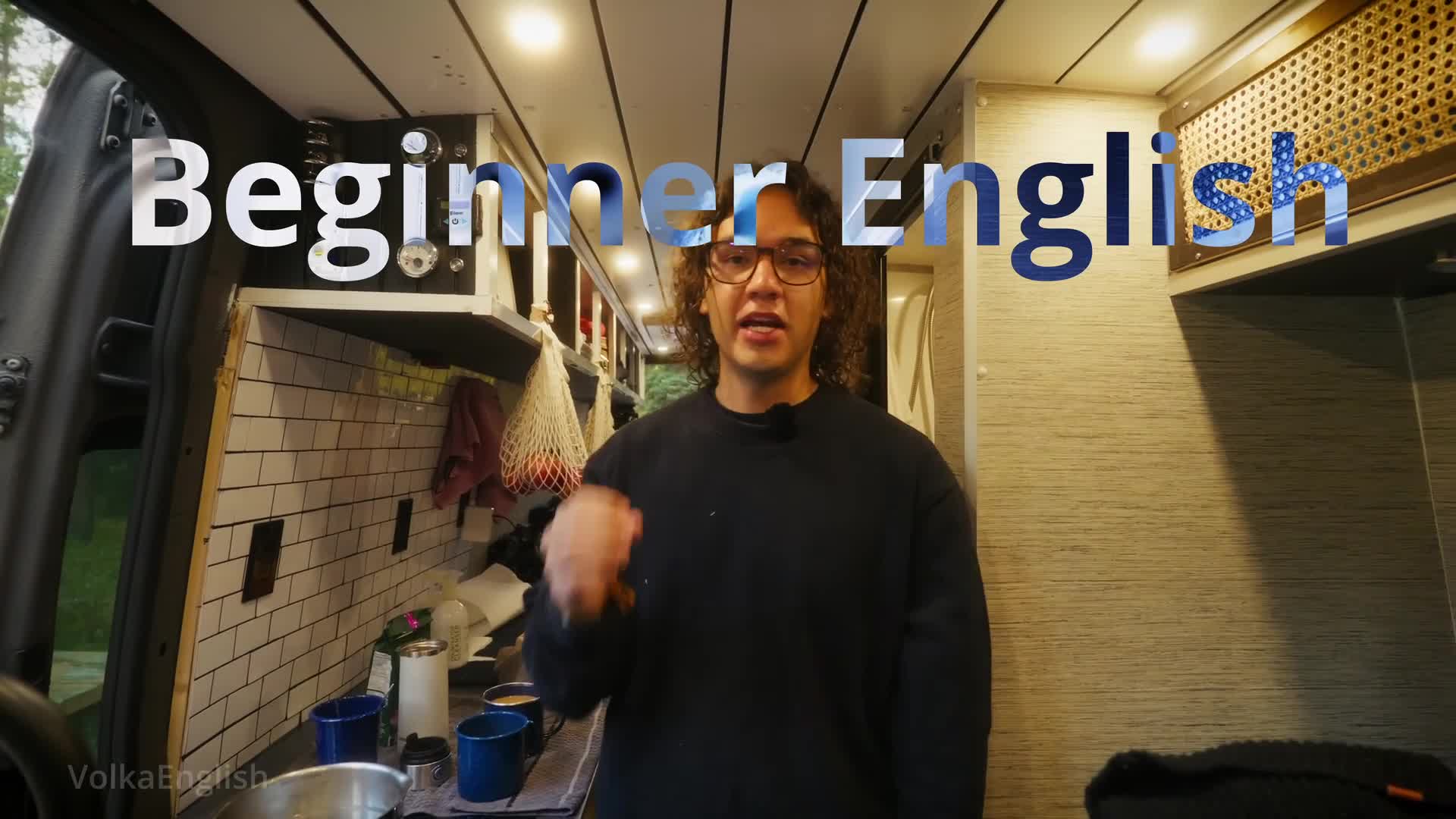
Good morning, guys.
Today, we are going to be learning beginner English here in the Rocky Mountains.
And these are just some beautiful mountains.
This is a can opener.
But it's been constantly receding over the years.
That is a waterfall.
When a forest burns, you call it a forest fire.
To catch fire.
What are we doing this morning, Mom?
Um, we're going to head on to, um, towards Jasper.
So we don't have any wifi, so we have to get somewhere that we can check out the route, and we have to book a campsite as well for tonight.
I'm just going to boil some eggs, um, so that we can eat something along the way.
How many eggs do you want to boil?
Six please.
So there are three eggs in the pot right now and I will add another three.
One, two, three.
This egg cracked when I dropped it in, but nothing is leaking out.
Do you want to put a lid on it?
Yes.
So these right here are drawers.
These are drawers that you could pull out this lid.
No, I'm looking for the other one.
Right now we're looking for a lid to put on top of this pot.
No lid. to improvise and we'll use that as our lid.
Okay, so we're just going to use this metal bowl as our lid.
What do you want to do with the rest of these eggs?
I'm going to secure it in the drawer.
Do we have to do anything else before we pack up and head out?
Yes.
Can you take this coffee and these rusks and put it on that table so that Leon can have some coffee with rusks?
One of the coffees has cream.
The other one is just regular black coffee.
Now I'm going to set them down on this table.
I just set them down.
These are rusks.
This is a type of South African biscuit that is usually eaten for breakfast.
These rusks are in a plastic Ziploc bag.
Ziploc is the brand.
And now I'm going to set them down on this table beside the two coffee mugs.
Do we need to do anything else inside here?
No, I can handle the rest.
Thank you.
Okay.
Let's go outside to see if we need to do anything else before we pack up and head to Athabasca Falls.
We're going that direction.
We have a few stops planned.
This is a neck pillow.
The neck pillow was on the ground and I just picked it up.
Now I'm going to set the neck pillow on this seat.
I'm going to put my shoes on.
I'm sliding my feet into the shoes.
My shoes are now on and we are going to go outside.
So I just put my shoes on and now I'm going to step out of the camper van.
This step is very high.
It's very high.
That's why there's this small step to help you climb up.
And also this handle, on the right hand side to grab as support when you're climbing in.
But you can see our campsite is clean.
There's nothing on the table.
There's nothing in our campsite.
Our camper van is still plugged into the power here.
So we are still plugged in to the power.
Let's go around back here.
The back doors on the camper van are open and you can see this is a storage area, a storage area.
We have our propane cylinder here, our cooler here, a suitcase, someone's suitcase here, and also some other miscellaneous items.
So the back is all packed up.
There's nothing around our campsite or in our campsite.
The last thing we'll have to do is just roll up this power cord, and that'll just be the last thing we do.
Once everyone's ready to leave, we'll roll it up, pack it away and then we could head out, and actually the very last thing we have to do is take out the wheel chocks.
So this is a piece of wood, but it could also be used as a wheel chalk.
You can see it's made to be a wheel chalk wheel chalk, not wheel choke.
In a past video i said wheel choke.
That was incorrect.
It's wheel chalk.
So we'll leave that for now.
And when we're ready to leave, we'll pull out the two wheel chalks.
And can you tell me what a wheel chalk is used for?
Any guesses?
What is a wheel chalk used for?
It is used just in case your vehicle starts to roll.
So even if you put your vehicle in park and pull up the handbrake, it can still move.
And this is a last resort to keep your vehicle from moving.
So the wheel chalk will stop the vehicle.
So it's very important for safety to have wheel chalks, especially if you're sleeping in there at night.
Is everything looking good?
Do we have anything else to do?
No, just checking the oil level in the coolant.
So two important things to check, then you should be okay.
So this is the coolant, and you check the level on the side here.
And this is, where's the oil dipstick?
The oil dipstick is right behind here.
So this is the oil dipstick in his hand, and that is used to check the oil.
Then you should be good for the day.
All good?
Yep, all good to go.
All good.
You have, are you all ready too?
I'm all ready.
My eggs are now boiled.
I'll leave them in there.
The eggs are boiled.
This is the one I accidentally cracked.
You can see some of the egg boiled out.
And these eggs, these six eggs are inside this metal tin or this metal container.
There you go.
Thank you.
So we can hit the road.
We can hit the road.
Yep.
And you can see it's cold out here and you can see the steam coming out from the pot and also my breath.
Cause it's cold.
Do you have the temperature?
If we start up the truck, we'll be able to see the temperature.
So we have no connection here.
There's no cellular connection.
So we can't use the internet or our data.
We have everything ready to go.
So let's head out.
So now he's putting the wheel chalks in the back or the wheel chalk in the back.
The other one is just a piece of wood.
So it went over there and now he is going to roll up the power cord.
So you can see he's rolling up the power cord.
So now the power cord is rolled up and we are going to pack it away in the back of the van.
Now he's closing the door and we're ready to go.
Now we're headed towards Jasper, but along the way we're going to stop at the Athabasca glacier and also do a skywalk and then the Athabasca falls.
So let's go.
Okay guys, we've just arrived at a viewpoint, so let's go check it out.
I'm going to open the door and now i'm going to step out.
You can see, up there there's a glacier that's crow foot glacier, and these are just some beautiful mountains.
That's actually so nice.
How long would it take you to climb to the peak of that mountain?
At least 30 minutes.
No, don't ask me because I don't know.
You think it would take you to climb up?
No, this is your opinion.
How long do you think it would take you to climb up to that peak?
I think I can do it in a day.
So you can see that glacier over there.
It's pretty much just a huge mass of ice that moves slowly.
But that one you can see is pretty small.
The glaciers, I don't know, millions and millions of years ago used to be ginormous.
And that's what carved out most of these valleys.
The glaciers came and carved out most of these valleys here in the Rockies.
But that's a crow foot.
It's yeah.
Crow foot?
Yeah, I thought it was said crow.
Crow foot, not crow's nest.
No, no, Crowfoot.
That's Crowfoot Glacier.
But we're also going to go see the Athabatic Glacier, which is way bigger.
Yeah, we're going to go to see other glaciers too.
So now let's head back into the van.
Now I'm going to open the sliding door.
This is a sliding door because it slides.
I just opened the sliding door.
Now I'm going to hop into the van.
Let's go.
So this is called a coach bus.
And now we're getting into our van.
I'm going to peel the eggs that we boiled earlier and then we can eat it as a snack along the way.
Okay.
So now you're peeling the eggs.
So what is the part that you're removing right now?
It's the egg shell. so this is the eggshell and this is a quick way to peel your eggs yeah this is actually a tablespoon it's a little bit bigger than a teaspoon a tablespoon yeah my eggs are soft in the middle i like it soft and this makes it easy for me to peel the eggs So right now she's peeling the eggs with a tablespoon and then we're going to eat them with salt and pepper.
This is pepper.
This is ground pepper.
And this is salt, salt and pepper.
These are the peeled eggs and we put salt and pepper on them.
Now I'm going to try this one.
Not bad.
The Canadian flag.
Okay, this is our view for lunch and we're making lunch.
What are you making mom?
Tuna sandwiches with mayonnaise and your father and Leon will have leftovers.
Okay, so we're having tuna sandwiches for lunch with this beautiful view.
Like, literally right outside our door.
There's a nice river right here, The river is flowing.
The river is flowing, So you're opening a can of tuna with a can opener.
This, this is a can opener, And this is a can of tuna.
These are cans of tuna.
And this, right here, this is mayonnaise Mayonnaise With avocado oil.
Yes, That's all the ingredients we need to make our tuna sandwich.
You want an onion with it?
Yeah, pass me the red onion, please.
Where's the salt and pepper?
Salt and pepper is in the drawer.
Let's change positions.
Which drawer?
Where the spices are.
How much salt?
Not a lot because I think it must be salty though.
So I'm going to use this spoon to scoop out.
I'm going to use this spoon to scoop out some mayonnaise.
So right now we are cooking.
We are cooking.
I peeled the onion.
Now I'm going to chop the onion.
So now she's chopping the onion into smaller pieces.
And I've just finished mixing the tuna and the mayonnaise for our sandwiches.
My mom is just cutting up the onion there so that we can put some onion inside here.
Put it in.
Can you put a little bit of salt on it?
More?
I think on the onion.
You know what I need?
I want to warm up our buns.
Can you get me the pan?
Where is it?
I have my tuna sandwich here.
So I'm going to eat.
This is the tuna sandwich.
And there's Leon eating his food with this nice view.
Okay, so what are you doing now, mom?
I'm going to clean up now.
I'm going to just gather everything that is dirty And pack some stuff away.
Now she's going to clean up And I'm going to go take a walk outside.
How was your lunch?
My lunch was delicious Delicious What's a slang word for delicious?
Yummy Tasty Scrumptious What's my favorite slang word?
Bussing.
There you go.
Bussing.
Look at this mountain.
That's enormous.
That is so humongous.
That is beautiful.
And then on the other side too.
Wow.
We just finished eating and this was our view.
You guys see this cliff edge behind me?
That is gnarly.
So that right there is the ice field, Columbia ice field.
Okay, so now I'm putting on a double layer of socks because it's going to be cold on the glacier.
So I have my snow pants on, two layers of socks, my sweatshirt, my t-shirt. and the jacket.
I think I'm warm enough.
Got all this.
Maybe I'll put a hat on.
So I'll put this hat on too.
Cause I think it's probably going to be pretty windy up there.
So this is my sun hat.
I think my hands are going to be cold.
Let's go to the glacier now.
Okay.
So we're going to have to walk a little bit, but I would say I'm pretty warm but, as always, got to wear the Berks, but the rest of my body is pretty warm.
So let's go hike.
So the Columbia ice field has grown and shrunk constantly over the past 250 000 years and this is one of like, the only remaining glaciers from like that time and uh, in those past 250 000 years, most of canada was like covered with ice, or almost covered with ice, but this is one of the only glaciers that still uh, still is intact from that time.
The glacier was here in 1982.
I don't know how thick, but it was here.
The Athabasca Glacier is part of the Columbia Ice Field, which is the biggest ice field in Canada, spanning around 325 square kilometers.
And, as you saw down there, it was way down there in 1982, but it's been constantly receding over the years.
And the glacier has receded over 1.5 kilometers in the past 125 years.
So you could just see where it was in 1982 with that marker up front there.
So it's receded quite a bit.
So what you see behind me is called a glacier.
A glacier is just a huge piece of ice that moves.
It moves like a river, only a little bit every year, but it still moves.
And that is the Athabasca Glacier, which is part of the Columbia Ice Field.
And an ice field is just a large area covered by interconnected glaciers.
This is one of the glaciers in the Columbia Ice Field.
Let's go closer.
So the glacier is about six kilometers long and one kilometer wide.
And you can see there's actually people that go on the glacier.
I remember when we were here in 2008.
We were here in 2008, and I think it was around here, honestly.
I think the glacier was like somewhere around here, because we were able to walk on the glacier and touch it.
But now you can see there's just water from it melting that's flowing.
So you can't actually go onto the glacier unless you pay for a tour.
Let's go.
I think there, Volkan, there's the board, 2008.
So if it's just here, we could walk on it.
2008.
Okay, here you can see, this is where the Glacier was in 2006.
So when we came in 2008 it might have just been a little bit further back, so you could really see how much it receded in the past, in the past almost two decades here.
But I think people are walking around like they're going all the way around to climb onto that Glacier.
Let's go.
You guys walk so fast.
I was just going to sit here and wait for you.
We just got to our first waterfall of the day.
After this, we're going to athabasca falls, so we're going to go.
It's only like a 13 kilometer walk to the falls, but actually i could already hear it, so i'm pretty sure we don't even have to walk.
I think we can just see it right there.
San wapta falls that sounds like a indigenous name.
Yeah, and it's just down there.
Let's go.
That's actually kind of nice.
That cliff's edge is like gnarly.
That's so steep.
You think people cliff jump here?
So that right there, that is a waterfall.
And you can see that big, big rock, that big boulder right in the middle of the waterfall and it's cutting it in half.
And I guess you could get even closer.
Those people on the side are pretty close.
You could just jump in.
How much to jump in?
Five bucks?
No, no, no.
How much for you to jump in?
This forest all burned and it goes way back there.
All of that burned.
And all of that mountain, this whole mountain and the forest, this whole area burned.
So all this forest burned.
When a forest burns, you call it a forest fire.
A forest fire.
So that is a coach bus.
That is a coach bus.
And that one looks like It's only one.
It's not a double decker, but there's a lot of storage room underneath.
Warning, do not climb over fences or walls.
So this is a fence.
Do not climb over it unless you want to die.
So I guess they have this because someone died here last year.
Yeah.
No, not last year, a few years ago.
A few years ago, someone died here.
Yeah, apparently he dropped his debit card and then he went over to pick it up and he slipped and fell because of the moisture.
In the winter.
Huh?
In the winter.
No, I think it was in the summer because of the spray that the river... It's misty.
The mist.
It was right here.
It's all really, really slippery.
Yeah, a young guy too.
So yeah, someone died here last year.
They fell in.
Potholes.
So those are called potholes.
That's crazy.
Can you give me any advice on getting such a long arm like you have?
You need to have a 16 millimeter.
You see that garbage?
One important rule of the parks is to leave it the way you found it.
So don't litter or don't throw garbage, especially where no one can reach it.
The Lane Canyon.
Now we're inside this crevice.
We're inside this crevice here.
Makes a nice pathway to walk on.
Yeah, area closed, no access.
Last time I was here, you were able to walk down to the lake.
You can see the whole forest is burned.
Calm after the falls.
So that area is a lot calmer than up here.
The waterfall is behind me.
Do not climb over this fence.
Look at that gas station.
It completely burned and a lot of this town burned too.
Yeah, last year there was a huge fire.
These are shipping containers.
It's a long train.
So right now we are filling our water up with... with potable water.
Potable water.
The word potable is very common when you're camping or out in the outdoors.
But besides that, you could just say safe to drink.
The water is safe to drink.
So we're just filling up our water with potable water.
This is non-potable water.
That means you can't drink this water.
You could just use it to wash dishes or something.
But that water is potable so you can drink it.
This is an elk.
Can you please take this for me outside to the cooler?
It's the meat for breakfast and for lunch tomorrow.
Okay, i'll go put this inside the cooler.
So this is a cooler, this is a cooler.
I'm gonna open the cooler And now I'm going to put the cheese, the beef and the sausage inside this cooler.
And now I'm going to close the cooler.
Now we're starting the fire.
We are starting the fire.
You see that?
That is the flame.
The flame.
And we want the wood to catch fire.
And if you can see over there, that whole forest burned and all around there too.
He's chopping the wood with a hatchet.
A hatchet is a small axe.
An axe is longer.
He finished chopping wood and all that white stuff is smoke.
That's smoke.
He chopped the wood.
Okay, I have my plate of food here.
What do you have for me?
So I'm the chef, as usual, and this is what we have chicken.
What is this with barbecue sauce?
Spicy barbecue sauce sauce me.
Up there we go, first piece, There you go.
This is the drumstick of the chicken, which is part of the leg.
So I have two drumsticks here.
My dad is already eating and this is where we are camping today.
If you guys wanna get the 3000 most common English words, it's in the description.
This was my favorite comment from last video and these are the top three countries you were from in the last video.
Our drawers, right now we're looking for a lid, is a neck pillow.
So we are still plugged in to the power.
Miscellaneous items is a wheel chalk, and this is a last resort.
So this is the coolant, and you check the level on the side here.
See, he's rolling up the power cord. and these are just some beautiful mountains.
So this is called a coach bus.
So this is the eggshell.
Tablespoon.
This is pepper and this is salt.
The river is flowing.
This is a can opener.
Scoop out a double layer of socks.
But it's been constantly receding over the years.
It's called a glacier.
And an ice field is just a large area covered by interconnected glaciers.
That is a waterfall.
When a forest burns, you call it a forest fire.
Don't litter or don't throw garbage.
These are shipping containers.
That is the flame to catch fire.
He's chopping the wood with a hatchet.
A hatchet is a small axe and all that white stuff is smoke.
And remember guys, you will become fluent in English.
Bye guys.