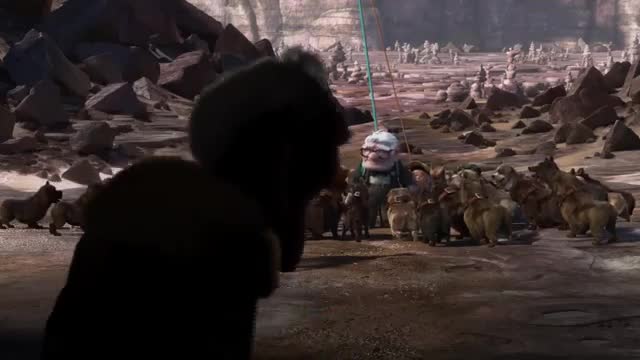
You came here in that?
Uh, yeah.
In a house?
A floating house?
That is the darndest thing I've ever seen.
You're not after my bird, are you?
But if you need to borrow a cup of sugar, I'd be happy to oblige.
Well, this is all a misunderstanding.
My dog's made a mistake.
Wait, are you Charles Muntz?
Yeah, well, yes.
The Charles Muntz?
Adventures out there.
It's really huge.
Oh yeah, today we're learning advanced English with Disney Pixar's Up, specifically the moment when Carl Fredricksen finally meets his childhood hero.
Hi, I'm Xenia, your real-life English fluency coach.
So Carl and Russell have traveled all the way to South America in Carl's balloon-powered house, trying to reach Paradise Falls.
After landing and having a few adventures along the way, they run into the legendary explorer Charles Muntz, the man Carl has admired since he was a boy.
Muntz has them aboard his airship for dinner, but as the conversation unfolds things start to get a bit strange.
Now, before we jump into the first clip, you should know that this lesson comes with its own vocabulary flashcards covering all the key expressions we'll learn today.
Practicing them daily is the easiest way for you to internalize and remember these words forever.
If that sounds interesting to you, just click the link in the description below, using your phone, to get our app and start your vocabulary practice right after the lesson.
So let's get started by watching the first clip with subtitles in English.
You sure we're not a bother.
I'd hate to impose.
No, no, it's a pleasure to have guests.
A real treat.
I shouldn't have used that word.
Having guests is a delight.
More often I get thieves come to steal what's rightfully mine.
No.
They called me a fraud, those... But once I bring back this creature, my name will be cleared.
Beautiful, isn't it?
Oh, I've spent a lifetime tracking it.
Sometimes years go by between sightings.
I've tried to smoke it out of that deathly labyrinth where it lives.
Can't go in after it.
Once in, there's no way out.
Okay, so we're just getting started.
We have the whole scene to cover today.
We'll break down the advanced expressions we just saw, actually starting from the short clip you watched at the beginning of the video.
Let's see it again.
That's the dumbest thing I've ever seen.
Darnedest is an informal way to say strangest or most surprising.
By his tone, though, Munt actually seems quite happy, almost relieved.
Let's see why.
That is the darnedest thing I've ever seen.
You're not after my bird, are you?
To be after something means to be following something and trying to catch it.
For example, you might say the dog went after the ball, or she decided to go after her dream of becoming a doctor.
Muntz was concerned that Carl was just another explorer going after the legendary bird he's been searching for all these years.
But he follows with this joke.
And if you need to borrow a cup of sugar, I'd be happy to oblige!
Since Carl arrived in Paradise Falls in a house.
Muntz is joking that maybe Carl is just a neighbor stopping by to borrow some sugar like neighbors do, and that he'd be happy to oblige.
To oblige in this context means to do someone a favor or help them out.
The phrase happy to oblige is the same as happy to help or I'm willing to do that for you.
See this example.
Finally, Muntz apologizes by saying this.
A misunderstanding is when someone thinks you meant one thing, but you meant something else.
Natives use this word often, especially the verb form.
Check out these two examples.
This is a simple misunderstanding.
And, by the way, did you know that if you don't dedicate some time later to reviewing the expressions you are learning today, you might misunderstand them and actually forget them pretty quickly?
In my experience, that actually happens to all learners who don't have the habit of activating what they've learned.
So to help you exactly with that, we've created a set of flashcards for this lesson with Up that is available for free on our app.
It's a really fantastic tool for internalizing the vocabulary you learn from our lessons and keeping this knowledge active in your brain.
So the magic is actually in the science and the right technology behind it.
Because the app knows exact words you've learned from all lessons.
And just when you're about to forget a particular expression, the app brings it back to you for review and practice.
It's that easy.
And...
By using it for just 10-15 minutes a day, wherever you are, you'll see how it'll help you start speaking English naturally, having all these words at the tip of your tongue.
So, click the link in the description below using your phone to get the real-life app right now.
I'm sure you will love it.
Now, let's move on to analyzing the advanced expressions they use to dinner.
When you're a bother to someone, you're causing them inconvenience or trouble.
This is more commonly heard as a verb to bother someone, but this noun form is also an option to be a bother.
And to impose means to force your presence or needs on someone who might not want them.
It's the kind of thing you say when visiting someone.
I hope we're not a bother or I don't want to impose.
Now, here's where it gets funny.
The word treat has several meanings.
And that's the joke in this scene.
First, when Munch says having guests is a real treat, he means it's a pleasure, something special and enjoyable.
In other words, a delight, as he says later.
See this example.
However, the dogs hear the word treat and think of food.
That's the second meaning.
A treat is also a small snack or reward, especially something you give to dogs.
A third use of this word that is valuable for you to know is when you pay for someone else.
For example, if you have dinner with a friend and it comes time to pay, you might say it's my treat before paying for both your meals.
Can we get another bottle of champagne for the table?
Don't worry, it's my treat.
Officer, I can't thank you enough.
So kind, really.
Can I pay you back?
Oh no, my treat.
Something is rightfully yours.
You own it by right or by law.
It belongs to you fair and square.
That's another expression you could use.
Muntz believes the bird is rightfully his because he's been searching for it for so long.
If you've watched the movie, you know that Muntz discovered this bird species years ago, when he brought back a skeleton as proof.
People didn't believe him.
They accused him of being a fraud.
They called me a fraud, those... But once I bring back this creature, my name will be cleared.
A fraud is someone who's faking something, pretending to be something they're not, or lying about their achievements.
Muntz wants to catch the bird to prove to everyone that he wasn't lying.
Once he has physical proof he believes, his name will be cleared.
That is, people will know he was telling the truth all along.
He'll have proven his innocence and restored his reputation.
A lifetime is the entire duration of someone's life, or a very long period of time.
He's basically saying he's dedicated years and years, possibly decades of his life, to the single task of tracking this animal.
To track an animal means to follow or hunt it by following its signs and traces, like looking for footprints or other evidence of where the animal has been.
When time goes by, it simply passes.
You might say summer went by so quickly this year.
So he said that sometimes years would go by between sightings.
Sighting is when you see something, especially something rare.
We use this word a lot for animals that are hard to find, or even for UFOs and other mysterious things.
For example, Bigfoot sightings are reported every year, but there is never any proof.
I've tried to smoke it out of that deadly labyrinth where it lives.
Can't go in after it.
Once in, there's no way out.
To smoke out originally meant to use actual smoke to force an animal out of its hiding place.
But now we use it more broadly, to mean forcing someone out of hiding by any means.
And a labyrinth is a maze, like this, a complicated system of passages where it's easy to get lost.
Muntz is saying he can't go into the location where the bird is because it's too dangerous or deathly, as he says.
And by the way, here we have another nice opportunity for practicing connector speech.
This time we get some interesting patterns of the American T sound where instead of linking the words like smoke it out, Munch says smoke it out.
Smoke it out.
And he links that phrasal verb to the word off to create another American T sound in smoke it outer.
Yes, he doesn't say the full sound off.
He reduces it to a simple a sound.
Outer.
Smoke it outer.
Smoke it out of that.
Let's repeat after him.
I've tried to smoke it out of that.
Right now, let's move on to the next part of the scene to see where this conversation goes.
Things are about to get pretty tense.
Here they come, these bandits, and think the bird is theirs to take.
But they soon find that this mountain is a very dangerous place.
Hey, that looks like Kevin.
Kevin?
Yeah, that's my new giant bird pet.
I trained it to follow us.
Follow you?
It was impossible.
How?
She likes chocolate.
Chocolate?
Yeah, I gave her some of my chocolate.
She goes gaga for it.
But it ran off.
It's gone now.
You know, Carl...
People who pass through here, they all tell pretty good stories.
A surveyor making a map.
A botanist cataloging plants.
An old man taking his house to Paradise Falls.
That's the best one yet.
I can't wait to hear how it ends.
So here things take a dark turn.
Russell innocently reveals that they know the bird Mons has been hunting.
Suddenly, the friendly dinner becomes tense and dangerous.
Let's look at the key expressions.
Here they come, these bandits, and think the bird is theirs to take.
They soon find that this mountain is a very dangerous place.
When something is theirs to take, it means they believe they can just take it.
Muntz is angry because these bandits come to his territory thinking they can just take the bird as if it belongs to them.
My life is not yours to take.
He killed my family.
I don't think those were yours to take.
Well, then it wouldn't be the first time I stole something away from Coach Shane.
Yeah, I gave her some of my chocolate.
She goes gaga for it.
When someone goes gaga for something, it means they absolutely love it.
They're crazy about it.
For example, in the movie, Doug the Dog goes gaga for tennis balls.
He can't control himself when he sees one.
Did Miss Grant seem a little off to you?
She's always like that with Clark.
She goes gaga for him.
Yeah.
I gave her some of my chocolate.
She goes gaga for it.
But it ran off.
It's gone now.
When someone runs off, it means they escape or leave quickly.
Carl is saying the animal was there, but then it ran off and disappeared.
Carl is lying here trying to protect the bird and Russell.
And then Muntz lists off some supposed aliases that different thieves have used when trying to catch the bird before him.
You know, Carl, these people who pass through here, they all tell pretty good stories.
A surveyor making a map.
A botanist cataloging plants.
An old man taking his house to Paradise Falls.
A surveyor is a professional who measures and maps land.
They create accurate maps of areas by taking careful measurements.
A botanist is a scientist who studies plants.
And to catalog something means to make a systematic list of items.
So, cataloging plants means carefully documenting different plant species.
All right, great job with the lesson so far.
We're still going to watch how this scene closes.
But before we do, we have an essential step of the lesson to complete.
The test.
This is where you challenge yourself and consolidate your improved listening skills and the new vocabulary you've learned.
We'll watch the entire scene without subtitles and I'm going to ask you a few quiz questions.
Are you ready?
Let's do it!
That's the darndest thing I've ever seen.
You're not after my bird, are you?
But if you need to borrow a cup of sugar, I'd be happy to oblige.
Well, this is all a misunderstanding.
My dog's made a mistake.
Wait, are you Charles Muntz?
Yeah, well, uh...
What could be the opposite of to impose in this case?
Respect, facilitate, leave.
Oh, no, it's a pleasure to have guests.
A real treat.
Treat!
Treat!
I want a treat!
No, don't.
I want a treat!
I want a treat!
I want a treat!
I shouldn't have used that word.
Having guests is a delight.
More often I get thieves come to steal what's rightfully mine.
No.
They called me a fraud, those...
What does it mean when someone's name is cleared?
Their name is easy to pronounce.
They've changed their name legally.
They've proven the accusations were false.
Beautiful, isn't it?
Oh, I've spent a lifetime tracking it.
Sometimes years go by between sightings.
I've tried to smoke it out of that deathly labyrinth where it lives.
Can't go in after it.
Once in, there's no way out.
Here they come, these bandits, and think the bird is theirs to take.
But they soon find that this mountain What does go gaga mean?
But it ran off.
It's gone now.
You know, Carl, these people who pass through here, they all tell pretty good stories.
A surveyor making a map.
An old man taking his house to Paradise Falls.
Oh, you really must stay.
I insist.
We have so much more to talk about.
Kevin?
Oh, yeah, great job, guys.
Now, if you're new to this YouTube channel, you should know that every single week, we make new lessons, just like this one with your favorite movies and TV series, to help you understand fast-speaking natives without getting lost, without missing the jokes and without subtitles.
So if that sounds like something you want to be able to do, just hit the subscribe button and the bell down below to not miss any of our new lessons.
And remember right now.
This would be a great time for you to go and practice everything you learned today on the RealLife app.
Just click the link in the description below to get your free lesson.
Before I see if you are a match, I splash this on your heart to bring love to the surface.
And I will read the smoke.
I'm doing a reading.
Sorry, gotta grab some stuff.
So, are we a match?
It's true love.
Which is more than I ever smelled on this one.
Oh, goody, this old chestnut.